
Pulp Fiction, 1885 · page 9 of 32
Beadle's Dime Library No. 364 — page 9: what you’re looking at
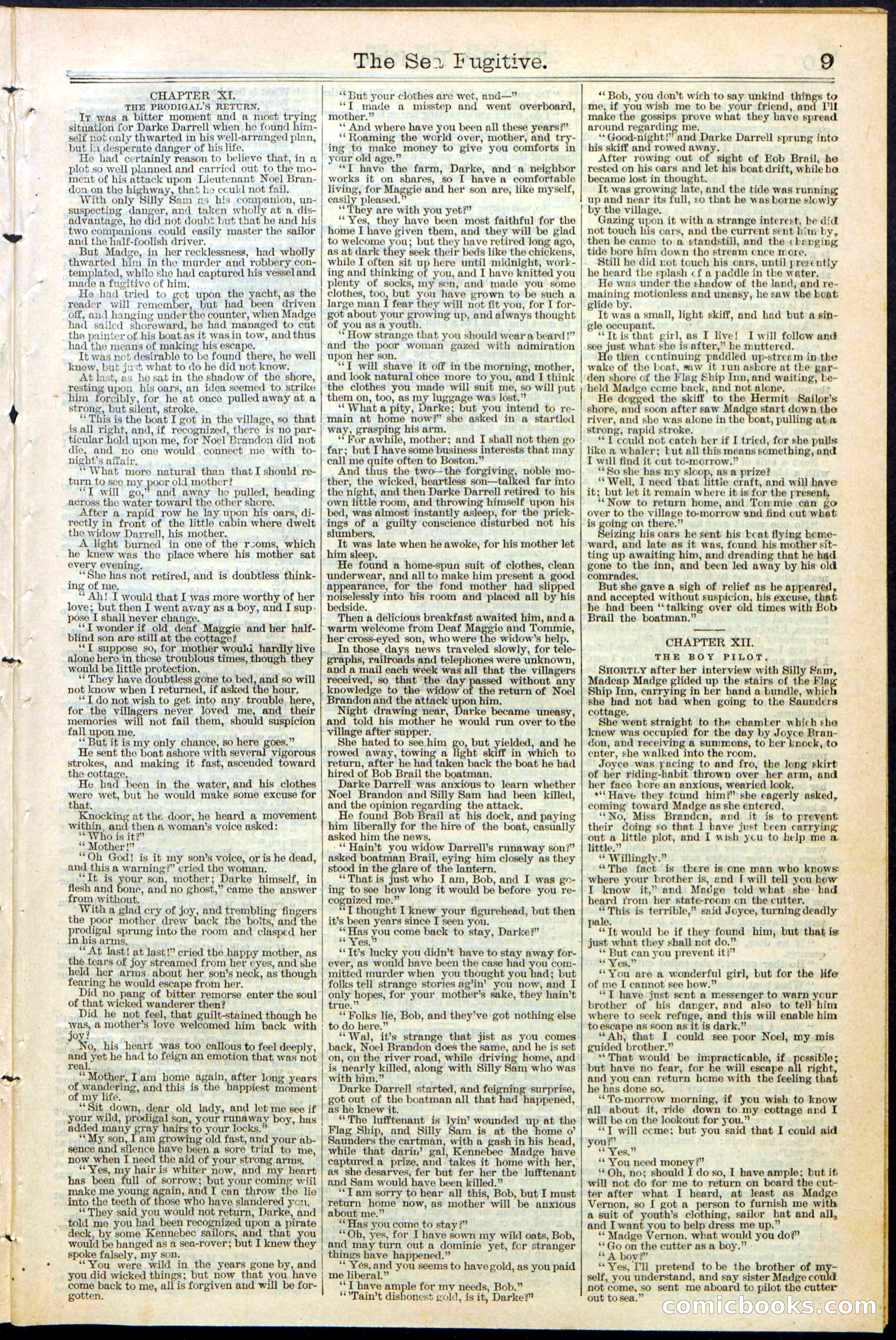
A restored page from Pulp Fiction, 1885. Page through the whole issue in the reader above.
📄 Transcribed text from this page (OCR, searchable)
Machine-transcribed from the original scan — historical spelling and the odd misread are preserved.
“ J 2 ¢ — SST —— . 2 » \ = ~~, CHAPTER XI, THE PRODIGAL’S RETURN, It was a bitter moment and a most trying situation for Darke Darrell when he found him- self not only thwarted in his well-arranged plan, but in desperate danger of his life. He had certainly reason to believe that, in a plot so well planned and carried out _to the mo- ment of his attack upon Lieutenant Noel Bran- don.on the highway, that he cculd not fail, With only Silly Sam 25 his companion, un- suspecting danger, and taken wholly at a dis- advantage, he did not doubf but that he and his two companions could easily master the sailor and the half-foolish driver. But Madge, in her recklessness, had wholly thwarted him in the murder and robbery con- vempplated, whilo she had captured his vessel and made a fugitive of him. He had tried to get upon the yacht, as the reader will remember, but had been driven off, and hanging under the counter, when Madge had sailed shoreward, he had managed to cut the painter of his boat. as it wasin tow, and thus had the means of making his escape. It was not desirable to be found there, he well knew, but just what to do he did not know. At last, as he sat in the shadow of the shore, resting upon his oars, an idea seemed to strike him forcibly, for he at once pulled away at a strong, but silent, stroke, ‘* This is the boat I got in the village, so that is all right, and, if recognized, there is no par- ticular hold upon me, for Noel Brandon did not die, and no one would connect me with to- night’s affair. ‘What more natural than that I should re- turn to see my poor old mother? ‘I will go,” and away he pulled, heading across the water toward the other shore. After a rapid row he lay upon his oars, di- rectly in front of the little cabin where dwelt the widow Darrell, his mother. A light burned in one of the rsoms, which he knew was the place where his mother sat every evening. _ “She has not retired, and is doubtless think- ing of me. ‘Ah! I would that I was more worthy of her love; but then I went away as a boy, and I sup. pose I shall never change. ‘I wonder if old deaf Maggie and her half- blind son are still at the cottage? ‘*T suppose so, for mother would hardly live alone here in these troublous times, though they would be little protection, | ‘* They have doubtless gone to bed, and so will not know when I returned, if asked the hour. ‘IT do not wish to get into any trouble here, for the villagers never loved me, and their memories will not fail them, should suspicion fall upon me, ‘* But if is my only chance, so here goes.” He sent the boat ashore with several vigorous strokes, and making it fast, ascended toward the cottage. He had been in the water, and his clothes mabe wet, but he would make some excuse for that. Knocking at the door, he heard a movement within, and then a woman’s voice asked: ‘Who is it?” ‘* Mother!” ‘Oh God! is it my son’s voice, or is he dead, and this a warning?” cried the woman. ‘It is your son, mother; Darke himself, in flesh and bone, and no ghost,” came the answer from without. With a glad cry of joy, and trembling fingers the poor mother drew back the bolts, and the prodigal sprung into the room and clasped her in his arms, ‘At last! at last!” cried the happy mother, as the tears of joy streamed from her eyes, and she held her arms about her son’s neck, as though fearing he would escape from her. Did no pang of bitter remorse enter the soul of that wicked wanderer then? Did he not feel, that guilt-stained though he was, a mother’s love welcomed him back with joy? F No, his heart was too callous to feel deeply, pi yet he had to feign an emotion that was not real. ‘Mother, Iam home again, after long years of wandering, and this is the happiest moment of my life. “Sit down, dear old lady, and let me see if your wild, prodigal son, your runaway boy, has added many gray hairs to your locks.” ‘* My son, I am growing old fast, and your ab- sence and silence have been a sore trial to me, now when I need the aid of your strong arms, “Yes, my hair is whiter now, and my heart TTT The Se2 fugitive. ‘But your clothes are wet, and—” ‘“T made a misstep and went overboard, mother.” ‘** And where have you been all these years?” **Roaming the world over, mother, and try- ing to make money to give you comforts in your old age.” ‘*T have the farm, Darke, and a neighbor works it on shares, so I have a comfortable living, for Maggie and her son are, like myself, canny pleased.” “They are with you yet?” ‘Yes, they have been most faithful for the home I have given them, and they will be glad to welcome you; but they have retired long ago, as at dark they seek their beds like the chickens, while I often sit up here until midnight, work- ing and thinking of you, and I have knitted you plenty of socks, my son, and made you some clothes, too, but you have grown to such a large man I fear they will not fit you, for I for- got about your growing up, and always thought of you as a youth. ‘* How strange that you should wear a beard !” and the poor woman gazed with admiration upon her son. ‘I will shave it off in the morning, mother, and look natural once more to you, and I think the clothes you made will suit me, so will put them on, too, as my luggage was lost.” ‘* What a pity, Darke; but you intend to re- main at home now?” she asked in a startled way, grasping his arm. ‘For awhile, mother; and I shall not then go far; but I have some business interests that may call me quite often to Boston.” And thus the two-—the forgiving, noble mo- ther, the wicked, heartless son—talked far into the night, and then Darke Darrell retired to his own little room, and throwing himself upon his bed, was almost instantly asleep, for the prick- ings of a guilty conscience disturbed not his slumbers, It was late when he awoke, for his mother let him sleep. He found a home-spun suit of clothes, clean underwear, and all to make him present a g appearance, for the fond mother had slipped noiselessly into his room and placed all by his bedside. Then a delicious breakfast awaited him, anda warm welcome from Deaf Maggie and Tommie, her cross-eyed son, who were the widow’s help. In those days news traveled slowly, for tele- graphs, railroads and telephones were unknown, and a mail each week was all that the villagers received, so that ‘the day passed without any knowledge to the widow of the return of Noel Brandon and the attack upon him, Night drawing near, Darke became uneasy, and told his mother he would run over to the village after supper. She hated to see him 0, but yielded, and he rowed away, towing a light skiff in which to return, after he had taken back the boat he had hired of Bob Brail the boatman. Darke Darrell was anxious to learn whether Noel Brandon and Silly Sam had been killed, and the opinion regarding the attack, He found Bob Brail at his dock, and paying him liberally for the hire of the boat, casually asked him the news, ‘**Hain’t you widow Darrell’s runaway son?” asked boatman Brail, eying him closely as they stood in the glare of the lantern. ‘That is just who I am, Bob, and I was go- ing to see how long it would be before you re- cognized me.” ‘I thought I knew your figurehead, but then it’s been years since I seen you. ‘Has you come back to stay, Darke?” ce ‘It’s lucky you didn’t have to stay away for- ever, as would have been the case had you com- mitted murder when you thought you had; but folks tell strange stories ag’in’ you now, and I only hopes, for your mother’s sake, they hain’t true. ‘Folks lie, Bob, and they’ve got nothing else ' to do here.” ‘Wal, it’s strange that jist as you comes back, Noel Brandon does the same, and he is set on, on the river road, while driving home, and is nearly killed, along with Silly Sam who was with him.” Darke Darrell started, and feigning surprise, got out of the boatman all that had happened, as he knew it. “The lufftenant is lyin’ wounded up at the Flag Ship, and Silly Sam is at the eet 0 Saunders the cartman, with a gash in his head, while that darin’ gal, Kennebec Madge have captured a prize, and takes it home with her, as she desarves, fer but fer her the lufftenant has been full of sorrow; but your coming wiil | and Sam would have been killed.” make me young again, and I can throw the lie into the teeth of those who have slandered yon, ‘*T am sorry to hear all this, Bob, but I must return home now, as mother will be anxious * They said you would not return, Darke, and | about me.” told me you had been recognized upon a pirate deck, by some Kennebec sailors, and that you would be hanged as a sea-rover; but I knew spoke falsely, my son. ‘Has you come to stay?” **Oh, yes, for I have sown my wild oats, Bob, ey | and may turn out a dominie yet, for stranger hings have happened.” t You were wild in the years gone by, and | ‘* Yes, and you seems to have gold, as you paid you did wicked things; but now that you have come back to me, all is forgiven and will be for- gotten. me liberal.” ‘*[ have ample for my needs, Bob.” ‘*Tain’t dishonest gold, is it, Darke?” SS Oo ‘** Bob, you don’t wich to say unkind things to me, if ‘is wish me to be your friend, and Til make the gossips prove what they have spread around regarding me, ‘“* Good-night!” and Darke Darrell sprung into his skiff and rowed away. After rowing out of sight of Eob Brail, he rested on his oars and let his boat drift, while he became lost in thought. It was growing late, and the tide was running; up and near its full, so that he was borne slowly by the village. Gazing upon it with a strange interest, be did not touch his oars, and the current sent him by, then he came to a standstill, and the «banging tide bore him down the stream once more, Still he did not touch his cars, until presently he heard the splash cf a paddle in the water, . He was under the thadow of the land, and re- maining motionless and uneasy, he saw the boat glide by. It was a small, light skiff, and had but a sin- gle occupant. ‘Tt is that girl, as I live! I will follow and see just what she is after,” he muttered. e then continuing paddled up-stream in the wake of the boat, saw it 1un ashore at the gar- den shore of the Flag Ship Inn, and waiting, be- held Madge come back, and not alone. ; He dogged the skiff to the Hermit Sailor’s shore, ont soon after saw Madge start down the river, and she was alone in the boat, pulling ata strong, rapid stroke, **T could not catch her if I tried, for she pulls like a whaler; but all this means something, and I will find it out to-morrow.” ‘**So she has my ee as a prize? ‘* Well, I need that little craft, and will have it; but let it remain where it is for the present, ‘*Now to return home, and Tommie can go over to the village to-morrow and find cut what is going on there.” izing his oars he sent his beat flying heme- ward, and late as it was, found his mother sit- ting up awaiting him, and dreading that he had gone to the inn, and been led away by his old comrades, But she gave a sigh of relief as he appeared, and accepted without suspicion, his excuse, that he had been ‘‘talking over old times with Bob Brail the boatman,” CHAPTER XII. THE BOY PILOT. SHORTLY after her interview with Silly Sam, Madcap Madge glided up the stairs of the Flag Ship Inn, carrying in her hand a bundle, whie she had not had when going to the Saunders cottage, of She went straight to the chamber which she knew was occupied for the day by Joyce Bran- don, and receiving a summons, to her knock, to enter, she walked into the room, Joyce was yacing to and fro, the long skirt of her riding-habit thrown over her arm, and her face hore an anxious, wearied look, ; *“ Have they found bim?” she eagerly asked, coming toward Madge as she entered. ‘‘No, Miss Branden, and it is to prevent their doing so that 1 have just been carrying out a little plot, and I wish ycu to help me a little.” * Willingly.” “The fact is there is one man who knows: where your brother is, end I will tell you how I know it,” and Madge told what she had heard rrom. her state-room on the cutter. “This is terrible,” said Joyce, turning deadly pale. ‘Tt would be if they found him, but that is just what they shall not do.” ** But can you prevent it?” . as Yes.” ‘You are a wonderful girl, but for the lif of me I cannot see how.” ‘*T have just sent a messenger to warn your brother of his danger, and also to tell him where to seek refuge, and this will enable him toescape as soon as it is dark.” ““Ah, that I could see poor Noel, my mis guided brother.” “That would be impracticable, if . possible; but have no fear, for he will escape all right and you can return home with the feeling tha he has done so. ‘*To-morrow morning, if you wish to know all about it, ride down to my cottage and I will be on the lookout for you.” ‘*T will come; but you said that I could aid you?” “ec Yes.” ** You need money?” ‘Oh, no; should I do so, I have ample; but it will not do for me to return on board the cut- ter after what I heard, at least as Madge Vernon, so [ got a_ person to furnish me wi a suit of youth’s clothing, sailor hat and all, and I want you to help dress me up.” ““Madge Vernon, what would you do?” ‘*Go on the cutter as a boy.” ‘A boy?” ‘Yes, [ll pretend to be the brother of my- self, you understand, and say sister Madge could not come, so sent me aboard to pilot the cutter oem GOnMiGooOo (E(0) <S ~o oo Se a