
Pulp Fiction, 1885 · page 7 of 32
Beadle's New York Dime Library No. 363 — page 7: what you’re looking at
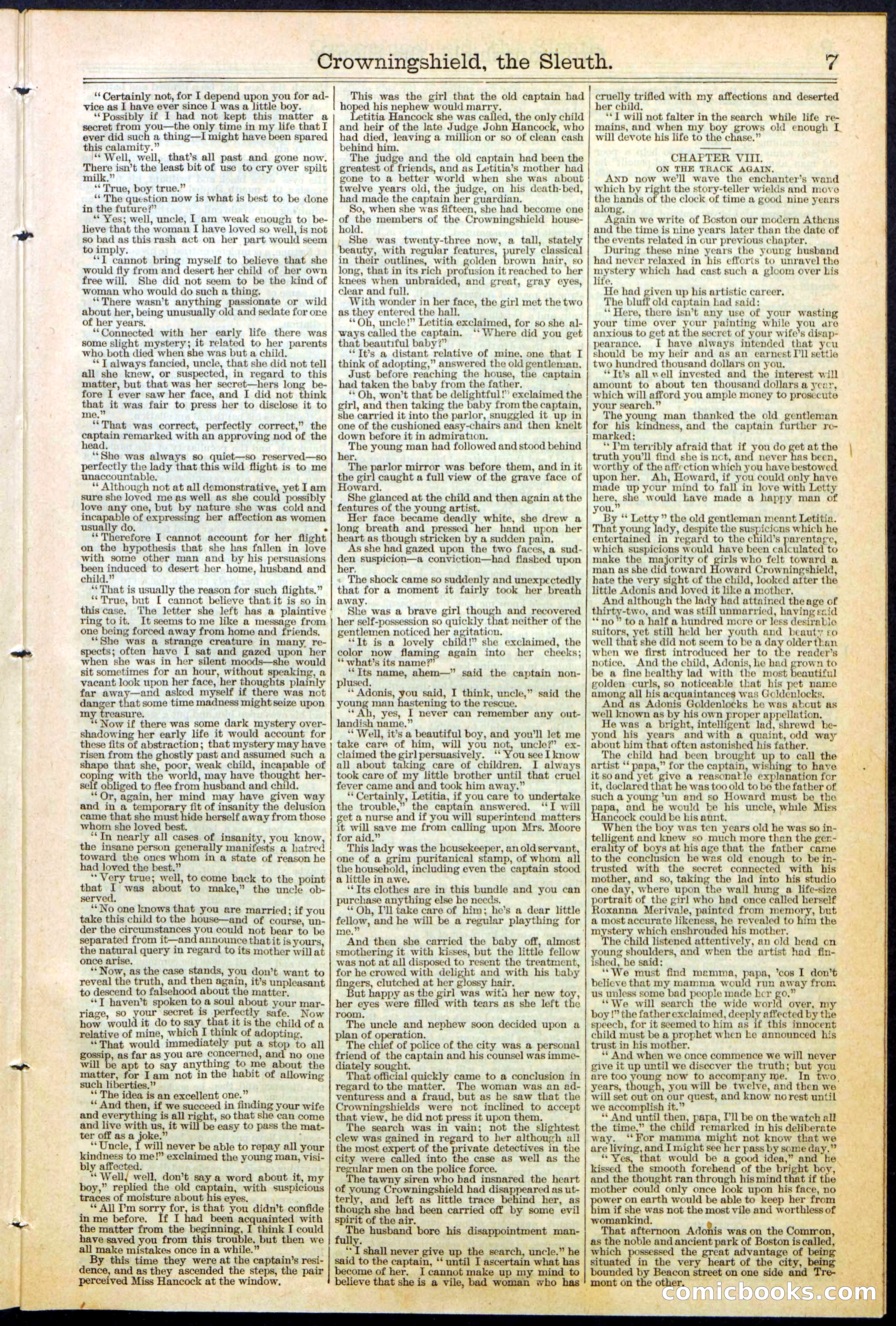
A restored page from Pulp Fiction, 1885. Page through the whole issue in the reader above.
📄 Transcribed text from this page (OCR, searchable)
Machine-transcribed from the original scan — historical spelling and the odd misread are preserved.
Crowningshield, the Sleuth. ‘Certainly not, for I depend upon you for ad- vice as I have ever since I was a little boy. ‘“Possibly if I had not kept this matter a secret from you—the only time in my life that I ever did such a thing—I might have been spared this calamity.” ‘Well, well, that’s all past and gone now. There isn’t the least bit of use to cry over spilt ; ” ‘True, boy true.” ‘* The question now is what is best to be done in the future?” “Yes; well, uncle, I am weak enough to be- lieve that the woman I have loved so well, is not so bad as this rash act on her part would seem to imply. ‘*] cannot bring myself to believe that she would fly from and desert her child of her own free will. She did not seem to be the kind of woman who would do such a thing. ‘*There wasn’t anything passionate or wild about her, being unusually old and sedate for ore of her years. ‘Connected with her early life there was some slight mystery; it related to her parents who both died when she was but a child. ‘“*T always fancied, uncle, that she did not tell all she knew, or suspected, in regard to this matter, but that was her secret—hers long be- fore I ever saw her face, and I did not think that it was fair to press her to disclose it to me, ‘*That was correct, perfectly correct,” the er ee remarked with an approving nod of the ea ‘**She was always so quiet—so reserved—so perfectly the lady that this wild flight is to me unaccountable. ** Although not at all domonstrative, yet I am sure she loved me as well as she could possibly love any one, but by nature she was cold and incapable of expressing her affection as women usually do. ° ** Therefore I cannot account for her flight on the hypothesis that she has fallen in love with some other man and by his persuasions been induced to desert her home, husband and child.” ‘That is usually the reason for such flights.” ‘**True, but [ cannot believe that it is so in this case. The letter she left has a plaintive ring toit. It seems to me like a message from one being forced away from home and friends. **She was a strange creature in many. re- spects; often have I sat and gazed upon her when she was in her silent moods—she would sit sometimes for an hour, without speaking, a vacant look upon her face, her thoughts plainly far away—and asked myself if there was not danger that some time madness might seize upon my treasure. ‘Now if there was some dark mystery over- shadowing her early life it would account for these fits of abstraction; that mystery may have risen from the ghostly past and assumed such a that she, poor, weak child, incapable of coping with the world, may have thought her- self obliged to flee from husband and child. ‘*Or, again, her mind may have given way and in a temporary fit of insanity the delusion came that she must hide herself away from those whom she loved best. ‘In nearly all cases of insanity, you know, the insane person generally manifests a hatred toward the ones whom in a state of reason he had loved the best.” “Very true; well, to come back to the point that I was about to make,” the uncle ob- served, ** No one knows that you are married; if you take this child to the house—and of course, un- der the circumstances you could not bear to be separated from it—and announce thatit is yours, the natural query in regard to its mother will at once arise. ** Now, as the case stands, you don’t want to reveal the truth, and then again, it’s unpleasant to descend to falsehood about the matter. ‘‘T haven’t spoken to a soul about your mar- riage, so your secret is perfectly safe. Now how would it do to say that it is the child of a relative of mine, which I think of adopting, ‘That would immediately put a stop to all gossip, as far as you are concerned, and no one will be apt to say anything to me about the matter, for Iam not in the habit of allowing such liberties.” ‘* The idea is an excellent one.” __ **‘ And then, if we succeed in finding your wife and everything is all right, so that she can come and live with us, it will be easy to pass the mat- ter off as a joke.” ; **Uncle, I will never be able to repay all your kindness to me!” exclaimed the young man, visi- bly affected. “Well, well, don’t say a word about it, my boy,” replied the old i with suspicious traces of moisture about his eyes. ‘* All ’'m sorry for, is that you didn’t confide in me before. I had been acquainted with matter from the the beginning, I think I could have saved you from this trouble, but then we all make mistakes once in a while.” By this time they were at the captain’s resi- dence, and as they ascended the steps, the pair perceived Miss Hancock at the window, Stes i ee OS 8OroOe OS OO nig ne sees > This was the girl that the old captain had nope his nephew would marry. titia Hancock she was called, the only child and heir of the late Judge John Hancock, who had died, leaving a million or so of clean cash behind him. The judge and the old captain had been the greatest of friends, and as Letitia’s mother had gone to a better world when she was about twelve years old, the judge, on his death-bed, had made the captain her guardian. So, when she was fifteen, she had become one of the members of the Crowningshield house- hold. She was twenty-three now, a tall, stately beauty, with regular features, purely classical in their outlines, with golden brown hair, so long, that in its rich profusion it reached to her knees when unbraided, and great, gray eyes, clear and full. With wonder in her face, the girl met the two as they entered the hall. **Oh, uncle!” Letitia exclaimed, for so she al- ways called the captain. ‘‘Where did you get that beautiful baby?” “Tt’s a distant relative of mine, one that I think of adopting,” answered the old gentleman. Just before reaching the house, the captain had taken the baby from the father. ** Oh, won’t that be delightful!” exclaimed the girl, and then taking the baby from the captain, she carried it into the parlor, snuggled it up in one of the cushioned easy-chairs and then knelt down before it in admiration. The young man had followed and stood behind sss er. The parlor mirror was before them, and in it the ait caught a full view of the grave face of Howard. She glanced at the child and then again at the features of the young artist. Her face became deadly white, she drew a long breath and pressed her hand upon her heart as though stricken by a sudden pain, As she had gazed upon the two faces, a sud- Se suspicion—a conviction—had flasked upon er. » The shock came so suddenly and unexpectedly that for a moment it fairly took her breath away. Sire was a brave girl though and recovered her self-possession so quickly that neither of the gentlemen noticed her agitation. ‘It is a lovely child!” she exclaimed, the color now flaming again into her cheeks; **what’s its name?” ‘Its name, ahem—” said the captain non- plused. ‘** Adonis, you said, I think, uncle,” said the young man hastening to the rescue. ‘*Ah, yes, I never can remember any out- landish name.” ‘Well, it’s a beautiful boy, and you'll let me take care of him, will you not, uncle?’ ex- claimed the girl persuasively. ‘‘ You see l know all about taking care of children. I always took care of my little brother until that cruel fever came and and took him away.” ‘Certainly, Letitia, if you care to undertake the trouble,” the captain answered. ‘I will get a nurse and if you will superintend matters it will save me from calling upon Mrs. Moore for aid.” This lady was the housekeeper, an old servant, one of a grim puritanical stamp, of whom all the household, including even the captain stood a little in awe. ‘* Its clothes are in this bundle and you can purchase anything else he needs, ‘** Oh, I'll take care of him; he’s a dear little fellow, and he will be a regular plaything for me.” And then she carried the baby off, almost smothering it with kisses, but the little fellow was not at all disposed to resent the treatment, for he crowed with delight and with his baby fingers, clutched at her glossy hair, But happy as the girl was with her new toy, her eyes were filled with tears as she left the room. The uncle and nephew soon decided upon a plan of operation. The chief of police of the city was a personal friend of the captain and his counsel was imme- diately sought. That official quickly came to a conclusion in regard to the matter. The woman was an ad- venturess and a fraud, but as he saw that the Crowningshields were not inclined to accept that view, he did not press it upon them. The search was in vain; not the slightest clew was gained in regard to her although all the most expert of the private detectives in the city were called into the case as well as the regular men on the police force. The tawny siren who bad insnared the heart of young Crowningshield had disappeared as ut- terly, and left as little trace behind her, as though she had been carried off by some evil spirit of the air. The husband bore his disappointment man- ““T shall never give e search, uncle.” he said to the captain, ‘ a a what h Pei hs i att ha are living, and I might see mother coul ‘ wer on earth would be able to keep her from im if she was not the most vile and worthlessof = 4 cruelly trifled with my affections and deserted her child. ‘*] will not falter in the search while life re- mains, and when my boy grows old enough I will devote his life to the chase.” CHAPTER VIII. ON THE TRACK AGAIN, AND now we'll wave the enchanter’s wand which by right the story-teller wields and move Ss hands of the clock of time a good nine years along. Again we write of Boston our modern Athens and the time is nine years later than the date of the events related in cur previous chapter. During these nine years the young husband had never relaxed in his efforts to unravel the a which had cast such a gloom over his ife, He had given up his artistic career. The bluff old captain had said: ‘* Here, there isn’t any use of your wasting your time over your painting while you are anxious to get at the secret of your wife’s disap- pearance. I have always intended that ycu should be my heir and as an earnest I'll settle two hundred thousand dollars on you. “Tt’s all well invested and the interest will amount to about ten thousand dollars a year, which will afford you ample money to prosecute your search.” The young man thanked the old gentleman for his kindness, and the captain further re- marked: ** Tm terribly afraid that if you do get at the truth you'll find she is nct, and never has been worthy of the affection which you have bestowed upon her, Ah, Howard, if you could only have made up your mind to fall in love with Letty here, she would Lave made a happy man of ou. By ‘ Letty ” the old gentleman meant Letitia. That young lady, despite the suspicions which he editor tain’ in regard to the child’s parentage, which suspicions would have been calculated to make the majority of girls who felt toward a man as she did toward Howard Crowningshield, hate the very sight of the child, looked atter the little Adonis and loved it like a mother. And although the lady had attained theage of thirty-two, and was still unmarried, having said **no” to a half a hundred more or less desirable suitors, yet still held her youth and beauty so well that she did not seem to be a day olderthan when we first introduced her to tke reader’s notice. And the child, Adonis, he had grown to be a fine healthy lad with the most beautiful golden curls, so noticeable that his pet name among all his acquaintances was Goldenlocks, And as Adonis Goldenlocks he was about as well known as by his own proper appellation, He was a bright, intelligent lad, shrewd he- yond his years and with a quaint, odd way about him that often astonished his father. The child had been brought up to call the artist ‘‘ papa,” for the captain, wishing to have it soand yet give a reasonatle explanation for it, declared that he was too old to be the father of | such a young ‘un and so Howard must be the apa, and he would be his uncle, while Miss ancock could be his aunt. When the boy was ten years old he was so in- telligent and knew so much more than the ger- erality of boys at his age that the father came to the conclusion he wes old enough to be in- trusted with the secret connected with his mother, and so, taking the lad into his studio one day, where upon the wall hung a life-size ortrait of the girl who had once called herself oxanna Merivale, painted from memory, but a most accurate likeness, he revealed to him the | mystery which enshrouded his mother. The child listened attentively, an old head on oung shoulders, and when the artist had fin- ished, he said: ‘We must find memma, papa, ’cos I don’t believe that my Mamma would run away from us unless some bad people made her g0." ‘We will search the wide world over, my boy !” the father exclaimed, deeply affected by the speech, for it seemed to him as if this innocent child must be a prophet when he announced his trust in his mother. ** And when we once commence we will never give it up until we disccver the truth; but you are too young now to accompany me. In two. years, though, you will be twelve, and then we will set out on our quest, and know no rest until we accomplish it.” “And until then, papa, Pll be on thewatch all the time,” the ch way. remarked in his deliberate * Yes, that would be a good idea,” and kissed the smooth forehead of the bright bo and the thought ran through his mind that if the 47 only once look upon his face, no- womankind. That afternoon Adohis was on the Comrron, Si | as the noble and ancient park of Boston is call ae which possessed | situated in the very heart of the city, bounded by Beacon street on one side and ' the great advantage of be tag t on the 1GOMiICc m 200! “For mamma plant not know that we _ er pass by aa a * es 7 : <7