
Pulp Fiction, 1885 · page 5 of 32
Beadle's New York Dime Library No. 363 — page 5: what you’re looking at
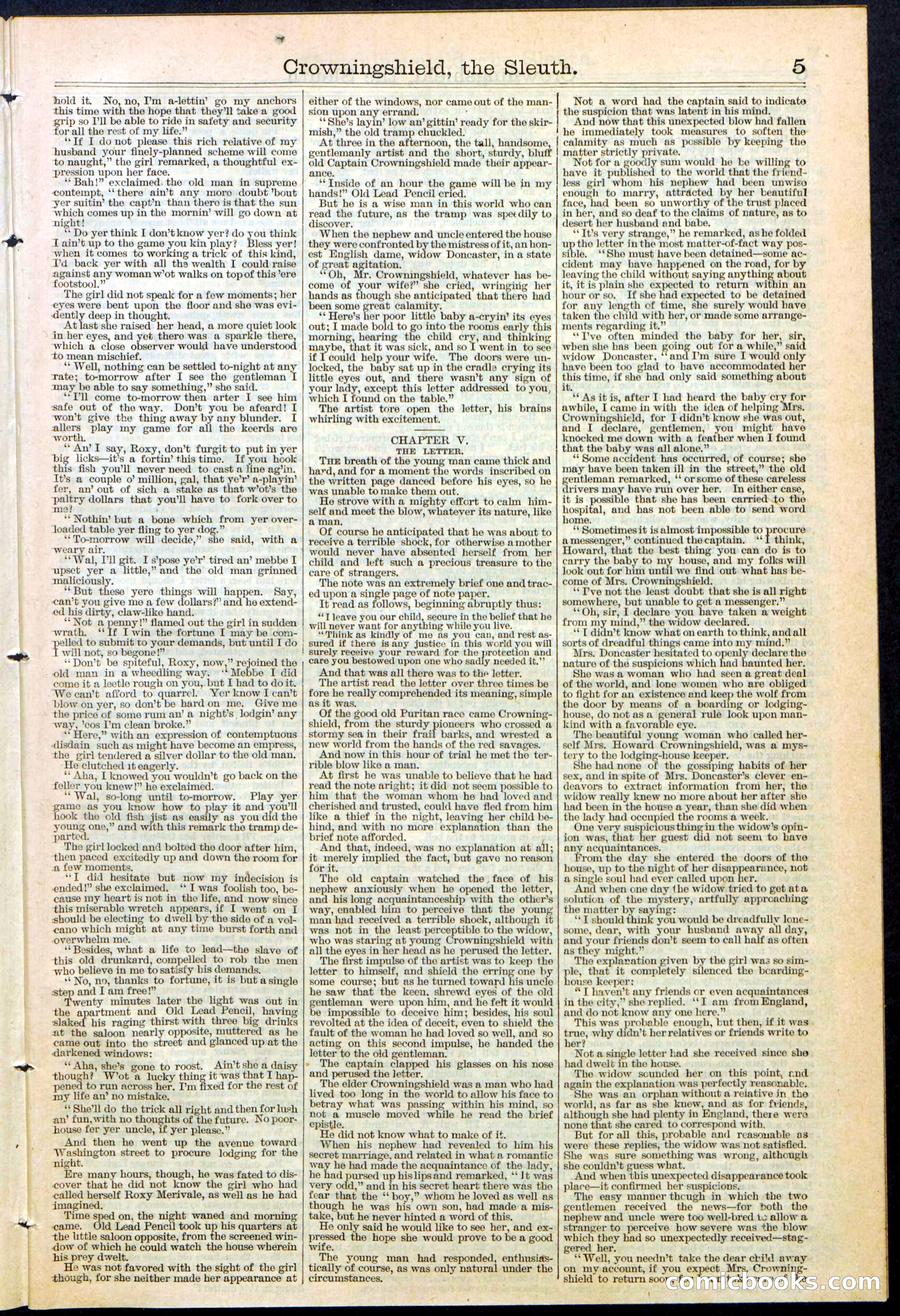
A restored page from Pulp Fiction, 1885. Page through the whole issue in the reader above.
📄 Transcribed text from this page (OCR, searchable)
Machine-transcribed from the original scan — historical spelling and the odd misread are preserved.
a . “Tt —__ _— — ee hold it. No, no, I’m a-lettin’ go my anchors this time with the hope that they'll take a good grip so ll be able to ride in safety and security for all the rest of my life.” ‘Tf I do not please this rich relative of my husband your finely-planned scheme will come to naught,” the girl remarked, a thoughtful ex- pression upon her face. ** Bah!” exclaimed. the old man in supreme contempt, ‘‘there ain’t any more doubt ’bout yer suitin’ the capt’n than thero is that the sun which comes up in the mornin’ will go down at night! ** Do yer think I don’t know yer? do you think [ ain’t up to the game you kin play? Bless yer! when it comes to working a trick of this kind, Pd back yer with all ths wealth I could raise against any woman w’ot walks on topof this ’ere footstool.” The girl did not speak for a few moments; her eyes were bent upon the floor and she was evi- dently deep in thought. At last she raised her head, a more quiet look in her eyes, and yet there was a sparkle there, which a close observer would have understood to mean mischief. ** Well, nothing can be settled to-night at any rate; to-morrow after I see the gentleman may be able to say something,” sho said. **Tll come to-morrow then arter I see him safe out of the way. Don’t you be afeard! I won't give the thing away by any blunder. I allers play my game for all the keerds are worth. **An’ I say, Roxy, don’t furgit to put in yer big licks—it’s a fortin’ this time. If you hook this fish you'll never need to cast a line ag’in. It’s a couple o’ million, gal, that ye’r’ a-playin’ fer, an’ out of sich a stake as that w’ot’s the paltry dollars that you'll have to fork over to mez ‘ ‘* Nothin’ but a bone which from yer over- loaded table yer fling to yer eh ’ ‘To-morrow will decide,” she said, with a weary air. ‘Wal, [ll git. I s’pose ye’r’ tired an’ mebbe I upset yer a little,” and the old man grinned maliciously. ** But these yere things will happen. Say, can’t you give me a few dollars?” and he extend- ed his dirty, claw-like hand. ‘Not a per flamed out the girl in sudden wrath. ‘If I win the fortune I may be com- yelled to submit to your demands, but until I do will not, so begone!” ‘* Don’t be spiteful, Roxy, now,” rejoined the old man in a wheedling way. ‘‘Mebbe I did come it a leetle rough on you, but I had to doit. We can’t afford to quarrel. Yer know I can’t blow on yer, so don’t be hard on me, Give me the price of some rum an’ a night’s lodgin’ any way, ’cos I’m clean broke.” ** Here,” with an expression of contemptuous disdain such as might have become an empress, the girl tendered a silver dollar to the old man, He clutched it eagerly. ** Aha, I knowed you wouldn’t go back on the feller you knew!” he exclaimed. ‘Wal, so-long until to-morrow. Play yer game as you know how to play it and you'll hook the old fish jist as easily as you did the young one,” and with this remark the tramp de- parted. The girl locked and bolted the door after him, then paced excitedly up and down the room for a few moments. “T did hesitate but now my indecision is ended!” she exclaimed, ‘* I was foolish too, be- cause my heart is not in the life, and now since this miserable wretch appears, if I went on I should be electing to dwell by the side of a vol- eano which might at any time burst forth and overwhelm me. ‘Besides, what a life to lead—the slave of this old drunkard, compelled to rob the men who believe in me to satisfy his demands. ‘No, no, thanks to fortune, it is but a single step and I am free!” wenty minutes later the light was out in the apartment and Old Lead Pencil, having slaked his raging thirst with three big drinks at the saloon nearly opposite, muttered as he came out into the street and glanced up at the darkened windows: ** Aha, she’s gone to roost. <Ain’t she a daisy though? W’ot a lucky thing it was that I hap- pened to run across her. I’m fixed for the rest of my life an’ no mistake, ‘She'll do the trick all right and then for lush an’ fun, with no thoughts of the future. No poor- house fer yer uncle, if yer please.” And then he went up the avenue toward ia og de street to procure lodging for the night. Ere many hours, though, he was fated to dis- cover that he did not know the girl who had called herself Roxy Merivale, as well as he had imagined, Time aa on, the night waned and mornin came. Old Lead Pencil took up his quarters a the little saloon opposite, from the screened win- dow of which he could watch the house wherein his prey dwelt. 2 was not favored with the sight of the girl though, for she neither made her appearance at a" Crowningshield, the Sleuth. _ ——E either of the windows, nor came out of the man- | sion upon any errand. , **She’s layin’ low an’ gittin’ ready for the skir- mish,” the old tramp chuckled. At three in the afternoon, the tall, handsome, gentlemanly artist and the short, sturdy, bluff ! old Captain Crowningshield made their appear- ance. ‘Inside of an hour the game will be in my hands!” Old Lead Pencil cried. But he is a wise man in this world who can read the future, as the tramp was speedily to discover. When the nephew and uncle entered the house they were confronted by the mistress of it, an hon- est English dame, widow Doncaster, in a state of great agitation. **Oh, Mr. Crowningshield, whatever has be- come of your wife?” she cried, wringitig her hands as though she anticipated that there had been some great calamity. ‘* Here’s her poor little baby a-cryin’ its eyes out; I made bold to go into the rooms early this morning, hearing the child ery, and thinking maybe, that it was sick, and so I went in to see if I could help your wife. The doors were un- locked, the baby sat up in the cradle crying its little eyes out, and there wasn’t any sign of your lady, except this letter addressed to you, which I found on the table.” The artist tore open the letter, his brains whirling with excitement. CHAPTER V. THE LETTER. THE breath of the young man came thick and hard, and for a moment the words inscribed on the written page danced before his eyes, so he was unable to make them out. He strove with a mighty effort to calm him- self and meet the blow, whatever its nature, like a man. Of course he anticipated that he was about to receive a terrible shock, for otherwise a mother would never have absented herself from her child and left such a precious treasure to the care of strangers. The note was an extremely brief one and trac- ed upon a single page of note paper. It read as follows, beginning abruptly thus: “T leave you our child, secure in the belief that he will never want for anything while you live. “Think as kindly of me as you can, and rest as- sured if there is any justice in this world you will surely receive your reward for the protection and care you bestowed upon one who sadly needed it.”’ | And that was all there was to the letter. The artist read the letter over three times be fore he really comprehended its meaning, simple as it was. Of the good old Puritan race came Crowning- shield, from the sturdy pioneers who crossed a stormy sea in their frail barks, and wrested a new world from the hands of the red savages. And now in this hour of trial he met the ter- rible blow like a man. At first he was unable to believe that he had read the note aright; it did not seem possible to him that the woman whom he had loved and cherished and trusted, could have fled from him like a thief in the night, leaving her child be- hind, and with no more explanation than the brief note afforded. And that, indeed, was no explanation at all; y merely implied the fact, but gave no reason or it. The old captain watched the face of his nephew anxiously when he opened the letter, and his long acquaintanceship with the other’s way, enabled him to perceive that the young man had received a terrible shock, although it was not in the least perceptible to the widow, who was staring at young Crowningshield with all the eyes in her head as he perused the letter. The first impulse of the artist was to keep the letter to himself, and shield the erring one by some course; but as he turned toward his uncle he saw that the keen, shrewd eyes of the old gentleman were upon him, and he felt it would be impossible to deceive him; besides, his soul revolted at the idea of deceit, even to shield the fault of the woman he had loved so well, and so acting on this second impulse, he handed the letter to the old gentleman. » The captain cr ig his glasses on his nose and perused the letter. ; The elder Crowningshield was a man who had lived too long in the world to allow his face to betray what was passing within his mind, so not a muscle moved while he read the brief epistle. He did not know what to make of it, When his nephew had revealed to him his secret marriage, and related in what a romantic way he had made the acquaintance of the lady, he had pursed up hislipsand remarked, ‘‘ 1t was very odd,” and in his secret heart there was the fear that the ‘‘ boy,” whom he loved as well as though he was his own son, had made a mis- take, but he never hinted a word of this. He only said he would like to see her, and ex- leraweg the hope she would prove to be a good e The young man had responded, enthusias- tically of course, as was only natvral under the circumstances, - 5 -_——~ Not a word had the captain said to indicate the suspicion that was latent in his mind. And now that this unexpected blow had fallen he immediately took measures to soften the | calamity as much as possible by keeping the matter strictly private. Not for a goodly sum would he be willing to have it published to the world that the friend- less girl whom his nephew had been unwiso enough to marry, attracted by her beautiful face, had been so unworthy of the trust placed in her, and so deaf to the claims of nature, as to desert her husband and babe. ‘*Tt’s very strange,” he remarked, as he folded a the letter inthe most matter-of-fact way pos- sible. ‘*She must have been detained—some ac- cident may have happened on the road, for by leaving the child without saying anything about it, it is plain she expected to return within an hour or so. If she had expected to be detained for any length of time, she surely would have taken the child with her, or made some arrange- ments regarding it.” *T've often minded the baby for her, sir when she has been going out for a while,” said widow Doncaster, ‘‘and I’m sure I would only have been too glad to have accommodated her this time, if she had only said something about it. ‘* As it is, after I had heard the baby cry for awhile, [ came in with the idea of helping Mrs. Crowningshield, for I didn’t know she was out, and I declare, gentlemen, you might have knocked me down with a feather when I found that the baby was all alone.” ** Some accident has occurred, of course; she may have been taken ill in the street,” the old gentleman remarked, ‘‘ or some of these careless drivers may have run over her. In either case, it is possible that she has been carried.to the hospital, and has not been able to send word home. ‘* Sometimes it is almost impossible to procure a messenger,” continued thecaptain. ‘I think, Howard, that the best thing you can do is to carry the baby to my house, and my folks will look out for him until we find out what has be- come of Mrs, Crowningshield. ‘*Pve not the least doubt that she is all right somewhere, but unable to get a messenger.” **Oh, sir, I declare you bave taken a weight from my mind,” the widow declared. ‘*T didn’t know what on earth to think, and all sorts of dreadful things came into my mind.” Mrs. Doncaster hesitated to openly declare the nature of the suspicions which had haunted her. She was a woman who had seen a great deal of the world, and lone women who are obliged to fight for an existence end keep the wolf from the door by means of a boarding or lodging- house, do not as a general rule look upon man- kind with a favorable eye. The beautiful young woman who called her- self Mrs. Howard Crowningshield, was a mys- tery to the lodging-house keeper. She had none of the gossiping habits of her sex, and in spite of Mrs. Doncaster’s clever en- deavors to extract information from her, the widow really knew no more about her after she had been in the house a year, than she did when the lady had occupied the rooms a week. One very suspicious thing in the widow’s opin- ion was, that her guest did not seem to have any acquaintances, From the day she entered the doors of the house, up to the night of her disappearance, not a single soul had ever called upon her. And when one day the widow tried to get ata solution of the mystery, artfully approaching the matter by saying: ‘*T should think you would be dreadfully lone- some, dear, with your husband away all day, and your friends don’t seem to call half as often as they might.” The explaration given by the girl was so sim- ple, that it completely silenced the bearding- ouse keeper: “T haven't any friends or even acquaintances in the city,” she replied. ‘‘I am from England, and do not know any one here.” This was probable enough, but then, if it was. wey why didn’t her relatives or friends write to er? Not a single letter had she received since she had dwelt in the house. The widow sounded her on this point, and again the explanation was perfectly reasonable. She was an orphan without a reiative in the world, as far as she knew, and as for friends, although she had plenty in England, there were none that she cared to correspond with, But for all this, probable and reasonable as were these replies, the widow was not satisfied. She was sure something was wrong, although she couldn’t guess what. And when this unexpected disappearance took place—it confirmed her suspicions. The easy manner thcugh in which the two gentlemen received the news—for both the nephew and uncle were too well-bred to allow a stranger to perceive how severe was the blow which they had so unexpectedly received—stag- gered her. ** Well, you needn’t take the dear child away ee ig rgb can if you ‘oat Crowning- shi return soo7 1 a \ | ~aCOl JOOKS (E(0) .