
Pulp Fiction, 1885 · page 10 of 32
Beadle's New York Dime Library No. 363 — page 10: what you’re looking at
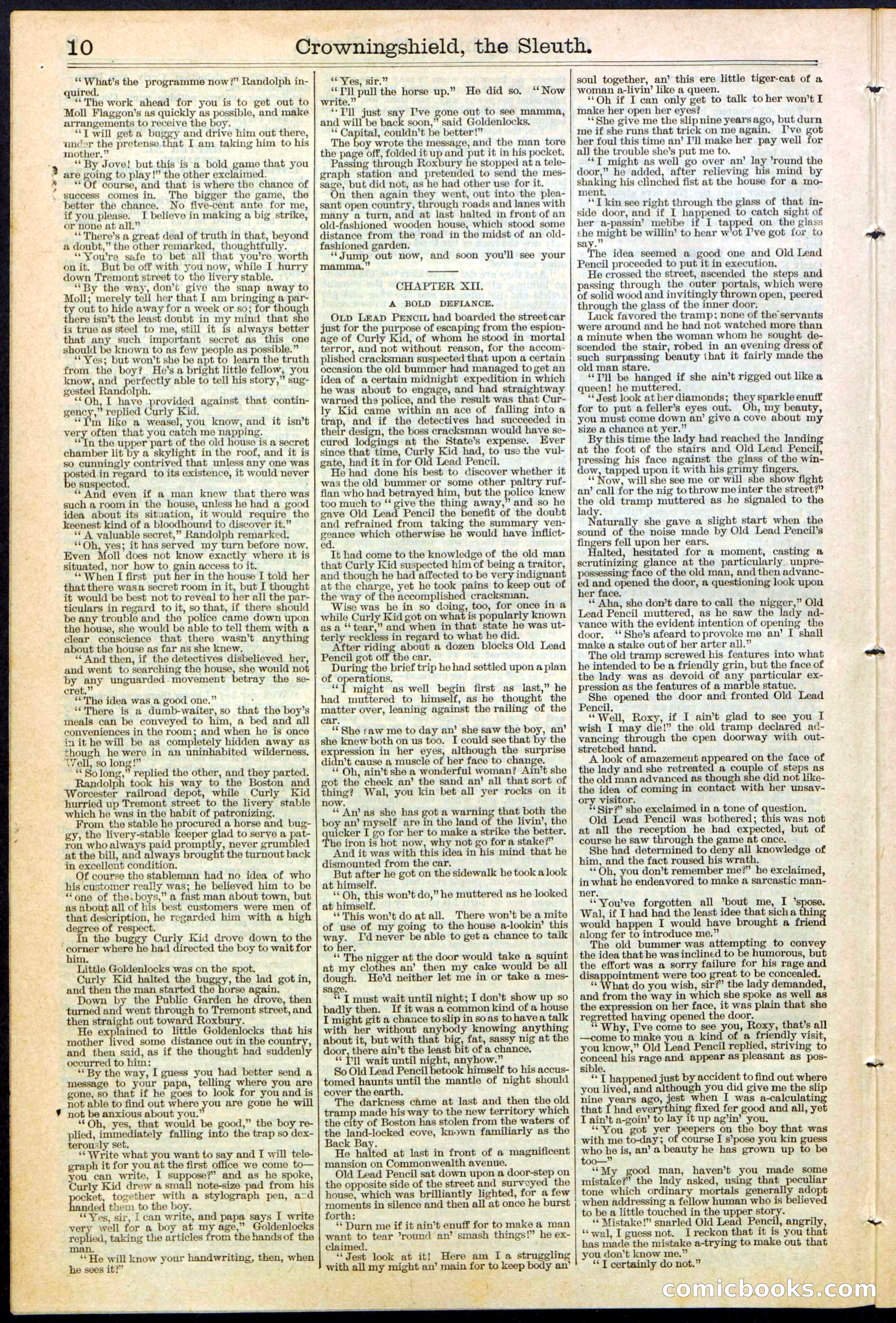
A restored page from Pulp Fiction, 1885. Page through the whole issue in the reader above.
📄 Transcribed text from this page (OCR, searchable)
Machine-transcribed from the original scan — historical spelling and the odd misread are preserved.
4 a . Success comes In, - message to your papa, tellin 10 “What's the programme now?” Randolph in- quired. “The work ahead for you is to get out to Moll Flaggon’s as quickly as possible, and make arrangements to receive the boy. “YT will geta buggy and drive him out there, under the pretense that I am taking him to his mother,” ** By Jove! but this is a bold game that you are going to play!” the other exclaimed. *“Of course, and that is where the chance of The bigger the game, the better the chance. No five-cent ante for me, if you please. I believe in making a big strike, or none at all.” ‘**There’s a great deal of truth in that, beyond a doubt,” the other remarked, thoughtfully. **Youwre safe to bet all that you’re worth onit. But be off with you now, while I hurry down Tremont street to the livery stable. ‘““By the way, don’t give the snap away to Moll; merely tell her that [ am bringing a par- ty out to hide away for a week or so; for though there isn’t the least doubt in my mind that she is true as steel to me, still it is always better that any such important secret as this one should be known to as few people as possible.” ‘Yes; but won’t she be apt to learn the truth from the boy? He’s a bright little fellow, you know, and perfectly able to tell his story,” sug- gested Randolph. **Oh, [I have provided against that contin- gency,” ae Curly Kid. ‘i'm like a weasel, you know, and it isn’t very often that you catch me napping. ‘In the upper part of the old house is a secret chamber lit by a skylight in the roof, and it is so cunningly contrived that unless any one was si bag in regard to its existence, it would never 6 suspected. “And even if a man knew that there was such a roomin the house, unless he had a good idea about its situation, it would require the keenest kind of a bloodhound to discover it.” ‘¢ A valuable secret,” Randolph remarked, ‘*Oh, yes; it has served my turn before now. Even Moll does not know exactly where it is situated, nor how to gain access to it. ‘“ When I first put her in the house I told her that there wasa secret room in it, but I thought it would be best not to reveal to her all the par- ticulars in regard to it, so that, if there should be any trouble and the police came down upon the house, she would be able to tell them with a clear conscience that there wasn’t anything about the house as far as she knew. ‘¢ And then, if the detectives disbelieved her, and went to searching the house, she would not by any unguarded .movement betray the se- cret. ‘The idea was a good one.” > ““There is a dumb-waiter,so that the boy’s meals can be conveyed to him, a bed and all conveniences in the room; and when he is once in it he will be as completely hidden away as though he were in an uninhabited wilderness. \7ell, so long!” ‘35 long,” replied the other, and they parted. Randolph took his way to the Boston and Worcester railroad depot, while Curly Kid hurried up Tremont street to the livery stable which he was in the habit of patronizing. From the stable he procured a horse and bug- gy, the livery-stable keeper glad to serve a pat- ron who always paid promptly, never grumbled at the bill, and always brought the turnout back in excellent condition. Of course the stableman had no idea of who his customer really was; he believed him to be “one of the. boys,” a fast man about town, but as about all of his best customers were men of that description, he regarded him with a high de of respect. In the buggy Curly Kid drove down to the corner where he had directed the boy to wait for m. Little Goldenlocks was on the spot. Curly Kid halted the buggy, the lad got in, and then the man started the horse again. Down by the Public Garden he drove, then turned and went through to Tremont street, and then plaka: Se out toward Roxbury. He ap ained to little Goldenlocks that his mother lived some distance out in the country, and then said, as if the thought had suddenly oecurred to him: ‘* By the way, I guess you had better send a where you are gone, so that if he goes to look for you and is not able to find out where you are gone he will ¥ not be anxious about you. “Oh, yes, that would be good,” the boy re- plied, immediately falling into the trap so dex- terously set. ‘‘ Write what you want to say and I will tele- graph it for you at the first office we come to— you can write, I sup ?’ and as he spoke, Curly Kid drew a small note-size pad from his ket, together with a stylograph pen, a=d ded them to the boy. ' ‘“Yos, sir, I can write, and papa says I write very well for a boy at my age,” Goldenlocks _ replied, taking the articles from the hands of the man. ‘He will know your handwriting, then, when he sees it?” / Crowningshield, the Sleut. ‘* Yes, sir.” ‘‘I*}l pull the horse up.” He did so. ‘‘ Now write.” ‘Til just say Pve gone out to see mamma, and will be back soon,” said Goldenlocks. ‘** Capital, couldn’t be better!” The boy wrote the message, and the man tore the page off, folded it up and put it in his pocket. Passing through Roxbury he stopped at a tele- graph station and pretended to send the mes- sage, but did not, as he had other use for it. On then again they went, out into the plea- sant open country, through roads and lanes with many a turn, and at last halted in front of an old-fashioned wooden house, which stood some distance from the road in the midst of an old- fashioned garden. ‘Jump out now, and soon you'll see your mamma.” CHAPTER XII. A BOLD DEFIANCE, OLp LEAD PENCIL had boarded the street car just for the purpose of escaping from the espion- age of Curly Kid, of whom he stood in mortal terror, and not without reason, for the accom- plished cracksman suspected that upon a certain occasion the old bummer had managed to get an idea of a certain midnight expedition in which he was about to engage, and had straightway warned the police, and the result was that Cur- ly Kid came within an ace of falling into a trap, and if the detectives had succeeded in their design, the boss cracksman would haye se- cured lodgings at the State’s expense. Ever since that time, Curly Kid had, to use the vul- gate, had it in for Old Lead Pencil. He had done his best to discover whether it was the old bummer or some other paltry ruf- fian who had betrayed him, but the police knew too much to “ give the thing away,” and so he gave Old Lead Pencil the benefit of the doubt and refrained from taking the summary ven- rp which otherwise he would have inflict- ed. Tt had come to the knowledge of the old man that Curly Kid suspected him of being a traitor, and though he had affected to be very indignant at the charge, yet he took pains to keep out of the way of the accomplished cracksman, Wise was he in so doing, too, for once in a while Curly Kid got on what is popularly known as a *“‘ tear,” and when in that state he was ut- terly reckless in regard to what he did. After riding about a dozen blocks Old Lead Pencil got off the car. During the brief trip he had settled upon a plan of operations. “| might as well begin first as last,” he had muttered to himself, as he thought the matter over, leaning against the railing of the car. ‘She saw me to day an’ she saw the boy, an’ she knew both on us too. I could see that by the prs we gina in her eyes, although the surprise didn’t cause a muscle of her face to change. ‘“‘ Oh, ain’t she a wonderful woman? Ain't she ot the cheek an’ the sand an’ all that sort of hing? Wal, you kin bet all yer rocks on it now. ‘An’ as she has got a warning that both the boy an’ myself are in the land of the livin’, the uicker I go for her to make a strike the better. he iron is hot now, why not go for a stake?” And it was with this idea in his mind that he dismounted from the car. But after he got on the sidewalk he took a look at himself. ‘‘ Oh, this won’t do,” he muttered as he looked at himself. “This won’t do at all. There won’t be a mite of use of my going to the house a-lookin’ this bk S I'd never be able to get a chance to talk to her. “ The nigger at the door would take a squint at my clothes an’ then my cake would be all dough. He’d neither let me in or take a mes- e. ‘T must wait until night; I don’t show up so badly then. If it was a common kind of a house I might git a chance toslip in soas tohavea talk with her without anybody knowing anything about it, but with that big, fat, sassy nig at the door, there ain’t the least bit of a chance. “Tl wait until night, anyhow.” So Old Lead Pencil betook himself to his accus- tomed haunts until the mantle of night should cover the earth. The darkness came at last and then the old tramp made his way to the new territory which the city of Boston has stolen from the waters of the land-locked cove, known familiarly as the Back Bay. , He ted at last in front of a magnificent mansion on Commonwealth avenue. Old Lead Pencil sat down upon a door-step on the opposite side of the street and surveyed the house, which was brilliantly lighted, for a few eo in silence and then all at once he burst orth: ‘‘ Durn me if it ain’t enuff for to make a man want to tear ’round an’ smash things!” he ex- claimed. ‘Jest look at it! Here am I a struggling with all my might an’ main for to keep body an’ 2 EE eVv"_— ———— ne ee eee eee | soul together, an’ this ere little tiger-cat of a woman a-livin’ like a queen. ‘‘Oh if I can only get to talk to her won't I make her open her eyes? ‘‘She give me the slip nine years ago, but durn me if she runs that trick on me again. I’ve got her foul this time an’ I'll make her pay well for all the trouble she’s put me to. “‘T might as well go over an’ lay ’round the door,” he added, after relieving his mind by shaking his clinched fist at the house for a mo- ment. ‘“‘T kin see right through the glass of that in- side door, and if [ happened to catch sight of her a-passin’ mebbe if I tapped on the glass che might be willin’ to hear w’ot ve got for to say. The idea seemed a good one and Old Lead Pencil proceeded to put it in execution. He crossed the street, ascended the steps and passing through the outer portals, which were of solid wood and invitingly thrown open, peered through the glass of the inner door. Tpit favored the tramp; none of the servants were around and he had not watched more than a minute when the woman whom he py i de- scended the stair, robed in an evening dress of such surpassing beauty that it fairly made the old man stare. “Tll be hanged if she ain’t rigged out like a queen! he muttered. ** Jest look at her diamonds; they sparkle enuff for to put a feller’s eyes out. Oh, my beauty, you must come down an’ give a cove about my size a chance at yer.” By this time the lady had reached the landing at the foot of the stairs and Old Lead Pencil, bea his face against the glass of the win- ow, tapped upon it with his grimy fingers. ‘Now, will she see me or will she show fight an’ call for the nig to throw me inter the street?” oa old tramp muttered as he signaled to the ady. aturally she gave a slight start when the sound of the noise made by Old Lead Pencil’s fingers fell upon her ears. alted, hesitated for a moment, casting a ee glance at the particularly. unpre- possessing face of the old man, and then advanc- ed and opened the door, a questioning look upon her face. ‘* Aha, she don’t dare to call the nigger,” Old Lead Pencil muttered, as he saw the lady ad- vance with the evident intention of opening the door. ‘‘ She's afeard to provoke me an’ I shall make a stake out of her arter all.” The old tramp screwed his features into what he intended to be a friendly grin, but the face of the lady was as devoid of any particular ex- pression as the features of a marble statue. She opened the door and fronted Old Lead Pencil. “Well, Roxy, if I ain’t glad to see you I wish I may die!” the old tramp declared adc- vancing through the open doorway with out- stretched hand. A look of amazement appeared on the face of the lady and she retreated a scene of steps as the old man advanced as though she did not like- the idea of coming in contact with her unsay- ory visitor. ‘Sir?’ she exclaimed in a tone of question. Old Lead Pencil was bothered; this was not at all the reception he had expected, but of course he saw through the game at once. She had determined to deny all knowledge of him, and the fact roused his wrath. ‘‘Oh, you don’t remember me?” he exclaimed, in what he endeavored to make a sarcastic man- ner. “You've forgotten all "bout me, I ’ ‘ Wal, if I had had the least idee that sich a thi would happen I would have brought a frien along fer to introduce me.” ; The old bummer was attempting to convey the idea that he was inclined to be humorous, but the effort was a sorry failure for his rage and disappointment were too great to be concealed. “What do you wish, sir?’ the lady demanded, and from the way in which she spoke as well as the expression on her face, it was plain that she regretted having opened the door. ‘Why, I’ve come to see you, Roxy, that’s all —come to make you a kind of a friendly visit, you know,” Old d Pencil replied, striving to OS a his rage and appear as pleasant as pos- sible. ‘“‘T happened just by accident to find out where you lived, and although you did give me the slip nine years ago, jest when I was a-calculati that fhad everything fixed fer good and all, ye T ain’t a-goin’ to lay it up ag’in’ you. ‘You got yer peepers on the boy that was with me to-day; of course I s’pose you kin guess who he is, an’ a beauty he has grown up to be Oo— to phy | good man, haven’t you made some mistake? the lady asked, using that peat adopt tone which ordinary mortals generall lieved when addressing a fellow human who is to be a little touched in the eee sae ‘‘ Mistake!” snarled Old Lead Pencil, angrily, ‘wal, I guess not. Ireckon that it is you that has made the mistake a-trying te make out that you don’t know me.” ‘*T certainly do not.” Gbooks, ¢€om ry) SP in ~ %