
Pulp Fiction, 1885 · page 11 of 24
Beadle's Dime Library No. 362 — page 11: what you’re looking at
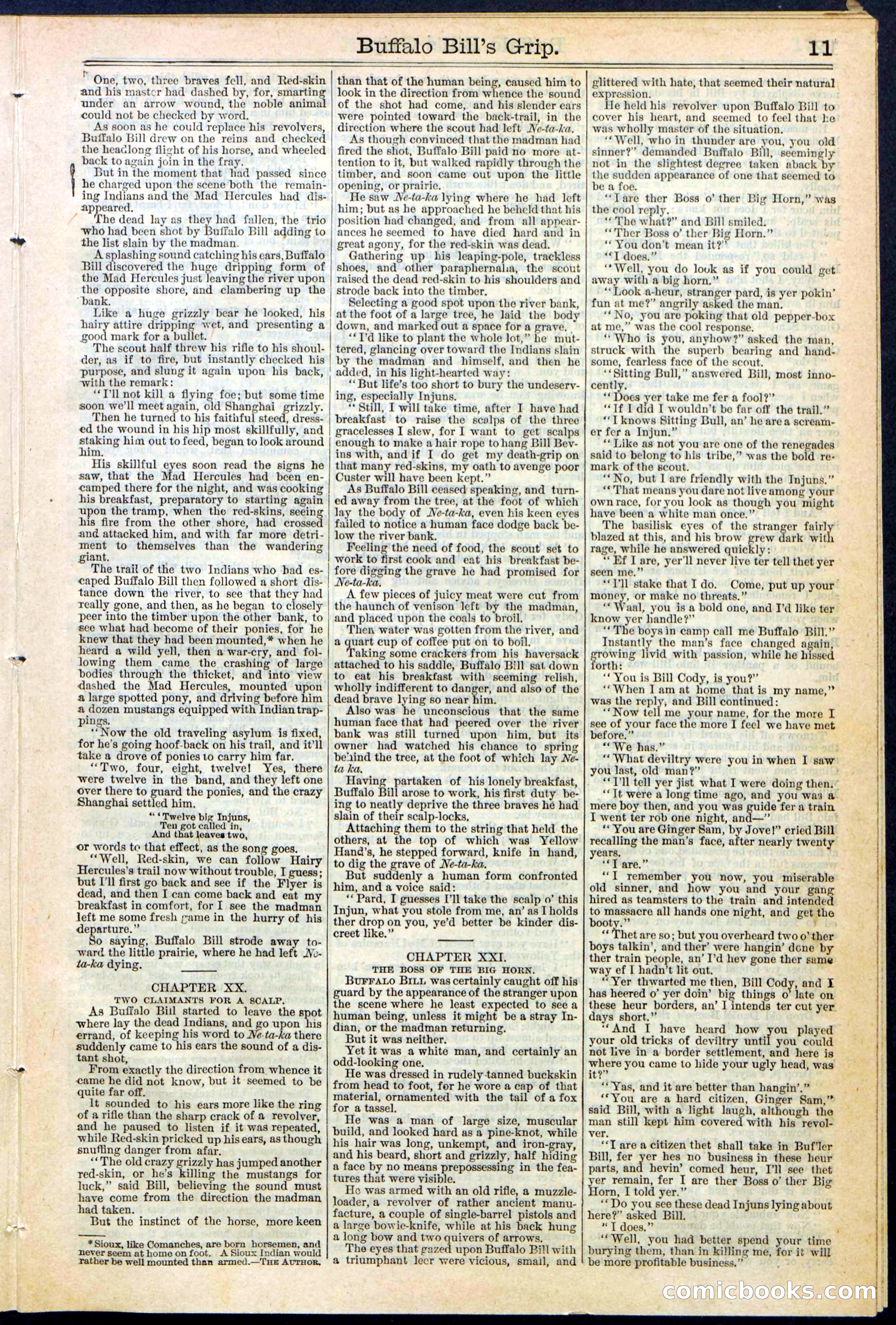
A restored page from Pulp Fiction, 1885. Page through the whole issue in the reader above.
📄 Transcribed text from this page (OCR, searchable)
Machine-transcribed from the original scan — historical spelling and the odd misread are preserved.
| -+-+--—- Buffalo Bill’s Grip. TL " One, two, three braves fell, and Red-skin and his mastcr had dashed by, for, Hig eters under an arrow wound, the noble anima could not be checked by word. As soon as he could replace his revolvers, Buffalo Bill drew on the reins and checked the heaclong flight of his horse, and wheeled back to again join in the fray. jut in the moment that had passed since | he charged upon the scene both the remain- ing Indians and the Mad Hercules had dis- appeared, The dead lay as they had fallen, the trio who had been shot by Buffalo Bill adding to the list slain by the madman. A splashing sound catching his ears, Buffalo Bill discovered the huge dripping form of than that of the human being, caused him to look in the direction from whence the sound of the shot had come, and his slender ears were pointed toward the back-trail, in the direction where the scout had left Ne-ta-ka. As though convinced that the madman had fired the shot, Buffalo Bill paid no more at- tention to it, but walked rapidly through the timber, and soon came out upon the little opening, or prairie. He saw Ve-ta-ka lying where he had left him; but as he approached he beheld that his position had changed, and from all appear- ances he seemed to have died hard and in great agony, for the red-skin was dead. Gathering up his leaping-pole, trackless shoes, and other paraphernalia, the scout the Mad Hercules just leaving the river upon | raised the dead red-skin to his shoulders and the opposite shore, and clambering up the bank. | strode back into the timber, Selecting a good spot upon the river bank, Like a huge grizzly bear he looked, his ‘at the foot of a large tree, he laid the body hairy attire dripping wet, and presenting a | down, and marked out a space for a grave, | good mark for a bullet. The scout half threw his rifle to his shoul- der, as if to fire, but instantly checked his ** I'd like to plant the whole lot,” he mut- tered, glancing over toward the Indians slain by the madman and himself, and then he purpose, and slung it again upon his back, | added, in his light-hearted way: with the remark: ** But life’s too short to bury the undesery- “Pll not kill a flying foe; but some time | ing, especially Injuns. soon we'll meet again, old Shanghai grizzly. Then he turned to his faithful steed, dress- ed the wound in his hip most skillfully, and staking him out to feed, began to look around him. His skillful eyes soon read the signs he saw, that the Mad Hercules had been en- camped there for the night, and was cooking his breakfast, preparatory to starting again upon the tramp, when the red-skins, seein his fire from the other shore, had crosse and attacked him, and with far more detri- ment to themselves than the wandering giant, : The trail of the two Indians who had es- caped Buffalo Bill then followed a short dis- tance down the river, to sce that they had really gone, and then, as he began to closely peer into the timber upon the other bank, to see what had become of their ponies, for he knew that they had been mounted,* when he heard a wild yell, then a war-cry, and fol- lowing them came the crashing of large bodies through the thicket, and into’ view dashed the Mad Hercules, mounted upon a large spotted pony, and driving before him a dozen mustangs equipped with Indian trap- pings. ‘Now the old traveling asylum is fixed, for he’s going hoof-back on his trail, and it'll take a drove of ponies to carry him far. “Two, four, eight, twelve! Yes, there were twelve in the band, and they left one over there to guard the ponies, and the crazy Shanghai settled him. “* Twelve big Injuns, Ten got called in, And that leaves two, or words te that effect, as the song goes. “Well, Red-skin, we can follow Hairy Hercules's trail now without trouble, I guess; but I'll first go back and see if the Flyer is dead, and then I can come back and eat my breakfast in comfort, for I see the madman left me some fresh ame in the hurry of his departure.” 8 saying, Buffalo Bill strode away to- ward the little prairie, where he had left We- la-ka dying. CHAPTER XX. TWO CLAIMANTS FOR A SCALP. As Buffalo Bill started to leave the spot where lay the dead Indians, and go upon his errand, of keeping his word to We-ta-ka there suddenly came to his ears the sound of a dis- tant shot, . From exactly the direction from whence it came he did not know, but it seemed to be quite far off. It sounded to his ears more like the ring of a rifle than the sharp crack of a revolver, and he paused to listen if it was repeated, while Red-skin pricked up his ears, as though snufling danger from afar. ‘‘The old crazy grizzly has jumped another red-skin, or he’s killing the mustangs for luck,” said Bill, believing the sound must have come from the direction the madman had taken. But the instinct of the horse, more keen * Sioux, like Comanches, are born horsemen, and never seem at home on foot. <A Sioux Indian would rather be well mounted than armed.—TuEe AvTHOR, TT LL CTC ii _"--,,,,-,-,,,""-----—_——K---- ** Still, I will take time, after I have had breakfast to raise the scalps of the three gracelesses I slew, for I want to get scalps enough to make a hair rope to hang Bill Bev- ins with, and if I do get my death-grip on that many red-skins, my oath to avenge poor Custer will have been kept.” As Buffalo Bill ceased speaking, and turn- ed away from the tree, at the foot of which lay the body of Ne-ta-ka, even his keen eyes failed to notice a human face dodge back be- low the river bank. Feeling the need of food, the scout set to work to first cook and eat his breakfast be- fore digging the grave he had promised for Ne-ta-ka, A few pieces of juicy meat were cut from the haunch of venison left by the madman, and placed upon the coals to broil. Then water was gotten from the river, and a quart cup of coffee put on to boil. aking some crackers from his haversack attached to his saddle, Buffalo Bill sat, down to eat his breakfast with seeming relish, wholly indifferent to danger, and also of the dead brave lying so near him. Also was he unconscious that the same human face that had peered over the river bank was still turned upon him, but its owner had watched his chance to spring bend the tree, at the foot of which lay Ne- ta ka, Having partaken of his lonely breakfast, Buffalo Bill arose to work, his first duty be- ing to neatly deprive the three braves hé had slain of their scalp-locks, Attaching them to the string that held the others, at the top of which was Yellow Hand’s, he stepped forward, knife in hand, to dig the grave of Ne-ta-ka. But suddenly a human form confronted him, and a voice said: ‘*Pard, I guesses I’ll take the scalp o’ this Injun, what you stole from me, an’ as I holds ther drop on you, ye’d better be kinder dis- creet like.” CHAPTER XXI. THE BOSS OF THE BIG HORN. BuFFALO BIL was certainly caught off his guard by the appearance of the stranger upon the scene where he least expected to see a human being, unless it might be a stray In- dian, or the madman returning. But it was neither. Yet it was a white man, and certainly an odd-looking one. He was dressed in rudely tanned buckskin from head to foot, for he wore a cap of that material, ornamented with the tail of a fox for a tassel. He was a man of large size, muscular build, and looked hard as a pine-knot, while his hair was long, unkempt, and iron-gray, and his beard, short and grizzly, half hiding a face by no means prepossessing in the fea- tures that were visible. Ho was armed with an old rifle, a muzzle- loader, a revolver of rather ancient manu- facture, a couple of single-barrel pistols and a large bowie-knife, while at his back hung a long bow and two quivers of arrows. The eyes that gazed upon Buffalo Bill with a triumphant lecr were vicious, smail, and glittered with hate, that seemed their natural expression. He held his revolver upon Buffalo Bill to cover his heart, and seemed to feel that he was wholly master of the situation. ‘‘Well, who in thunder are you, you old sinner?” demanded Buffalo Bill, seemingly not in the slightest degree taken aback by the sudden appearance of one that seemed to be a foe. ‘‘Tare ther Boss o’ ther Big Horn,” was the cool reply. | ‘©The what?” and Bill smiled. “Ther Boss o’ ther Big Horn.” ** You don’t mean it?” **T does.” ‘* Well, you do lovk as if you could get. away with a big horn.” ‘“‘Look a-heur, stranger pard, is yer pokin’ fun at me?” angrily asked the man. ‘* No, you are poking that old pepper-box at me,” was the cool response. * Who is you, anyhow?” asked the man, struck with the superb bearing and hand- some, fearless face of the scout. ‘*Sitting Bull,” answered Bill, most inno- cently. ** Does yer take me fer a fool?” “If I did I wouldn’t be far off the trail.” ‘‘| knows Sitting Bull, an’ he area scream- er fer a Injun.” ‘* Like as not you are one of the renegades said to belong to his tribe,” was the bold re- mark of the scout. ‘‘No, but I are friendly with the Injuns.” ““That means you dare not live among your own race, for you look as though you might have been a white man once.” The basilisk eyes of the stranger fairl blazed at this, and his brow grew dark wit rage, while he answered quickly: | ‘Ef I are, yer'll never live ter tell thet yer seen me.” : ‘ll stake that Ido. Come, put up your moncy, or make no threats.” | “Waal, you is a bold one, and I'd like ter know yer handle?” ‘ ‘*The boys in camp call me Buffalo Bill.” Instantly the man’s face changed again, owing livid with passion, while he hissed orth: ‘* You is Bill Cody, is you?” ‘“When Iam at home that is my name,” was the reply, and Bill continued: ‘*Now tell me your name, for the more I see of your face the more I feel we have met before.” (ied, “We has.” “What deviltry were you last, old man?” ‘Tl tell yer jist what I were doing then.” ‘‘It were a long time ago, and you was a. mere boy then, and you was guide fer a train I went ter rob one night, anita? e ‘You are Ginger Sam, by Jove!” cried Bill recalling the man’s face, after nearly twenty years. ‘*T are.” you in when I saw: ‘“‘T remember you now, you miserable old sinner, and how you and your gan hired as teamsters to the train and intended to massacre all hands one night, and gebthe booty.” ‘Thet are so; but you overheard two o’ ther boys talkin’, and ther’ were hangin’ done by — ther train people, an’ I’d hev gone ther same way ef I hadn’t lit out. “Yer thwarted me then, Bill Cody, and I has heered o’ yer doin’ big things o’ late on these heur borders, an’ I intends ter cut yer days short.” ‘‘And I have heard how ob played your old tricks of deviltry until you could not live in a border settlement, and here is where you came to hide your ugly head, was it?” ‘*'Yas, and it are better than hangin’.” — ‘*You are a hard citizen, Ginger Sam,” said Bill, with a light laugh, although th man still kept him covered with his revol- ver. ‘*T are a citizen thet shall take in Buf’ler Bill, fer an hes no business in these heur parts, and hevin’ comed heur, I’ll see thet yer remain, fer I are ther Boss o’ ther Big orn, I told yer.” ‘““Do you see these dead Injuns lying about here?” asked Bill. T does.” ) ‘Well, you had better spend your burying them, than in killing me, for it will be more profitable business.” 7 me : r time a a - 4 r toe OO el 6 eee ee ee Sm te ee Eomichooks