
Pulp Fiction, 1878 · page 9 of 32
Beadle's Dime Library, Vol. III, No. 31 — page 9: what you’re looking at
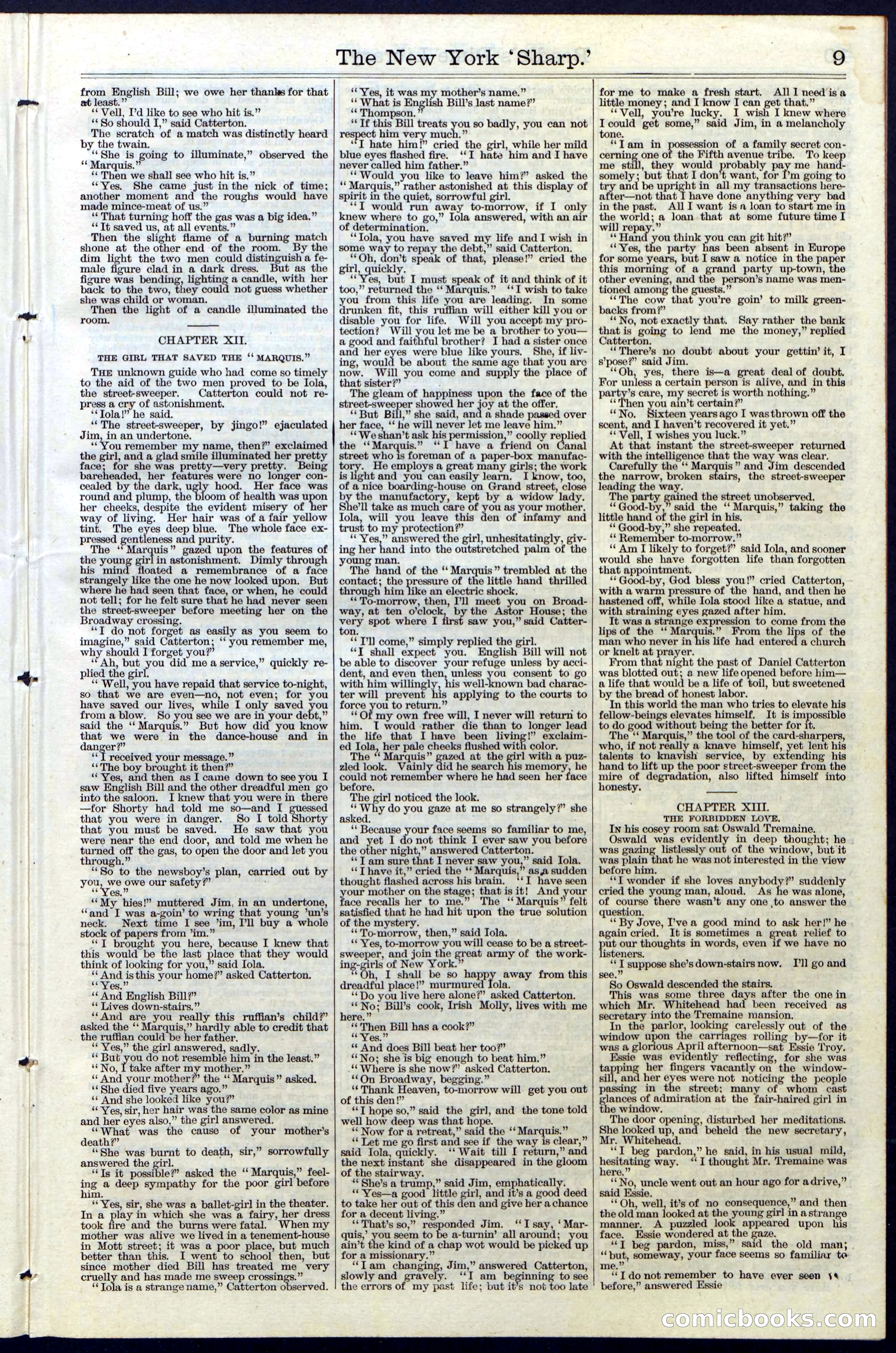
A restored page from Pulp Fiction, 1878. Page through the whole issue in the reader above.
📄 Transcribed text from this page (OCR, searchable)
Machine-transcribed from the original scan — historical spelling and the odd misread are preserved.
from English Bill; we owe her thanlss for that least.” ext 5 ‘* Vell, ’'d like to see who hit is.” ** So should I,” said Catterton. The scratch of a match was distinctly heard by the twain. ‘‘She is going to illuminate,” observed the “* Marquis.” ‘* Then we shall see who hit is.” ‘““Yes. She came just in the nick of time; another moment and the roughs would have made mince-meat of us.” ‘That turning hoff the gas was a big idea.” “Tt saved us, at all events.” Then the slight flame of a burning match shone at the other end of the room. By the dim light the two men could distinguish a fe- male figure clad in a dark dress. But as the figure was bending, lighting a candle, with her back to the two, they could not guess whether she was child or woman, Then the light of a candle illuminated the room. CHAPTER XII. THE GIRL THAT SAVED THE ‘‘ MARQUIS.” THE unknown guide who had come so timely to the aid of the two men proved to be Iola, the street-sweeper. Catiterton could not re- press a cry of astonishment. ‘*Tola!” he said. ‘“The street-sweeper, by jingo!” ejaculated Jim, in an undertone, “You remember my name, then?” exclaimed the girl, and a glad smile illuminated her pretty face; for she was pretty—very pretty. Being bareheaded, her featurés were no longer con- cealed by the dark ugly hood. Her face was round and plump, the bloom of health was upon her cheeks, despite the evident misery of her way of living. Her hair was of a fair yellow tint. The eyes deep blue. The whole face ex- pressed gent eness and purity. The ‘* Marquis” gazed upon the features of the young girlin astonishment. Dimly through his mind floated a remembrance of a face strangely like the one he now looked upon. But where he had seen that face, or when, he could not tell; for he felt sure that he had never seen the street-sweeper before meeting her on the Broadway crossing. ‘‘T do not forget as easily as you seem to imagine,” said Catterton ; ‘* you remember me, why should I forget you? ‘*Ah, but you did me a service,” quickly re- plied the girl. ‘* Well, you have repaid that service to-night, so that we are even—no, not even; for you have saved our lives, while I only saved you from a blow. So you see we are in your debt,” said the ‘‘ Marquis.” But how did you know that we were in the dance-house and in danger?” ‘*T received your message.” ‘*The boy brought it then?” ‘Yes, and then as I came down to see you I saw English Bill and the other dreadful men go into the saloon. I knew that you were in there —for Shorty had told me so—and I cg that you were in danger. So I told Shorty that you must be saved. He saw that you were near the end door, and told me when he turned off the gas, to open the door and let you through.” ‘*So to the newsboy’s plan, carried out by you, we owe our safety?” ‘*My hies!” muttered Jim, in an undertone, “and I was a-goin’ to wring that young ’un’s neck. Next time I see ’im, Pll buy a whole stock of papers from ’im.” ‘“T brought you here, because I knew that this would be the last place that they would think of looking for you,” said Lola. “And is this your home?” asked Catterton. ‘‘ And English Bill?” ‘** Lives down-stairs.” ‘‘And are you really this ruffian’s child?” asked the ‘*‘ Marquis,” hardly able to credit that the ruffian could be her father. ‘* Yes,” the girl answered, sadly. ou do not resemble him in the least.” ** But ‘*No, I take after my mother.” ‘ And your mother?” the “‘ Marquis” asked. ‘‘ She died five years ago.” ‘¢ And she looked like you?” ‘Yes, sir, her hair was the same color as mine and her eyes also,” the girl answered. ‘““What was the cause of your mother’s death?” “She was burnt to death, sir,” sorrowfully answered the girl. . ‘Is it possible?” asked the ‘“‘ Marquis,” feel- ing a deep sympathy for the poor girl before ‘Yes, sir, she was a ballet-girl in the theater. In a play in which she was a fairy, her took fire and the burns were fatal. When my mother was alive we lived in a tenement-house in Mott street; it was a poor place, but much better than this. I went to school then, but since mother died Bill has treated me very cruelly and has made me sweep ore ee es ‘‘Tola is a strange name,” Catterton observed. The New York ‘Sharp.’ ‘Yes, it was my mother’s name.” ‘What is English Bill’s last name?’ ** Thompson. ’ “Tf this Bill treats you so badly, you can not respect him very much.” “I hate him!” cried the girl, while her mild blue eyes flashed fire. ‘‘I hate him and I have never called him father.” ‘Would you like to leave him?’ asked the ** Marquis,” rather astonished at this display of spirit in the quiet, sorrowful girl. ‘I would run away to-morrow, if I only knew where to go,” Iola answered, with an air of determination. ‘*Tola, you have saved my life and I wish in some way to repay the debt,” said Catterton. “Oh, don’t speak of that, please!” cried the girl, quickly. ‘Yes, but I must speak of it and think of it too,” returned the ‘‘ Marquis.” ‘I wish to take you from this life you are leading. In some drunken fit, this ruffian will either kill you or disable you for life. Will you accept my pro- tection? Will you let me be a brother to you— a good and faithful brother? I had a sister once and her eyes were blue like yours. She, if liv- ing, would be about the same age that you aro now. Will you come and supply the place of that sister?” The gleam of happiness upon the face of the street-sweeper showed her joy at the offer, ‘*But Bill,” she said, and a shade passed over her face, ‘‘ he will never let me leave him.” ‘“Weshan’t ask his permission,” coolly replied the “Marquis.” “I have a friend on Canal street who is foreman of a paper-box manufac- tory. He employs a great many girls; the work is hght and you can easily learn. I know, too, of a nice boarding-house on Grand street, close by the manufactory, kept by a widow lady. She’ll take as much care of you as your mother. Iola, will you leave this den of infamy and trust to my protection?” “Yes,” answered the girl, unhesitatingly, giv- ing her hand into the outstretched palm of the young man. The hand of the ‘‘ Marquis” trembled at the contact; the pressure of the little hand thrilled through him like an electric shock. ** To-morrow, then, ll] meet you on Broad- way, at ten hogy Ee the Astor House; the yeas, spot where I saw you,” said Catter- n. ‘* Tl] come,” simply replied the girl. “T shall expect you. English Bill will not be able to discover your refuge unless by acci- dent, and even then, unless you consent to go with him phere his well-known bad charac- ter will prevent his applying to the courts to force er to return.” : ‘*Of my own free will, I never will return to him. IT would rather die than to longer lead the life that I have been living!” exclaim- ed lola, her pale cheeks flushed with color. The *‘ Marquis” gases at the girl with a puz- zled look. Vainly did he search his memory, he h could not remember where he had seen her face before. The girl noticed the look, ‘Why do you gaze at me so strangely?” she asked, ‘** Because your face seems so familiar to me, and yet I donot think I ever saw you before the other night,” answered Catterton. ‘‘T am sure that I never saw you,” said Iola. ‘‘T have it,” cried the ‘‘ Marquis,” as sudden thought flashed across his brain. ‘‘I have seen our mother on the stage; that is it! And your ace recalls her to me.” The ‘ Marquis” felt satisfied that he had hit upon the true solution of the mystery. ‘* To-morrow, then,” said Iola. ‘* Yes, to-morrow you will cease to be a street- sweeper, and join the great army of the work- ing- irls of New York.” ‘Oh, I shall be so happy away from this dreadful place!” murmured Iola. ‘Do you live here alone?” asked Catterton. ** No; Bill’s cook, Irish Molly, lives with me ” ‘‘Then Bill has a cook?” cc Yes. ” “* And does Bill beat her too?” ‘‘No; she is big enough to beat him.” .““ Where is she now?” asked Catterton. ‘On Broadway, begging.” “Thank Heaven, to-morrow will get you out of this den!” “T hope so.” said the girl, and the tone told well how deep was that hope. . “ Now for a retreat,” said the ‘‘ Marquis.” ‘‘ Let me go first and see if the way is clear,” said Iola, quickly. ‘‘ Wait till I return,” and the next instant she disappeared in the gloom of the stairway. ** She’s a trump,” said Jim, emphatically. **'Yes—a good little girl, and i ed, goud dead to take her out of this den and give her a chance for a decent living.” ‘*That’s so,” responded Jim. ‘I say, ‘ Mar- quis,’ you seem to be a-turnin’ all around; you ain’t the kind of a chap wot would be picked up for a missionary.” “Tam changing, Jim,” answered Catterton, slowly and gravely. ‘‘I am beginning to see the errors of my past life; but it’s not too late 9 forme to make a fresh start. All 1 need isa little money; and I know I can get that.” ‘Vell, youre lucky. I wish I knew where I could get some,” said Jim, in a melancholy tone. ‘Tam in session of a family secret con- cerning one of the Fifth avenue tri To kee me still, the would probably pay me hand- somely; but that I don’t want, for ’m going to try and be vy in all my transactions here- after—not that I have done anything very bad in the past. All I want is a loan to start me in the world; a loan that at some future time I will repay.” ** Hand you think you can git hit?” ‘Yes, the party has been absent in Europe for some years, but I saw a notice in the paper this morning of a grand party up-town, the other evening, and the person’s hame was men- tioned among the guests.” “The cow that you’re goin’ to milk green- backs from?” ‘* No, not exactly that. Say rather the bank that is going to lend me the money,” replied Catterton. “There’s no doubt about your gettin’ it, I s’pose?” said Jim. ‘“Oh, yes, there is—a great deal of doubt. For unless a certain person is alive, and in this party’s care, my secret is worth nothing.” “Then you ain’t certain?” “No, Sixteen yearsago I wasthrown off the scent, and I haven’t recovered it yet.” Vell, I wishes you luck.” At that instant the street-sweeper returned with the intelligence that the way was clear. Carefully the “* Marquis” and Jim descended the narrow, broken s , the street-sweeper leading the way. The party gained the street unobserved. ““Good-by,” said the ‘‘ Marquis,” taking the little hand of the girl in his. ** Good-by,” she repeated. ** Remember to-morrow.” ‘Am I likely to forget?” said Iola, and sooner would she have forgotten life than forgotten that appointment. ‘* Good-by, God bless you!” cried Catterton, with a warm pressure of the hand, and then he hastened off, while Iola stood like a statue, and with straining eyes gazed after him. It was a strange expression to come from the lips of the ‘ ipa ” From the lips of the man who never in his life had entered a church or knelt at prayer. From that night the past of Daniel Catterton was blotted out; a new life opened before him— a life that would be a life of toil, but sweetened by the bread of honest labor. In this world the man who tries to elevate his fellow-beings elevates himself. It is impossible to do good without being the better for it. The ‘‘ Marquis,” the tool of the card-sharpers, who, if not really a knave himself, yet lent his talents to knavish service, by extending his hand to lift up the poor street-sweeper from the mire of degradation, also lifted himself into honesty. CHAPTER XIII. THE FORBIDDEN LOVE. IN his cosey room sat Oswald Tremaine. Oswald was evidentl was gazing listlessly out of the window, but it was plain that he was not interested in the view before him. ‘‘T wonder if she loves anybody?” suddenly cried the young man, aloud. As he was alone, of course there wasn’t any one ,to answer the question. ‘“ By Jove, ’ve a good mind to ask her!” he again cried. It is sometimes a t relief to ut our thoughts in words, even if we have no isteners. “I suppose she’s down-stairs now. Tl go and see. So Oswald descended the stairs. This was some three days after the one in which Mr. Whitehead had been received as secretary into the Tremaine mansion, In the parlor, looking carelessly out of the window upon the carriages rolling by—for it was a glorious th afternoon—sat Essie Troy. Essie was evidently reflecting, for she was tapping her fingers vacantly on the window- ill, and her aa were not noticing the people passing in the street; many of whom cast lances of admiration at the fair-haired girl in the window. The door opening, disturbed her meditations. She looked up, and beheld the new secretary, Mr. Whitehead gh beg pardon,” he said, in his usual mild, Lane way. “I thought Mr. Tremaine was ere. aa uncle went out an hour ago for adrive,” e. ‘‘Oh, well, it’s of no consequence,” and then the old man looked at the young girl in astran ge manner. A puzzled look appeared upon his face. Essie wondered at the gaze. ““T beg pardon, miss,” me, ‘*T do not remember to have ever seen }& before,” answered Essie in deep thought; he | d the old man; . “ but, someway, your face seems so familiar te (EO MALICE! OIC) cS (E(@)