
Pulp Fiction, 1878 · page 7 of 32
Beadle's Dime Library, Vol. III, No. 31 — page 7: what you’re looking at
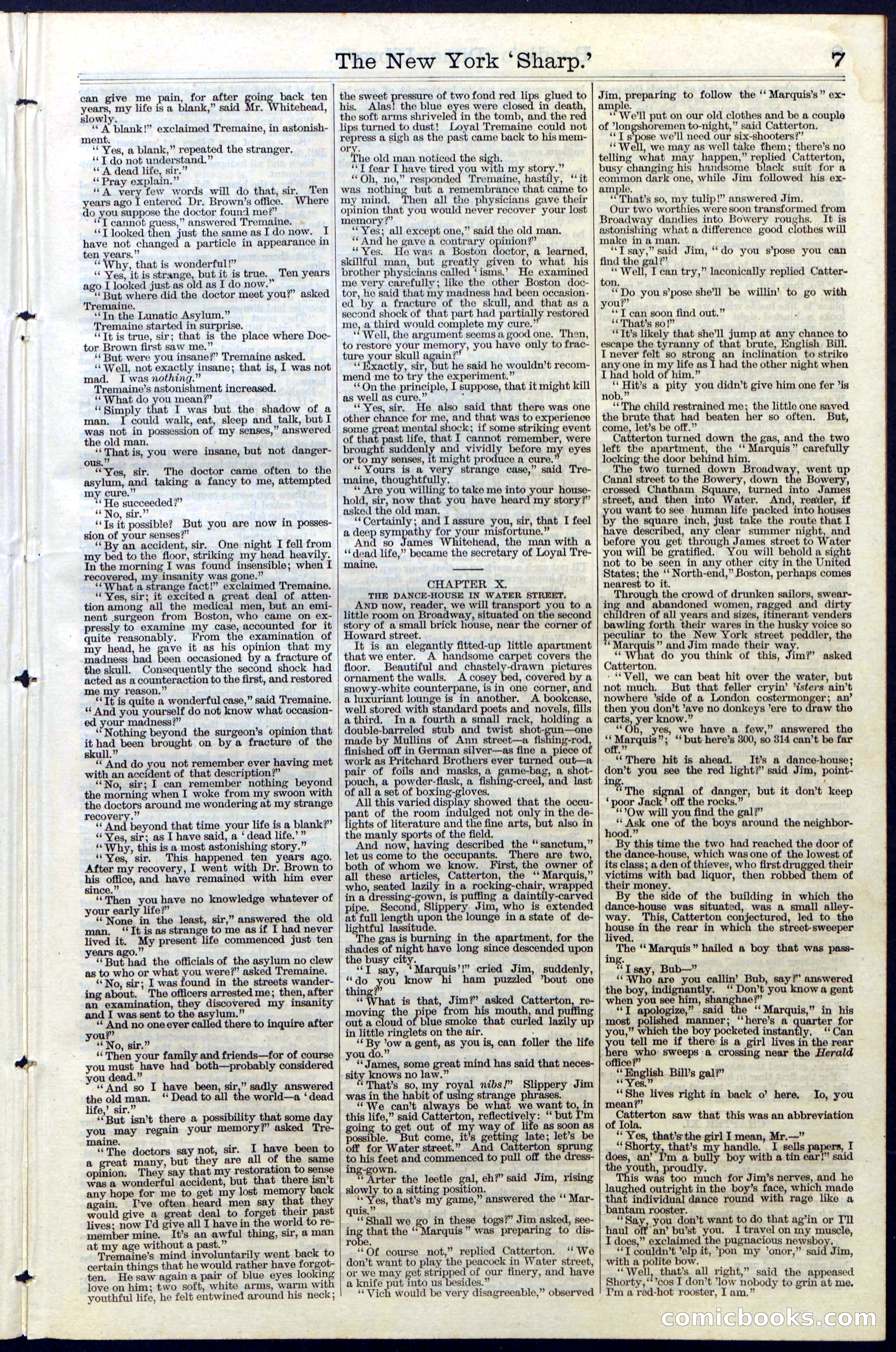
A restored page from Pulp Fiction, 1878. Page through the whole issue in the reader above.
📄 Transcribed text from this page (OCR, searchable)
Machine-transcribed from the original scan — historical spelling and the odd misread are preserved.
can give me pain, for after going back ten wa my life is a blank,” said Mr. Whitehead, slowly. “ A blank!” exclaimed Tremaine, in astonish- ment. “Yes, a blank,” repeated the stranger. ‘‘T do not understand.” ‘“ A dead life, sir.” ‘‘ Pray explain.” ‘“A very few words will do that, sir. years ago I entered Dr. Brown’s office. do you. suppose the doctor found me?” ‘*T cannot guess,” answered Tremaine. - ‘“T looked then just the same as I do now. I have not changed a particle in appearance ten years.” ‘Why, that is wonderful!” ‘« Yes, it is strange, but it is true. | ago I looked just.as old as I do now.’ ‘“‘ But where did the doctor meet you?” asked Tremaine. ‘In the Lunatic Asylum.” Tremaine started in surprise. ‘‘Tt is true, sir; that is the place where Doc- tor Brown first saw me.” ‘‘But were you insane?” Tremaine asked. ‘‘ Well, not exactly insane; that is, 1 was not mad. I was nothing.” Tremaine’s astonishment increased. Ten 1ere Ten years ‘What do you mean?” ‘‘Simply that I was but the shadow of a man. T could walk, eat, sleep and talk, but I was not in possession of my senses,” answered the old man. “ That is, you were insane, but not danger- ous. “Yes, sir. ‘The doctor came often to the asylum, and taking a fancy to me, attempted my cure.” ‘‘ He succeeded?” ‘No, sir.” ‘‘Ts it possible? But you are now in posses- sion of your senses?” , ‘By an accident, sir. One night I fell from my bed to the floor, striking my head heavily. In the morning I was found insensible; when I recovered, my insanity was gone.” ‘What a strange fact!” exclaimed Tremaine. “Yes, sir; it excited a great deal of atten- tion among all the medical men, but an emi- nent surgeon from Boston, who came on ex- pressly to examine my case, accounted for it quite reasonably. From the examination of my head, he gave it as his opinion that my madness had been occasioned by a fracture of the skull. Consequently the second shock had acted as a counteraction to the first, and restored me my reason.” ‘Tt is quite a wonderful case,” said Tremaine. “ And you yourself do not know what occasion- ed your madness?” ‘Nothing beyond the surgeon’s opinion that a had been brought on by a fracture of the ull. ‘And do you not remember ever having met with an accident of that description?” “No, sir; I can remember nothing beyond the morning when I woke from my swoon with the doctors around me wondering at my strange recovery.” tay ‘“‘ And beyond that time your life is a blank?” ‘Yes, sir; as I have said, a ‘ dead life.’” “Why, this is a most astonishing story.” ‘‘ Yes, sir. This happened ten years ago. After my recovery, I went with Dr. Brown to his office, and have remained with him ever since.” ‘Then you have no knowledge whatever of your early life?” ‘‘ None in the least, sir,” answered the old man. “Itis as strange to me asif I had never lived it. My present life commenced just ten years ago.” ‘‘But had the officials of the asylum no clew as to who or what you were?” asked Tremaine. ‘No, sir; I was found in the streets wander- ing about. The officers arrested me; then, after an examination, they discovered my insanity and I was sent to the asylum.” “ And no oneever called there to inquire after ‘No, sir.” ‘Then your family and friends—for of course you or shave had both—probably considered ou dead. . ‘‘And so I have been, sir,” sadly answered the old man. ‘“ Dead to all the world—a ‘dead life,’ sir.” - ' ‘“But isn’t there a possibility that some day you may regain your memory?” asked Tre- maine. ; “The doctors say not, sir. I have been to a great many, but they are all of the same opinion, They say that my restoration to sense was a wonderful accident, but that there isn’t any hope for me to get my lost memo back again. Ive often. heard men say that they would give a great deal to forget their past lives: now I'd give all I have in the world to re- member omen 8 It’s an awful thing, sir, a man at m without a past. Tnanaine’s mind involuntarily went back to certain things that he would rather have forgot- ten. Hesaw again a pair of blue eyes maths love on him; two soft, white arms, warm wit youthful life, he felt entwined around his neck; The New York ‘Sharp.’ the sweet pressure of two fond red lips glued to his. Alas! the blue eyes were closed in death the soft arms shriveled in the tomb, and the red lips turned to dust! Loyal Tremaine could not repress a sigh as the past came back to his mem- ry. The old man noticed the sigh. ‘*) fear I have tired you with my story.” Oh, no,” Masbabaed’ Tremaine, hastily, ‘it was nothing but a remembrance that came to my mind, Then all the physicians gave their opinion that you would never recover your lost memory ?” ‘Yes; all except one,” said the old man. ‘And he gave a contrary opinion?” “Yes. He was a Boston doctor, a learned, skillful man, but greatly given to what his brother physicians called ‘isms.’ He examined me very carefully; like the other Boston doc- tor, he said that my madness had been occasion- ed by a fracture of the skull, and that as a second shock of that part had partially restored me, a third would complete my cure.’ d Well, the argument seems a good one. Then, to restore your memory, you have only to frac- ture your skull again?’ ‘““Hxactly, sir, but he said he wouldn’t recom- mend me to try the experiment.” ‘On the principle, I suppose, that it might kill as well as cure,” : ‘‘- Yes, sir. He also said that there was one other chance for me, and that was to experience some great mental shock; if some striking event of that past life, that I cannot remember, were brought suddenly and vividly before my eyes or to my senses, it might produce a cure.’ “Yours is a very strange case,” said Tre- maine, thoughtfully. ** Are you willing to take me into your house- hold, sir, now that you have heard my story?” asked the old man. ‘Certainly; and I assure you, sir, that I feel a deep sympathy for your misfortune.” And so James Whitehead, the man with a ‘‘ dead life,” became the secretary of Loyal Tre- maine, CHAPTER X. THE DANCE-HOUSE IN WATER STREET. AND now, reader, we will transport you to a little room on Broadway, situated on the second story of a small brick house, near the corner of Howard street. It is an elegantly fitted-up little apartment that we enter. A handsome carpet covers the floor. Beautiful and chastely-drawn pictures ornament the walls. A cosey , covered by a snowy-white counterpane, isin one corner, and a luxuriant lounge is in another. A bookcase, well stored with standard poets and novels, fills a third. Ina fourth a small rack, holding a double-barreled stub and twist geht ey made by Mullins of Ann street—a fishing-rod, finished off in German silver—as fine a piece of work as Pritchard Brothers ever turned out—a pair of foils and masks, a game-bag, a shot- pouch, a powder-flask, a fishing-creel, and last of all a set of boxing-gloves. All this varied display showed that the occu- ant of the room indulged not only in the de- ights of literature and the fine arts, but also in the manly sports of the field. And now, having described the “sanctum,” let us come to the occupants. There are two both of whom we know. First, the owner of all these articles, Catterton, the ‘* Marquis,” who, seated lazily in a rocking-chair, wrapped in a dressing-gown, is puffing a daintily-carved pipe. Second, Slippery Jim, who is extended at full length + a the lounge ina state of de- lightful lassitude. he gas is b in the apartment, for the shades of night have long since descended upon the busy city. “T gay, ‘Marquis’!” cried Jim, suddenly, do > know hi ham puzzled "bout one ’ : What is that, Jim?’ asked Catterton, re- moving the rp from his mouth, and p out a cloud of blue smoke that curled lazily up in little ringlets on the air, : s iS ow a gent, as you is, can foller the life ou do. * “James, some great mind has said that neces- sity knows no law.” ‘That’s so, my royal nibs!” Slippery Jim was in the habit of strange phrases. “We can’t always what we want to, in this life,” said Catterton, reflectively: “but I’m going to get out of my wa of life as soon as Sins. ut come, it’s getting. late; let’s be off for Water street.” And Ca sprung to his feet and commenced to pull off the dress- wn. eRe the leetle gal, eh?’ said Jim, rising slowly to a sitting position. ‘i a es, that’s my game,” answered the ‘‘ Mar- iis | ‘Shall we go in these togs?” Jim asked, see- “e ang SOY the uis” was preparing to dis- robe. “Of course not,” replied Catterton. ‘ We don’t want to play the peacock in Water street, or we may get stripped of our finery, and have a knife put into us besides.” ‘“Vich would be very disagreeable,” observed 7 ————$ od _- | Jim, preparing to follow the ‘‘ Marquis’s” ex- ample. Well put on our old clothes and be a couple of ‘longshoremen to-night,” said Catterton. ‘‘T s’pose we'll need our six-shooters?” ‘Well, we may as well take them; there’s no telling what may happen,” es es Catterton, busy changing his handsome black suit for a common dark one, while Jim followed his ex- ample, ‘'That’s so, my tulip!” answered Jim. Our two worthies were soon transformed from Broadway dandies into Bowery roughs. It is astonishing what a difference good clothes will ny in Bee . 4 ‘IT say,” said Jim, *‘do you s’pose you can find the gal?” “ ** Well, I can try,” laconically replied Catter- ton. ‘‘Do you s’pose she’ll be willin’ to go with you?” ‘*T can soon find out.” ‘'That’s so!” ‘It’s likely that she’ll jump at any chance to escape the tyranny of that brute, English Bill. I never felt so strong an inclination to strike any one in my life as I had the other night when I had hold of him,” [ Hit’s a pity you didn’t give him one fer ’is ‘‘The child restrained me; the little one saved the brute that had beaten her so often. But, come, let’s be off.” Catterton turned down the gas, and the two left the apartment, the ‘‘ Marquis” carefully locking the door behind him, The two turned down Broadway, went up Canal street to the Bowery, down the Bowery, crossed Chatham Square, turned into James street, and then into Water. And, reader, if you want to see human life packed into houses y the square inch, just take the route that I have described, any clear summer night, and before you get through James street to Water you will be gratified, You will behold a sight not to be seen in any other city in the United States; the ‘‘ North-end,” Boston, perhaps comes nearest to it. Through the crowd of drunken sailors, swear- ing. and abandoned women, ragged and dirty children of all years and sizes, itinerant venders bawling forth their wares in the husky voice so eculiar to the New York street peddler, the ‘Marquis” and Jim made their ax “What do you think of this, Jim?’ asked Catterton. - Vell, we can beat hit over the water, but not much. But that feller cryin’ "isters ain't nowhere ’side of a London costermonger; an’ then you don’t ’ave no donkeys ’ere to draw the carts, yer know.” ““Oh, yes, we have a few,” answered the a ”; “but here’s 800, so 314 can’t be far off, ‘There hit is ahead. It’s a dance-house; don’t you see the red light?’ said Jim, point- ‘The signal of danger, but it don’t kee ‘poor Jack’ off the vocke? ¢ ‘Ow will you find the gal?” ie one of the boys around the neighbor- By this time the two had reached the door of the dance-house, which was one of the lowest of its class; a den of thieves, who first drugged their victims with bad liquor, then robbed them of their money. By the side of the building in which the dance-house was situated, was a small alley- way. This, Catterton conjectured, led to she nanee in the rear in which the street-sweeper a4 . _ The “ Marquis” hailed a boy that was pass- in ‘‘-Who are you callin’ Bub, say?’ answered the boy, indignantly. ‘‘ Don’t you knowa gent vor you see him, ata hae?” cia te ‘ apologize e Ps most Sees manner; ‘‘here’s a quarter for you,” which the boy pocketed instantly, ‘Can ou tell me if there is a girl lives in the rear ere who sweeps a crossing near the Herald office?” _ “Wnglish Bill’s gal?” ‘6'Yes.” “She lives right in back o’ here, Io, you mean?” Catterton saw that this was an abbreviation of Iola, “Yes, that’s the girl I mean, Mr.—” ‘Shorty, that’s my handle. _ I sells I does, an’ a bully boy with a tin ear!” said the youth, proudly 0 ‘ is was too much for Jim’s nerves, and he laughed outright in the boy’s face, which made that individual dance round with rage like a fel y, you don’t want to do that ag’in or Tl haul off an’ bu’st you. I travel on my muscle, I does,” exclaimed the pugnacious newsboy. **T couldn’t ’elp it, *pon my ’onor,” said Jim, with a sar bow. “We : that’s all right,” said the appeased Shorty, ‘’cos I don’t low nobody to grin at me, I’m a red-hot rooster, I am.” Gomilcboo Sn)