
Pulp Fiction, 1878 · page 4 of 32
Beadle's Dime Library, Vol. III, No. 31 — page 4: what you’re looking at
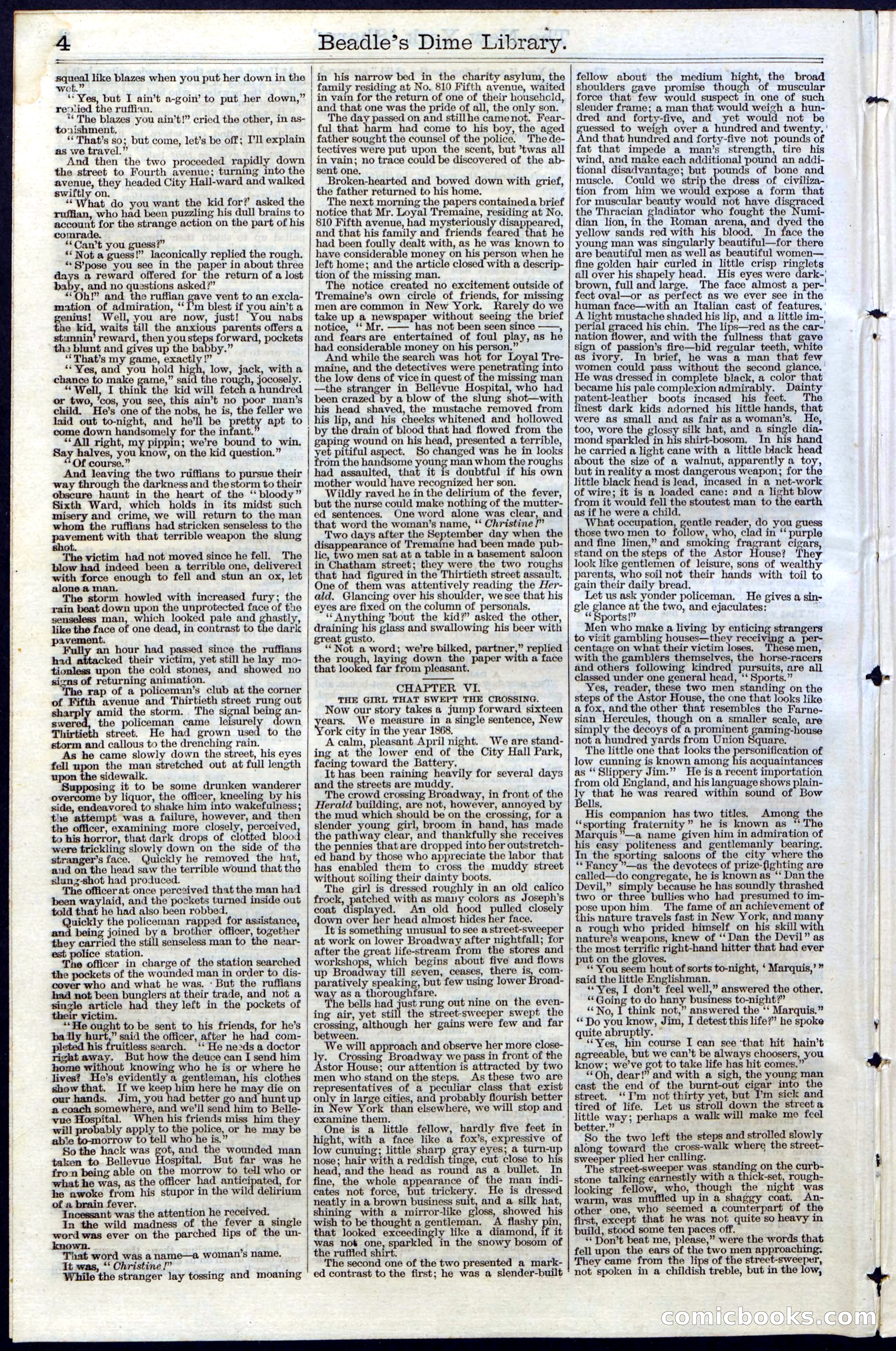
A restored page from Pulp Fiction, 1878. Page through the whole issue in the reader above.
📄 Transcribed text from this page (OCR, searchable)
Machine-transcribed from the original scan — historical spelling and the odd misread are preserved.
¢ | saneet like blazes when you put her down in the we “Yes, but I ain’t a-goin’ to put her down,” re> ied the ruffian. “The blazes you ain’t!” cried the other, in as- tonishment. “‘ That’s so; but come, let’s be off; Pll explain as we travel.” And then the two proceeded rapidly down the street to Fourth avenue; turning into the avenue, they headed City Hall-ward and walked swiftly on. ‘““What do you want the kid for?’ asked the who had been puzzling his dull brains to account for the strange action on the part of his comrade. **Can’t you guess?” * Not a guess!” laconically replied the rough. ““S’pose you see in the paper in about three days a reward offered for the return of a lost baby, and no questions asked?” *““Oh!” and the ruffian gave vent to an excla- mation of admiration, “I’m blest if you ain’t a oat Well, on are now, just! You nabs e kid, waits till the anxious parents offers a stunnin’ reward, then you steps forward, pockets the blunt and gives up the babby.” “That’s my game, exactly!” “Yes, and you hold high, low, jack, with a chance to make game,” said the rough, qorone ny “Well, I think the kid will fetch a hundred or two, ’cos, you see, this ain’t no r man’s child. He’s one of the nobs, he is, the feller we laid out to-night, and he’ll be retty apt to come down handsomely for the infant.” “All right, my pippin; we’re bound to win. Say halves, you know, on the kid question.” “ Of course.” And leaving the two riffians to pursue their way through the darkness and the storm to their obscure haunt in the heart of the ‘ bloody” Sixth Ward, which holds in its midst such misery and crime, we will return to the man whom the ruffians had stricken senseless to the pa with that terrible weapon the slung ti. The victim had not moved since he fell. The blow had indeed been a terrible one, delivered with force enough to fell and stun an ox, let alone a man. ; The storm howled with increased fury; the rain beat down upon the unprotected face of the senseless man, which looked pale and ghastly, like the face of one dead, in contrast to the dark pavement. Fully an hour had passed since the ruffians had p My their victim, yet still he lay mo- tionless upon the cold stones, and showed no iens of returning animation. The rap of a policeman’s club at the corner of Fifth avenue and Thirtieth street rung out sharply amid the storm. The signal being an- swered the policeman came leisurel own Thirtieth street. He had grown used to the storm and callous to the drenching rain. As he came slowly down the street, his eyes fell upon the man stretched out at full length upon the sidewalk. Supposing it to be some drunken wanderer overcome by liquor, the officer, kneeling by his ide, endeavored to shake him into wakefulness; the attempt was a failure, however, and then the officer, examining more closely, perceived to his horror, that dark drops of clotted bloo: were trickling slowly down on the side of the stranger’s face. Quickly he removed the hat, aud on the head saw the terrible wound that the slunz-shot had produced. The officer at once perceived that the man had been waylaid, and the pockets turned inside out told that he had also been robbed. Bie the policeman rapped for assistance, being joined bya brother officer, together they carried the still senseless man to the near- est police station. The officer in charge of the station searched the pockets of the wounded man in order to dis- cover who and what he was. - But the ruffians had not been bunglers at their trade, and not a single article they left in the pockets of their victim. “He ought to be sent to his friends, for he’s ba ily hurt,” said the officer, after he had com- eted his tless search. ‘‘ He neods a doctor right away. But how the deuce can I send him home without knowing who he is or where he lives? He’s evidently a gentleman, his clothes show that. If we keep him here he may die on our hands. Jim, you had better go and hunt up a coach somewhere, and we’ll send him to Belle- vue H om boat a nal het pn, Bah they will ably apply e police, or he may be shle to-anchiow to tell wid he is.” 3 So the hack was got, and the wounded man taken to Bellevue Hospital. But far was he fron being able on the morrow to tell who or what he was, as the officer had anticipated, for he awoke from his stupor in the wild delirium of a brain fever. Incessant was the attention he received. _ In the wild madness of the fever a single word was ever on the parched lips of the un- known. , That word was aname—a woman's name, It was, “‘ Christine !” ; While the stranger lay tossing and moaning Beadle’s Dime Library. ee Sn rrr eesti eee oon ——— ———_ - —-— - _~ -_— in his narrow bed in the charity asylum, the family residing at No. 810 Fifth avenue, waited in vain for the return of one of their household, and that one was the pride of all, the only son. The day passed on and stillhe camenot. Fear- ful that harm had come to his boy, the aged father sought the counsel of the police. The de- tectives were put upon the scent, but ’twas all in vain; no trace could be discovered of the ab- sent one, Broken-hearted and bowed down with grief, the father returned to his home, The next morning the papers contained a brief notice that Mr. Loyal Tremaine, residing at No. 810 Fifth avenue, had mysteriously disappeared, and that his family and friends feared that he had been foully dealt with, as he was known to have considerable money on his person when he left home; and the article closed with a descrip- tion of the missing man. The notice created no excitement outside of Tremaine’s own circle of friends, for missing men are common in New York. Rarely do we take up a newspaper without seeing the brief notice, ‘‘ Mr. —— has not been seen since —, and fears are entertained of foul play, as he had considerable money on his person.” And while the search was hot for Loyal Tre- maine, and the detectives were penetrating into the low dens of vice in quest of the missing man —the stranger in Bellevue Hospital, who had been crazed by a blow of the slung shot—with his head shaved, the mustache removed from his lip, and his cheeks whitened and hollowed by the drain of blood that had flowed from the gaping wound on his head, presented a terrible, yet pitiful aspect. So changed was he in looks from the handsome young man whom the roughs had assaulted, that it is doubtful if his own mother would have recognized her son. Wildly raved he in the delirium of the fever, but the nurse could make nothing of the mutter- ed sentences. One word alone was clear, and that word the woman’s name, ‘* Christine !” Two days after the Se tember day when the disappearance of Tremaine had been made pub- lic, two men sat at a table in a basement saloon in Chatham street; they were the two roughs that had figured in the Thirtieth street assault. One of them was attentively reading the Her- ald. Glancing over his shoulder, we see that his eyes are fixed on the column of personals. ** Anything "bout the kid?’ asked the other, draining his glass and swallowing his beer with great gusto “Not a word; we're bilked, partner,” replied the ot Sa ey bee down the paper with a face that loo far from pleasant. CHAPTER VI. THE GIRL THAT SWEPT THE CROSSING. Now our story takes a jump forward sixteen ears. We measure in a single sentence, New ork city in the year 1868. A calm, pleasant April at We are stand- ing at the lower end of the City Hall Park, facing toward the Battery. It has been raining heavily for several days and the streets are muddy. The crowd crossing Broadway, in front of the Herald building, are not, however, annoyed by the mud which should be on the crossing, for a slender young girl, broom in hand, has made the pathway clear, and thankfully she receives the pennies that are dropped into her outstretch- ed hand by those who appreciate the labor that has enabled them to cross the muddy street without soiling their dainty boots. The girl is dressed roughly in an old calico frock, patched with as many colors as Joseph’s coat displayed. An old hood pulled closely down over her head almost hides her face. It is something unusual to see astreet-sweeper at work on lower Broadway after nightfall; for after the great life-stream from the stores and workshops, which begins about five and flows up Broadway till seven, ceases, there is, com- paratively speaking, but few using lower Broad- way as a thoroughfare. . The bells had just rung out nine on the even- ing air, yet still the street-sweeper swept the crossing, although her gains were few and far between. We will approach and observe her more close- é Crossing Broadway we pass in front of the tor House; our attention is attracted by two men who stand on the steps. As these two are pe greigianen of a peculiar class that exist only in large cities, and probably flourish better in New York than elsewhere, we will stop and examine them. ; One is a little fellow, hardly five feet in hight, with a face like a fox’s, expressive of low cunuing; little sha ay eyes; a turn-u nose; hair with a reddish tinge, cut close to his head, and the head as round as a bullet. In fine, the whole appearance of the man indi- cates not force, but trickery. He is dressed neatly in a brown business suit, and a silk hat, shining with a mirror-like gloss, showed his wish to be thought a gentleman. A fashy pin, that looked exceedingly like a diamond, if it was not one, sparkled in the snowy bosom of the ruffled shirt. The second one of the two presented a mark- ed contrast to the first; he was a slender-built fellow about the medium hight, the broad shoulders gave promise though of muscular force that few would suspect in one of such slender frame; a man that would weigh a hun- dred and forty-five, and yet would not be guessed to weigh over a hundred and twenty. ' And that hundred and forty-five not pounds of fat that impede a man’s strength, tire his wind, and make each additional pound an addi- tional disadvantage; but pounds of bone and muscle. Could we strip the dress of civiliza- tion from him we would expose a form that for muscular beauty would not have disgraced the Thracian gladiator who fought the Numi- dian lion, in the Roman arena, and dyed the yellow sands red with his blood. In face the young man was singularly beautiful—for there are beautiful men as well as beautiful women— fine golden hair curled in little crisp ringlets all over his shapely head. His eyes were dark-' brown, full and large. The face almost a per-' fect oval—or as perfect as we ever see in the human face—with an Italian cast of features, A light mustache shaded his lip, and _a little im- perial graced his chin. The lips—red as the car- nation flower, and with the fullness that gave sign of passion’s fire—hid regular teeth, white as ivory. In brief, he was a man that few women could pass without the second glance, He was dressed in complete black, a color that became his pale complexion admirably. Dainty tent-leather boots incased his feet. The inest dark kids adorned his little hands, that were as small and as fair asa woman’s. He, too, wore the glossy silk hat, and a single dia- mond sparkled in his shirt-bosom. In his hand he carried a light cane with a little black head about the size of a walnut, apparently a toy, but in reality a most dangerous weapon; for the little black head is lead, incased in a net-work of wire; it is a loaded cane: and a light blow from it would fell the stoutest man to the earth as if Mabe) a oe sir ecittche hi What occupation, gentle reader, do you guess those two men to tollow who, clad in purple and fine linen,” and smoking fragrant cigars, stand on the steps of the Astor House? They look like gentlemen of leisure, sons of wealthy parents, who soil not their hands with toil to gain their daily bread. Let us ask yonder policeman. He gives a sin- gle gene at the two, and ejaculates: ‘“ Sports!” Men who make a living by enticing strangers to visit gambling houses—they receiving a per- centage on what their victim loses, ese men, with the gamblers themselves, the horse-racers and others following kindred pursuits, are all classed under one general head, ‘‘ Sports.” Yes, reader, these two men standing on the steps of the Astor House, the one that looks like a fox, and the other that resembles the Farne- sian Hercules, though on a smaller scale, are reo the decoys of a prominent gaming-house not a hundred yards from Union Square. The little one that looks the personification of low cunning is known among his acquaintances as “Slippery Jim.” He is a recent importation from old England, and his language shows plain- ly a he was reared wit sound of Bow ells, His companion has two titles, Among the “sporting fraternity” he is known as * The Marquis ”—a name given him in admiration of his easy politeness and gentlemanly bearing. In the sporting saloons of the city where the ‘*Fancy ”—as the devotees of prize-fighting are called—do congregate, he is known as ‘‘ Dan the Devil,” simply because he has soundly thrashed two or three bullies who had presumed to im- pose upon him. The fame of an achievement of this nature travels fast in New York, and man a rough who prided himself on his skill wi nature’s weapons, knew of ‘‘Dan the Devil” as the most terrific right-hand hitter that had ever put on the gloves. “You seem hout of sorts to-night, ‘ Marquis,’ ” said the little Englishman. “Yes, I don’t feel well,” answered the other, “Going to do hany business to-night?’ ‘No, I think not,” answered the ‘‘ Marquis.” ““Do you know, Jim, I detest this life?’ he spok quite abruptly. — ‘“Yes, hin course I can see ‘that hit hain’t agreeable, but we can’t be always choosers, you know; we've got to take life has hit comes,” “Oh, dear!” and with a sigh, the young man cast the end of the burnt-out ci into the street. ‘I’m not thirty yet, but I'm sick and tired of life. Let us stroll down the streeta See way ; perhaps a walk will make me feel otter.” So the two left the steps and strolled aorly along wowart ae cross-walk where the stree sweeper pli er calling. The shreck@ubelier was standing on the curb- stone talking earnestly with a thick-set, rough- looking fellow, who, though the night was warm, was muffled up in a shaggy coat. An- other one, who seemed a counterpart of the first, except that he was not quite so heavy in build, stood some ten paces off. ‘Don’t beat me, please,” were the words that fell upon the ears of the two men approaching, They came from the lips of the street-sweeper, not spoken in a childish treble, but in the low, MIE OOO) KS (E(@) (C (E(@) \ af |