
Pulp Fiction, 1878 · page 2 of 32
Beadle's Dime Library, Vol. III, No. 31 — page 2: what you’re looking at
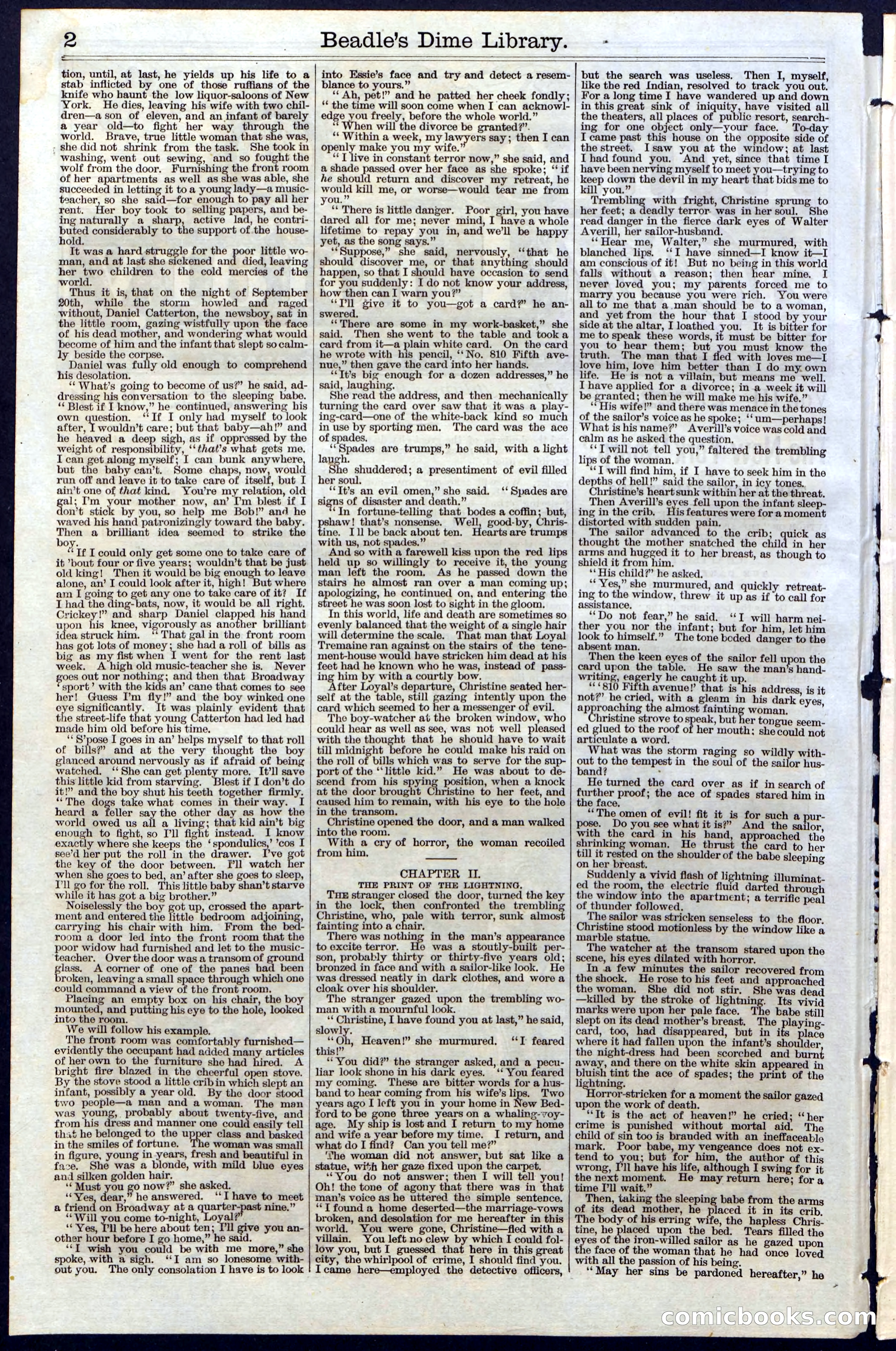
A restored page from Pulp Fiction, 1878. Page through the whole issue in the reader above.
📄 Transcribed text from this page (OCR, searchable)
Machine-transcribed from the original scan — historical spelling and the odd misread are preserved.
2 —— a — tion, until, at last, he yields up his life to a stab inflicted by one of those ruffians of the knife who haunt the low liquor-saloons of New York. He dies, leaving his wife with two chil- dren—a son of eleven, and an infant of barely a year old—to fight her way through the world. Brave, true little woman that she was, - she did not shrink from the task. She took in washing, went out sewing, and so fought the wolf from the door. Furnishing the front room of her apartments as well as she was able, she succeeded in letting it to a young lady—a music- teacher, so she said—for enough to pay all her rent. Her boy took to selling papers, and be- ing naturally a sharp, active lad, he contri- buted considerably to the support of the house- hold. It was a hard struggle for the r little wo- man, and at last she sickened and died, leaving her two children to the cold mercies of the world, Thus it is, that on the night of September 20th, while the storm howled and raged without, Daniel Catterton, the newsboy, sat in the little room, gazing wistfully upon the face of his dead mother, and wondering what would become of him and the infant that slept so calm- ly beside the corpse. Daniel was fully old enough to comprehend his desolation. : ““What’s going to become of us?” he said, ad- dressing his conversation to the sleeping babe. ‘¢ Blest if I know,” he continued, answering his own question. ‘‘If I only had myself to look after, I wouldn’t care; but that baby—ah!” and he heaved a deep sigh, as if oppressed by the weight of responsibility, ‘‘that’s what gets me. I can get along myself; I can bunk anywhere, but the baby can’t. Some chaps, now, would run off and leave it to take care of itself, but I ain’t one of that kind, You’re my relation, old al; I’m your mother now, an’ I’m blest if I on’t stick by you, so help me Bob!” and he waved his hand patronizingly toward the baby. Then a brilliant idea seemed to strike the oy. “Tf I could only get some one to take care of it bout four or five years; wouldn’t that be just old king! Then it would be big enough to leave alone, an’ I could look after it, high! But where am I going to get any one to take care of it? If I had the ding-bats, now, it would be all right. Crickey!” and sharp Daniel clapped his hand upon his knee, vigorously as another brilliant idea struck him. ‘ That galin the front room has got lots of money; she had a roll of bills as big as my fist when I went for the rent last week. A high old music-teacher she is. Never goes out nor nothing; and then that Broadway sport’ with the kids an’ cane that comes to see her! Guess ’'m fly!” and the boy winked one ove aay it t was plainly evident that the street-life that young Catterton had led had made him old before his time. ‘‘ S’pose I goes in an’ helps myself to that roll of bills?’ and at the very thought the boy glanced around nervously as if afraid of being watched. ‘‘She can get plenty more. It’ll save this little kid from starving. Blest if I don’t do it!” and the boy shut his teeth together firmly. “The dogs take what comes in their way. I heard a feller say the other day as how the world owed us all a living; that kid ain’t big enough to fight, so I'll fight instead. I know exactly where she keeps the ‘spondulics,’ ’cos I see’d her put the roll in the drawer. [ve got the key of the door between. Fll watch her when she goes to bed, an’ after she goes to sleep, Vl go for the roll. This little baby shan’t starve while it has got a big brother.” Noiselessly the boy got up, crossed the apart- ment and entered the Tittle bedroom ee carrying his chair with him. From the room a door led into the front room that the poor widow had furnished and let to the music- teacher. Over the door was a transom of ground bm A corner of one of the panes had been roken, leaving a small space through which one could command a view of the front room, lacing an ae box on his chair, the boy mounted, and putting his eye to the hole, looked into the room. We will follow his example. The front room was comfortably furnished— evidently the occupant had added many articles of her own to the furniture she had hired. A bright fire blazed in the cheerful open stove. By the stove stood a little cribin which slept an infant, possibly a year old. By the door stood two people—a man and a woman. The man was young, probably about twenty-five, and from his dress and manner one could easily tell that he belonged to the ss class and basked in the smiles of fortune. ca phi tev small in figure, young in years, fresh an utiful in fon She was a blonde, with mild blue eyes and silken golden hair. ‘Must you go now?” she asked. ‘“Yes, dear,” he answered. ‘‘I have to meet a friend on Broadway ata Ta nine.”’ ‘“Will you come to-night, ore ‘‘- Yes, Pll be here about ten; Pll give you an- other hour before I go home,” he said. ms ish you could be with me more,” she spoke, with a sigh. ‘“‘I am so lonesome with- out you. The only consolation I have is to look Beadle’s Dime Library. into Essie’s face and try and detect a resem- blance to yours.” ‘* Ah, pet!” and he patted her cheek fondly; ‘ the time will soon come when I can acknowl- edge you freely, before the whole world.” ‘When will the divorce be granted?’. ** Within a week, my lawyers say; then I can eet, make you my wife.’ ‘I live in constant terror now,” she said, and a shade passed over her face as she spoke; “ if he should return and discover my retreat, he would kill me, or worse—would tear me from ou. ‘* There is little danger. Poor girl, you have dared all for me; never mind, I have a whole lifetime to repay you in, and we'll be happy yet, as the song says.” ‘*Suppose,” she said, nervously, ‘“‘that he should discover me, or that anything should happen, so that I should have occasion to send for you suddenly: I do not know your address, how then can I warn you?” “Tll give it to you—got a card?” he an- swered. ‘*There are some in my work-basket,” she said. Then she went to the table and tooka card from it—a plain white card. On the card he wrote with his pencil, ‘‘No. 810 Fifth ave- nue,” then gave the card into her hands. “Ts big enough for a dozen addresses,” he said, laughing. She read the address, and then mechanically turning the card over saw that it was a play- ing-card—one of the white-back kind so much in use by sporting men. The card was the ace of spades. ‘*Spades are trumps,” he said, with a light laygh. e shuddered; a presentiment of evil filled her soul. **Tt’s an evil omen,” she said. signs of disaster and death.” ‘In fortune-telling that bodes a coffin; but, pshaw! that’s nonsense. Well, good-by, Chris- tine. Il be back about ten. Hearts are trumps with us, not spades,” And so with a farewell kiss upon the red lips held up so willingly to receive it, the young man left the room, As he down the stairs he almost ran over a man coming up; apologizing, he continued on, and entering the street he was soon lost to sight in the gloom, In this world, life and death are sometimes so evenly balanced that the weight of a single hair will determine the scale. That man that Loyal Tremaine ran against on the stairs of the tene- ment-house would have stricken him dead at his feet had he known who he was, instead of pass- ing him by with a courtly bow. ‘A tter Loyal’s departure, Christine seated her- self at the table, still gazing intently upon the card which seemed to her a messenger of evil. The boy-watcher at the broken window, who could hear as well as see, was not well pleased with the thought that he should have to wait till midnight before he could make his raid on the roll of bills which was to serve for the sup- port of the ‘‘little kid.” He was about to de- scend from his spying position, when a knock at the door brought tine to her feet, and caused him to remain, with his eye to the hole in the transom. Christine opened the door, and a man walked into the room. With a cry of horror, the woman recoiled from him, ** Spades are CHAPTER II. THE PRINT OF THE LIGHTNING. THE stranger closed the door, turned the key in the lock, then confronted the tremblin Christine, who, ae with terror, sunk almos fainting into a chair. There was ae in the man’s ee to excite terror. He was a stoutly-built per- son, probably thirty or thirty-five years old; bronzed in face and with a sailor-like look. He was dressed neatly in dark clothes, and wore a oe ise his oe ore e stranger gazed upon the trembling wo- man with a mournful took: ‘* Christine, I have found you at last,” he said, slowly. Heaven!” she murmured, ‘TI feared ‘23 O this!” ’ ‘You did?” the stranger asked, and a pecu- liar look shone in his k eyes. ‘‘ You feared my coming. These are bitter words for a hus- band to hear coming from his wife’s lips. Two ears ago I left you in your home in New Bed- ford vi one three years on a whaling-voy- age. My ship is lost and I return to my home and wife a year before my time. I return, and what do I find? Can you tell me?” ‘The eo did we ge ie ae sat ov a statue, with her gaze fixed upon the carpet. ‘You do not answer; then I will tell you! Oh! the tone of agony that there was in that man’s voice as he uttered the simple sentence. ‘*T found a home deserted—the marriage-vows broken, and desolation for me hereafter in this world. You were gone, Christine—fled with a villain. You left no clew by which I could fol- low you, but I guessed that here in this great city, the whirlpool of crime, I should find you. Icame here—employed the detective officers, _ but the search was useless. Then I, myself, like the red Indian, resolved to track you out. For a long time I have wandered up and down in this great sink of iniquity, have visited all the theaters, all places of public resort, search- ing for one object only—your face. To-day I came past this house on the opposite side of the street. Isaw you at the window; at last Thad found you. And yet, since that time I have been nerving myself to meet you—trying to keep down the devil in my heart that bids me to kill you.” Trembling with fright, Christine sprung to her feet; a deadly terror was in her soul. She read danger in the fierce dark eyes of Walter Averill, her sailor-husband. ‘‘Hear me, Walter,” she murmured, with blanched lips. ‘‘I have sinned—I know it—I am conscious of it! But no being in this world falls without a reason; then hear mine, [ never loved you; my parents forced me to marry you because you were rich. You were all to me that a.man should be to a woman, and yet from the hour that I stood by your side at the altar, I loathed you. It is bitter for me to speak these words, it must be bitter for you to hear them; but you must know the truth. The man that I fied with loves me—I love him, love him better than I do my. own life. He is not a villain, but means me well. I have applied for a divorce; in a week it will be granted; then he will make me his wife.” ‘* His wife!” and there was menace in the tones of the sailor’s voice as he spoke; ‘‘um—perhaps! What is his name?” Averill’s voice was cold and calm as he asked the question, ‘*T will not tell you,” faltered the trembling lips of the woman, ‘“*T will find him, if I have to seek him in the depths of hell!” said the sailor, in icy tones. Christine’s heart sunk within her m | the threat. Then Averill’s eyes fell upon the infant sleep- ing in the crib, is features were for a moment distorted with sudden pain, The sailor advanced to the crib; quick as thought the mother snatched the child in her arms and hugged it to her breast, as though to shield it from him. a ie is pe ?” he asked, es," she murmured, and quickly retrea: ing to the window, threw it hips if "te call for assistance, ‘‘Do not fear,” he said. ‘I will harm nei- ther you nor the infant; but for him, let him look to himself.” The tone boded danger to the eThen the k f th en the keen eyes of the sailor fell upon the card upon the table. He saw the man’ hand. writing, eagerly he caught it up. ‘**810 Fifth avenue!’ that is his address, is it not?’ he cried, with a gleam in his dark eyes approaching the almost faintin woman. ! hristine strove to speak, but her tongue seem- ed glued to the roof of her mouth; she could not articulate a word. What was the storm raging so wildly with- ou a the tempest in the soul of the sailor hus- n ‘ He turned the card over as if in search of further proof; the ace of spades stared him in the face, “The omen of evil! fit it is for such a pur- pose. Do you see what it is?” And the sailor, with the card in his hand, approached the shrinking woman. He thrust the card to her till it res on the shoulder of th i eg of the babe sleeping Suddenly a vivid flash of lightning illuminat- oa the Spee. get fluid darted peas e window he apartment; a terri of ee followed. * Regen he sailor was stricken senseless to the floor. Christine stood motionless by the window like a sa witb sis e wa rat the transom stared upon — a eyes it pmb la re a few minu e or recovered from the shock. He rose to his feet and approached the woman, She did not stir. She was dead —killed by the stroke of lightning. Its vivid marks were upon her pale face. The babe still slept on its dead mother’s breast. The playing- card, too, had disappeared, but in i lace where it had fallen upon the infant’s shoulder, the night-dress had n scorched and burnt away, and there on the white skin appeared in tr i the ace of spades; the print of th ning. | orror-stricken for a moment the sailor gazed upon the work of death. ‘‘It is the act of heaven!” he cried; “her crime is punished without mortal aid. The child of sin too is branded with an ineffaceable mark. Poor babe, my vengeance does not ex- tend to you; but for him, the author of this wrong, I'll have his life, eschough I swing for it the next moment. He may return here; for q aoe oe hen, e sleep e from the arms of its dead mother, he placed it in its crib. The body of his erring wife, the hapless Chris- tine, he placed upon the bed. Tears filled the eyes of the iron-willed sailor as he gazed upon the face of the woman that he had once loved with all the passion of his being. ‘May her sins be pardoned hereafter,” he <S NiGDoOOo (ECO) (E() et A