
Pulp Fiction, 1884 · page 8 of 32
Beadle's Dime Library No. 309 — page 8: what you’re looking at
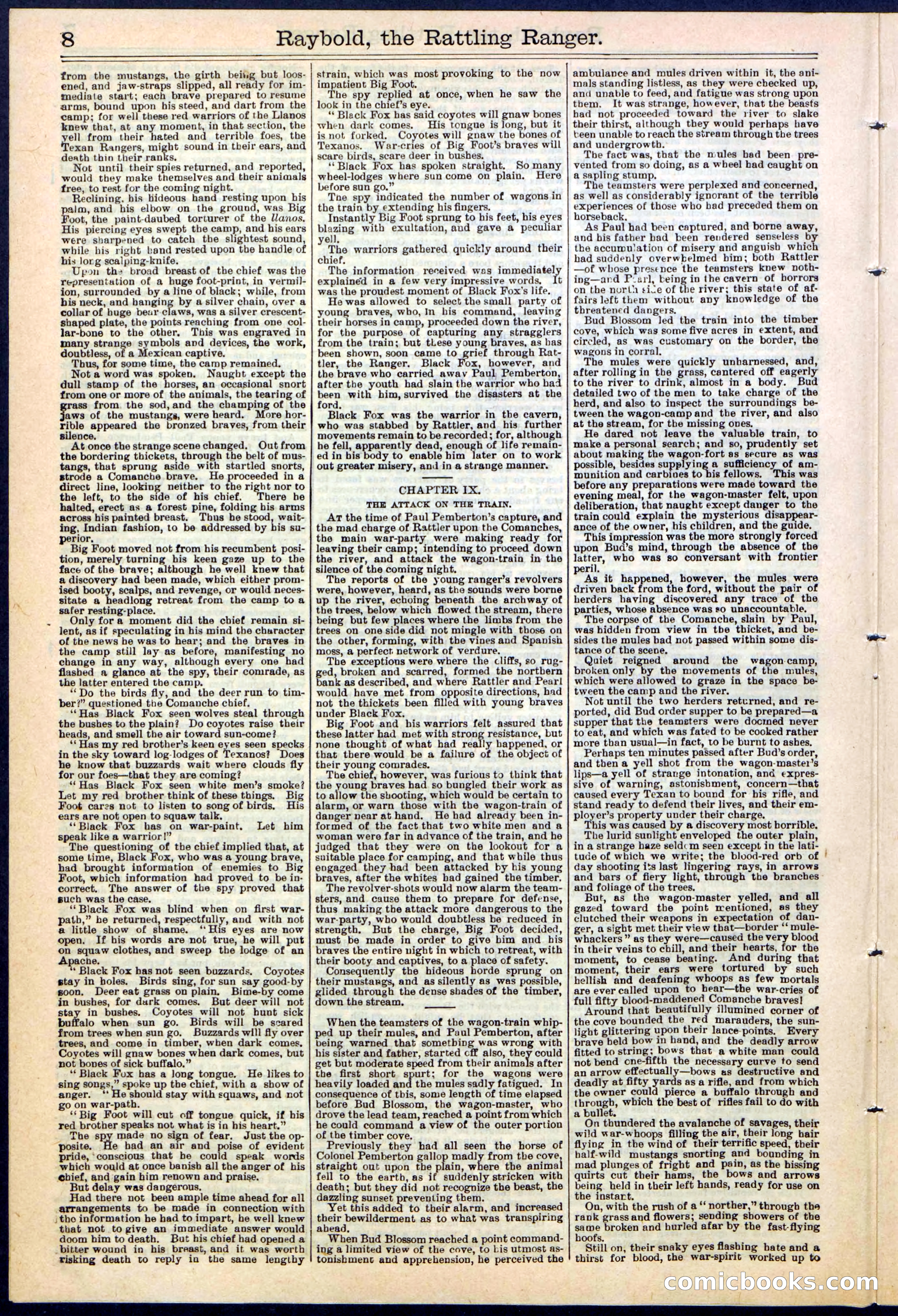
A restored page from Pulp Fiction, 1884. Page through the whole issue in the reader above.
📄 Transcribed text from this page (OCR, searchable)
Machine-transcribed from the original scan — historical spelling and the odd misread are preserved.
posite. 8 Raybold, the Rattling Ranger. from the mustangs, the girth beitig but loos- | strain, which was most provoking to the now ened, and jaw-straps slipped, all ready for im- mediate start; each brave prepared to resume arms, bound upon his steed, and dart from the camp; for well these red warriors of the Llanos knew that, at any moment, in that section, the vell from their hated and terrible foes, the Texan Rangers, migot sound in their ears, and death thin their ranks. Not until their spies returned, and reported, would they make themselves and their animals free, to rest for the coming night. Reclining, his hideous hand resting upon his alm, and his elbow on the ground, was Big oot, the paint-daubed torturer of the llanos, His piercing eyes swept the camp, and his ears were sharpened to catch the slightest sound, while his right band rested upon the handle of his lorg scalping-knife. Upon the broad breast of the chief was the representation of a huge foot-print, in vermil- ion, surrounded by a line of black; while, from his neck, and banging by a silver chain, over a collar of huge bear claws, was a silver crescent- shaped plate, the points reaching from one col- lar-bone to the other, This was engraved in many strange symbols and devices, the work, doubtless, as Mexican captive. Thus, for some time, the camp remained. Not a word was spoken. Naugbt except the dull stamp of the horses, an occasional snort from one or more of the animals, the tearing of ass from. the sod,and the champing of the foes of the mustangs, were heard. More hor- rible appeared the bronzed braves, from their silence. At once the strange scene changed, Out from the bordering thickets, through the belt of mus- tangs, that sprung aside with startled snorts, strode a Comanche brave. He proceeded in a direct line, looking neither to the right nor to the left, to the side of his chief. here he halted, erect as a forest pine, folding bis arms across his painted breast. Thus he stood, wait- ing, Indian fashion, to be addressed by bis su- perior. Big Foot moved not from his recumbent posi- tion, merely turning his keen gaze up to the face of the brave; although he well knew that a discovery had been made, which either prom- ised ane « scalps, and revenge, or would neces- sitate a headlong retreat from the camp toa safer resting-place. Only for a moment did the chief remain si- lent, as if speculating in his mind the character of the news he was to hear; and the braves in the camp still lay as before, manifesting no change in any way, although every one had flashed a glance at the spy, their comrade, as the latter entered the camp. ‘Do the birds fly, and the deer run to tim- ber?” questioned the Comanche cbief. ‘“‘Has Black Fox seen wolves steal through the bushes to the plain? Do coyotes raise their heads, and smell the air toward sun-come? ‘* Has my red brother’s keen eyes seen specks in the sky toward log-lodges of Texanos? Does he know that buzzards wait where clouds fly for our foes—that they are coming? “Has Black Fox seen white men’s smoke? Let my red brother think of these things. Big Foot cares not to listen to song of birds, His ears are not open to squaw talk. ‘*Black Fox has on war-paint. Let him speak like a warrior!” The questioning of the chief implied that, at some time, Black Fox, who was a young brave, had brought information of enemies to Big Foot, which information had proved to be in- correct. The answer of the spy proved that Buch was the case, ‘Black Fox was blind when on first war- path,” be returned, respectfully, and with not @ little show of shame. ‘His eyes are now open. If bis words are not true, he will put y squaw clothes, and sweep the lodge of an che. W Black Fox bas not seen buzzards. Coyotes stay in holes. Birds sing, for sun say good-by goon, Deer eat grass on plain. Bime-by come in bushes, for durk comes. But deer will not tay in bushes. Coyotes will not hunt sick buffalo when sun go. Birds will be scared from trees when sun go. Buzzards will fly over trees, and come in timber, when dark comes, Coyotes will gnaw bones when dark comes, but not bones of sick buffalo.” ‘* Black Fox has a Jong tongue. He likes to sing songs,” spoke up the chief, with a show of anger. ‘* He should stay with squaws, and not go on war-path. ‘* Big Foot will cut off tongue quick, if his red brother speaks not what is in his heart.” The spy made no sign of fear. Just the op- e bad an air and poise of evident pride, ‘conscious that be could speak words which would at once banish all the anger of his ebief, and gain him renown and praise. But delay was dangerous. Had there not been ample time ahead for all arrangements to be made in connection with , tho information he had to impart, be well knew that not togive an immediate answer would doom him to death. But his chief had opened a bitter wound in his breast, and it was worth risking death to reply in the same lengthy impatient Big Foot. The spy replied at once, when he saw the look in the chief’s eye. ‘** Black Fox bas said coyotes will gnaw bones when dark comes. His tongue is long, but it is not forked. Coyotes will gnaw the bones of Texanos. War-cries of Big Foot’s braves will scare birds, scare deer in bushes. ‘‘ Black Fox has spoken straight. wheel-lodges where sun come on plain. before sun go.” The spy indicated the number of wagons in the train by extending his fingers. Instantly Big Foot sprung to his feet, his eyes blazing with exultation, and gave a peculiar yell. The warriors gathered quickly around their chief, The information received was immediatel explained in a few very impressive words, It was the proudest moment of Black Fox's life. He was allowed to select the small party of young braves, who, In his command, leaving their horses in camp, proceeded down the river, for the purpose of capturing any stragglers from the train; but tLese young braves, as bas been shown, soon came to grief through Rat- tler, the Ranger. Black Fox, however, and the brave who carried awav Paul Pemberton, after the youth had slain the warrior who had peen with him, survived the disasters at the ord. Black Fox was the warrior in the cavern, who was stabbed by Rattler, and his further movements remain to be recorded; for, although he fell, apparently dead, enough of life remain- ed in bis body to enable him later on to work out greater misery, and in a strange manner. So many Here CHAPTER IX, THE ATTACK ON THE TRAIN, AT the time of Paul Pemberton’s capture, and the mad charge of Rattler upon the Comanches, the main war-party were making ready for leaving their camp; intending to proceed down the river, and attack the wagon-train in the silence of the coming night. The reports of the young ranger’s revolvers were, however, heard, as the sounds were borne up the river, echoing beneath the archway of the trees, below which flowed the stream, there being but few places where the limbs from the trees on one side did not mingle with those on the other, forming, with tbe vines and Spanish moss, a perfect network of verdure. The exceptions were where the cliffs, so rug- ged, broken and scarred, formed the nortbern bank as described, and where Rattler and Pearl would have met from opposite directions, had not the thickets been filled with young braves under Black Fox. Big Foot and his warriors felt assured that these latter had met with strong resistance, but none thought of what had really happened, or that there would be a failure of the object of their young comrades. The chief, however, was furious to think that the young braves had so bungled their work as to allow the shooting, which would be certain to alarm, or warn those with the wagon-train of danger near at hand. He had already been in- formed of the fact that two white men and a woman were far in advance of the train, and he judged that they were on the lookout for a suitable place for camping, and that while thus engaged they had been attacked by his young braves, after the whites bad gained the timber. The revolver-shots would now alarm the team- sters, and cause them to prepare for defense, thus making the attack more dangerous to the war-party, who would doubtless be reduced in strength. But the charge, Big Foot decided, must be made in order to give bim and his braves the entire night in which to retreat, with their booty and captives, to a place of safety. Consequently the hideous horde sprung on their mustangs, and as silently as was possible, glided through the dense shades of the timber, down the stream, When the teamsters of the wagon-train whip- ped up their mules, and Paul Pemberton, after being warned that sometbing was wrong with his sister and father, started off also, they could get but moderate speed from their animals after the first short spurt: for the wagons were heavily loaded and the mules sadly fatigued. In consequence of this, some length of time elapsed before Bud Blossom, the wagon-master, who drove the lead team, reached a point from which he could command a view of the outer portion of the timber cove, Previously they had all seen the horse of Colonel Pemberton gallop madly from the cove straight out upon the plain, where the anima fell to the earth, as if suddenly stricken with death; but they did not recognize the beast, the dazzling sunset preventing them. Yet this added to their alarm, and increased their bewilderment as to what was transpiring abead, When Bud Blossom reached a point command- ing a limited view of the cove, to bis utmost as- tonishment and apprehension, he perceived the ambulance and mules driven within it, the ani- mals standing listless, as they were checked up, and unable to feed, and fatigue was strong upon them. It was strange, however, that the beasts had not proceeded toward the river to slake their thirst, although they would perhaps have teen unable to reach the stream through the trees and undergrowth. The fact was, that the mules bad been pre- vented from so doing, as a wheel had caught on a sapling stump, The teamsters were perplexed and concerned, as well as considerably ignorant of the terrible experiences of those who bad preceded them on horseback, As Paul had been captured, and borne away, and bis father bad been revdered senseless b the accumulation of misery and anguisb_ whic had suddenly overwhelmed him; both Rattler —of whose presence the teamsters knew noth- ing—and Parl, being in the cavern of borrors on the north sice of the river; this state of af- fairs left them without any knowledge of the threatened dangers. Bud Blossom led the train into the timber cove, which was some five acres in extent, and circled, as was customary on the border, the wagons in corral. The mules were quickly unharnessed, and, after rolling in the grass, cantered off eagerly to the river to drink, almost in a body. Bud detailed two of the men to take charge of the herd, and also to inspect the surroundings be- tween the wagon-camp and the river, and also at the stream, for the missing ones. He dared not leave the valuable train, to make a personal search; and so, prudently set about making the wagon-fort as secure as was possible, besides supp ying. & sufficiency of am- munition and carbines to his fellows. This was before any preparations were made toward the evening meal, for the wagon-master felt, upon deliberation, that naught except danger to the train could explain the mysterious disappear- ance of the owner, his children, and the guide. This impression was the more strongly forced upon Bud’s mind, through the absence of the latter, who was so conversant with frontier peril. As it happened, however, the mules were driven back from the ford, without the pair of herders having discovered any trace of the parties, whose absence was so unaccountable, The corpse of the Comanche, slain by Paul, was hidden from view in tbe thicket, and be- sides the mules bad not passed within some dis- tance of the scene. Quiet reigned around the wagon-camp, broken only by the movements of the mules, which were allowed to graze in the space be- tween the camp and the river. Not until the two herders returned, and re- ported, did Bud order supper to be prepared—a supper that the teamsters were docmed never to eat, and which was fated to be cooked rather more than usual—in fact, to be burnt to ashes, Perhaps ten minutes passed after Bud’s order, and then a yell shot from the wagon-maste1’s lips—a yell of strange intonation, and expres- sive of warning, astonishment, concern—that caused every Texan to bound for his rifle, and stand ready to defend their lives, and their em- ag property under their charge, his was caused by a discovery most borrible. The lurid sunlight enveloped the outer plain, in a strange haze seldcm seen except in the lati- tude of which we write; the blood-red orb of day shooting its last lingering rays, in arrows and bars of fiery light, through the branches and foliage of the trees. But, as the wagon-master yelled, and all gazed toward the point mentioned, as they clutched their weapons in expectation of dan- ger, a sight met their view that—border “‘ mule- whackers ” as they were—caused the very blood in their veins to chill, and their hearts, for the moment, to cease beating. And during that moment, their ears were tortured by such hellish and deafening whoops as few mortals are ever called upon to hear—the war-cries of full fifty blood-maddened Comanche braves! Around that beautifully illumined corner of the cove bounded the red marauders, the sun- light glittering upon their lance-points. Every brave beld bow in hand, and the deadly arrow fitted to string: bows that a white man could not bend one-fifth the necessary curve to send an arrow effectually—bows as destructive and deadly at fifty yards as a rifle, and from which the owner could pierce a buffalo through and through, which the best of rifles fail to do with a bullet. On thundered the avalanche of savages, their wild war-whoops filling the air, their long hair flying in the wind of their terrific speed, their half-wild mustangs snorting and bounding in mad plunges of fright and pain, as the hissing quirts cut their hams, the bows and arrows being held in their left hands, ready for use on the instart. On, with the rush of a “ norther,” through the rank grass and flowers; sending showers of the swe broken and hurled afar by the fast-flying oofs. Still on, their snaky eyes flashing hate and a thirst for blood, the war-spirit worked up to iC “com boo S ee we aad » | ~ * “BL .«% aut . “ ‘ ‘ > 7“