
Pulp Fiction, 1884 · page 8 of 32
Beadle's New York Dime Library No. 308 — page 8: what you’re looking at
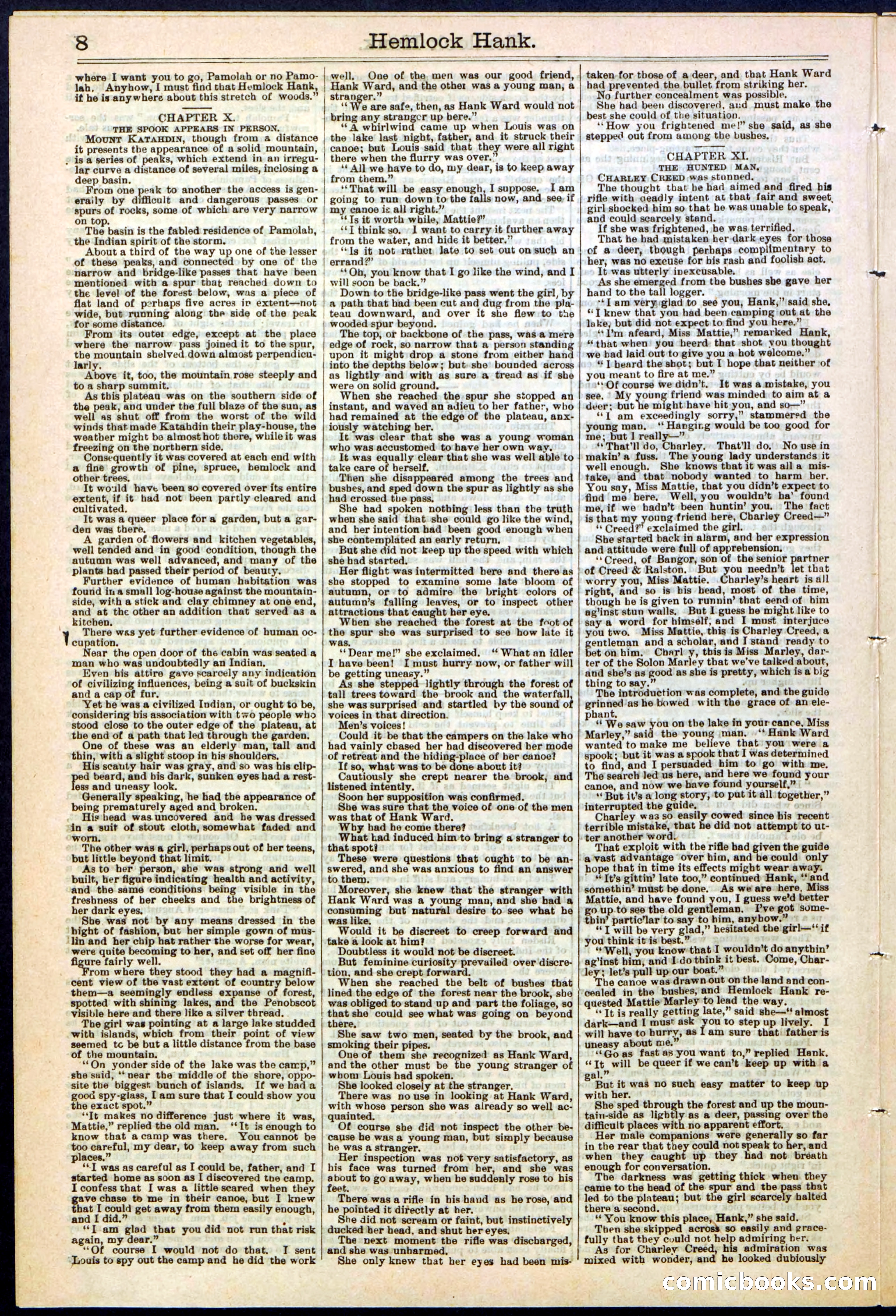
A restored page from Pulp Fiction, 1884. Page through the whole issue in the reader above.
📄 Transcribed text from this page (OCR, searchable)
Machine-transcribed from the original scan — historical spelling and the odd misread are preserved.
where I want you to go, Pamolah or no Pamo- lah, Anyhow, I must find that Hemlock Hank, it he is anywhere about this stretch of woods.” CHAPTER X. THE SPOOK APPEARS IN PERSON. Mount KaTAHDIN, though from a distance it presents the appearance of a solid mountain, . is a series of peaks, which extend in an irregu- lar curve a distance of several miles, inclosing a | deep basin. ; From one peak to another the access is gen- eraily by difficult and dangerous passes or spurs of rocks, some of which are very narrow on top. The basin is the fabled residence of Pamolab, the Indian spirit of the storm. About a third of the way up one of the lesser of these peaks, and connected by one of the narrow and bridge-like passes that have been | mentioned with a spur that reached down to the level of the forest below, was a piece of flat land of perbaps five acres ir extent—not wide, but running along the side of the peak for some distance. From its outer edge, except at the place where the narrow pass joined it to the spur, the mountain shelved down almost perpendicu- Above it, too, the mountain rose steeply and to a sharp summit. As this plateau was on the southern side of the peak, and under the full blaze of the sun, as well as shut off from the worst of the wild winds that made Katahdin their play-house, the weather might be almost hot there, while it was freezing on the northern side, Consequently it was covered at each end with a fine growth of pine, spruce, bemlock and other trees. It would have been so covered over its entire extent, if it had not been partly cleared and cultivated. It was a queer place fora garden, but a gar- den was there. A garden of flowers and kitchen vegetables, well tended and in good condition, though the autumn was well advanced, and many of the plants bad passed their period of beauty. Further evidence of human habitation was found ina small log-house against the mountain- side, with a stick and clay chimney at one end, and at the other an addition that served as a kitchen, y There was yet further evidence of human oc- gig) per ear the open door of the cabin was seated a man who was undoubtedly an Indian. Even his attire gave scarcely any indication of civilizing influences, being a suit of buckskin and a cap of fur. Yet he was a civilized Indian, or ought to be, considering bis association with two people who stood close to the outer edge of the plateau, at the end of a path that led through the garden. One of these was an elderly man, tall and thin, with a slight stoop in his shoulders, His scanty hair was gray, and so was bis clip- beard, and bis dark, sunken eyes had a rest- ess and uneasy look. Generally speaking, he had the appearance of being prematurely aged and broken. His head was.uncovered and he was dressed ‘in a suit of stout cloth, somewhat faded and worn, The other was a girl, perhaps out of her teens, but little beyond that limit. As to her person, she was strong and well built, her figure indicating health and activity, and the same conditions being visible in the freshness of ber cheeks and the brightness of her dark eyes. She was not b any means dressed in the ‘bight of fashion, but her simple gown of mus- ‘lin and her chip hat rather the worse for wear, were quite becoming to her, and set off her fine figure fairly well. rom where they stood they had a magnifi- cent view of the vast extent of country below them—a seemingly endless expanse of forest, spotted with shining lakes, and the Penobscot visible here and there like a silver thread. The girl was pointing at a large lake studded with islands, which from their point of view seemed tc be but a little distance from the base of the mountain. ‘On yonder side of the lake was the carp,” she suid, “‘ near the middle of the shore, oppo- site the biggest’ bunch of islands. If we hada good spy-giass, [ am sure that I could show you the exact spot.” ‘It makes no difference just where it was, Mattie,” replied the old man. ‘It is enough to know that acamp was there, You cannot be too careful, my dear, to keep away from such places.” ‘*T was as careful as I could be, father, and I started home as soon as I discovered the camp. I confess that I was a little seared when they ve chase to me in their canoe, but I knew at I could get away from them easily enough, and I did.” J **T am glad that you did not run that risk again, my dear.” “Of course I would not do that. I sent ‘Louis to spy out the camp and he did the work | — - cee ee oe ee ee ee — Hemlock Hank. well. One of the. men was our good friend, Hank Ward, and the other was a young man, a stranger.” ‘“ We are safe, then, as Hank Ward would not bring any strangcr up bere.” “A whirlwind came up when Louis was on the lake last night, father, and it struck their canoe; but Louis said that they were all right there when the flurry was over.” ‘* All we have to do, my dear, is to keep away from them.” ‘That will be easy enough, I suppose. I am going to run down to the falls now, and see, if my canoe is all right.” **Ts it worth while, Mattie?’ ‘*‘] think so. 1 want to carry it further away from the water, and hide it better.” ‘Is if not rather Jate to set out onsuch an errand?” “*Ohb, you know that I go like the wind, and I will soon be back.” Down to the bridge-like pass went the girl, by a path that had been cut and dug from the pla- teau downward, and over it she flew to the wooded spur beyond. The top, or backbone of the pass, was a mere edge of rock, so narrow that a person standing upon if might drop a stone from eitber hand into the depths below; but) she bounded across as lightly and with as sure a tread as if she were on solid ground. When she reached the spur she stopped an instant, and waved an adieu to ber father, who had remained at the edge of the plateau, anx- iously watching ber. t was clear that she was a young woman who was accustomed to have her own way. It was equally clear that she was well able to take care of herself. Then she disappeared among the trees and busbes, and sped down the spur as lightly as she had crossed the pass. She bad spoken nothing less than the truth when she said that she could go like the wind, and her intention had been good enough when she contemplated an early return, But she did not keep up the speed with which she had started. Her flight was intermitted here and there as she stopped to examine some late bloom of autumn, or to admire the bright colors of autumn’s falling leaves, or to inspect other attractions that caught her eye. When she reached the forest at the foot of the spur ske was surprised to see how late it w as. ‘*Dear me!” she exclaimed. ‘* What an idler I have been! I must hurry now, or father will be getting uneasy.” she stepped lightly through the forest of tall trees toward the brook and the waterfall she was surprised and startled by the sound of voices in that direction. Men’s voices! Could it be that the campers on the lake who had vainly chased her had discovered ber mode of retreat and the hiding-place of ber canoe? If so, what was to be done about it? Cautiously she crept nearer the brook, and listened intently. Soon her supposition was confirmed. She was sure that the voice of one of the men was that of Hank Ward. Why bad he come there? What had induced him to bring a stranger to that spot? These were questions that ought to be an- swered, and she was anxious to find an answer to them. Moreover, she knew that the stranger with Hank Ward was a young man, and she had a consuming but natural desire to see what be was like. Would it be discreet to creep forward and take a look at him? Doubtless it would not be discreet. But feminine curiosity prevailed over discre- tion, and she crept forw When she reached the belt of bushes that lined the edge of the forest near the brook, she was obliged to stand up and part the foliage, so om she could see what was going on beyond there, She saw two men, seated by the brook, and smoking their pipes. One of them she recognized as Hank Ward, and the other must be the young stranger of whom Louis had spoken. She looked closely at the stranger. There was no use in looking at Hank Ward, with whose person she was already so well ac- quainted. Of course she did not inspect the other be- cause he was a young man, but simply because he was a stranger. Her inspection was not very satisfactory, as his face was turned from her, and she was about to go away, when he suddenly rose to his be There was a rifle in his hand as he rose, and he pointed it directly at her. he did not scream or faint, but instinctively ducked ber head, and shut her eyes, next moment tbe rifle was discharged, and she was unharmed, : She only knew that her eyes had been mis- taken. for those of a deer, and that Hank Ward had prevented the bullet from striking her. No further concealment was possible. She had been discovered, aud must make the best she could of the situation. ‘‘How you frightened me!” she said, as she stepped out from among the bushes, CHAPTER XI. THE HUNTED MAN, CHARLEY CREED was stanned, The thought tbat be had aimed and fired bis rifle with aeadly intent at that fair and sweet, girl shocked him so that be was unable to speak, and could searcely stand. } If she was frightened, he was terrified. That he bad mistaken her dark eyes for those of a deer, though perbaps complimentary to her; was no excuse for bis rash and foolish act, It was utterly inexcusable. As she emerged from the bushes she gave her hand to the tall logger. ‘Tam very:giad to see you, Hank,” said she, ‘T knew that you had been camping out at the lake, but did not expect to find you here,” “I'm afeard, Miss Mattie,” remarked Hank, “that when you beerd that shot you thought we bad laid out to give you a bot welcome.” ** | beard the shot; but I hope that neither of you meant to fire at me.” ‘- Of course we didn’t. It was a mistake, you see, My young friend was minded to aim at a deer: but he might have hit you, and so—” ‘‘] am exceedingly sorry,” stammered the young man. ‘ Hanging would be too good for me; but | really—” ‘*That’ll do, Charley. That'll do. No use in makin’ a fuss. The young lady understanés it well enough. She knows that it was alla mis- take, and that nobody wanted to harm ber. You say, Miss Mattie, that you didn’t expect to find me bere, Well, you wouldn’t ba’ found me, if we hadn’t been huntin’ you. The fact is that m young friend bere, Charley Creed—” ‘* Creed?’ exclaimed the girl. She started back in alarm, and ber expression and attitude were full of apprebension, ‘‘Creed, of Bangor, son of the senior partner of Creed & Ralston. But you needn’t let that worry you, Miss Mattie. Charley’s heart is all right, and so is his head, most of the time, though be is given to runnin’ that eend of bim ag’inst stun walls, But 1 guess he might like to say a word for himself, and I must interjuce you two. Miss Mattie, this is Charley Creed, a entleman and a scholar, and I stand ready to bet on him. Charl y, this is Miss Marley, dar- ter of the Solon Marley that we've talked about, and she’s as good as she is pretty, which isa big thing to say.” ; The introduction was complete, and the guide grinned as he bowed with the grace of an ele- hant, ’ ae We saw hes on the lake in your canoe, Miss Marley,” said the young man. ‘* Hank Ward wanted to make me believe that you were a spook; but it was a spook that I was determined to find, and I persuaded bim to go with me, The search led us bere, and here we found your canoe, and now we have found yourself,” ~ ** But it’s a long story, to put itall together,” interrupted the guide, Charley was so easily cowed since his recent terrible mistake, that he did not attempt to ut- ter another word. That exploit with the rifle bad ee the guide a vast advantage over him, and be could only hope that in time its effects might wear away. ' “It’s gittin’ late too,” continued Hank, “and somethin’ must be done. As we are here, Miss Mattie, and have found you, I guess we’d better go up.to see the old gentleman. Pye got some- thin’ partic’lar to say to him, anybow.” *T will be very glad,” hesitated the girl—‘‘if ou think itis best. qt “Well, you know that I wouldn't do anythin’ ag’inst him, and Ido think it best. Come, Char- ley; let’s pull up our boat.” The canoe was drawn out on the land and con- cealed in the bushes, and Hemlock Hank re- quested Mattie Marley to lead the way. “It is really getting late,” said she—* almost dark—and I must ask you to step up lively. I will have to burry, as lam sure that father is uneasy about me. “Goas fast as you want to,” replied Hank, ‘It will be queer if we can’t keep up with a al. ; x But it was no such easy matter to keep up with her. She sped through the forest and up the moun- tain-side as light y as a deer, passing over the difficult places with no apparent effort. Her male companions were generally so far in the rear that they could not speak to her, and when they caught up they had not bréath enough for conversation. The darkness was getting thick when they came to the head of the spur and the pass that led to the plateau; but the girl scarcely halted there a second. ’ wh 4 ‘* You know this place, Hank,” she said. Then she skipped a so easily and grace- fully that they cvuld not wins digs ae ber. As for Charley Creed, his admiration was mixed with wonder, and he looked dubiously Cc (@) Gomicbooks