
Pulp Fiction, 1884 · page 6 of 32
Beadle's New York Dime Library No. 308 — page 6: what you’re looking at
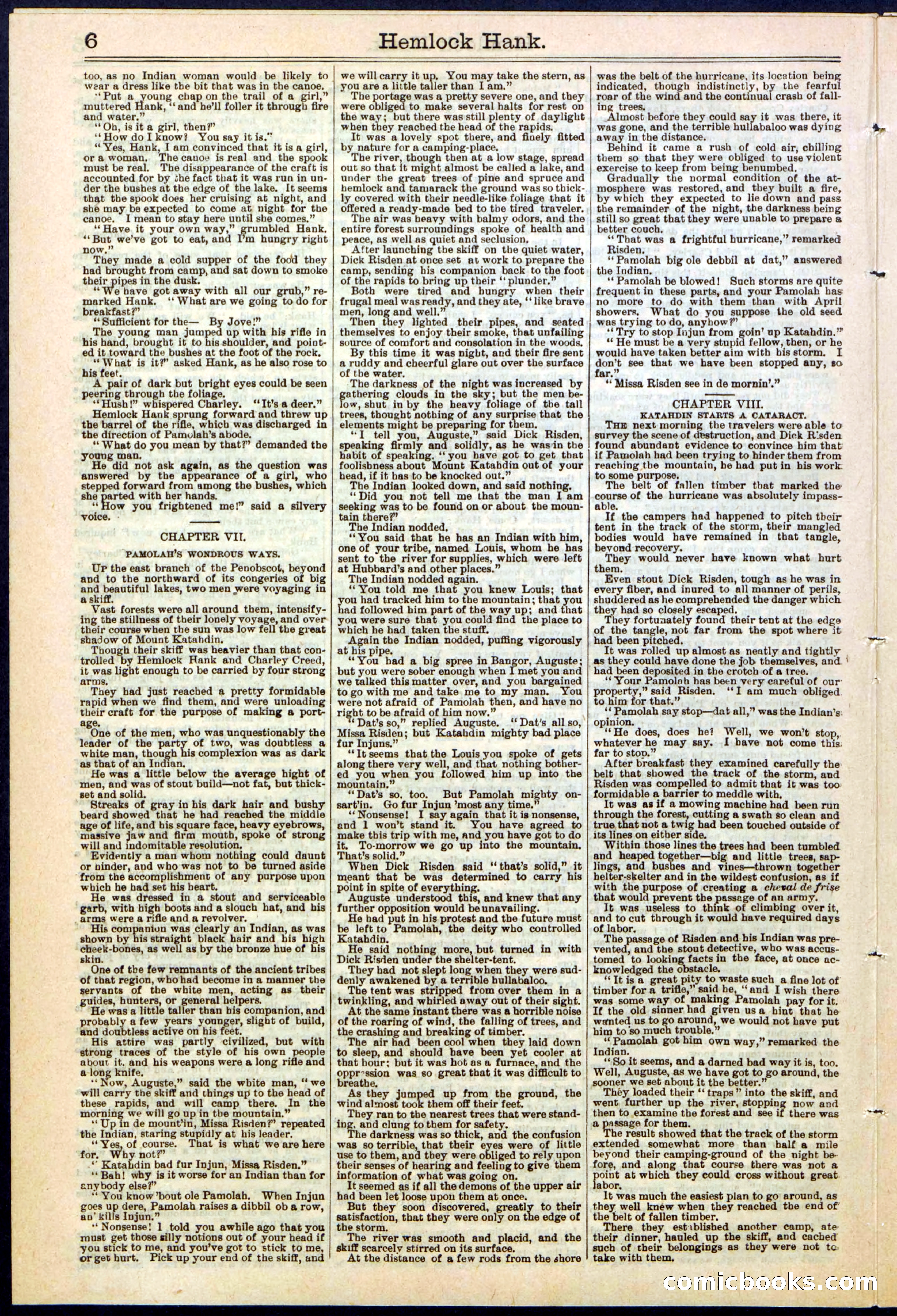
A restored page from Pulp Fiction, 1884. Page through the whole issue in the reader above.
📄 Transcribed text from this page (OCR, searchable)
Machine-transcribed from the original scan — historical spelling and the odd misread are preserved.
6 Bei eS ae REE ie aN cs a ei, 7 Hank. too, as no Indian woman would be likely to wear a dress like the bit that was in the canoe. ‘*Put a young chap on the trail of a girl,” muttered Hank, ‘‘ and he’ll foller it through fire and water,” “Ob, is it a girl, then?” “How dol know? You say it is.” “Yes, Hank, I am convinced that ‘ttt is a girl, ora woman, The canoe is real and the spook must be real. The disappearance of the craft is accounted for by the fact that it was run in un- der the bushes at the edge of the lake. It seems that the spook does her cruising at night, and she may be expected to come at night for the canoe. I mean to stay here until she comes,” ‘‘ Have it your own way,” grumbled Hank. “But we've got to eat, and ’m hungry right now,’ They made a cold supper of the food they had brought from camp, and sat down to smoke their ipes in the dusk. e have got away with all our grub,” re- marked Hank. ‘‘ What are we going to do for breakfast?” ‘Sufficient for the— By Jove!” The young man jumped up with his rifle in his hand, brought it to his shoulder, and poiot- ed it toward the bushes at the foot of the rock. ““What is it?’ asked Hank, as he also rose to his feet. A pair of dark but bright eyes could be seen peering through the foliage. ‘*Hush!” whispered Charley. ‘‘It’s a deer.” Hemlock Hank sprung forward and threw up the barrel of the rifle, which was discharged in the direction of Pamulah’s abode, ‘What do you mean by that?’ demanded the young man He Said not ask again, as the question was answered by the appearance of a girl, who stepped forward from among the bushes, which she rted with her hands. ow you frightened me!” said a silvery ili. CHAPTER VII. PAMOLAH’S WONDROUS WAYS. Up the east branch of the Penobscot, beyond and to the northward of its congeries of big ape penct lakes, two men were voyaging in as Vast forests were all around them, intensify- ing the stillness of their lonely voyage, and over their course when the sun was low fell the great shadow of Mount Katahdin. Though their skiff was heavier than that con- trolled by Hemlock Hank and Charley Creed, it was light enough to be carried by four strong arms, They had just reached a pretty formidable rapid when we find them, and were unloading their craft for the purpose of making a port- Ons of the men, who was unquestionably the leader of the party of two, was doubtless a white man, though his complexion was as dark as that of an Indian. He was a little below the average hight of men, and was of stout build—not fat, but thick- set and solid. - Streaks of gray in his dark hair and bushy beard showed that he had reached the middle age of life, and bis square face, heavy eyebrows, massive jaw and firm mouth, spoke of strong will and indomitable resolution. Evidently a man whom nothing could daunt or binder, and who was not to be turned aside from the accomplishment of any purpose upon which he had set his heart. He was d in a stout and serviceable garb, with high boots and a slouch hat, and his _arms were a rifle and a revolver. companiun was clearly an Indian, as was shown by his straight black hair and bis high Poca fe -bones, as well as by the bronze hue of his skin One of the few remnants of the ancient tribes of that region, who had become in a manner the servants of the white men, acting as their guides, hunters, or general helpers. He was a little taller than his companion, and probably a few years youn er, slight of build, and doubtless active on his fee His attire was partly civilized, but with strong traces of the style of his own people ahoar it. and his weapons were a long rifle and a ‘lon knife, ow, Auguste,” said the white man, ‘‘ we will carry the skiff and things up to the head of these rapids, and will camp there. ue the morning we will go up in the mountain.” ‘‘Up in de mount’in, Missa Risden?” repeated the Padian: staring stupidly at his leader, “* Yes, of coures That is what we are here vr hy not?” tahdin bad fur Injun, Missa Risden.” - Bah! why is it worse for an Indian than for eny body else?” “You know ’bout ole Pamolah, When Injun goes up dere, Pamolah raises a dibbil ob a row, ao’ kills Injun.” “Nonsense! 1 told you awhile ago that you must get those silly notions out of your head if you stick to me, and you've got to stick to me, or get hurt. Pick up your end of the skiff, and we willcarry it up, You may take the stern, as you ane . little taller than I am.” The a, was a pretty severe one, and they were 0 aid to make several halts for rest on the way; but there was still plenty of daylight when they reached the head of the rapids. It was a lovely spot there, and finely fitted by nature for a camping-place. The river, ya then at a low stage, spread out so that it might almost be called a lake, and under the arent trees of pine and spruce and hemlock and tamarack the ground was so thick- ly covered with their needle-like foliage that it offered a ready-made bed to the tired traveler. The air was beavy with balmy odors, and the entire forest surroundings spoke of health and peace, as well as quiet and seclusion, After launching the skiff on the quiet water, Dick Risden at once set at work to prepare the camp, sending his companion back to the foot of the rapids to bring up their ‘‘ plunder,” Both were tired and hungry when their frugal meal was ready, and they ate, ‘‘ like brave men, mie, tm ms well,” Then t ey lighted their pipes, and seated themselves to enjoy their smoke, that unfailing source of comfort and consolation in the woods, By this time it was night, and their fire sent a ruddy and cheerful glare out over the surface of the water. The darkness of the night wasincreased by pitering clouds in the sky; but the men be- ow, shut in by the heavy foliage of the tall trees, thought nothing of any surprise that the elements might be preparing for them. ‘I tell you, Auguste,” said Dick Risden, speaking firmly an solidly, as he was’in the habit of speaking. ‘‘ you bave got to get that foolishness about Mount Katabdin out of your head, if it has to be knocked out.” The Indian looked down, and said nothing. “Did you not tell me that the man I am seeking was to be found on or about the moun- tain there?’ The Indian nodded, ‘*You said that he has an Indian with him, one of your tribe, named Louis, whom he has sent to the river for asppiles, which were left at Hubbard’s and other places.” The Indian nodded again. **'You told me that you knew Louis; that a had tracked him to the mountain; that you ad followed him part of the way up; and that you were sure that you could find the place to Which he had taken the stuff. Again the Indian nodded, puffing vigorously at his pipe. “You had a big spree in Bangor, Auguste; but you were sober enough when I met you and we talked this matter over, and you bargained to go with me and take me to my man. You were not afraid of Pamolah then, and have no right to be afraid of him now.” Dat’s so,” replied Auguste. ‘‘ Dat’s all so, Missa Risden; but Katahdin mighty bad = fur Injuns.” “‘Itseems that the Louis you spoke of along there very well, and that nothing bot ser ed you when you followed him up into the mountain,” **Dat’s so. too. sartvin. Go fur Injun ’most any time. ‘*Nonsense! I say again that it is nonsense, and 1 won’t stand it. You have agreed to make this trip with me, and you have got to do it. To-morrow we go up into the mountain, That’s solid.” When Dick Risden said ‘that’s solid,” it meant that be was determined to ca carry h point in spite of everything. Auguste understood this, and knew that any further opposition would be unavailing. He bad put in his protest and the future must be left to Pamolah, the deity who controlled Katahdin. He said nothing more, but turned in with Dick Risden under the shelter-tent. They had not slept long when they were sud- denly awakened by a terrible hullabaloo. The tent was stripped But Pamolah mighty on- from over them in a twinkling, and whirled away out of their sight. At the same instant there was a horrible noise of the roaring of wind, the falling of trees, and the crashing and breaking of timber. The air had been cool when they laid down to sleep, and should bave been yet cooler at that hour; but it was hot as a furnace, and the oppression was so great that it was difficult to Pras the from th a, th t up m the group e wind alnoie tee took them off their feet. They ran to the nearest trees that were stand- a and clung to them for safety. he darkness was so thick, and the confusion was so terrible, that their eyes were of little use to them, and they were obliged to rely upon their senses of hearing and feeling to give them information of what was going on. It seemed as if all the Aorigie of the upper air had been let loose upon them at once. But they soon discovered, greetly. to their C) satisfaction, that they were only on edge of the storm. The river was smooth and placid, and the skiff scarcely stirred on its surface. At the distance of a few rods from the shore was the belt of the hurricane, its location being indicated, though indistinctly, by the fearful roar of the wind and the continual crash of fall- ing trees, Almost before they could say it was there, it was gone, and the terrible hullabaloo was dyin g away in the distance. Behind it came a rush of cold air, chilling them so that they were obliged to use violent exercise to keep from being benumbed. Gradually the normal condition of the at- mosphere was restored, and they built a fire, by which they expected to liedown and pass the remainder of the night, the darkness being still so great that they were unable to prepare & better couch, Pd was a frightful burricane,” remarked i ‘*Pamolah big ole debbil at dat,” answered the Indian. ‘*Pamolah be blowed! Such storms are quite frequent in these parts, and your Pamolab has no more to do with them than with April showers. What do you suppose the old seed was trying to do, anyhow?” ‘* Try to stop Tnjun from Lm up Katahdin.” “‘ He must be a very stupid fellow, then, or he would have taken better aim with bis storm. emp see thut we have been stopped any, so ar. ‘* Missa Risden see in de mornin’.” CHAPTER VIII. KATAHDIN STARTS A CATARACT. THE next morning the travelers were able to survey the scene of destruction, and Dick R'sden found abundant evidence to convince him that if Pamolah had been trying to hinder them from rian the mountain, he had putin his work. to some purpose, The ‘pelt of fallen timber that marked the course of the hurricane was absolutely impass- able. If the campers had happened to pitch their tent in the track of the storm, their mangled bodies would have remained in that tangle, beyond recovery. They would never have known what burt them. Even stout Dick Risden, tough as he was in every fiber, and inured to all manner of perils, shuddered as he comprehended the danger which the ey had so closely escaped. hey fortunately found their tent at the edge of the tangle, not far from the spot where it had been pitched, It was rolled up almost as neatly and tightly as they could have done the job themselves, and. had been deposited in the crotch of a tree. ‘*' Your Pamoloh has been very careful of our’ property,” said Risden. ‘I am much obliged. to him for that.” ‘* Pamolah say stop—dat all,” was the Indian’s: opinion. ‘*He does, does he? Well, we won’t stop, whatever he may say. far to stov.” After breakfast they examined carefully the belt that showed the track of the storm, and Risden was compelled to admit that it was too formidable a barrier to meddle with, It was as if a mowing machine had been run ary h the fo cutting a swath so clean and t not a twig had been touched outside of its Gatinee on eitber ie Within those lines the trees had been tumbled and heaped to gt gee Co little trees, sap- lings, and bushes and es—thrown together helter-skelter and in the wildest confusion, as if with the purpose of creating a cheval de Srise that would prevent the passege of an army. It was useless to think of climbing over it, and to cut through it would have required days of labor. The age of Risden and his Indian was pre- vented, and the stout detective, who was accus- tomed to lookin ee in the face, at once ac- knowledged the o “Tt isa great pity to waste such a fine lot of timber for a trifle,” said he, ‘‘and I wish there was some way of making Pamolah pay for it. If the old Pebgionayd had given usa hint that he wanted us to go she Kom ,we would not have put bim to’so much trouble.” ‘ apa got him own way,” remarked the ndian ‘« So it seems, and a darned bad way it is, too. Well, Auguste, as we have got to £0 around, the sooner we set about it the better.” Théy loaded their ‘‘ traps” into the skiff, and went. further up the river, stopping now and then to examine the forest and see if there was a my ssage for them. he result showed that the track of the storm extended somewhat more than half a mile beyond their camping-ground of the night be- fore, and along that course there was not a ine at which they could cross without great abo It was much the easiest plan to go around, as they well knew when they reached the end of the belt of fallen timber. There they estiblished another camp, ate their dinner, hauled up the skiff, and cached such of their belongings as they were not to take with them, I have not come this: a Eomichbooks Cc el ‘com