
Pulp Fiction, 1884 · page 24 of 32
Beadle's New York Dime Library No. 308 — page 24: what you’re looking at
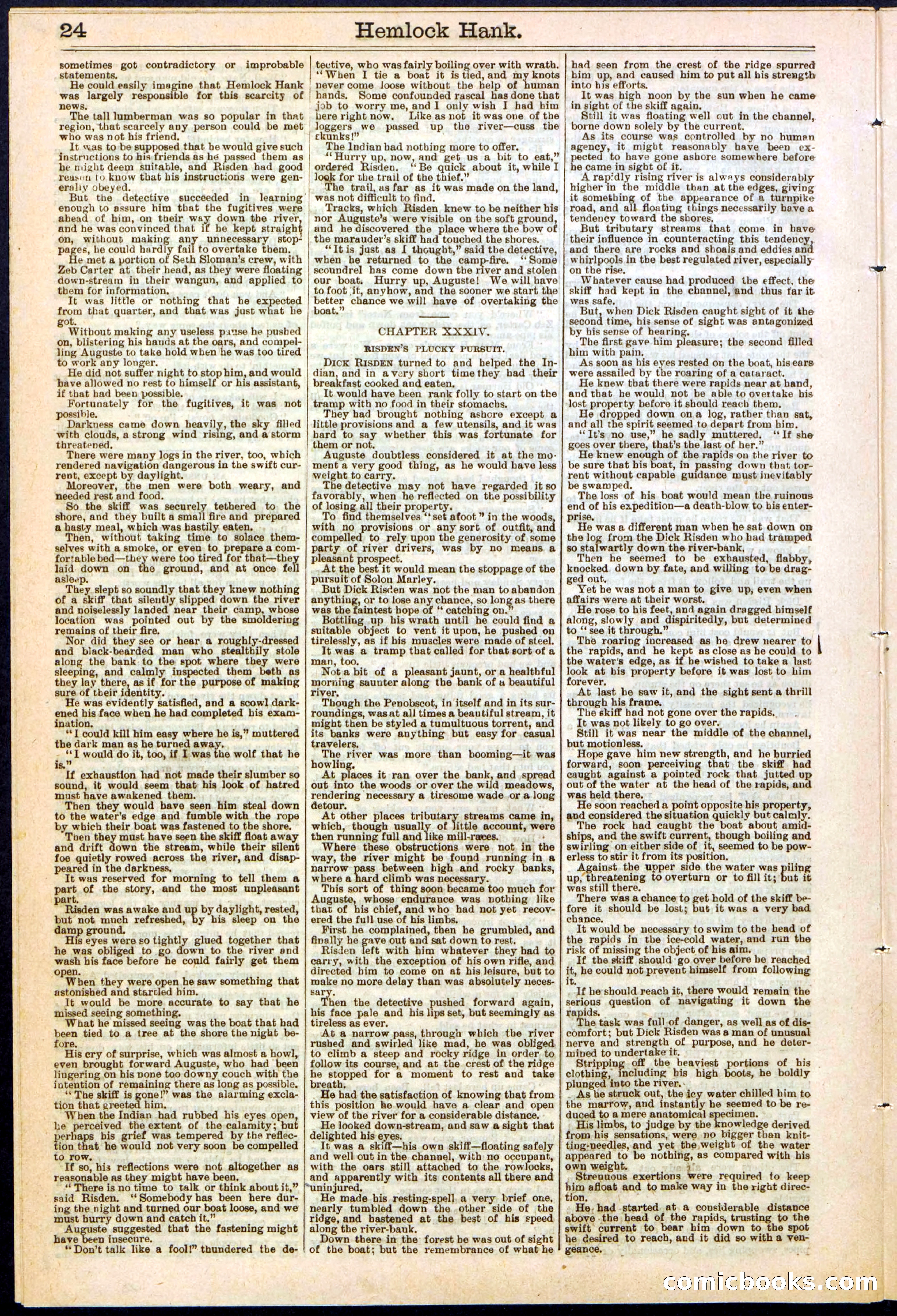
A restored page from Pulp Fiction, 1884. Page through the whole issue in the reader above.
📄 Transcribed text from this page (OCR, searchable)
Machine-transcribed from the original scan — historical spelling and the odd misread are preserved.
——_ + said Risden. (tt ee — 24 sometimes got contradictory or improbable statements. He could easily imagine that Hemlock Hank was largely responsible for this scarcity of ews, The tall lumberman was so popular in that region, that scarcely any person could be met who was not his friend. lt was to be supposed that he would give such instructions to his friends as hé passed them as he night deem suitable, and Risden had good reascu to know that bis instructions were gen- eraliy obeyed. But the detective succeeded enough to assure him that the fugitives were ahead of him, on their way down the river, and he was convinced that if he kept straigh on, without making any unnecessary stop- pages, he could hardly fail to overtake them. e met a portion of Seth Sloman’s crew, with Zeb Carter at their head, as they were floating down-stream in their wangun, and applied to them for information, It was little or nothing that he expected from that quarter, and that was just what he t ot. Without making any useless pattse he pushed on, blistering his bauds at the oars, and compel- ling Auguste to take hold when he was too tired to work any longer. He did not suffer night to stop him, and would have allowed no rest to himself or his assistant, if that had been possible. Fortunately for the fugitives, it was not possible, Darkness came down heavily, the sky filled with clouds, a strong wind rising, and a storm threatened, There were many logs in the river, too, which rendered navigation dangerous in the swift cur- rent, except by daylight. Moreover, the men were both weary, and needed rest and food, So the skiff was securely tethered to the shore, and they built a small fire and prepared a hasty meal, which was hastily eaten. Then, without taking time to solace them- selves with a smoke, or even to prepare a com- fortable bed—they were too tired for a ee laid down on the ground, and at once fell asleep. They slept so soundly that they knew nothing of a skiff that silently slipped down the river and noiselessly landed near their camp, whose location was pointed out by the smoldering remains of their fire, Nor did they see or hear a roughly-dressed and black-bearded man who stealthily stole along the bank to the spot where they were sleeping, and calmly inspected them beth as they lay there, asif for the purpose of making sure of their identity. He was evidently satisfied, and a scowl dark- ened his face when he had completed his exam- ation, **I could kill him easy where he is,” muttered the dark man as he turned away, ; vt would do it, too, if Iwas the wolf that he is. If exhaustion had not made their slumber so sound, it would seem that his look of hatred must have awakened them. Then they would bave seen him steal down to the water’s edge and fumble with the rope by which their boat was fastened to the shore. Then they must have seen the skiff float away and drift down the stream, while their silent foe quietly rowed across the river, and disap- peared in the darkness, It was reserved for morning to tell them a part of the story, and the most unpleasant rt. PeRieden was awake and up by daylight, rested, ut not much refreshed, by his sleep on the pee Seca eyes were so tightly glued together that he was obliged to go down to the river and wash his face before he could fairly get them open. PWhen they were open he saw something that astonished and startled him. It would be more accurate to say that he missed seeing something. What he missed seeing was the boat that had pen tied to a tree at the shore the night be- ore. His ery of surprise, which was almost a howl, even brought forward Auguste, who had been lingering on his pone too downy couch with the intention of remaining there as long as possible. ‘The skiff is gone!” was the alarming excla- tion that greeted him, When the Indian had rubbed his eyes open, he perceived the extent of the calamity; but akg bis grief was tempered by the reflec- tion that he would not very soon be compelled to row. If so, his reflections were not altogether as reasonable as they might have been. eg re is no time to talk or think about it,” **Somebody has been here dur- ing the night and turned our boat loose, and we must burry down and catch it.” A te suggested that the fastening might have been insecure. ** Don’t talk like a fool!” thundered the de- in learning’ —_ - ee Hemlock Hank. tective, who was fairly boiling over with wrath. ‘When I tie a boat it is tied, and my knots | never come loose without the help of human hands. Some confounded rascal has done that job to worry me, and I only wish I had him _bereright now. Like as not it was one of the loggers we passed up the river—cuss the ckunks!” The Indian bad notbing more to offer. “‘Hurry up, now, and get us a bit to eat,” ordered Risden. “Be quick about it, while I lope for the trail of the thief.” The trail, as far as it was made on the land, was not difficult to find. Tracks, which Risden knew to be neither his nor Auguste’s were visible on the soft ground, and he discovered the place where the bow of the marauder’s skiff had touched the shores, “It is just as [ thought,” said the detective, | when he returned to the camp-fire. ‘‘ Some | scoundrel has come down the river and stolen our boat. Hurry up, Auguste! We will have to foot ‘it, anyhow, and the sooner we start the Leos, chance we will have of overtaking the t. CHAPTER XXXIV. RISDEN’S PLUCKY PURSUIT. Dick RIsDEN turned to and helped the In- dian, and in avery short timethey had their breakfast cooked and eaten. It would have been rank folly to start on the tramp with no food in their stomachs. They had brought nothing ashore except a little provisions and a few utensils, and it was bard to say whether this was fortunate for them or not, Auguste doubtless considered it at the mo- ment a very good thing, as he would have less renga to carry. The detective may not have regarded itso favorably, when he reflected on the possibility of losing all their property. To find themselves ‘set afoot ” in the woods with no provisions or any sort of outfit, and compelled to rely upon the generosity of some party of river drivers, was by no means a pleasant prospect. At the best it would mean the stoppage of the pursuit of Solon Marley. But Dick Riscen was not the man to abandon anything, or to lose any chance, so long as there was the faintest bope of * catching on. Bottling up his wrath until he could find a suitable object to vent it upon, he pushed on tirelessly, as if bis muscles were made of steel. It was a tramp that called for that sort of a man, too, Nota bit of a pleaye jaunt, or a healthful morning saunter along the bank of u beautiful river, Though the Penobscot, in itself and in its sur- roundings, wasat all times a beautiful stream, it might then be styled a tumultuous torrent, and its banks were anything but easy for casual travelers, The river was more than booming—it was howling. At places it ran over the bank, and spread out into the woods or over the wild meadows, rendering necessary a tiresome wade or a long detour. At other places tributary streams came in, which, though usually of little account, were then running full and like mill-raves. , Where these obstructions were not in the way, the river might be found running in a narrow between high and rocky banks, where a hard climb was necessary. This sort of thing soon became too much for Auguste, whose endurance was nothing like that of his chief, and who had not yet recoy- ered the full use of his limbs. First he complained, then he grumbled, and finally he gave out and sat down to rest. Risden left with him whatever they had to carry, with the exception of his own rifle, and directed him to come on at his leisure, but to make no more delay than was absolutely neces- sary. Then the detective pushed forward again, his face pale and his lips set, but seemingly as tireless as ever. At a narrow pass, through which the river rushed and swirled like mad, he was obliged to climb a steep and rocky ridge in order to follow its course, and at the crest of the Hoge he stopped for a moment to rest and take breath, He had the satisfaction of knowing that from this position he.would have a clear and open view of the river for a considerable distance, He looked down-stream, and saw a sight that delighted his eyes. It was a skiff—his own skiff—floating safely and well out in the channel, with no occupant, with the oars still attached to the rowlocks, and apparently with its contents all there and nipjur He made his resting-spell,a very brief one, ridge, and bastened at the best of his speed along the river-bauk. Down there in the forest he was out of sight of the boat; but the remembrance of what he nearly tumbled down the other side of the | had seen from the crest of the ridge spurred him up, and caused him to put all his strength into his efforts. It was high noon by the sun when he came in sight of the skiff again. Still it was floating well out in the channel,. borne down solely by the current, As its course was controlled by no humen agency, it migbt reasonably have been ex- ected to have gone asbore somewhere before e came in sight of it. A rapidly rising river is alwys considerably higher in the middle than at the edges, giving it something of the appearance of a turnpike road, and all floating things necessarily bave a tendency toward the shores, But tributary streams that come in bave their influence in counteracting this tendency, and there are rocks and shoals and eddies an whirlpools in the best regulated river, especially on the rise. W hatever cause had produced the effect, the skiff had kept in the channel, and thus far it. was safe, But, when Dick Risden caught sight of it the second time, his sense of sight was antagonized by his sense of hearing, The first gave him pleasure; the second filled him with pain, As soon as his eyes rested on the boat, his ears were assailed by the roaring of a cataract. He knew tbat there were rapids near at band, and that he would not be able to overtake bis lost. property before it should reacb them, He dropped down on.a log, rather than sat, and all the spirit seemed to depart from him. “It’s no use,” he sadly muttered, ‘If she goes over there, that’s the last of her.” He knew enough of the rapids on the river to be sure that his boat, in passing down that tor- rent without capable guidance must inevitably be swamped. The loss of his boat would mean the ruinous end of his expedition—a death-blow to bis enter- prise. He was a different man when he sat down on the log from the Dick Risden who had tramped so stalwartly down the river-bank, Then he seemed to be exhausted, flabby, ig down by fate, and willing to be drag- ged out, Yet he was not a man to give up, even when affairs were at their worst. He rose to his feet, and again dragged himself along, slowly and dispiritedly, but determined to ‘‘see it through.” The roaring increased as he drew nearer to the rapids, and he nee as close as he could to the water’s edge, as if he wished to take a last look at bis property before it was lost to him forever. At last be saw it, and the sight sent a thrill through his frame. The skiff had not gone over the rapids, It was not likely to go over. Still it was near the middle of the channel, but motionless, Hope gave him new strength, and he hurried forward, soon perceiving that the skiff had caught against a pointed rock that jutted u out of the water at the head of the rapids, tom was held there. He soon reached a point opposite his property, and considered the situation quickly but calmly. The rock had caught the boat about amid- ships, and the swift current, though boiling and swirling on either side of it, seemed to be pow- erless to stir it from its position, dolor’ the upper side the water was piling “threatening to overturn or to fill it; but it up, was still there. There was a chance to get hold of the skiff be- fore it should be lost; but it was a very bad chance. It would be necessary to swim to the head of the rapids in tbe ice-cold water, and run the risk of missing the object of his aim, If the skiff should go over before be reached it, he could not prevent himself from following it. . If he should reach it, there would remain the supe question of navigating it down the rapids, he task was full.of danger, as well as of dis- comfort; but Dick Risden was a man of unusual nerve and strength of purpose, and he deter- mined to undertake it. clothi ng bis high boots, he boldly plunged into the river. : __ As he struck out, the icy water chilled him to the marrow, and instantly he seemed to be re- duced to a mere anatomical 5 ey - His limbs, to judge by the knowledge derived from his sensations, were no bigger than knit- ting-needles, and yet the, weight of the water appeared to be nothing, as compared with his own weight. ¢ : _ Streuuous exertions were required to keep him afloat and to make way in the right direc- tion, ' - He. had started at a considerable distance e-the head of the rapids, trusting to the swift urrent to bear him down to the spot he. to reach, and it did so with a ven- = Biripping off the heaviest portions of his _ , includi —Eomicboo S G om