
Pulp Fiction, 1884 · page 4 of 32
Beadle's Dime Library No. 307 — page 4: what you’re looking at
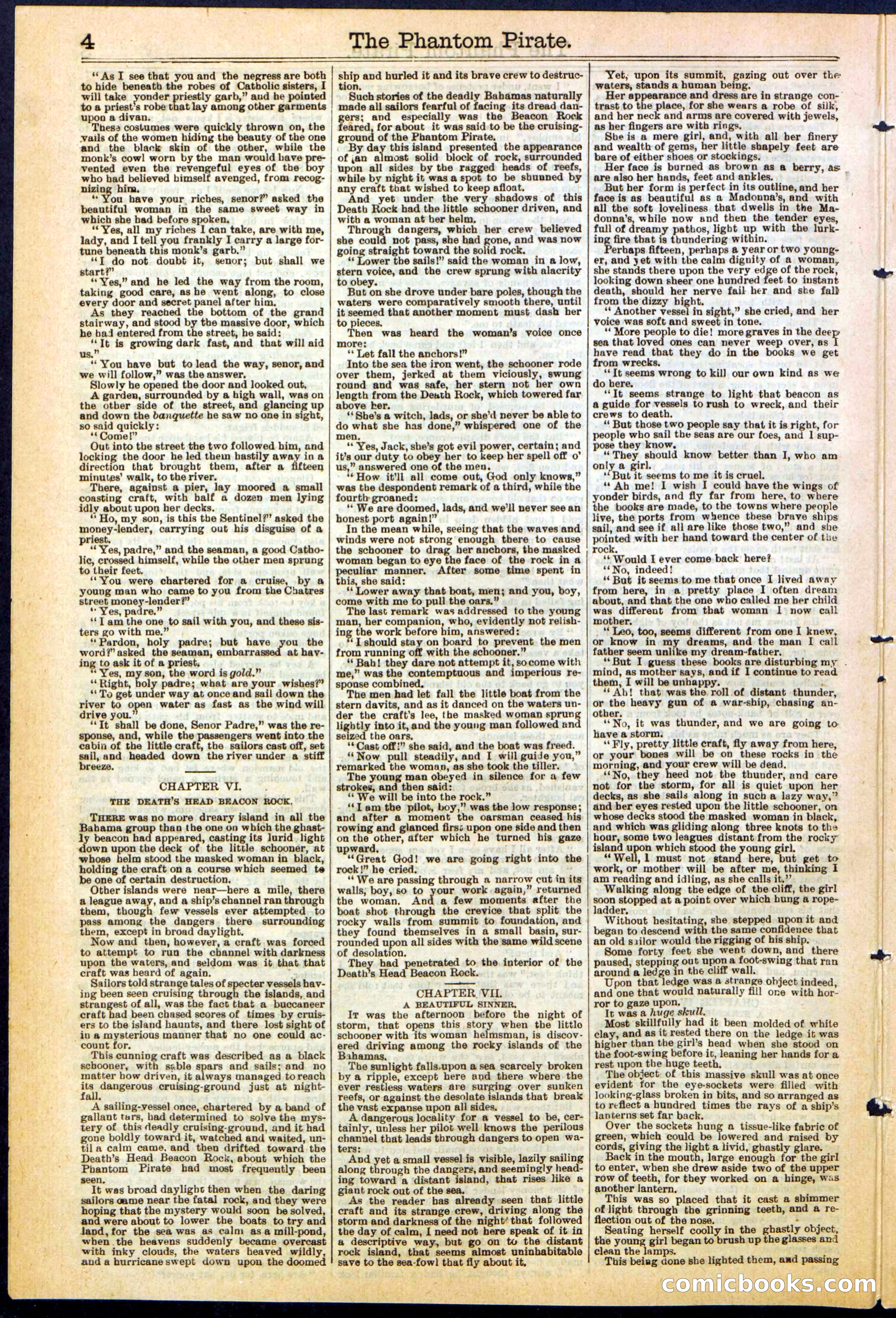
A restored page from Pulp Fiction, 1884. Page through the whole issue in the reader above.
📄 Transcribed text from this page (OCR, searchable)
Machine-transcribed from the original scan — historical spelling and the odd misread are preserved.
4 The Phantom Pirate. ‘As I see that you and the negress are both to hide beneatb the robes of Catholic sisters, I will take yonder riestly garb,” aud he pointed to a priest’s robe that lay among other garments upoo a divan. Thesa costumes were quickly thrown on, the vails of the women hiding the uty of the one and the black skin of the other, while the monk’s cow! worn by the man would bave vented even the revengeful eyes of the boy who had believed himself avenged, from recog- me him, * You have your riches, senor?” asked the beautiful woman in the same sweet way in which she bad before spoken, ‘*'Yes, all my riches I can take, are with me, lady, and I tell you frankly I carry a large for- tune beneath this monk’s garb.” ‘““T do not doubt it, senor; but shall we start?” **Yes,” and he led the way from the room, taking good care, ashe went along, to close every door and secret panel after him, As they reached the bottom of the grand stairway, and stood by the massive door, which he bad entered from the street, he said: “It is growing dark fast, and that will aid “You have but to lead the way, senor, and we will follow,” was the answer, Slowly he opened the door and looked out, A garden, surrounded by a high wall, was on the otber side of the street, and glancing up and down the banquette he saw no one in sight, so said quickly: ** Come!” Out into the street the two followed him, and locking the door he led thein hastily away ina direction that brought them, after a fifteen minutes’ walk, to the river. There, against a pier, lay moored a small coasting craft, with balf a dozen men lying idly about upon her decks. ‘* Ho, my son, is this the Sentinel?’ asked the money-lender, carrying out his disguise of a priest. “Yes, padre,” and the seaman, a good Catho- lic, crossed himself, while the other men sprung to their feet. ‘“You were chartered for a cruise, by a young man who came to you from the Chatres street money-lender?”’ * Yes, padre.” ‘‘T am the one to sail with you, and these sis- ters go with me,” ‘*Pardon, holy padre; but have you the word?” asked the seaman, embarra at hav- ing to ask it of a priest, ‘Yes, my son, the word is gold.” “Right, boly padre; what are your wishes?” ‘*To get under way at once and sail down the river to open water as fast as the wind will drive you.’ “It shall be done, Senor Padre,” was the re- nse, and, while the passengers went into the cabin of the little craft, the sailors cast off, set soil, and headed down theriver under a stiff eeze. CHAPTER VI. THE DEATH’S HEAD BEACON ROCK, THERE was no more dreary island in all the Bahama gr than the one on which the ghast- ly beacon had appeared, casting its lurid light own upon the deck of the little schooner, at whose belm stood the masked woman in black, holding the craft on a course which seemed te be one of certain destruction. Other islands were near—here a mile, there a league away, and a ship’s channel ran through them, though few vessels ever attempted to pass among the dangers there surrounding them, except in broad daylight. Now and then, however, a craft was forced to attempt to run the cbannel with darkness upon the waters, and seldom was it that that craft was heard of again. z Sailors told strange tales of specter vessels hav- ing been seen cruising iveunke: the islands, and strangest of all, was the fact that a buccaneer craft bad been chased scores of times by cruis- ers to the island haunts, and there lost sight of iv a mysterious manner that no one could ac- count for. This cunning craft was described as a black schooner, with sable spars and sails; and no matter bow driven, it always managed toreach AP dangerous cruising-ground just at night- A sailing-vessel once, chartered by a band of gallant turs, bad determined to solve the mys- tery of this deadly cruising-ground, and it had gone boldly toward it, watched and waited, un- tila calm came, and then drifted toward the Death’s Head Beacon Rock, about which the Phantom Pirate had most frequently been seen. It was broad daylight then when the daring sailors game near the fatal rock, and they were hoping that the mystery would soon be solved, and were about to lower the boats to try and d,for the sea was as calm asa mill-pond, when the heavens suddenly became overcast with inky clouds, the waters heaved wildly, and a hurricaneswept down upon the doomed : .. ship and hurled it and its brave crew to destruc- on. Such stories of the deadly Bahamas naturally made all sailors fearful of facing its dread dan- gers; and especially was the Beacon Rock feared, for about it was said to be the cruising- ground of the Phantom Pirate. By day this island presented the appearance of jan almost solid block of rock, surrounded upon all sides by the ragged heads of reefs, while by night it was a spot to be shunned by any craft that wished to keep afloat, And yet under the very shadows of this Death Rock had the little schooner driven, and with a woman at ber helm, Through dangers, which her crew believed she could not pass, she had gone, and was now going straight toward the solid rock. ‘* Lower the sails!” said the woman in a low, stern voice, and the crew sprung with alacrity to obey. But on she drove under bare poles, though the waters were comparatively smooth there, until it seemed that another moment must dash her to pieces. Then was heard the woman’s voice once more: ‘** Let fall the anchors!” Into the sea the iron went, the schooner rode over them, jerked at them viciously, swung round and was safe, her stern not her own length from the Death Rock, which towered far above ker. ‘‘She’s a witch, lads, or she’d never be able to do what she has done,” whispered one of the men, “* Yes, Jack, she’s got evil power, certain; and it’s our duty to obey her to keep her spell off o° us,” answered one of the men. ‘* How it'll all come out, God only knows,” was the despondent remark of a third, while the fourth groaned: ‘* We are doomed, lads, and we'll never see an honest port again!” In the mean while, seeing that the waves and winds were not strong enough there to cause the schooner to drag her anchors, the masked woman began to eye the face of the rock in a peculiar manner. After some time spent in this, she said: ** Lower away that boat, men; and you, boy, come with me to pull the oars.” The last remark was addressed to the young man, her companion, who, evidently not relish- ing the work before him, answered: ‘I should stay on board to prevent the men from running off with the schooner.” ‘* Bah! they dare not attempt it, socome with me,” was the contemptuous and imperious re- sponse combined, The men had let fall the little boat from the stern davits, and as it danced on the waters un- der the craft's lee, the masked woman sprun lightly into it, and the young man followed an se the oars, ‘* Cast off!” she said, and the boat was freed. ‘‘Now pull steadily, and I will guide you,” remarked the woman, as she took the tiller. The young man obeyed in silence for a few strokes, and then said: | ‘* We will be into the rock.” ‘*T am the pilot, boy,” was the low response; and after a moment the oarsman ceased his rowing and glanced firs: upon one side and then on the other, after which he turned his gaze upward, “Great God! we are going right into the rock!” he cried. ‘We are passing through a narrow cut in its walls; boy, so to your work again,” returned the woman. And a few moments after the boat shot through the crevice that split the rocky walls from summit to foundation, and they found themselves in a small basin, sur- rounded upon all sides with the same wild scene of desolation. They bad penetrated to the interior of the Death’s Head Beacon Rock. CHAPTER VIL. A BEAUTIFUL SINNER. Ir was the afternoon before the night of storm, that opens this story when the little schooner with its woman helmsman, is discov- ered driving among the rocky islands of the Bahamas, The sunlight falls.upon a sea scarcely broken by a ripple, except here and there where the ever restless waters are surging over sunken reefs, or against the desolate islands that break the vast expanse upon all sides. A dangerous locality for a vessel to be, cer- tainly, unless her pilot well knows the perilous channel that leads through dangers to open wa- rs: And ye a small vessel is visible, lazily sailing along through the dangers, and seemingly head- ing toward a distant lainnd; that rises like a giant rock out of the sea, . As the reader has already seen that little craft and its strange crew, driving along the storm and darkness of the night‘ that followed the day of calm, [ need not here speak of it ia a descriptive way, but go on to the distant rock t seems almost uninhabitable save to the ow] that fly about it, On os et rt — Ee eee OOOO Oe Yet, upon its summit, gazing out over the waters, stands a human being. Her appearance and dress are in strange con- trast to the place, for she wears a robe of silk, and her neck and arms are covered with jewels, as her fingers are with rings, Sbe is a mere girl, and, with all her finery and wealth of gems, her little shapely feet are bare of either shoes or stockings. Her face is burned as brown as a berry, as are also her hands, feet and ankles. But her form is perfect in its outline, and her face is as beautiful as a Madonna’s, and with all the soft loveliness that dwells in the Ma- donna’s, while now and then the tender eyes, full of dreamy pathos, light up with the lurk- ing fire that is thundering within. erbaps fifteen, perhaps a year or two young- er, and yet with the calm dignity of a woman, she stands there upon the very edge of the rock, looking down sheer one hundred feet to instant death, should her nerve fail her and she fal) from the dizzy hight. ‘* Another vessel in sight,” she cried, and her voice was soft and sweet in tone. ** More people to die! more graves in the dee sea that loved ones can never weep over, as 4 have read that they do in the books we get from wrecks. ‘*Tt seems wrong to kil] our own kind as we do here. ‘*It seems strange to light that beacon as a guide for vessels torush to wreck, and their crews to death. “‘ But those two people say that it is right, for people who sail the seas are our foes, and | sup- pose they know, ‘They should know better than I, who am only a girl. ‘But it seems to me it is cruel. ‘* Ah me! I wish I could have the wings of yonder birds, and fly far from here, to where the books are made, to the towns where people live, the ports from whence these brave ships sail, and see if all are like those two,” and she pointed with ber hand toward the center of the rock. ‘* Would I ever come back here? ‘*No, indeed! ‘‘ But it seems to me that once I lived away from here, in a pretty place I often dream about, and that the one who called me ber child was different from that woman I now call mother. * , too, seems different from one I knew, or know in my dreams, and the man [I call father seem unlike my dream-father. ‘* But I guess these books are disturbing my . mind, as mother says, and if I continue to read them, I will be unhappy. : ‘* Ab! that was the roll of distant thunder, — heavy gun of a war-ship, chasing an- other. ‘‘ No, it was thunder, and we are going to have a storm, ‘Fly, pretty little craft, fly away from here, or your es will on these rocks in the morning, and your crew will be dead. ‘No, they heed not the thunder, and care not for the storm, for all is quiet upon her decks, as she sails along in such a lazy way,” and her eyes rested upon the little schooner, on whose decks stood the masked woman in black, and which was mone along three knots to the hour, some two leagues distant from the rocky island upon which stood the young girl. ‘Well, | must not stand here, but get to work, or motber will be after me, thinking 1 am reading and idling, as she calls it,” Walking along the edge of the cliff, the girl = stopped at a point over which bung a rope- adder, Without nese ae she stepped upon it and began to descend with the same confidence that an old siilor would the rigging of his ship. Some forty feet she went down, and there paused, stepping out upon a foot-swing that ran around a ledge in the cliff wall. Upon that ledge was a strange object indeed, and one that would naturally fill one with hor- ror to gaze upon, It was a huge skull, — Most skillfully had it been molded of white clay, and as it rested there on the ledge it was higher than the girl’s head when she stood on the foot-swing before it, leaning her hands for a rest upon the huge teeth, The object. of this massive skull was at once evident for the eye-sockets were filled with looking-glass broken in bits, and so arranged as to reflect a hundred times the rays of a sbip’s lanterns set far back. Over the sockets Sane a tissue-like fabric of green, which could be lo cords, giving the light a livid, ghastly glare. Back in the mouth, large enough for the girl to enter, when she drew aside two of the upper row of teeth, for they worked on a hinge, was another lantern, This was so placed that it cast a shimmer of light through the grinning teeth, and a re- flection out of the nose. | . Seating herself coolly in the ghastly object the young girl began to brush u eglasses and clean the lamps. This beiag done she lighted them, and passing \ : ? by \ pi? of des oT 4 a om SS Pm Sa J wered and raised by | ef es ' ' ' ' ' a », £ . » oe) a7 Po i 4