
Pulp Fiction, 1884 · page 18 of 32
Beadle's Dime Library No. 307 — page 18: what you’re looking at
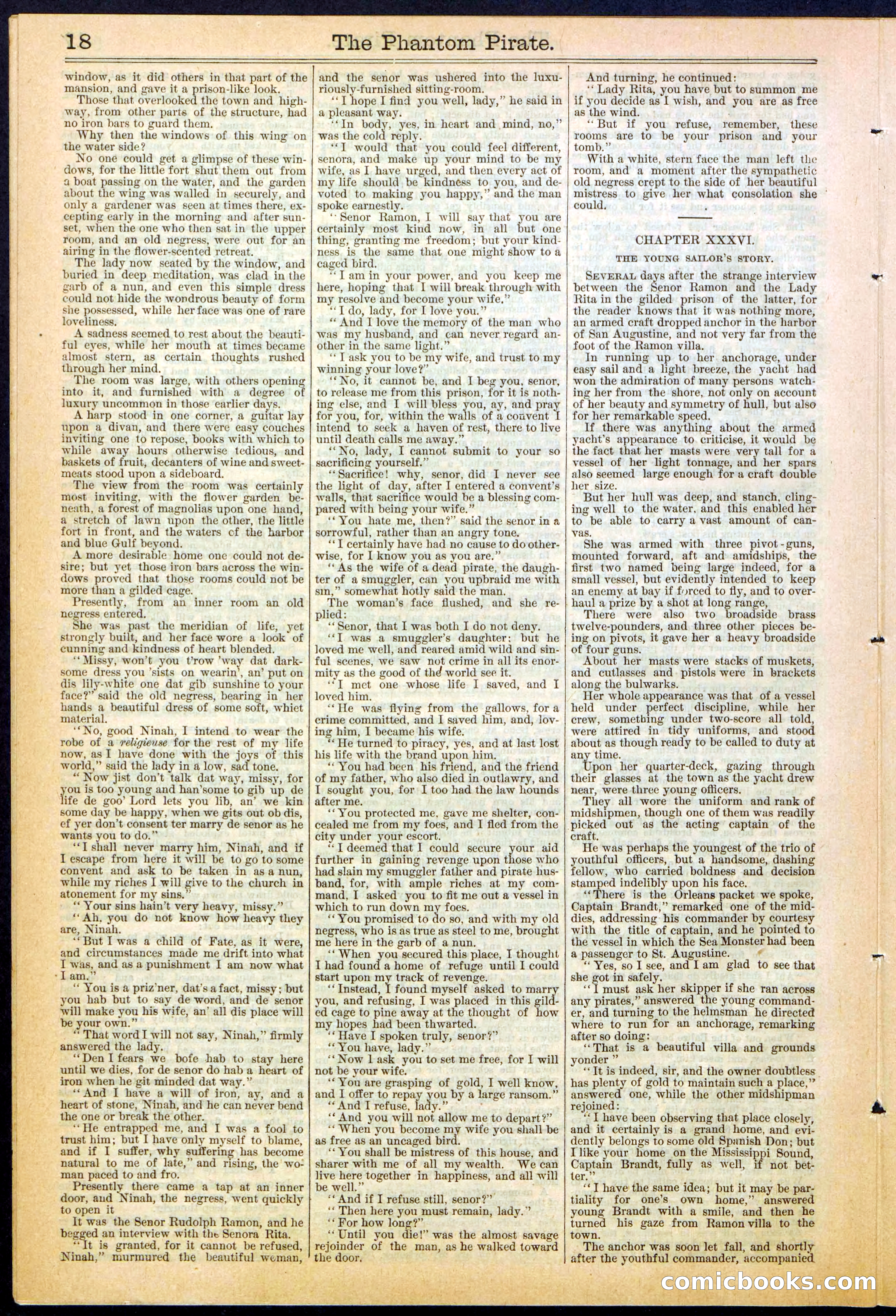
A restored page from Pulp Fiction, 1884. Page through the whole issue in the reader above.
📄 Transcribed text from this page (OCR, searchable)
Machine-transcribed from the original scan — historical spelling and the odd misread are preserved.
eae om —— ee a . » . - he Sao ee ae rd ~~ - — ve? ; Si _ ult “ste. . - - + - te *, ~ iy a ve a * am ye" “i : » ~ es 72 7u » ~* => 42 : ry up BOE. lg » ad ey wy ya iy ts § ' = “~ i“, « Br tA ra ats 4 * ~ .- “ae al ~ / A 18 window, as it did others in that part of the mansion, and gave it a prison-like look. Those that overlooked the town and _ high- way, from other parts of the structure, had no iron bars to guard them. Why then the windows of this wing on the water side? No oné could get a glimpse of these win- - dows, for the little fort shut them out from a boat passing on the water, and the garden about the wing was walled in securely, and only a gardener was seen at times there, ex- cepting early in the morning and after sun- set, when the one who then sat in the upper room, and an old negress, were out for an airing in the flower-scented retreat. The lady now seated by the window, and buried in deep meditation, was clad in the garb of a nun, and even this simple dress could not hide the wondrous beauty of form she possessed, while her face was one of rare loveliness, A sadness seemed to rest about the beauti- ful eyes, while her mouth at times became almost stern, as certain thoughts rushed through her mind. The room was large, with others opening into it, and furnished with a degree of luxury uncommon in those earlier days. A harp stood in one corner, a guitar lay upon a divan, and there were easy couches inviting one to repose, books with which to while away hours otherwise tedious, and baskets of fruit, decanters of wine and sweet- meats stood upon a sideboard. The view from the room was certainly most inviting, with the flower garden be- neath, a forest of magnolias upon one hand, a stretch of lawn upon the other, the little fort in front, and the waters of the harbor and blue Gulf beyond. A more desirable home one could not de- sire; but yet those iron bars across the win- dows proved that those rooms could not be more than a gilded cage. Presently, from an inner room an old negress entered. She was past the meridian of life, yet strongly built, and her face wore a look of cunning and kindness of heart blended. ‘* Missy, won’t you t’row ’way dat dark- some dress you ’sists on wearin’, an’ put on dis lily-white one dat gib sunshine to your face?” said the old negress, bearing in her hands a beautiful dress of some soft, whiet material. ‘*No, good Ninah, I intend to wear the robe of a religieuse for the rest of my life now, as I have done with the joys of this _ world,” said the lady in a low, sad tone. “ Now jist don’t talk dat way, missy, for qo is too young and han’some to gib up de life de goo’ Lord lets you lib, an’ we kin some day be happy, when we gits out ob dis, ef yer don’t consent ter marry de senor as he wants you to do.” **T shall never marry him, Ninah, and if I escape from here it will be to go to some convent and ask to be taken in as a nun, while my riches I will give to the church in atonement for my sins.” “Your sins hain’t very heavy, missy.” ‘Ah, you do not know how heavy they are, Ninah. ‘*But I was a child of Fate, as it were, and circumstances made me drift into what I was, and as a punishment I am now what ~l am.” ‘‘ You is a priz’ner, dat’s a fact, missy ; but you hab but to say de word, and de senor will make you his wife, an’ all dis place will be your own.” _ “That word I will not say, Ninah,” firmly _ answered the lady. - “DenI fears we bofe hab to stay here until we dies, for de senor do hab a heart of iron when he git minded dat way.” ‘*And I have a will of iron, ay, and a heart of stone, Ninah, and he can never bend the one or break the other. ‘He entrapped me, and I was a fool to trust him; but I have only myself to blame, and if I suffer, why suffering has become natural to me of late,” and rising, the wo- man paced to and fro. Presently there came a tap at an inner door, aud Ninah, the negress, went quickly ets vs to open it It was the Senor Rudolph Ramon, and he _ begged an interview with the Senora Rita. ie “It is vie 2’, S : > _ Ninah,’ granted, for it cannot be refused, murmured the beautiful woman, Pa =< aa A VET AR ee r 4a 7 et ~} The Phantom Pirate. and the senor was ushered into the luxu- riously-furnished sitting-room. ‘‘T hope I find you well, lady,” he said in a pleasant way. ‘‘In body, yes, in heart and mind, no,” was the cold reply. ‘“T would that you could feel different, senora, and make up your mind to be my wife, as 1 have urged, and then every act of my life should be kindnéss to you, and de- voted to making you happy,” and the man spoke earnestly. ‘-Senor Ramon, I will say that you are certainly most kind now, in all but one thing, granting me freedom; but your kind- ness is the same that one might show toa caged bird. ‘‘T amin your power, and you keep me here, hoping that I will break through with my resolve and become your wife,” “IT do, lady, for I love you.” ** And I love the memory of the man who was my husband, and can never regard an- other in the same light.” ‘*T ask you to be my wife, and trust to my winning your love?” ‘* No, it cannot be, and I beg you, senor, to release me from this prison, for it is noth- ing else, and I will bless you, ay, and pray for you, for, within the walls of a convent [ intend to seek a haven of rest, there to live until death calls me away.” ‘“No, lady, I cannot submit to your so sacrificing yourself.” ‘Sacrifice! why, senor, did I never see the light of day, after I entered a convent’s walls, that sacrifice would be a blessing com- pared with being your wife.” ‘* You hate me, then?” said the senor ina sorrowful, rather than an angry tone. **] certainly have had no cause to do other- wise, for I know you as you are.” ‘‘As the wife of a dead pirate, the daugh- ter of a smuggler, can you upbraid me with sin,” somewhat hotly said the man. The woman’s face flushed, and she re- plied: ‘‘ Senor, that I was both I do not deny. ‘““T was a smuggler’s daughter: but he loved me well, and reared amid wild and sin- ful scenes, we saw not crime in all its enor- mity as the good of thd world see it. ‘*T met one whose life I saved, and I loved him. ““He was flying from the gallows, fora crime committed, and I saved him, and, lov- ing him, I became his wife. ** He turned to piracy, yes, and at last lost his life with the brand upon him. ‘You had been his friend, and the friend of my father, who also died in outlawry, and I sought you, for I too had the law hounds after me. ‘“ You protected me, gave me shelter, con- cealed me from my foes, and I fled from the city under your escort. ; ‘“‘T deemed that I could secure your aid further in gaining revenge upon those who had slain my smuggler father and pirate hus- band, for, with ample riches at my com- mand, I asked you to fit me out a vessel in which to run down my foes. ‘* You promised to do so, and with my old negress, who is as true as steel to me, brought me here in the garb of a nun, ‘‘ When you secured this place, I thought I had ae a home of refuge until I could start upon my track of revenge. ‘Instead, [ found myself asked to marry you, and refusing, I was placed in this gild- ed cage to pine away at the thought of how my hopes had been thwarted. ‘* Have I spoken truly, senor?” “You have, lady.” ‘* Now Lask you to set me free, for I will not be your wife. “You are grasping of gold, I well know, and I offer to repay you by a large ransom.” ** And T refuse, lady.” ‘‘ And you will not allow me to depart?” ‘‘ When you become a wite you shall be as free as an uncaged bird. ‘You shall be mistress of this house, and sharer with me of all my wealth. We can live here together in happiness, and all will be well.” : ‘And if I refuse still, senor?” ‘* Then here you must remain, lady.” ‘* For how long?” ‘Until you rejoinder of the man, as he walked toward the door, & - — * = ie!” was the almost savage | town. : Saha sateen: 0 Angee _ The anchor was soon let fall, and shortly after the youthful commander, accc 4a And turning, he continued: ‘‘ Lady Rita, you have but to summon me if you decide as I wish, and you are as free as the wind. : “But if you refuse, remember, these rooms are to be your prison and your tomb.” With a white, stern face the man left the room, and a moment after the sympathetic old negress crept to the side of her beautiful mistress to give her what consolation she ' could, CHAPTER XXXVI. THE YOUNG SAILOR’S STORY. SEVERAL days after the strange interview between the Senor Ramon and the Lady Rita in the gilded prison of the latter, for the reader knows that it was nothing more, an armed craft dropped anchor in the harbor of San Augustine, and not very far from the foot of the Ramon villa. In running up to her anchorage, under easy sail and a light breeze, the yacht had won the admiration of many persons watch- ing her from the shore, not only on account of her beauty and symmetry of hull, but also for her remarkable speed. If there was anything about the armed yacht’s appearance to. criticise, it would be the fact that her masts were very tall for a vessel of her light tonnage, and her spars also seemed large enough for a craft double her size. But her hull was deep, and stanch, cling- ing well to the water, and this enabled her to be able to carry a vast amount of can- vas. She was armed with three pivot -guns, mounted forward, aft and amidships, the first two named being large indeed, for a small vessel, but evidently intended to keep an enemy at bay if forced to fly, and to over- haul a prize by a shot at long range, There were also two ee brass twelve-pounders, and three other pieces be- ing on pivots, it gave her a heavy broadside of four guns. About her masts were stacks of muskets, and cutlasses and. pistols were in brackets along the bulwarks. Her whole appearance was that of a vessel held under perfect discipline, while her crew, something under two-score all told, were attired in tidy uniforms, and stood about as though ready to be called to duty at any time. Jpon her quarter-deck, gazing through their glasses at the town as the yacht drew near, were three young officers. They all wore the uniform and rank of midshipmen, though one of them was readily picked out as the acting captain of the craft. He was perhaps the youngest of the trio of youthful officers, but a handsome, dashing fellow, who carried boldness and decision stamped indelibly upon his face. ‘“‘There is the Orleans packet we spoke, Captain Brandt,” remarked one of the mid- dies, addressing his commander by courtesy with the title of captain, and he pointed to the vessel in which the Sea Monster had been a passenger to St. Augustine. ‘ “ Yes, sol see, and lam glad to see that she got in safely. ; ‘*T must ask her skipper if she ran across any pirates,” answered the young command- er, and turning to the helmsman he directed where to run for an anchorage, remarking after so doing: “That is a beautiful villa and grounds yonder ” ‘Tt is indeed, sir, and the owner doubtless has plenty of gold to maintain such a place,” answered one, while the other midshipman rejoined: ‘‘T have been observing that place closely, and it certainly is a grand home, and evi- dently belongs to some old Spanish Don; but I like your home on the Mississippi Sound, Captain Brandt, fully as well, if not bet- ter,.”’ ‘T have the same idea; but it may be par- tiality for one’s own home,” answered young Brandt with a smile, and then he turned his s ie | & : jo) gaze from Ramon villa to the ‘ts a ; “ ] : | a