
Pulp Fiction, 1884 · page 14 of 32
Beadle's Dime Library No. 307 — page 14: what you’re looking at
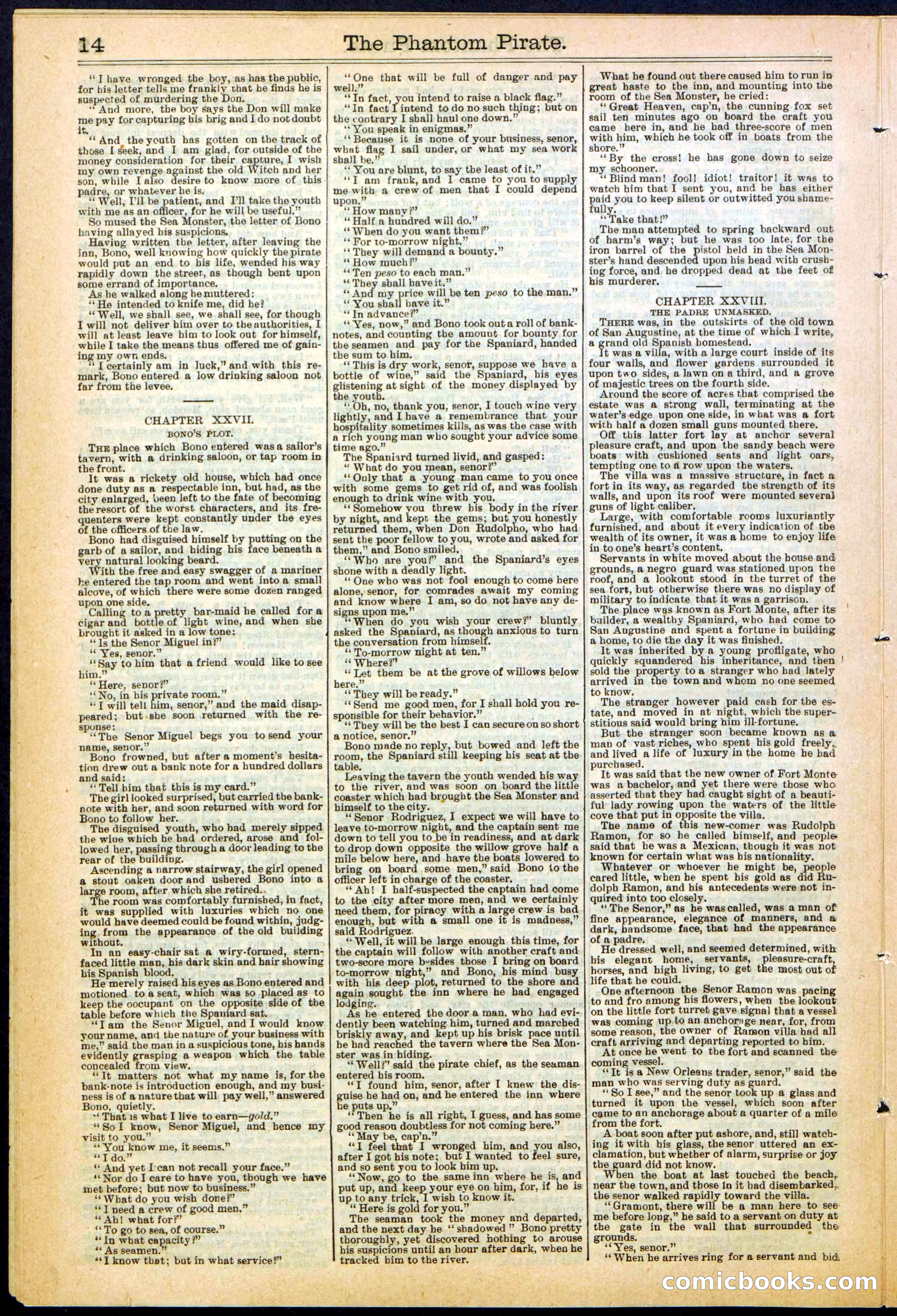
A restored page from Pulp Fiction, 1884. Page through the whole issue in the reader above.
📄 Transcribed text from this page (OCR, searchable)
Machine-transcribed from the original scan — historical spelling and the odd misread are preserved.
eS eS -—-—- ---— a4 SS a a SSD Li Sa The Phantom Pirate. ‘‘T have wronged the boy, as has the public, for bis letter tells me frankly that he finds he is suspected of murdering the Don. ‘““And more, the boy says the Don will make me pay for capturing bis brig and 1 do not doubt ‘“‘And the youth has gotten on the track of those I geek, and I am glad, for outside of the money consideration for their capture, I wish my own revenge against the old Witch and her son, while I also desire to know more of this adre, or whatever he is. ‘“ Well, [ll be patient, and I'll take the youth with me as an officer, for he will be useful.” So mused the Sea Monster, the letter of Bono having allayed bis suspicions, Haviug written the letter, after leaving the inn, Bono, well knowing how quickly the pirate would put an end to his life, wended his way rapidly down the street, as though bent upon some errand of importance. As he walked along he muttered: ‘He intended to knife me, did he? ‘‘ Well, we shall see, we shall see, for though I will not deliver him over to the authorities, I will at least leave him to look out for himself, while I take the means thus offered me of gain- ing my own ends. ‘I certainly am in Juck,” and with this re- mark, Bono entered a low drinking saloon not far from the levee. CHAPTER XXVII. BONO’S PLOT. THE place which Bono entered wasa sailor’s tavern, with a drinking saloon, or tap room in the front. ; It was a rickety old house, which had once done duty as a respectable inn, but had, as the city enlarged, been left to the fate of becoming the resort of the worst characters, and its fre- quenters were kept constantly under the eyes of the officers of the law. Bono had disguised himself by putting on the garb of asailor, and hiding his face beneath a a! natural looking beard. ith the free and easy swagger of a mariner he entered the tap room and went into a small alcove, of which there were some dozen ranged upon one side, Pag, toa prety bar-maid he called fora cigar and bottle of light wine, and when she brought it asked in a low tone: ‘1s the Senor Miguel in?” “ Yes, senor.” “Say to him that a friend would like to see him.” ‘* Here, senor?” ‘‘No, in his private room.” ‘“T will tell him, senor,” and the maid disap- peared; but-sbe soon returned with the re- sponse: ‘‘The Senor Miguel begs you tosend your name, senor.” Bono frowned, but after a moment’s hesita- tion drew out a bank note for a hundred dollars and said: ‘Tell bim that this is my card.” The girl looked surprised, but carried the bank- note with her, and soon returned with word for Bono to follow her. 3 The disguised youth, who bad merely sipped the wive which be bad ordered, arose and fol- lowed her, passing through a door leading to the rear of the building. Ascending a narrow stairway, the girl opened a stout oaken door and ushered Bono into a large room, after which she retired.. e room was comfortably furnished, in fact, it was supplied with luxuries which no one would have deemed could be found within, judg- ing. from the appearance of the old building without. In an easy-chair sat a wiry-formed, stern- faced little man, his dark skin and hair showing bis Spanish blood. He merely raised his eyes as Bono entered and motioned toa seat, which was so placed as to keep the oocupant on the opposite side of tbe table before which the Spaniard sat. ‘Tam the Senor Miguel, and I would know your name, and the nature of your business with me,” said the man in a suspicious tone, bis hands evidently grasping a weapon which the table concealed from view. “It matters not what my name is, for the bank-note is introduction enough, and my busi- ness is of anature that will pay well,” answered Bono, quietly. ** That 1s what I live to earn—gold.” “Sol know, Senor Miguel, and hence my visit to you.” ‘*You know me, it seems.” ~ Cb I do. ” ‘And yet can not recall your face.” ‘‘Nor do I eare to have you, though we have met before; but now to business.” ‘*What do you wish done?” “T need a crew of good men,” ** Ab! what for?’ _ **To go to sea, of course.” * In what capacity ”? ** As seamen. “+I know tbat; but in what service?” jo - - 4 4 ~ “ “ = ‘to-morrow night - ; - ° a x + a i ee et As ~ Wy “Se 2 ‘“ ay. a oe BP Nt: side Pie RS SE Neri that will be full of danger and pay well. “Tn fact, you intend to raise a black flag.” “In fact lintend to do no such thing; but on the contrary I shall haul one down.” ‘* You speak in enigmas.” ‘* Because it is none of your business, senor, what flag I sail under, or what my sea work shall be.” ‘You are blunt, to say the least of it.” ‘‘T am frank, and I came to you to supply me with a crew of men that I could depend upon.” ‘* How many?’ “Half a hundred will do.” ‘‘ When do you want them?” ‘¢ For to-morrow night.” ‘¢They will demand a bounty.” ‘* How much?’ “‘Ten peso to each man.” ‘* They shall have it.” ‘* And my price will be ten peso to the man.” ‘‘ You shall bave it.” ‘In advance?” ‘* Yes, now,” and Bono took outa roll of bank- notes, and counting the amount for bounty for the seamen and pay for the Spaniard, handed the sum to him, ‘¢‘ This is dry work, senor, suppose we have a bottle of wine,” said the Spaniard, bis eyes glistening at sight of the money displayed by the youth. ‘Oh, no, thank you, senor, I touch wine very lightly, and [have a remembrance that your hospitality sometimes kills, as was the case with a rich young man who sought your advice some time ago.” The Spaniard turned livid, and gasped: “ What do you mean, senor?” ‘‘Only that a young man came to you once with some gems to get rid of, and was foolish enough to drink wine with you. ‘* Somehow you threw his body in the river by night, and kept the gems; but you honestly returned them, when Don Rudolpho, who had sent the poor fellow to you, wrote and asked for them,” and Bono smiled, ‘““Who are you?” and the Spaniard’s eyes shone with a deadly light. ‘‘ One who was not fool enough to come here alone, senor, for comrades await my coming and know where I am, so do not have any de- signs upon me.” ‘When do you wish your crew?’ bluntly asked the Spaniard, as though anxious to turn the conversation from himself. “ To-morrow night at ten.” ** Where?” ‘Let them be at the grove of willows below ere.” ‘“They will be ready.” ‘‘Send me good men, for I shall hold you re- sponsible for their behavior.” ‘‘ They will be the best I can secure on so short a notice, senor.” Bono made no reply, but bowed and left the EDOM, the Spaniard still keeping his seat at the table, Leaving the tavern the youth wended his way to the river, and was soon on board the little coaster which had brought the Sea Monster and himself to the city. ‘‘Senor Rodriguez, I expect we will have to leave to-morrow night, and the captain sent me down to tell you aae in readiness, and at dark to drop down opposite the willow grove half a mile below here, and have the boats lowered to bring on board some men,” said Bono to the officer left in charge of the coaster. ‘‘ Ah! I half-suspected the captain had come to the city after more men, and we certainly need them, for piracy with a large crew is bad enough, but with a small one it is madness,” said Rodriguez. ‘Well, it will be large enough this time, for the captain will follow with another craft and two-seore more besides those I bring on board and Bono, his mind busy with his deep plot, returned to the shore and again sought the inn where he had engaged odging. As he entered the door a man, who had evi- dently been watching him, turned and marched briskly away, and kept up his brisk pace until be had reached the tavern where the Sea Mon- ster was in akg ‘‘ Well?” said the pirate chief, as the seaman entered his room. “‘T found him, senor, after I knew the dis- guise he had on, and he entered the inn where he puts up.” ‘*Then he is all right, I guess, and has some good reason doubtless for not coming here.” “May be, cap’n.” “I feel that I wronged him, and you also, after I got his note; but I wanted to feel sure, and so sent you to look him up. “Now, go to the same inn where he is, and put up, and keep your eye on him, for, if he is up to any trick, I wish to know it. “ Here is gold for you.” The seaman took the money and departed, and the next day he ‘‘ shadowed ” Bono pretty thorougbly, yet discovered nothing to arouse his suspicions until an hour after dark, when he tracked bim to the river. What he found out there caused bim to run in great haste to the inn, and mounting into the room of the Sea Monster, he cried: ‘‘ Great Heaven, cap’n, the cunning fox set sail ten minutes ago on board the craft you came here in, and he had three-score of men with him, which he took off in boats from the shore.” ‘‘By the cross! be has gone down to seize my schooner. ‘‘ Blind man! fool! idiot! traitor! it was to watch him that I sent you, and he has either paid you to keep silent or outwitted you shame- ully. ‘* Take that!” The man attempted to spring backward out of harm’s way; but he was too late, for the iron barrel of the pistol held in the Sea Mon- ster’s hand descended upon his head with crush- ing force, and he dropped dead at the feet of his murderer. CHAPTER XXVIII. THE PADRE UNMASKED. THERE was, in the outskirts of the old town of San Augustine, at the time of which I write, a grauc old Spanish homestead. t was a villa, with a large court inside of its four walls, and flower yardens surrounded it upon two sides, a lJawn on a third, and a grove of majestic trees on the fourth side. Around the score of acres that comprised the estate was a strong wall, terminating at the water’s edge upon one side, in what was a fort with half a dozen small guns mounted there, Off this latter fort lay at anchor several pleasure craft, and upon the sandy beach were boats with cushioned seats and light oars, tempting one to a row upon the waters. The villa was a massive structure, in fact a fort in its way, as regarded the strength of its walls, and upon its roof were mounted several guns of light caliber. Large, with comfortable rooms luxuriantly furnished, and about it every indication of the wealth of its owner, it was a home to enjoy life in to one’s heart’s content, Servants in white moved about the bouse and grounds, a negro guard was stationed upon the roof, and a lookout stood in the turret of the sea fort, but otherwise there was no display of military toindicate that it was a garrison. The place was known as Fort Monte, after its builder, a wealthy Spaniard, who had come to San Augustine and spent a fortune in building a home, to die the day it was finished. It was inherited by a young profligate, who quickly squandered his inheritance, and then sold the property to a stranger who had Jately arrived in the town and whom no one seemed to know. The stranger however paid cash for the es- tate, and moved in at night, which the super- stitious said would bring him ill-fortune. But the stranger soon became known as a man of vast riches, who spent his gold freely, and lived alife of luxury in the home he had purchased. It was said that the new owner of Fort Monte: was a bachelor, and yet there were those who asserted that they had caught sight of a beauti- ful lady rowing upon the waters of the little cove that put in opposite the villa. The name of this new-comer was Rudolph Ramon, for so he called himself, and people said that he wasa Mexican, though it was not known for certain what was bis nationality, Whatever or whoever he might be, people cared little, when he spent his gold as did Ru- dolph Ramon, and bis antecedents were not in- quired into too closely. ‘‘ The Senor,” as he wascalled, was aman of fine appearance, elegance of manners, and a dark, bandsome face, that had the appearance of a padre, ’ He dressed well, and seemed determined, with his elegant home, servants, pleasure-craft horses, and high living, to get the most out of life that be could. One afternoon the Senor Ramon was pacing to and fro amoung his flowers, when the lookout on the little fort turret gave signal that a vessel was coming up to an anchorage near, for, from some reason, the owner of Ramon villa had all craft arriving and departing reported to him. At once he went to the fort and scanned the coming vessel. ‘‘Tt is a New Orleans trader, senor,” said the man who was serving duty as guard. ‘**So I see,” and the senor took up a glass and turned it upon the vessel, which soon after came to an anchorage about a quarter of a mile from the fort. A boat soon after put ashore, and, still watch- ing it with his glass, the senor uttered an ex- clamation, but whether of alarm, surprise or joy the guard did not know. ben the boat at last touched the beach, near the town, and those In it had disembarked.. the senor walked rapidly toward the villa. ‘‘Gramont, there will be a man here to see: me before long,” he said to a servant on duty at the gate in the wall that surrounded the grounds. . **'Yes, senor.” “ ‘~ Y* ll: ~) ., > » , y 4 ie Sy ws a i x oat Sb dim Fed 7 aa ~- = ~ * ced ‘When he arrives ring for a servant and bid. 1 o(eVe) XS f of (e(o) i=