
Pulp Fiction, 1884 · page 9 of 24
Beadle's New York Dime Library, No. 306 — page 9: what you’re looking at
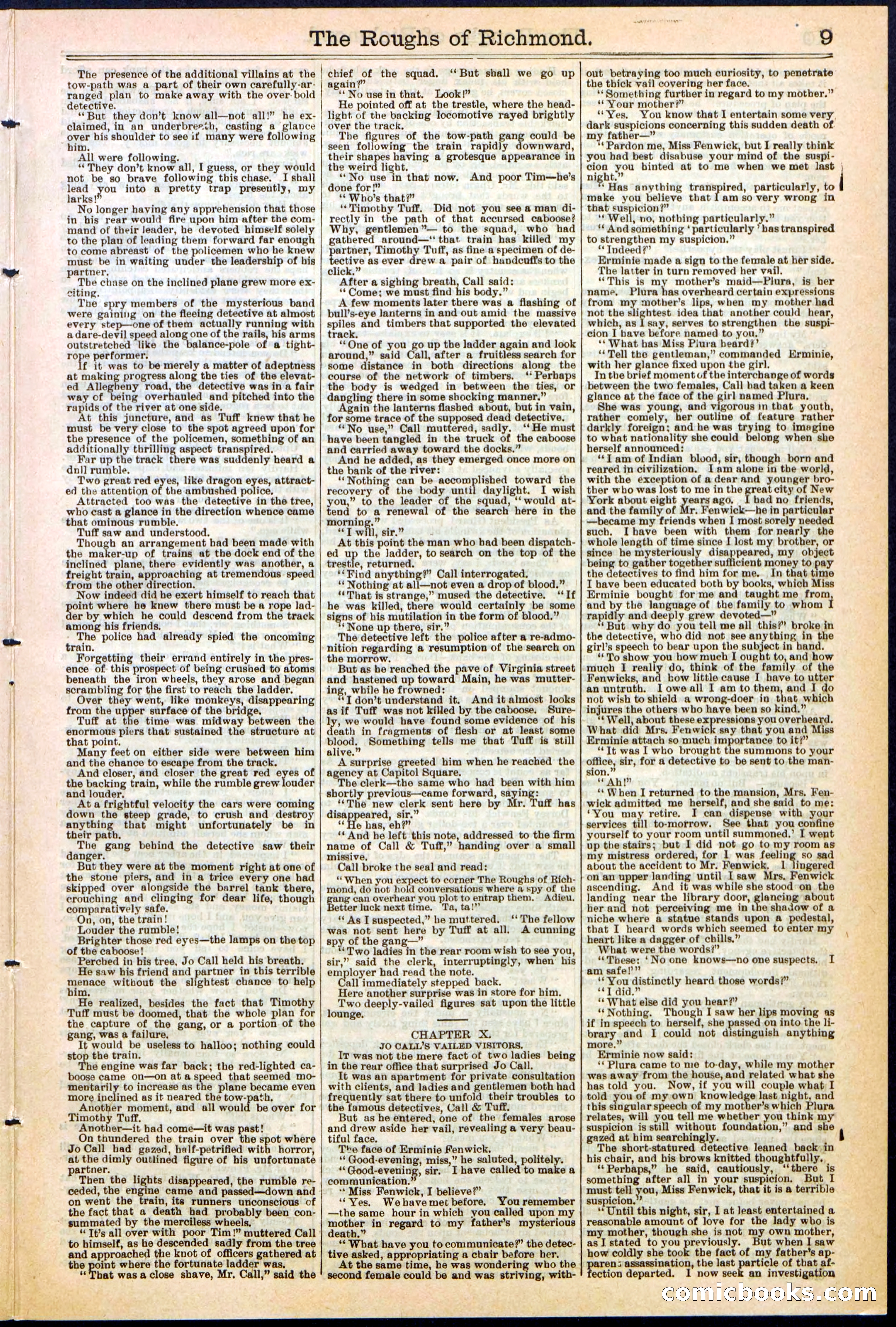
A restored page from Pulp Fiction, 1884. Page through the whole issue in the reader above.
📄 Transcribed text from this page (OCR, searchable)
Machine-transcribed from the original scan — historical spelling and the odd misread are preserved.
a “a = ae | OF cP Pe 18 ee The Roughs of Richm ond. i 9 The presence of the additional villains at the | chief of the squad. ‘But shall we go up tow-path was a part of their own carefully-ar- ranged plan to make away with the over. bold detective. again?” ‘No use in that. Look!” He pointed off at the trestle, where the head- “But they don’t know all—not all!” he ex- | light of the backing locomotive rayed brightly claimed, in an underbre*th, casting a glance over his shoulder to see if many were following him. All were following. ‘They don’t know all, I guess, or they would not be so brave following this chase. I shall lead you into a pretty trap presently, my larks! No longer haying any apprehension that those in his rear would fire upon him after the com- mand of their Jeader, he devoted himself solely to the plan of leading them forward far enough to come abreast of the policemen who he knew must be in waiting under the leadership of his partner, The chase on the inclined plane grew more ex- citing. The spry members of the mysterious band were gaining on the fleeing detective at almost every step—one of them actually running with a dare-devil speed along one of the rails, his arms outstretched like the balance-pole of a tight- SE performer. f it was to be merely a matter of adeptness at making progress along the ties of the elevat- ed Allegheny road, the detective was in a fair way of being overhauled and pitched into the rapids of the river at one side. At this juncture, and as Tuff knew that he must be very close to the spot agreed upon for the presence of the policemen, something of an additionally thrilling aspect transpired. Far up the track there was suddenly heard a dni] rumble. Two great red eyes, like dragon eyes, attract- ed the attention of the ambushed police, Attracted too was the detective in the tree, who cast a glance in the direction whence came that ominous rumble. Tuff saw and understood. Though an arrangement had been made with the maker-up of trains at the dock end of the inclined plane, there evidently was another, a freight train, approaching at tremendous speed from the other direction. Now indeed did he exert himself to reach that int where he knew there must be a rope lad- er by which he could descend from the track among his friends. ; The police had already spied the oncoming rain. Forgetting their errand entirely in the pres- ence of this prospect of being crushed to atoms beneath the iron wheels, they arose and began scrambling for the first to reach the ladder. Over they went, like monkeys, disappearing from the upper surface of the bridge, Tuff at the time was midway between the enormous piers that sustained the structure at that point. Many feet on either side were between him and the chance to escape from the track. And closer, and closer the great red eyes of the backing train, while the rumble grew louder and louder. At a frightful velocity the cars were coming down the steep grade, to crush and destroy anything that might unfortunately be in their path. The gang bebind the detective saw their danger. But they were at the moment right at one of the stone piers, and in a trice every one had skipped over alongside the barrel tank there, crouching and clinging for dear life; though comparatively safe. On, on, the train! Louder the rumble! Brighter those red eyes—the lamps on the top of the caboose! Perched in his tree, Jo Call held his breath. He saw his friend and partner in this terrible ae without the slightest chance to help im, He realized, besides the fact that Timothy Tuff must be doomed, that the whole plan for the capture of the gang, or a portion of the gang, was a failure, It would be useless to halloo; nothing could ec the train. he engine was far back; the red-lighted ca- boose came on—on at a speed that seemed mo- mentarily to increase as the plane became even more inclined as it neared the tow-path, Another moment, and all would be over for Another—it had come—it was past! On thundered the train over the spot where Jo Call bad gazed, half-petrified with horror, at the dimly outlined figure of his unfortunate Timothy Toff. partner. Then the lights disappeared, the rumble re- ceded, the engine came and passed—down and on went the train, its runners unconscious of the fact that a death had probably been con- ~ gummated by the merciless wheels. ‘¢ Tt’s all over with poor Tim!” muttered Call to himself, as he descended sadly from the tree and approached the knot of officers gathered at the point where the fortunate ladder was, “That was a close shave, Mr, Call,” said the over the track. The figures of the tow-path gang could be seen following the train rapidly downward, their pret having a grotesque appearance in the weird light, **No use in that now. And poor Tim—he’s done for!” ** Who's that?’ “Timothy Tuff. Did not you see a man di- rectly in the path of that accursed caboose? Why, gentlemen ”— to the squad, who had gathered around—“ that train has killed my rtner, Timothy Tuff, as fine a specimen of de- ective as ever drew a pair of handcuffs to the click.” After a sighing breath, Call said: ‘* Come; we must find his body.” A few moments later there was a flashing of bull’s-eye lanterns in and out amid the massive ine and timbers that supported the elevated track. ‘*One of you go up the ladder again and look around,” said Call, after a fruitless search for some distance in both directions along the course of the network of timbers. ‘ Perbaps the body is wedged in between the ties, or dangling there in some shocking manner.” Again the lanterns flashed about, but in vain, for some trace of the supposed dead detective. ‘No use,” Call muttered, sadly. ‘‘He must have been tangled in the truck of the caboose and carried away toward the docks.” And he added, as they emerged once more on the bank of the river: ‘“‘Nothing can be accomplished toward the recovery of the body until daylight. I wish you,” to the leader of the squad, ‘‘ would at- tend to a renewal of the search here in the morning.” “T will, sir.” At this point the man who bad been dispatch- ed np the ladder, to search on the top of the trestle, returned. ‘Find anything?” Call interrogated. ‘* Nothing at all—not even a drop of blood.” ‘*That is strange,” mused the detective. ‘If he was killed, there would certainly be some signs of his mutilation in the form of blood.” ‘* None up there, sir.” The detective left the police after a re-admo- nition regarding a resumption of the search on the morrow. But as he reached the pave of Virginia street and hastened up toward Main, he was mutter- ing, while he frowned: ‘I don’t understand it. And it almost looks as if Tuff was not killed by the caboose, Sure- ly, we would have found some evidence of his death in fragments of flesh or at least some blood, Something tells me that Tuff is still alive. A surprise greeted him when he reached the agency at Capitol Square. he clerk—the same who had been with him shortly previous—came forward, sa e ‘*The new clerk sent here by Mr. Tuff has ray = sete sir.” ** He has, eh?” ** And he left this note, addressed to the firm name of Call & Tuff,” handing over a small missive, Call broke the seal and read: “ When you expect to corner The Roughs of Rich- mond, do not hold conversations where a spy of the can overhear you plot to entrap them. Adieu. Better luck next time. Ta, ta!" ‘* As I suspected,” he muttered. ‘ The fellow was not sent here by Tuff at all. A cunning SPY of the gang—” : ‘Two ladies in the rear room wish to see you, sir,” said the clerk, interruptingly, when his employer had read the note. all immediately stepped back. Here another surprise was in store for him. Two deeply-vailed figures sat upon the little lounge. CHAPTER X. JO CALL’S VAILED VISITORS. It was not the mere fact of two ladies being in the rear office that surprised Jo Call. It was an apartment for private consultation with clients, and ladies and gentlemen both had frequently sat there to unfold their troubles to the famous detectives, Call & Tuff. But as he entered, one of the females arose and drew aside her vail, revealing a very beau- tiful face. Te face of Erminie Fenwick. ‘** Good-evening, miss,” he saluted, politely. “4 Good-evening, sir. Ihave called to ea communication.’ ** Miss Fenwick, I believe?” ‘“ Yes, Wehavemet before. You remember —the same hour in which you called upon my vee in regard to my father’s mysterious ‘What have you to communicate?” the detec- tive asked, appropriating a cbair before her. At the same time, he was wonderin second female could be and was striving, with- who the out betraying too much curiosity, to penetrate the thick vail covering her face. ‘* Something further in regard to my mother.” **- Your mother?” ‘| Yen: dark suspicions concerning this sudden death of. my father—” ‘* Pardon me, Miss Fenwick, but I really think you had best disabuse your mind of the suspi- wri you hinted at to me when we met last night. Has anything transpired, particularly, to make you believe that lam so very wrong in that suspicion?” ‘* Well, no, nothing particularly.” ** And something ‘ particularly ’ bas transpired to strengthen my suspicion.” ** Indeed?” Erminie made a sign to the female at her side. The latter in turn removed her vail. “This is my mother’s maid—Plura, is her name. Plura has overheard certain expressions from my mother’s lips, when my mother had not the we pay idea that another could hear, which, as l say, serves to strengthen the suspi- cion I bave before named to you.” ‘* What has Miss Piura beard?’ ‘Tell the gentleman,” commanded Erminie, with her glance fixed upon the girl. In the brief moment of the interchange of words between the two females, Call bad taken a keen glance at the face of the girl named Plura, She was young, and vigorous in that youth, rather comely, her outline of feature rather darkly foreign; and he was trying to imagine to what nationality she could belong when she herself announced: ‘*T am of Indian blood, sir, though born and reared in civilization. Iam alone in the world, with the exception of a dear and younger bro- ther who was lost to me in the great city of New York about eight yearsago. I bad no friends, and the family of Mr. Fenwick—he in particular —became my friends when I most sorely needed such. I have been with them for nearly the whole length of time since I lost my brother, or since he mysteriously disappeared, my object being to gather together suflicient money to pay the detectives to find him for me, In that time I have been educated both by books, which Miss Erminie bought for me and taught me from and by the language of the family to whom rapidly and deeply grew devoted—” ‘‘But why do you tell me all this?’ broke in the detective, who did not see anything in the girl’s speech to bear upon the subject in band, “To show = how much I ought to, and how much I really do, think of the family of the Fenwicks, and how little cause I have to utter an untruth. I oweall I am to them, and I do not wish to shield a wrong-doer in that whic injures the others who have been so kind.” ‘* Well, about these appromices you overheard. What did Mrs. Fenwick say that you and Miss Erminie attach so much importance to it?’ ‘Tt was I who brought the summons to your office, sir, for a detective to be sent to the man- = en ‘‘ When I returned to the mansion, Mrs, Fen- wick admitted me herself, and she said to me: ‘You may retire. I can dispense with your services till to-morrow. See that you confine yourself to your room until summoned,’ I went up the stairs; but I did not go to my room as my mistress ordered, for 1 was sauing so sad about the accident to Mr. Fenwick, 1 lingered on an upper landing until Lsaw Mrs. Fenwick ascending. And it was while she stood on the landing near the library door, glancing about her mul not perceiving me in the shadow of a niche where a statue stands upon a pedestal, that I heard words which seemed to enter my heart like a dagger of chills.” What were the words?” ‘‘These: ‘No one knows—no one suspects. I am safe!’”’ 4 an distinctly heard those words?” ‘ j jk b] ‘‘ What else did you hear?” ‘‘Nothing. Though I saw her lips moving as if in speech to herself, she passed on into the li- brary and I could not distinguish anything more.” Erminie now said: ' ‘*Plura came to me to-day, while my mother was away from the house, and related what she has told you. Now, if you will couple what I told youof my own knowledge last night, and this singular speech of my mother’s which Plura relates, will you tell me whether you think my suspicion is still without foundation,” and she gazed at him searckinaye The short-statured detective leaned back, in his chair, and his brows knitted thoughtfully. ‘*Perbaps,” he said, cautiously, ‘‘there is something after all in your suspicion. But I must tell you, Miss Fenwick, that it is a terrible suspicion.” “ Until this night, sir, I at Jeast entertained a reasonable amount of love for the lady who is my mother, though she is not my own mother, as I] stated to you previously. But when I saw how coldly she took the fact of my father's ap- eran. assassination, the last particle of that af- ection departed. I now seek an investigation You know that I entertain some very =—_ “ew : - Bi dp i MNIGCDOOKS (E(0) Gor