
Pulp Fiction, 1884 · page 22 of 24
Beadle's New York Dime Library, No. 306 — page 22: what you’re looking at
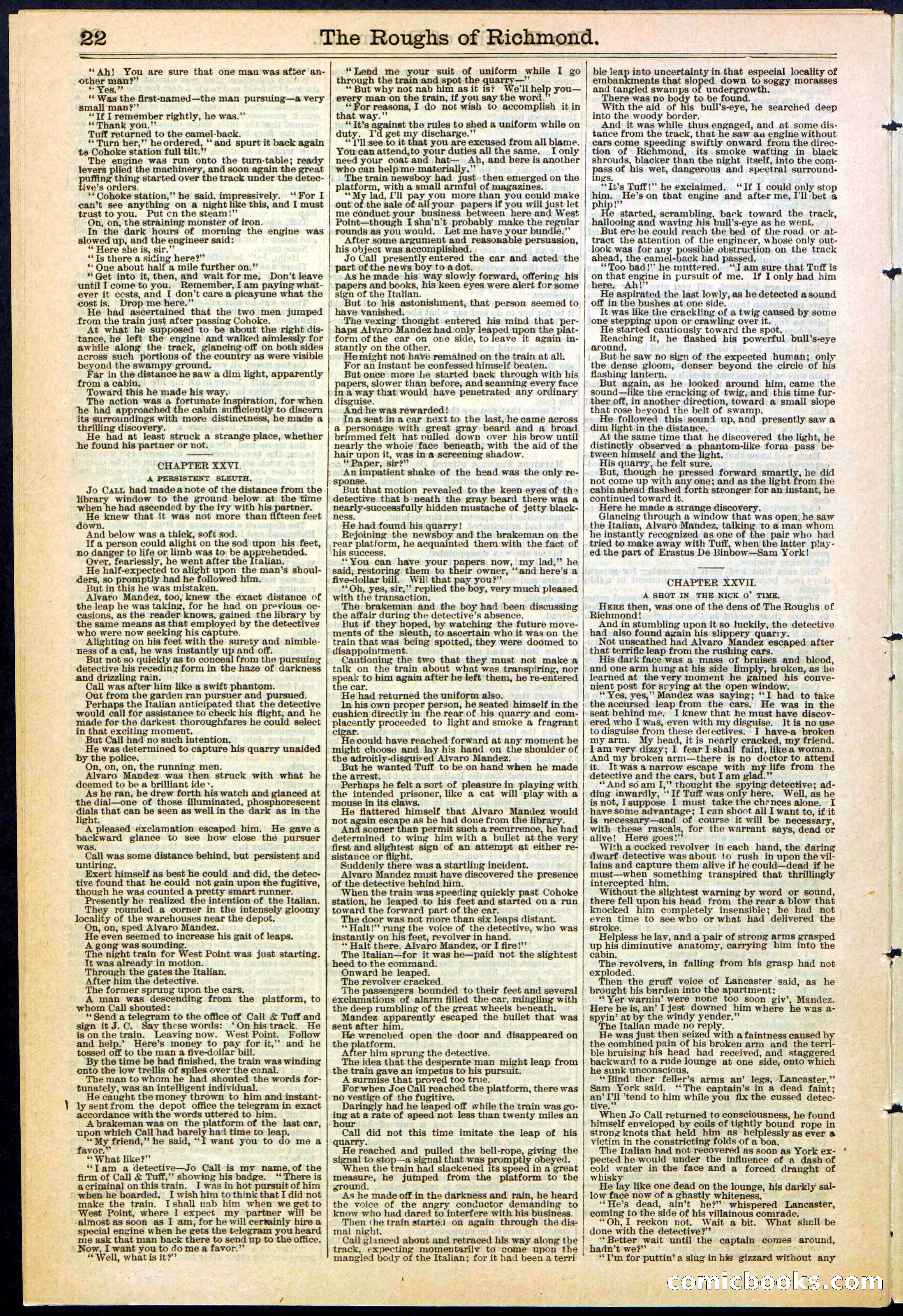
A restored page from Pulp Fiction, 1884. Page through the whole issue in the reader above.
📄 Transcribed text from this page (OCR, searchable)
Machine-transcribed from the original scan — historical spelling and the odd misread are preserved.
ay Peete 3 ee hae 22 —— + + ‘The Roughs of Richmond. — ee he ee eee ‘*‘Ah! You are sure that one man was after an- other man?” ' ** Was the first-named—the man pursuing—a very Small man?"’ “If I remember rightly, he was." “Thank you.”’ Tuff returned to the camel-back. ** Turn her,” he ordered, “and spurt it back again te Cohoke station full tilt.” The engine was run onto the turn-table; ready levers plied the machinery, and soon again the great uffing thing started over the track under the detec- ive’s orders. ** Cohoke station,” he said. impressively. ‘For I ean’t see anything on a night like this, and I must trust to you. Put cn the steam!” On, on, the straining monster of iron. In the dark hours of morning the engine was slowed up, and the engineer said: ‘“* Here she is, sir.” “Ts there a sicing here?” ** One about half a mile further on.” “Get into it, then, and wait forme. Don't leave until I come to you. Remember, I am paying what- ever it ccsts, and I don’t care a picayune what the cost is. Drop me here.” He had ascertained that the two men jumped from the train just after passing Cohoke. At what he supposed to be about the right dis- tance, he left the engine and walked aimlessly for awhile along the track, glancing off on both sides across such portions of the country as were visible beyond the swampy ground. ar in the distance he saw a dim light, apparently from a cabin. Toward this he made his way. The action was a fortunate ae ee for when he had approached the cabin sufficiently to diseern its surroundings with more distinctness, he made a thrilling discovery, He had at least struck a strange place, whether he found his partner or not. CHAPTER XXVI. A PERSISTENT SLEUTH. Jo Catt had madea note of the distance from the libr: window to the ground below at the time when he had ascended by the ivy with his Peto i He knew that it was not more than fifteen feet down. And below was a thick, soft sod. If a person could alight on the sod upon his feet, no danger to life or limb was to be apprehended. Over, fearlessly, he went after the Italian. He half-expected to alight upon the man’s shoul- ders, so promptly had he followed him. But in this he was mistaken. Alvaro Mandez, too, knew the exact distance of the leap he was taking, for he had on previous oe- casions, as the reader knows, gained the library by the same means as that employed by the detectives who were now seeking his capture. Alighting on his feet with the surety and nimble- ness of a cat, he was instantly up and off. But not so quickly as to conceal from the pursuing detective his receding form in the haze of darkness and drizzling rain. Call was after him like a swift phantom. Out from the garden ran pursuer and pursued. Perhaps the Italian anticipated that the detective would call for assistance to check his flight, and he made for the darkest thoroughfares he could select in that exciting moment, But Call had no such intention. He was determined to capture his quarry unaided by the police. On, on, on, the running men. Alvaro Mandez was then struck with what he deemed to be a brilliant ide». As he ran, be drew forth his watch and ced at the dial—one of those illuminated, phosphorescent a that can be seen as wellin the dark as in the ght. A pleased exclamation escaped him. He gavea backward glance to see how close the pursuer was. Call was some distance behind, but persistent and untiring. Exert himself as best he could and did, the detec- tive found that he could not gain upon the fugitive, though he was counted a pretty smart runner. Presently he realized the intention of the Italian. They rounded a corner in the intensely gloomy locality of the warehouses near the depot. On, on, sped Alvaro Mandez. He even seemed to increase his gait of leaps. A gong was 2 ag esi = The night train for West Point was just starting. It was already in motion. Through the gates the Italian. After him the detective. The former sprung upon the cars. A man was descending from the platform, to whom Call shouted: “Send a tel m to the office of Call & Tuff and sign it J.C. Say these words: ‘Onhistrack. He is onthe train. Leaving now. West Point. Follow and help.’ Here’s money to pay for it,’’ and he tossed off to the man a five-dollar bill. By the time he had finished, the train was winding onto the low trellis of spiles over the canal. The man to whom he had shouted the words for- tunately, was an intelligent individual. He caught the money thrown to him and instant- ly sentfrom the depot office the telegram in exact accordance with the words uttered to him. A brakeman was on the platform of the last car, upon which Call had os had time to leap. **My friend,” he said, “‘I want you to do me a favor.” ** What like?” ‘Tam a detective—Jo Call is my name, of the firm of Call & Tuff,” showing his badge. “There is acriminal] on this train. I was in hot pursuit of him when he boarded, I wish him to think that I did not make the train. Ishall nab him when we to West Point, where I expect my partner will be almost as soon as I am, for he will certainly hire a special engine when he gets the telegram you heard me ask that man back there to send up to the office. Now, I want you to do me a favor.” “Well, what is it?’ —— « - ceases seen eee summer ee L “Tend me your suit of uniform while I go through the train and spot the net n ** But why not nab him asit is? We'll help you— every man on the train, if you say the word.” ‘*FWor reasons, I do not wish to accomplish it in that way.”’ a sty nst the rules to shed a uniform while on duty. I'd get my discharge.”’ ** {ll see to it that you are excused from all blame. You ean attend,to your duties allthe same. I only need your coatand hat— Ah, and here is another who can help me materially.”’ The train newsboy had just then emerged on the platform, with a small armful of magazines. **My lad, (ll pay you more than you could make out of the sale of all your papers if you will just let me conduct your business between here and West Point—though Isha’n’t probably make the regular rounds as you would. Let me have your bundle.” After some argument and reasonable persuasion, his object was accomplished. Jo Call presently entered the car and acted the part of the news boy to a dot. As he made his way slowly forward, offering his papers and books, his keen eyes were alert for some sign of the Italian. — ut to his astonishment, that person seemed to have Vanished. The vexing thought entered his mind that per- haps Alvaro Mandez had only leaped upon the plat- form ofthe car on one side, toleave it again in- stantly on the other. He mizht not have remained on the train at all. For an instant he confessed himself beaten. But once more he started back through with his apers, slower than before, and scanning every face na way that would have penetrated any ordinary disguise. And he was rewarded! Ina seat ina car next to the last, he came across a B eit with great y beard and a broad brimmed felt hat pulled down over his brow until nearly the whole face beneath, with the aid of the hair upon it, was in a sereening shadow. “Paper, sir?” An impatient shake of the head was the only re- ponse. But that motion revealed to the keen eyes of ths detective that b neath the gray beard there was a nearly-successfully hidden mustache of jetty black- ness. He had found his quarry! Rejoining the newsboy and the brakeman on the rear platform, he acquainted them with the fact of his success. **You can have your oe ai now, my lad,”’ he said; restoring them to their owner, ‘‘and here’s a five-dollar bill. Will that pay you?” **Oh, yes, sir,’ replied the boy, very much pleased with the transaction. The brakeman and the boy had been discussing the affair during the detective’s absence. But if they hoped, by watching the future move- ments of the sleuth, to asce who it was on the train that was being spotted, they were doomed to disappointment. Cautioning the two that they must not make a talk on the train about what was transpiring, nor speak to bim again after he left them, he re-entered the car. He had returned the uniform also. ln his own proper person, he seated himself in the eushien directly in the rear of his quarry and com- placently proceeded to light and smoke a fragrant e could have reached forward at any moment he might choose and lay his hand on the shoulder of the adroitly-disguised Alvaro Mandez. But he wanted Tuff to be on hand when he made the arrest. Perhaps he felt a sort of pleasure in playing with the intended prisoner, like a cat will play with a mouse in its claws. He flattered himself that Alvaro Mandez would not in escape as he had done from the library. And sconer than permit such a recurrence, he had determined to wing him with a bullet at the very first and slightest sign of an attempt at either re- sistance or flight. Suddenly there was a startling incident. Alvaro Mandez must have discovered the presence of the detective behind him. When the train was speeding quickly past Cohoke station, he leaped to his feet and started ona run toward the forward part of the car. The door was not more than six leaps distant. * Halt!” rung the voice of the detective, who was instantly on his feet, revolver in hand. ** Halt there, Alvaro Mandez, or I fire!’’ The Italian—for it was he—paid not the slightest heed to the command. Onward he leaped. The revolver cracked. The passengers bounded to their feet and several exclamations of alarm filled the car, mingling with the deep rumbling of the great wheels beneath. Mandez apparently escaped the bullet that was sent after him. He wrenched open the door and disappeared on the platform. After him sprung the detective. The idea that the desperate man might leap from the train gave an impetus to his pursuit. A surmise that proved too true. For when Joe Call reached the platform, there was no vestige of the fugitive. Daringly had he leaped off while the train was go- ing at a rate of speed not less than twenty miles an our Call did not this time imitate the leap of his quarry. He reached and pulled the bell-rope, giving the signal to stop—a signal that was promptly obeyed. en the train had slackened its speed in a great —— he jumped from the platform to the u ground. As he made off in the darkness and rain, he heard the voice of the angry concuctor demanding to know who had dared to interfere with his business. Then the train started on again through the dis- mal night. Call glanced about and retraced his way along the track, expecting momentarily to come upon the mangled body of the Italian; for it had been a terri sss Oo ee Se ee a er ble leap into uncertainty in that especial locality of emba ents that sloped down to soggy morasses and tangled swamps of undergrowth, There was no body to be found. With the aid of his bull’s-eye, he searched deep into the woody border. And it was while thus engaged, and at some dis- tance from the track, that he saw aa engine without cars come § aa swiftly onward from the direc- tion of Richmond, its smoke watting in black shrouds, blacker than the night itself, into the com- ass of his wet, dangerous and spectral surround- ings. **It’s Tuff!’’ he exclaimed, “If I could only stop ee He’s on that engine and after me,I'll bet a phip! e started, scrambling, back toward the track, hallooing and waving his bull’s-eye as he went. But ere he could reach the bed of the road or at- tract the attention of the engineer, whose only out- look was for any possible obstruction on the track ahead, the camel-back had passed. **Too bad!’’ he muttered. “‘I am sure that Tuff is on that engine in pursuit of me. If I only had him here, Ah!” He aspirated the last lowly, as he detected a sound off in the bushes at one side. It was like the crackling of a twig caused by some one stepping upon or crawling over it. He started cautiously toward the spot, Reaching it, he flashed his powerful bull’s-eye around. But he saw no sign of the expected human; only the dense gloom, denser beyond the circle of his flashing lantern. But again, as he looked around him, came the sound—like the cracking of twig, and this time fur- ther off, in another direction, toward a small slope that rose beyond the belt of swamp. He followed this sound up, and presently saw a dim light in the distance. At the same time that he discovered the light, he distinctly observed a phantom-like form pass be- tween himself and the light. His quarry, he felt sure. But, though he pressed forward smartly, he did not come up with any one; and as the light from the cabin ahead flashed forth stronger for an instant, he continued toward it. Here he made a strange discovery. Glancing through a window that was open, he saw the Italian, Alvaro Mandez, bape: to @ man whom he instantly recognized as one of the pair who had tried to make away with Tuff, when the latter play- ed the part of Erastus De Binbow—Sam York! CHAPTER XXVII. A SHOT IN THE NICK O’ TIME. HERE then, was one of the dens of The Roughs of Richmond! And in stumbling upon it so Inckily, the detective had also found again his slippery quarry. Not unscathed had Alvaro Mandez escaped after that terrific leap from the rushing cars. His dark face was a mass of bruises and blood, and one arm hung at his side layer broken, as he learned at thev moment he gained his conve- nient post for srying at the open window. ‘Yes, yes,’’ Mandez was saying; ‘‘I had to take the accursed leap from the cars. He was in the seat behind me, I knew that he must have discov- lt is no use ered who I wus, even with my —— "- ves. ave-a broken to disguise from these detect my arm. My head, it is soe § cracked, my friend. lam very dizzy; I fear Isball faint, likea woman. And my broken arm—there is no doctor to attend it. Itwasa narrow escape with se life from the detective and the cars, but I am glac.”’ ‘**And so am I,”’ thought the spying detective; ad- ding inwardly, “If Tuff was only here. Well, as he is not, [suppose I must take the chences alone. I have some advantage; I can shoct all I want to, if it is necessary—and of course it will be necessary, with these rascals, for the warrant says, dead or alive! Here goes!” With a cocked revolver in each hand, the daring dwarf detective was about to rush in upon the vil- lains and capture them alive if he could—dead if he must—when something transpired that thrillingly intercepted him. Without the slightest warning by word or sound, there fell upon his head from the rear a blow that knocked him completely insensible; be had not be time to see who or what had delivered the stroke. Helpless he lay, and a pair of strong arms grasped ag diminutive anatomy, carrying him into the cabin. The revolvers, in falling from his grasp had not exploded. hen the gruff voice of Lancaster said, as he eet lo his burden into the apartment: “Yer warnin’ were none too soon giv’, Mandez. Here he is, an’ I jest downed him where he was a- spyin’ at by the windy yender.” The Italian made no i a He was just then seized with a faintness caused b the combined pain of his broken arm and the terri- ble bruising his head had received, and ered backward to a rude lounge at one side, onto which he sunk unconscious, “Bind ther feller’s arms an’ legs, Lancaster,” Sam York said. ‘“‘The captain’s in a dead faint; 23 Pil ‘tend to him while you fix the cussed detec- tive.’ When Jo Call returned to consciousness, he found himself enveloped by coils of tightly bound rope in strong knots that held him as helplessly as ever a victim in the constricting folds of a boa, The Italian had not recovered as soon as York ex- pected he would under the influence of a dash of ca Ale no in the face and a forced draught of whis He lay like one dead on the lounge, his darkly sal- low face now of a ghastly whiteness. ° ‘He's dead, ain't he?" whispered Lancaster, coming to the side of his villainous comrade. **Oh, I reckon not. Wait a bit. What shall be | done with the detective?” ‘‘ Better wait until the captain comes around, hadn't we?” ; **I’m for puttin’ a slug in his gizzard without any comicbooks: Mes