
Pulp Fiction, 1884 · page 2 of 24
Beadle's New York Dime Library, No. 306 — page 2: what you’re looking at
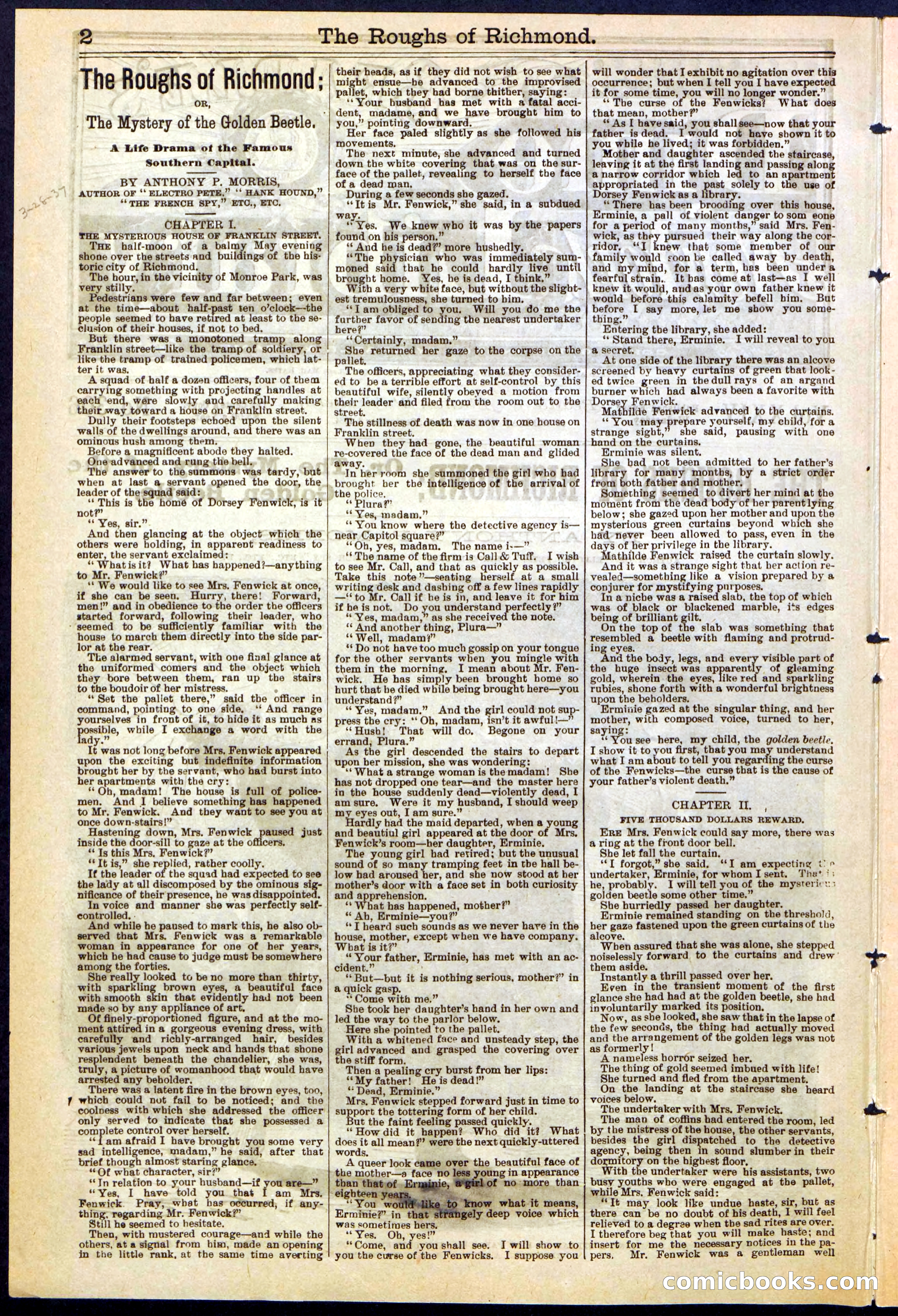
A restored page from Pulp Fiction, 1884. Page through the whole issue in the reader above.
📄 Transcribed text from this page (OCR, searchable)
Machine-transcribed from the original scan — historical spelling and the odd misread are preserved.
‘seemed to be sufficiently familiar kai The Roughs of Richmond. ) a ee —__-C The Roughs of Richmond; The Mystery of the Golden Beetle. A Life Drama oft the Famous Southern Capital. BY ANTHONY P. MORRIS, AUTHOR OF ‘‘ ELECTRO PETE,” ‘‘ HANK HOUND,” ‘‘THE FRENCH SPY,” ETO., ETC. CHAPTER I. z THE MYSTERIOUS HOUSE OF FRANKLIN STREET. THE half-moon of a balmy May evening shone over the streets and buildings of the his- toric city of Richmond. _ The hour, in the vicinity of Monroe Park, was very stilly. Pedestrians were few and far between; even at the time—about half-past ten o’clock—the people seemed to have retired at least to the se- clusion of their houses, if not to bed. But there was a monotoned tramp along Franklin street—like the tramp of soldiery, or like the tramp of trained policemen, which lat- ter it was. A squad of half a dozen officers, four of them carrying something with projecting handles at each ‘end, wére slowly and carefully making their way toward a house on Franklin street. Dully their footsteps echoed upon the silent walls of the dwellings around, and there was an ominous hush among them. Before a magnificent abode they halted. One-advanced and rung the bell. The answer to the summons was tardy, but when at last a. servant opened the door, the leader of the squad said: ‘‘ This is the homé of Dorsey Fenwick, is it not?” Yes, cir,” And then glancing at the object which the others were holding, in apparent readiness to enter, the servant dnrhateeigas “ Whatisit? What bas bappened?—anything to Mr. Fenwick?” ** We would like to see Mrs. Fenwick at once, if she can be seen. Hurry, there! Forward, men!” and in obedience to the order the officers started forward, following their leader, who with the house to march them directly into the side par- lor at the rear. The alarmed servant, with one final glance at the uniformed comers and the object which they bore between them, ran up the stairs to the boudoir of her mistress. ; “Set the paliet there,” said tbe officer in command, pointing to one side, ‘‘ And range yourselves in front of it, to hide it as much as a while I exchange a word with the lady.” It was not long before Mrs, Fenwick appeared upon the exciting but indefinite information brougbt her by the servant, who bad burst into her apartments with the cry: **Oh, madam! The house is full of police- men. And I believe something bas happened to Mr. Fenwick. And they want to see you at once down-stairs!” ppg down, Mrs. Fenwick P pce os just inside the door-sill to gaze at the officers, “ Is this Mrs, Fenwick?” **It is,” she oo desea rather coolly. If the leader of the squad had expected to see the lady at all discomposed by the ominous sig- nificance of their presence, he was disappointed. In voice and manner she was perfectly self- controlled. . And while he paused to mark this, he also ob- served that Mrs. Fenwick was a remarkable woman in appearance for one of her years, which he had cause to judge must be somewhere among the forties. She really looked to be no more than thirty, with sparkling brown eyes, a beautiful face with smooth skin that evidently had not been made so by any appliance of art, Of finely-proportioned figure, and at the mo- ment attired ina gorgeous evening dress, with carefully and richly-arranged hair, besides - yarious jewels upon neck and hands that shone “= resplendent beneath the chandelier, she was, truly, a picture of womanhood that would have arrested any bebolder. There was a latent fire in the brown eyes, too, which could not fail to be noticed; and the coolness with which she addressed the officer only served to indicate that she possessed a complete control over herself. ‘‘{ am afraid I have brought you some very sad intelligence, madam,” he said, after that brief though almost staring glance, *‘Of what character, sir?” yey “Tn relation to your husband—if you are—” “Yes, I have told you that am Mrs, Fenwick. Pray, what bas occurred, if any- thing, regarding Mr. Fenwick?” Still he seemed to hesitate. Then, with mustered courage—and while the others, at a signal from him, made an opening in the little rank, at the same time averting \ their heads, as if they did not wish to see what might ensue—be advanced to the improvised pallet, which they bad borne thither, saying: ‘*Your husband has met with a fatal acci- dent, madame, and we have brought him to you,” pointing downward. Her face paled slightly as she followed his movements, The next minute, she advanced and turned down the white covering that was on the sur- face of the pallet, revealing to herself the face of a dead man, During a few seconds she gazed. ‘‘Itis Mr, Fenwick,” she said, in a subdued way. ‘Yes. We knew who it was by the papers found on bis person.” ‘* And he is dead?” more hushedly. “The physician who was immediately sum- moned said that he could hardly live until brought home. Yes, he is dead, I think,” With a very white face, but without the slight- est tremulousness, she turned to bim. **T am obliged to you. Will you do me the furtber favor of sending the nearest undertaker here?” “Certainly, madam,” ae returned her gaze to the corpse on the pallet. The officers, appreciating what they consider- ed to be a terrible effort at self-control by this beautiful wife, silently obeyed a motion from their leader and filed from the room out to the street, The stillness of death was now in one house on Franklin street. When they had gone, the beautiful woman re-covered the face of the dead man and glided away. « : In her room she summoned the girl who had brought ber the intelligence of the arrival of the police, “ Plura?” ** Yes, madam,” ‘*'You know where the detective agency is— near Capitol square?” “Oh, yes, madam. The name i-—” ‘* The name of the firm is Call & Tuff. I wish to see Mr. Call, and that as quickly as possible. Take this note’—seating herself at a small writing desk and dashing off a few lines rapidly —‘*to Mr. Callif he is in, and leave it for him if he is not. Do you understand perfectly ?”’ ‘* Yes, madam,” as she received the note. ‘** And another thing, Plura—” ‘* Well, madam?” **Do not have too much gossip on your tongue for the other servants when you mingle with them in the morning. I mean about Mr. Fen- wick, He has simply been brought home so hurt that be died while being brought here—you understand?” “Yes, madam.” And the girl could not sup- press the cry: *‘Oh, madam, isn’t it awful!—’ ‘*Hush! That will do. Begone on your errand, Plura.” As the girl descended the stairs to depart upon ber mission, she was wondering: ‘What a strange woman is themadam! She has not dropped one tear—and the master here in the house suddenly dead—violently dead, I am sure, Were it my husband, I should weep a eb out, Iam sure.” — ardly had the maid departed, when a young and beautiul girl appeared at the door of Mrs, Fenwick’s room—her daughter, Erminie. The young girl had retired; but the unusual sound of so many tramping feet in tbe hall be- low had aroused her, and she now stood at her mother’s door with a face set in both curiosity and apprehension. ‘* What has happened, mother?” * Ah, Erminie—you?” **T heard such sounds as we never hare in the house, mother, except when we have company, What is it?” “Your father, Erminie, has met with an ac- cident. ; ** But—but it is nothing serious, mother?” in a quick gasp. “Come with me.” She took her daughter’s hand in her own and led the way to the parlor below. ere she pointed to the pallet. With a whitened face and unsteady step, the girl advanced and grasped the covering over ee a form. Bioeth ine 1t ena pealing cry burst from her lips: “My father! Sas is dead!” * Dead, Erminie.” Mrs, Fenwick stepped forward just in time to support the tottering form of her child. ut the faint feeling passed quickly. “How did it happen? Who did it? What does it all mean?’ were the next quickly-uttered words. A queer look came over the beautiful face of the mother—s face no less young in appearance an thatof Ermgipie, @girhof no more than what it means, 15 ‘deep voice which “You " Erminie strat was sometimes hers. © ‘*'Yes. Oh, yes!” “Come, and you shall see. I will show to you the curse of the Fenwicks. I suppose you will wonder that I exhibit no agitation over this occurrence; but when I tell you I have expected it for some time, you will no longer wonder.” ‘*The curse of the Fenwicks? What does that mean, mother?” ** As I have said, you shallsee—now that your father is dead. I would not have shown it to you while he lived; it was forbidden.” Mother and daughter ascended the staircase, leaving it at the first landing and passing along a narrow corridor which led to an apartment appropriated in the past solely to the use of Dorsey Fenwick as a library. * There has been brooding over this house, Erminie, a pall of violent danger to som eone for a period of many months,” said Mrs, Fen- wick, as they pursued their way along the cor- ridor, “I knew that some member of our family would soon be called away by death, and my mind, for a term, bas been undera fearful strain.. It bas come at last—as I well knew it. would, andas your own father knew it would before this calamity befell him. But pete I say more, let me show you some- thing, Entering tbe library, she added: ** Stand there, Erminie. I will reveal to you a secret. At one side of the library there was an alcove screened by heavy curtains of green that look- ed twice green in thedullrays of an argand burner which had always been a favorite with Dorsey Fenwick. Mathilde Fenwick advanced to the curtains. ‘* You may prepare yourself, my child, for a strange sight,” she said, pausing with one hand on the curtains, Erminie was silent, She bad not been admitted to her father’s library for many months, by a strict ordér from both fatber and mother, Something seemed to divert her mind at the moment from the dead body of ber parent lying below; she gazed upon her mother and upon the mysterious green curtains beyond which she had never been allowed to pass, even in the days of her privilege in the library. Mathilde Fenwick raised the curtain slowly. And it was a strange sight that ber action re- vealed—something like a vision prepared by a conjurer for mystifying # ach Stone In a nicbe was a raised slab, the top of which was of black or blackened marble, its edges being of brilliant gilt. On the top of the slab was something that resembled a beetle with flaming and protrud- 1g eyes nd the body, legs, and every visible part of the huge insect was arperedts of gleaming gold, wherein the eyes, like red and sparkling rubies, shone forth with a wonderful brightness upon the beholders, Ermiiie gazed at the singular thing, and her mother, with composed voice, turned to her, saying: x on see here, my child, the golden beetle. I show it to you first, that you may understand what I am about to tell you regarding the curse of the Fenwicks—the curse that is the cause of your father’s violent death.” CHAPTER II. , FIVE THOUSAND DOLLARS REWARD, Ere Mrs. Fenwick could say more, there was a ring at the front door bell. She let fall the curtain, “T forgot,” she said. “I am expecting t! undertaker, Erminie, for whom I sent. That}: he, probably. I will tell you of the mysteric:: golden beetle some other time,” She hurriedly passed her daughter. Erminie remained standing on the threshold, her gaze fastened upon the green curtains of the aleove. When assured that she was alone, she stepped noiseless] them aside. : Instantly a thrill passed over her. Even in the transient moment of the first glance she had had at the golden beetle, she had involuntarily marked its position. Now, as she looked, she saw that in the lapse of the few seconds, the thing had actually moved and the arrangement of the golden legs was not as formerly! A nameless horror seized her. The thing of gold seemed imbued with life! She turned and fled from the apartment, On the landing at the staircase she heard voices below. The undertaker with Mrs. Fenwick. The man of coffins had entered the room, led by the mistress of the house, the other servants, besides the girl dispatched to the detective agency, being then in sound slumber in their eg on the highest floor, ith the undertaker were his assistants, two busy youths who were engaged at the pallet, while Mrs. Fenwick said: “Tt may ‘ there can be no doubt of his death, I will feel relieved to a degree when the sad rites are over. I therefore beg that you will make haste; and insert for me the necessary notices in the pa- pers, Mr. Fenwick was a gentleman well cbooks.col com forward to the curtains and drew’ look like undue haste, sir, but as —