
Pulp Fiction, 1878 · page 8 of 32
Beadle's Dime Library, Vol. III, No. 29 — page 8: what you’re looking at
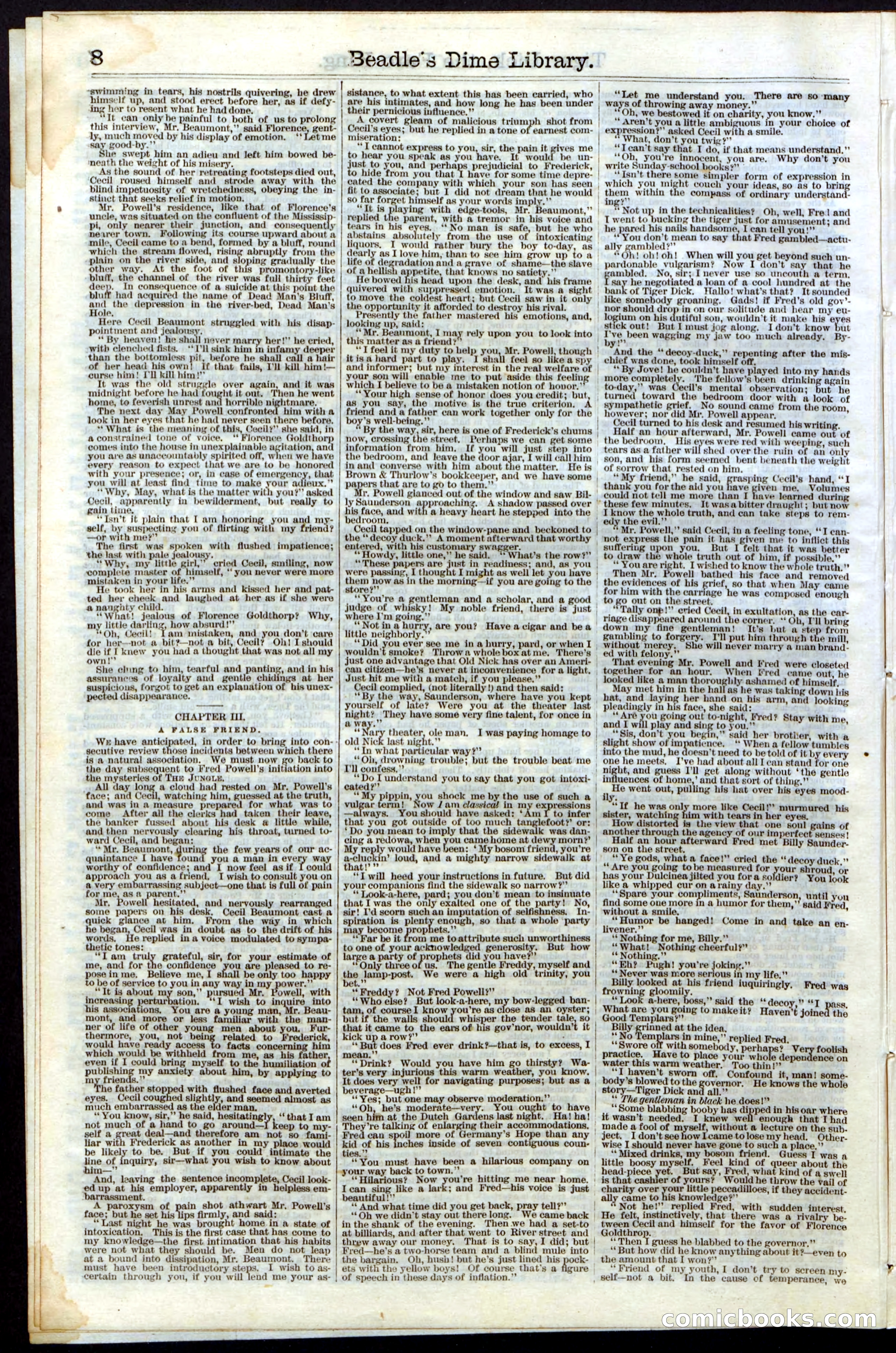
A restored page from Pulp Fiction, 1878. Page through the whole issue in the reader above.
📄 Transcribed text from this page (OCR, searchable)
Machine-transcribed from the original scan — historical spelling and the odd misread are preserved.
we him— eee ee ee - aii —~—e ~ ‘swimming in tears, his nostrils quivering, he drew himself up, and stood erect before her, as if defy- ing her to resent what he had done. “It can only be painful to both of us to prolong this interview, Mr. Beaumont,” said Florence, gent- ly, much moved by his display of emotion. ‘' Letme say good-by.”’ he swept him an adieu and left him bowed be- neath the weight of his misery. As the sound of her retreating footsteps died out, Cecil roused himself and strode away with the blind impetuosity of wretchedness, obeying the in- stinct that seeks relief in motion. Mr. Powell’s residence, like that of Florence's uncle, was situated on the confluent of the er pi, only nearer their junction, and consequently nearer town. Following its course upward about a mile, Cecil came to a bend, formed by a bluff, round which the stream flowed, rising abruptly from the plain on the river side, and sloping gradually the other way. At the foot of this promontory-like bluff, the channel of the river was full thirty feet SoS In consequence of a suicide at this poiut the bluff had acquired the name of Dead Man's Bluff, ant the depression in the river-bed, Dead Man's oe, Here Cecil Beaumont struggled with his disap- pointment and jealousy. “By heaven! he shall never marry her!’ he cried, with clenched fists. ** I'l sink mig infamy deeper than the bottomless pit, before he shall call a hair of her head his own! If that fails, [Ul kill him!— curse him! [Ul kill him!" It was the old struggle over again, and it was midnight before he had fought it out. Then he went home, to feverish unrest and horrible nightmare. The next day May Powell confron him with a look in her eyes that he had never seen there before. “What is the meaning of this, Cecil?” she said, in a constrained tone of voice. “ Florence Goldthorp comes into the house in unexplainable agnonen and you are as unaccountably spirited off, when we have every reason to expect that we are to be honored with your presence; or, in case of emergency, that you will at least find time to make your adieux.” ‘Why, May, what is the matter with you?” asked Cecil, apparently in bewilderment, but really to gain time, “Isn't it plain that I am honoring you ay my- self, by suspecting you of flirting with my friend? —or with me?” The first was spoken with flushed impatience; the last with pale jealousy. “Why, my little girl,’ cried Cecil, smiling, now complete master of himself, ‘‘ you never were more mistaken in your life.” He took her in his arms and kissed her and pat- ted her cheek and laughed at her as if she were a naughty child. ‘What! jealous of Florence Goldthorp? Why, my little darling, how absurd!” “Oh, Cecil!) [am mistaken, and you don't care for her—not a bit?—not a bit, Cecily Oh! I should die if [ knew you had a thought that was not all my own!" She ehing to him, tearful and panting, and in his assurances of loyalty and gentle chidings at her suspicious, forgot to get an explanation of his unex- pected disappearance. CHAPTER II, A FALSE FRIEND. We have antici secutive review those incidents between which there is a natural association. We must now go back to the day subsequent to Fred Powell's initiation into the mysteries of Tar Juna.e, : All day long a cloud had rested on Mr. Powell's face; and Cecil, watching him, guessed at the truth, and was in a measure prepared for what was to come After all the clerks had taken their leave, the banker fussed about his desk @ little while, and then nervously clearing his throat, turned to- ward Cecil, and began: “Mr. Beaumont, me 4 the few years of our ac- quaintance I have found you a man in every way worthy of confidence; and I now feel asif 1 could approach you as a friend, I wish to consult you on a very embarrassing subject—one that is full of pain for me, as ®& parent.”’ Mr, Powell hesitated, and nervously rearranged some papers on his desk, Cecil Beaumont cast a quick glance at him. From the way in which he began, Cecil was in doubt as to the drift of his words. He replied ina voice modulated to sympa- thetic tones: “Lam tr grateful, sir, for your estimate of me, and for the confidence you are pleased to re- poseinme, Believe me, I 1 be only too happy to be of service to you in any way in wer. “Tt is about my 80m," pursued Mr Howell, with noreasing. perear tion. “IL wish to inquire into his associations, You are a young man, Mr. Beau- mont, and more or less familiar with the man- ner of life of other young men about you. Fur- thermore, you, not b related to Frederick, would have ready access facts conce him which would be withheld from me, as his er even if I could bring myself to the humiliation of awa wooed anxiety about him, by applying to my rien he father stooped with flushed face and averted eyes. Cecil coughed slightly, and cnet almost as much embarrassed as the elder man, “You know, sir,”’ he said, hesitatingly, ‘that I am not much of a hand to go around} keep to my- self a great deal—and therefore am not so fami- liar with Frederick as another in my place would be we" to be. But if you could intimate the line of quiry, sir—what you wish to know about And, leaving the sentence incomplete, Cecil look- edup at his employer, apparently in helpless em- barrassment. A paroxysm of n shot athwart Mr. Powell's face; but he set his lips firmly, and said; “Last night he was brought home in a state of intoxication, This is the first case that has come to my knowledge—the first. intimation that his habits were not what they should be. Men do not leap at a bound into dissipation, Mr. Beaumont. There must have been introductory cer I wish to as- certain through you, if you will lend —- —=_— or ted, in order to bring into con-- a bate’: Dimalddbreny. sistance, to what extent this has been carried, who are his intimates, and how long he has been under their pernicious influence.” A covert gleam of malicious triumph shot from Cecil's eyes; but he replied in a tone of earnest com- miseration: “ I cannot express to you, sir, the pain it gives me | have. It would be un- to hear you speak as you prejudicial to Frederick, just to you, and perha to hide from you that cated the company with which your son has seen fit to associate; but I did not dream that he would so far se himself as your words imply.” “It is p replied the parent, with a tremor in his voice and tears in his eyes. ‘*No man is safe, but he who abstains absolutely from the use of intoxicating liquors, I would rather bury the boy to-day, as have for some time depre- | ee ee —_—___.... a 7 =a — — “Let me understand you. There are so ‘many ways of throwing away money.” ‘Oh, we bestowed if on charity, you know,” “ Aren’t you a little ambiguous in your choice of expression?” asked Cecil with a smile. * What, don’t you twig?” ‘IT can’t say that I do, if that means understand.” ‘Oh, you're innocent, you are. Why don’t you write Sunday-school books?” ‘Isn't there some dimpler form of expression in which you might couch your ideas, so as to bring them within the compass of ordinary understand ing?" aying with edge-tools, Mr. Beaumont,” | dearly as I love him, than to see him grow up to a_ life of degradation and a grave of shame—the slave | of a hellish appetite, that knows no satiety.”’ He bowed his head upon the desk, and his frame quivered with suppressed emotion. It was a sight to move the coldest heart; but Cecil saw in it only the opportunity it afforded to destroy his rival. Presently the father mastered his emotions, and, looking up, said: **Mr. Beanmont, I may rely upon you to look into this matter as a friend?” itisa hard part to play. I shall feel so like a spy and informer; but my interest in the real welfare of your sou will enable me to put aside this feeling which I believe to be a mistaken notion of hovor.’ “Your high sense of honor does you credit; but, as you say, the motive is the true criterion. A friend and a father can work together only for the boy's well-being.” “ By the way, sir, here is one of Fredevick’s chums now, crossing the street, P ‘rhaps we can get some information from him. If you will just step into the bedroom, and leave the door ajar, I will call him in andl converse with him about the matter. He is ‘Not up in the technicalities? Oh, well, Fre] and I went to bucking the tiger just for amusement; and he pared his nails handsome, I can tell you!” ‘*You don’t mean to say that Fred gambled—actu- ally gambled?” “Oh! oh! oh! When will you get beyond such un- pardonable vulgarism?’ Now I don’t say that he rambled. No, sir; [never use so uncouth a term. ona y he negotiated a loan of a cool hundred at the bank of Tiger Dick. Hallo! what’s that? It sounded like somebody groaning. Gads! if Fred's old gov’- nor should drop in on our solitude and hear my eu- logium on his dutiful son, wouldn't it make his eyes st ck out! But I must jog along. I don’t know but I've been wagging my jaw too much already. By- by!" “I feel it my duty to help you, Mr. Powell, though ' Ys _ more completely. Brown & Thurlow’'s bookkeeper, and we have some | papers that are to go to them.” Mr. Powell glanced out of the window and saw Bil- | ly Saunderson a poh sea, A shadow passed over pia, face, and with a heavy heart he stepped into the room, Cecil tapped on the window-pane and beckoned to the “decoy duck.” A moment afterward that worthy entered, with his customary swagger. * Howdy, little one,” he said. “ t’s the row?” “ These were } ng, | thought I might as well let you have ew now as in the morning—if you are going to the ore?’ “You're a gentleman and a scholar, and a good ’ these few minutes. pers are just in readiness; and, as you | judge of whisky! My noble friend, there is just — where I'm going.” “Notina hurry, are you? Have acigar and bea little neighborly. ye ever see mine in a hurry, pard, or when I | wouldn't smoke? Throw a whole box at me, There's just one advantage that Old Nick has over an Ameri- can citizen—he's never at inconvenience for a light, Just hit me with a match, if you please.” Cecil complied, (not literally!) and then said: ‘By the way, Saunderson, where have you kept yourself of late? Were you at the theater last night? They have some very fine talent, for once in a way.” ee Nar theater, ole man. I was paying homage to old Nick last night.” “In what particular way?” *Oh, drowning trouble; but the trouble beat me I'll confess.”’ naan I understand you to say that you got intoxi- as ca “*My pippin, you shock me by the use of such a vul foun Now Jam classical in ay eopreerons —always. You should have asked: ‘ to infer that you got outside of too much lefoot?’ or: ‘Do you mean to imply that the sidewalk was dan- cing a redowa, when you came home at dewy morn?’ My reply would have : ‘My bosom friend, you're And the “ decoy-duck,” repenting after the mis- chief was done, took himself off. ** By Jove! he couldn’t have played into my hands The fellow's been drinking again to-day,” was Cecil's mental observation; but he turned toward the bedroom door with a look of sympathetic grief. No sound came from the room, however; nor did Mr. Powell appear. Cecil turned to his desk and resumed his writing. Half an hour afterward, Mr. Powell came out of the bedroom, His eyes were red with weeping, such tears as a father will shed over the ruin of an only son, and his form seemed bent beneath the weiglit of sorrow that rested on him. “My friend,’ he said, grasping Cecil's hand, “I thank you for the aid you have given me, Volumes could not tell me more than I have learned during It was a bitter draught; but now I know the whole truth, and can take steps to rem- edy the evil.”’ ‘Mr. Powell,"’ said Cecil, in a feeling tone, “I can- not express the pain it has given me to inflict this suffering upon you. But I felt that it was better to draw the whole truth out of him, if possible.” * You are a I wished to know the whole truth.” Then Mr, Powell bathed his face and removed the evidences of his grief, so that when May came for him with the carriage he was composed enough to go out on the street. . _” Tally one!" eried Cecil, in exultation, as the ear- riage disappeared around the corner, ** Ob, T'll bring down my fine gentleman! It’s but a step from gambling to forgery. I'll put him through the mill, without merey, She will never marry a man brand: ed with felony.” That evening Mr. Powell and Fred were closeted together for an hour. When red came out, he looked like a man eg a ashamed of himself, May met him in the hall as he was taking down his hat, and Te her hand on his arm, and looking 5S a-cluckin’ loud, and a mighty narrow sidewalk at | that!’”’ *T will heed your instructions in future. But did your companions find the sidewalk so narrow?” ‘* Look-a-here, pard; you don’t mean to insinuate that I was the only exalted one of the party! No, sir! I'd scorn such an imputation of selfishness, In- spiration is plenty enough, so that a whole party may become prophets." ‘Far be it from me toattribute such unworthiness to one of your acknowledged generosity. But how large a party of oo did you have?’’ “Only three of us. The gentle Preddy, myself and the Jamp-post. We were a high old trinity, you be ’ “Freddy? Not Fred Powell?” ‘“Who else? But look-a-here, vA bow-legged ban- of course I know you're as close as an oyster; but if the walls should whis the tender ." kick up a row?” . it came to the ears of his gov’nor, wouldn’ does Fred ever drink?—that is, to excess, ean. ‘Drink? Would you have him go thirsty? Wa- ter’s very injurious this warm we ,» you know. It does very well for navigating purposes; but as a beverage—ugh!” - ‘“Yes; but one may observe moderation, “Oh, he’s moderate—very. You ought to have seen at the Dutch Gardens last night. Ha! ha! | “Are you going to be measured for | sto ner = talking of enlarging their accommodations, | Fre can § kid of his inches inside of seven ties.”’ ‘*You must have been a hilarious company on ‘our way back to town.” ous coun- i} more of Germany's Hope than any | contig ‘Hilarious? Now powee hitting me near home. | I can sing like a lark; and Fred—his voice is just beautiful!” “‘ And what time did you get back, pray tell?’ ‘‘Ob we didn’t stay out there long. We came back in the shank of the evening. Then.we had a set-to at billiards, and after that went to River street and threw away our money. That is to say, I did; but Fred—he’s a two-horse team and a blind mule into | Oh, hush! but he’s just lined his pock- Of course that’s a figure the bargain. ets with the yellow boys! 1e your as- | of speech in these days of inflation.” pleadingly in face, she said: * Aré Foo going out to-night, Fred? Stay with me and I will play and sing to you.” : “Sis, don’t you begin,” said her brother, with a slight show of impatience. ‘ When a fellow tumbles into the mud, he doesn't need to be told of it by every one he meets, I've had about all I can stand for one night, and guess I'll get along without ‘the gentle influences of home,’ and that sort of thing,” He went out, pulling his hat over his eyes mooa- “If he was only more like Cecil!” murmured his sister, watchin with tears in her eyes. How disto is the view that one soul gains of another through the agency of our imperfect senses! Half an hour afterward Fred met Billy Saunder- son on the street. “Ye gods, what a face!" cried the “decoy duck,” our shroud, has your Dulcinea jilted you fora soldier? You oy like a whipped cur on arainy day.” ‘*Spare your een Saunderson, until you find some one more in a humor for them," said Ired, without a smile. ‘““Humor be hanged! Come in and take an en- livener.”’ ‘* Nothing for me, Billy.” “What! Nothing cheerful?" “Eh? Pugh! you're joking.” ** Never was more serious in my life,” Billy looked at his friend iuquiringly, Fred was frowning gloomily. A Look a-here, boss,” said the “decoy,” “I What are you going to make it he Daas gol g eit? Haven't joined the a rn ap **No Tem mine,” ‘*Swore off wi aye ete foolish th somebody, perhaps? V ractice. Have to place your whole. 7 Pp water this warm weather. Too thin!’ I shaven t sworn off. Confound it, man! some- body’s blowed to the eee: He knows the whole 01 —Tiger Dick and all.” The gentleman in black he does\” depen nee on “Some blabbing booby has di in his oar where it wasn’t neaden’ I re Ae w anon that T had made a fool of —_ without a lecture on the sub- ject. I don't see how etolose my head. Other- wise I should never have gone to such a place,”’ ‘* Mixed drinks, my bosom friend. Guess I was a p aed: . Wo wn swell is that er of oe dhe he the vail of charity over your e oes, e ident- ally came to his knowledge?”’ Mon wos scmid “Not he!"’ replied Fred, with sudden interest. He felt, instinctively, that there was a rivalry be- en iland himself for the favor of Florence oO ro us Then tI guess he blabbed to the governor,” ‘“* But how did he know anything about it?—even to the amount that I won?” “Friend of my youth, I don't try to screen my- , self—not a bit. In the cause of temperance, we _(c(o) am GHDOOKSIEO