
Pulp Fiction, 1878 · page 3 of 32
Beadle's Dime Library, Vol. III, No. 29 — page 3: what you’re looking at
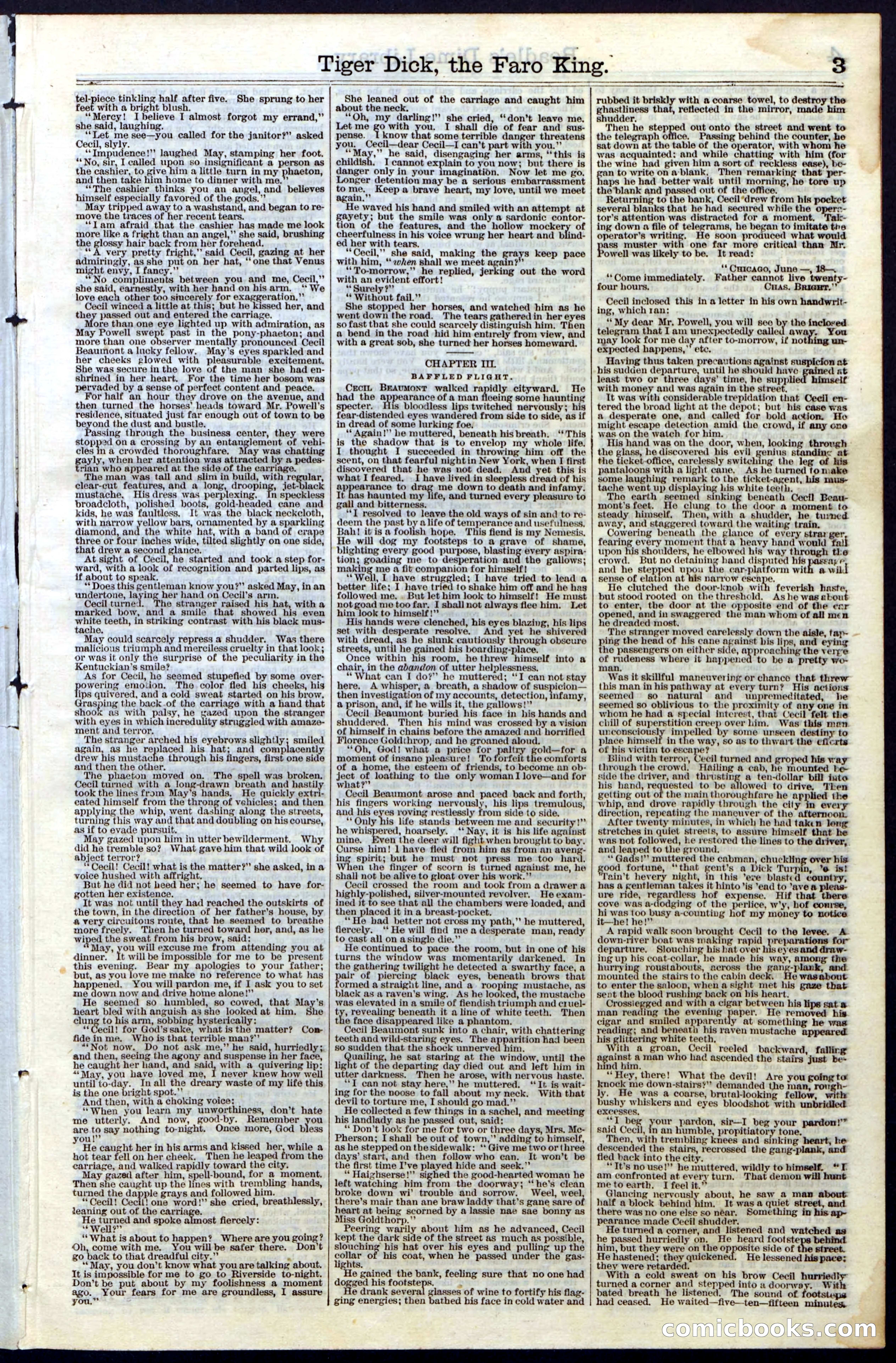
A restored page from Pulp Fiction, 1878. Page through the whole issue in the reader above.
📄 Transcribed text from this page (OCR, searchable)
Machine-transcribed from the original scan — historical spelling and the odd misread are preserved.
a a ieepietiiniaitisteeiaiane Le LR ELIOT 3) a OO pekmere tinkling half after five. She sprung to her feet with a bright blush. ‘““Mercy! I believe I almost forgot my errand,” she said, laughing. ‘*Let me see—you called for the janitor?” asked Cecil, slyly. ‘‘Impudence!”’ laughed May, stamping her foot. **No, sir, I called upon so insignificant a person as the cashier, to give him a little turn in my phaeton, and then take him home to dinner with me.”’ “The cashier thinks you an angel, and believes himself especially favored of the gods.” May tripped away to a washstand, and began to re- move the traces of her recent tears. ‘‘lam afraid that the cashier has made me look more like a fright than an angel,’ she said, brushing the glossy hair back from her forehead. “A very pretty fright,”’ said Cecil, gazing at her admiringly, as she put on her hat, ‘‘ one that Venus might envy, I fancy,"’ “No compliments between you and me, Cecil,” she said, earnestly, with her hand on hisarm. “ We love each other too sincerely for exaggeration,” Cecil winced a little at this; but he kissed her, and they passed out and entered the carriage. ince than one eye lighted up with admiration, as May Powell swept past in the pony-phaeton; and more than one observer mentally pronounced Cecil Beaumont a lucky fellow, May's eyes sparkled and her cheeks glowed with pleasurable excitement. She was secure in the love of the man she had en- shrined in her heart. For the time her bosom was pervaded by a sense of perfect content and peace. For half an hour they drove on the avenue, and then turned the horses’ heads toward Mr. Powell's residence, situated just far enough out of town to be beyond the dust and bustle. assing through the business center, they were stopped On a crossing by an entanglement of vehi- cles n a crowded thoroughfare, ay was chatting ayly, when her attention was attracted by a pedes- frian who appeared at the side of the carriage. The man was tall and slim in build, with regular, clear-cut features, and a long creeping jet-black mustache, His dress was perplexing. n speckless broadcloth, polished boots, gold-headed cane and kids, he was faultless, It was the black neckeloth, with narrow yellow bars, ornamented by a sparkling diamond ani. the white hat, with a band of crape three or four inches wide, tilted slightly on one side, that drew a second glance. At sight of Cecil, he started and took a step for- ward, with a look of recognition and parted lips, as if about to speak. ** Does this gentleman know you?” asked May, in an undertone, laying her hand on Cecil's arm. Cecil turned. The stranger raised his hat, with a marked bow, and a smile that showed his even ee teeth, in striking contrast with his black mus- tache, May could scarcely repress a shudder. Was there malicious triumph and merciless cruelty in that look; or was it only the surprise of the peculiarity in the Kentuckian’s smile? As for Cecil, he seemed stupefied by some over- owering emotion. The color fled his cheeks, his ips quivered, and a cold sweat started on his brow, Grasping the back.of the carriage with a hand that shook as with palsy, he pase’ upon the stranger with eyes in which incredulity struggled with amaze- ment and terror. The stranger arched his eyebrows slightly; smiled again, as he replaced his hat; and complacentl drew his mustache through his fingers, first one side and then the other. The phaecton moved on. The spell was broken. Cecil turned with a long-drawn breath and hastil took the lines from May’s hands. He quickly extri- eated himself from the throng of vehicles; and then applying the whip, went dashing along the streets, turning this way and that and doubling on his course, as if to evade pursuit. May gazed upon him in utter bewilderment. Why did he tremble so? What gave him that wild look of abject terror? “Cecil! Cecil! what is the matter?’ she asked, in a voice hushed with affright, But he did not heed her; he seemed to have for- gotten her existence. It was not until they had reached the outskirts of the town, in the direction of her father’s house, by a very circuitous route, that he seemed to breathe more freely. Then he turned toward her, and, as he wiped the sweat from his brow, said: “May, you will excuse me from attending you at dinner. It willbe impossible for me to be present this evening. Bear my apologies to your father; but, as you love me make no reference to what has happened. You will pardon me, if I ask you to set me eee now and drive home alone!” He seemed so humbled, so cowed, that May's heart bled with anguish as she looked at him. She clung to his arm, sobbing hysterically: **Cecil! for God’s sake, what is the matter? Com fide in me. Who is that terrible man?" “*Not now. Do not ask me,”’ he said, hurriedly; and then, seeing the agony and suspense in her face, he caught her hand, and said, with a quivering lip: “‘May, you have loved me, I never knew how well until to-day. In all the dreary waste of my life this is the one bright spot.”’ And then, with a choking voice; “When you learn my unworthiness, don’t hate me utterly, And now, good-by. Remember you are to say nothing to-night. Once more, God bless you’? ’ He caught her in his arms and kissed her, while a hot tear fell on her cheek. Then he leaped from the carriage, and walked rapidly toward the city. May gazed after him, spell-bound, for a moment. Then she caught up the lines with trembling hands, turned the da ple grays and followed him. “ Cecil! Cecil! one word!” she cried, breathlessly, leaning out of the mr eee and spoke ost fiercely: ‘ e 1 ‘What is about to happen? Where are you going? Oh, come with me. You will be safer there. Don’t go back to that dreadful city.” - “May, you don’t know what you are talking about. It is impossible for me to go to Riverside to-night. Don’t be put about by my foolishness a moment ago. Your fears for me are groundless, I assure you.” about the neck. “Oh, my darling!"’ she cried, ‘don’t leave me. Let me go with you. I shall die of fear and sus- pense. I know that some terrible danger threatens you, Cecil—dear Cecil—I can't part with you.” *“May,” he said, disengaging her arms, “this is childish. I cannot explain to you now; but there is danger only in your imaginatidn. Now let me go. Longer detention may be a serious embarrassment to ae Keep a brave heart, my love, until we meet again." He waved his hand and smiled with an attempt at gayety; but the smile was only a sardonic contor- tion of the features, and the hollow mockery of cheerfulness in his voice wrung her heart and blind- ed her with tears. “Cecil,” she said, making the ys keep pace with him, “hen shall we meet again? ; “To-morrow,”’ he replied, jerking out the word with an evident effort! “ Surely? “ Without fail.” She stopped her horses, and watched him as he went down the road. The tears gatheredin her eyes so fast that she could scarcely distinguish him. Then a bend in the road hid him entirely from view, and with a great sob, she turned her horses homeward. CHAPTER II. BAFFLED FLIGHT. Crecr. Braumont walked ve to cityward. He had the appearance of a man fleeing some haunting specter. is bloodless lips twitched nervously; his fear-distended eyes wandered from side to side, as if in dread of some lurking foe. ‘** Again!’’ be muttered, beneath his breath. ‘This is the shadow that is to envelop my whole life. I thought I succeeded in throwing him off the scent, on that fearful nightin New York, when I first discovered that he was not dead. And yet this is what I feared. I have lived in sleepless dread of his oupenmance to drag me down to death and infamy. It haunted my life, and turned every pleasure to gall and bitterness. “T resolved to leave the old ways of sin and to re- deem the past by a life of temperance and usefulness. Bah! itis a foolish hope. This fiend is my Nemesis. He will dog my footsteps to a grave of shame, blighting every good purpose, blasting every aspira- tion; goading me to desperation and the gallows; making me a fit companion for himself! ‘* Well, I have struggled; I have tried to lead a better life; I have t to shake him off and he has followed me. . But let him look to himself! He must not ped me too far, I shall not always flee him. Let him look to himself!” His hands were clenched, his eyes blazing, his lips set with desperate resolve. And yet he shivered with dread, as he slunk cautiously through obscure streets, until he gained his boarding-place. Once within his room, he threw himself into a chair, in the abandon of utter helplessness. “What can I do?” he muttered; “I can not stay here. A inne op a breath, a shadow of suspicion— then investigation of ripe ter detection, infamy, a prison, and, if he wills it, the gallows!” ecil Beaumont buried his face in his hands and shuddered. Then his mind was crossed by a vision of himself in chains before the amazed and horrified Florence Goldthrop, and he groaned aloud. “Oh, God! what a price for a old—for a moment of insano pleasure! To forfeit the comforts of a home, the esteem of friends, to become an ob- sat ma loathing to the only woman I love—and for what?’ Cecil Beaumont arose and paced back and forth, his fingers working soe i his lips tremulous, and his a roving restlessly from side to side. ‘** Only his life stands between me and security!” he whispered, hoarsely. ‘* Nay, it is his life against mine. Even the deer will ehh. when brought to bay. Curse him! 1 have fled from as from an seas ing spirit; but he must not press me too hard. en the —— of scorn is turned against me, he shall not be alive to gloat over his work.” Cecil crossed the room and took from a drawer a fA er nee silver-mounted revolver. He exam- ined it to see that all the chambers were loaded, and then placed it in a breast-pocket. “He bad better not cross my path,” he muttered, fiercely. “He will find mea desperate man, ready to cast all on asingle die.” He continued to pace the room, but in one of his turns the window was momentarily darkened. In the gathering at a he detected a swarthy face, a pers of piercing black eyes, beneath brows that ormed a straight line, and a conn mustache, as black as a raven's wing. As he looked, the mustache was elevated in a smile of fiendish triumph and cruel- bys revealing beneath it a line of white teeth. Then the face disappeared like a phantom. Cecil Beaumont sunk into a chair, with chattering teeth and wild-staring eyes. The ap arition had been so sudden that the shock unnerv im. _ Quailing, he sat staring at the window, until the light of the departing day died out and left him in utter darkness. Then he arose, with nervous haste. ‘**I can not stay here,’ he muttered. “It is wait- ing for the noose to fall about my neck. With that devil to torture me, I should go mad.” He collected a few things in a sachel, and meeting his landlady as he passed out, said: ** Don’t look for me for two or three days, Mrs, Me- Pherson; I shall be out of town,” adding to himself, as he stepped on the sidewalk: ** Give me two or three days’ start, and then follow who can. It won't be the first time I’ve played hide and seek.” “ Haizhserse!" sighed the good-hearted woman he left watching him from the doorway; “he's clean broke down wi’ trouble and sorrow. Weel, weel there’s mair than ane braw laddy that’s gane sare of heart at being scorned by a @ nae sae bonny as Miss Goldthorp."’ Peering warily about him as he advanced, Cecil kept the dark side of the street as much as possible, slouching his hat over his eyes and pulling up the Logan of his coat, when he passed under the gas- e gained the bank, feeling sure that no one had dogged his footsteps. ,- = e drank seve Guan of wine to fortify his flag- ging energies; then bathed his face in cold water and She leaned out of the carriage and caught him Tiger Dick, the Faro King. Per rubbed it briskly with a coarse towel, to destroy the se ea that, reflected in the mirror, made him udder. Then he step out onto the street and went to the telegraph office. Passing behind the counter, he sat down at the table of the vo with whom he was acquainted: and while chatting with him (for the wine had given him a sort of reckless ease), be- to write on a blank, Then remarking that per- aps he had better wait until morning, he tore up the*blank and out of the office. Returning to the bank, Cecil*drew from his poeket several blanks that he had secured while the - tor’s attention was distracted for a moment. . ing down a file of telegrams, ryote to imitate the operator’s writing. He soon produced what would ee muster with one far more critical than Mr. owell was likely to be. It read: ** Cuicaao, June —, 18— **Come immediately. Father cannot live twenty- four hours, Cuas. Briewr."’ Cecil inclosed this in a letter in his own handwrit- ing, which ran; ‘‘My dear Mr. Powell, you will see by the inclored telegram that Iam unexpectedly called away. You may look for me day after to-morrow, if no ur expected happens,”’ etc. Having thus taken precautions against mat his sudden departure, until he should have. at least two or three days’ time, he supplied himself with money and was again in the street. It was with considerable trepidation that Ceeil en- tered the broad light at the depot; but his case was a desperate one, and called for bold action. He might escape detection amid the crowd, if any one was on the watch for him. His hand was on the door, when, looking through the glass, he discovered his evil genius s at the ticket-office, carelessly switch the leg of his taloons with a light cane, As he turned tomake some laughing remark to the ticket-agent, his mus- tache went up Gaplering his white teeth, Tho earth seemec iking beneath Cecil Beau- mont’s feet. He clung to the door a moment to steady himself. Then, with a shudder, he turned awey, and staggered toward the waiting train. Cowering beneath the grance of every strarger fearing every moment that a heavy hand would fall upon his shoulders, he elbowed his way through the crowd. But no detaining hand disputed his ape and he stepped opou 1e car-platform with aw sense of elation at narrow escape, He clutched the door-knob with feverish haste but stood rooted on the threshold. Ashe was about to enter, the door at the opposite end of the ecr opened, and in swaggered the man whom of all men he dreaded most. The stranger moved carelessly down the aisle, tap- ping the head of his cane against bis lips, and eying the passengers on either side, pn ligne the verre of rudeness where it happened to be a pretty wo- man, Was it skillful maneuvering or chance that threw this man in his pathway at every turn? His actions seemed so natural and wunpremeditated, be seemed so oblivious to the proximity of any one in whom he had a special interest, that Cecil felt the chill of superstition creep over him. Was this men. unconscious! a> page y some unseen destiny to place himself in the way, so as to thwart the eflferts of his victim to povsen! 3 Blind with terror, Cecil turned and groped his way through the crowd, Hailing a cab, he mounted he- side the driver, and thrusting a ten-dollar bill tute his hand, requested to be allowed to drive, Then getting out of the main thoroughfare he ap the whip, and drove rapidly through the city every direction, repeating the maneuver of the afternoon After twenty minutes, in which he had taken long stretches in quiet streets, to assure himself that he was not followed, he restored the lines to the driver, and lea to the ground. ‘“*Gads!"' muttered the cabman, chuckling over his ood fortune, “that gent'’s a Dick Turpin, ’e is! ain't hevery night, in this ‘eve blasted country, has 2 aca erga takes it hinto is ‘ead to ’ave a pleas- ure ride, re ess hof expense. Hif that there cove was a-dodging of the perlice, w'y, hof course, aon : ee busy a-counting hof my money to notice e e oe A rapid walk soon ped Cecil to the levee. A. down-river boat was making rapid preparations for departure, Slouching his hat over his eyes and draw- ing up his coat-collar, he made his way, among the hurrying roustabouts, aeross the gene and a — oe to che cal ran hel caatie enter the saloon, when a sight me gaze that sent the blood rushing back on bis heart. Cross! and with a cigar between his lips sat man ng the eveniug r. He removed his. sengr and banca hs taven muctscin Svcd re : ven mus e 2 his littering white teeth, th a groan, Cecil reeled backward, falling a man who had ascended the stairs just be- ¢ “Hey, there! What the devil! Are you going to knock me down-stairs?" demanded the a rough~ ly. He was a coarse, brutal-looking fellow, bushy whiskers and eyes bloodshot with unbridled Onl bet pard ir—I b pardor!’” A your on, sir—I beg your y said Coell, a an humble propitiator Honk. Then, with trembling knees and sinking heart, he descended the Stairs, recrossed the gang-plank, and fled hack into the city. ‘“Tt's no use!’’ he muttered, wildly to himself, “T. am confronted at every turn. That demon will hunt metoearth. I feel it. Glancing nervo about, he saw a man about half a block behind It was a quiet and there was no one else so néar, Something in his ap~ pearance made Cecil shudder. He turned a corner, and listened and watched as he passed hurriedly on. He heard footsteps behind him, but they were on the opposite side of street. He hastened; they quicken He lessened his pace; they were retarded. With a cold sweat on his brow Cecil hurriedly turned a corner and stepped into a doorway. With bated breath he listened. The sound of f had ceased. He waited—five—ten—fifteen minutes Gomichoo SCO