
Pulp Fiction, 1878 · page 24 of 32
Beadle's Dime Library, Vol. III, No. 29 — page 24: what you’re looking at
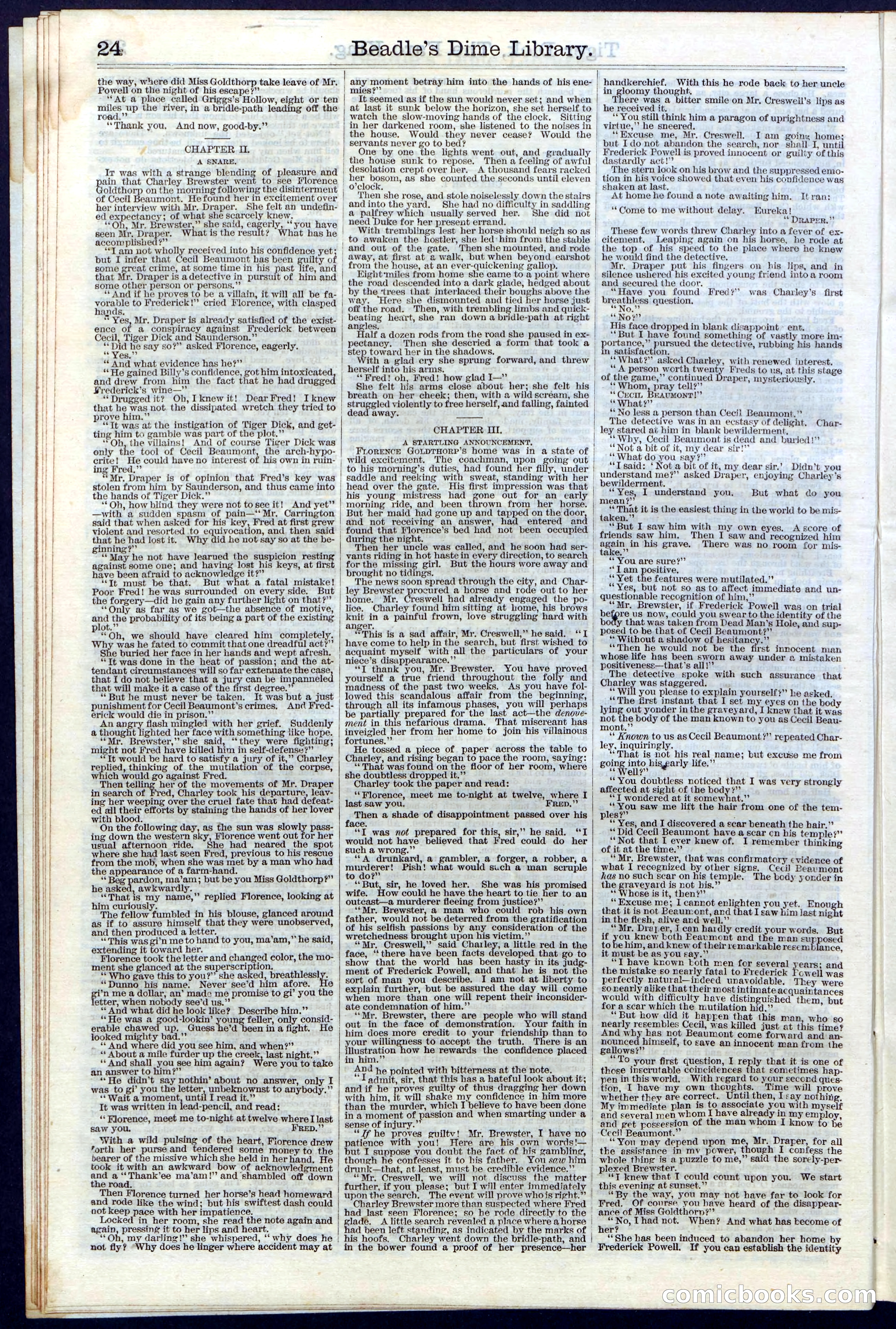
A restored page from Pulp Fiction, 1878. Page through the whole issue in the reader above.
📄 Transcribed text from this page (OCR, searchable)
Machine-transcribed from the original scan — historical spelling and the odd misread are preserved.
24; i es the way, where did Miss Goldthorp take leave of Mr. | Powell on the night of his escape?” “At a place called Griggs’s Hollow, eight or ten sea up the river, in a bridle-path leading off the road. ‘“Thank you. And now, good-by.” CHAPTER I. A SNARE, Ir was with a strange blendin ain that Charley Brewster wen toldthorp on the morning following the disinterment | of Cecil Beaumont. He found her in excitement over her interview with Mr. Draper. She felt an undefin- ed expectancy; of what she scarcely knew, ‘“Oh, Mr. Brewster,” she said, eagerly, ‘you have seen Mr. Draper. What is the result? "What bas he accomplished ?”’ ““T am not wholly received into his confidence yet; but I infer that Cecil Beaumont has been guilty o some great crime, at some time in his past life, and that Mr. Draper is adetective in pursuit of him and some other person or persons,” ‘‘ And if he proves to be a villain, it will all be fa- votalls to Frederick!” cried Florence, with clasped ands, * Yes, Mr. Draper is already satisfied of the exist- ence of a conspiracy against Frederick between Cecil, Tiger Dick and Saunderson.”’ ‘“Did he say so?” asked Florence, eagerly. &é Yes bP] of pleasure and | to see Florence | “And what evidence has he?” “He gained Billy’s confidence, got him intoxicated and drew from him the fact that he had drugged Vrederick’s wine—”’ “Drugged it? Ob, I knew it! Dear Fred! I knew that he was not. the dissipated wretch they tried to prove him,” : . “Tt was at the instigation of Tiger Dick, and get- ting him to gamble was part of the plot.” ‘*Oh, the villains! And of course Tiger Dick was only the tool of Cecil Beaumont, the arch-hypo- crite! He could have no interest of his own in ruin- ing Fred,”’ ‘Mr. Draper is of opinion that Fred’s key was stolen from him by Saunderson, and thus came into the hands of Tiger Dick.” ‘*Oh, how blind they were not tosee it! And yet” —with a sudden spasm of pain—‘‘Mr, Carrington said that when asked for his key, Fred at first grew violent and resorted to equivocation, and then said that he had lost it. Why did he not say so at the be- ginning?” a ‘* May he not have learned the suspicion resting against some one; and having lost his keys, at first have been afraid to acknowledge it?” : “Yt must be that. But what a fatal mistake! Poor Fred! he was surrounded on every side. But the forgery—did he gain any further light on that?’’ “Only as far as we got—the absence of motive, and the probability of its being a part of the existing lot.” pie Oh, we should have cleared him completely. Why was he fated to commit that one dreadful act?” She buried her face in her hands and wept afresh. ‘Tt was done in the heat of passion; and the at- | tendant circumstances will so far extenuate the case that I do not believe that a jury can be impanneled that will make it a case of the first degree.’ , “But he must never be taken. It was but a just punishment for Cecil Beaumont’s crimes, And Fred- erick would die in prison.”’ Anangry flash mingled with her grief. Suddenly a thought lighted her face with something tike hope. ‘‘Mr. Brewster,’’ she said, “‘they were fighting; might not Fred have killed him im self-defense?” ‘“*Tt would be hard to satisfy a jury of it,’ Charley replied, thinking of the mutilation of the corpse, which would go against Fred. Then telling her of the movements of Mr. Draper in search of Fred, Charley took his departure, leav- ing her weeping over the cruel fate that had defeat- ed og et efforts by staining the hands of her lover wit ood. On the forewing tee as the sun was slowly pass- ing down the western sky Florence went out for her usual afternoon ride. “She had neared the spot where she had last seen Fred, previous to his rescue from the mob, when she was met by a man who had the appearance of a farm-hand. Je don, ma’am; but be you Miss Goldthorp?” he asked, awkwardly. “That is my name,’’ replied Florence, looking at him curiously, The fellow fumbled in his blouse, glanced around as if to assure himself that they were unobserved, and then produced a letter. St ‘ “This was gi’n me to hand to you, ma’am,” he said, extending it toward her. Florence took the letter and changed color, the mo- ment she glanced at the superscription, ‘Who gave this to you?” she asked, Sport gC “Dunno his name, Never see’d him afore. He 385 me a dollar, an’ made me promise to gi’ you the etter, when nobody see’d us.” ** And what did he look like? Describe him.” | “He was a good-lookin’ youn feller, only consid- erable chawed up. Guess he’d been in a fight. He looked re, it bad.”’ . * And where did you see him, and when?” “‘ About a mile furder up the creek, last night.” ‘* And shall you see him again? Were you to take an answer to him?” ‘He didn’t say nothin’ about no answer, only I was to gi’ you the letter, unbeknownst to anybody.” ‘Wait a moment, until I read it.” It was written in lead-pencil, and read: ‘‘ Florence, meet me to-night at twelve where I last saw you. FRED.”’ With a wild ae of the heart, Fiorence drew forth her purse and tendered some money to the bearer of the missive which she held in herhand. He took it with an awkward bow of acknowledgment | and a ‘“‘Thank’ee ma’am!” and shambled off down the road. Then Florence turned her horse’s head homeward and rode like the wind; but his swiftest dash could not keep pace with her impatience. Locked in her room, she read the note again and again, pressing it to her lips and heart. st h, my darjing!’’ she whispered, “‘ why does he | not fly? “Why does he linger where accident may at _ the house sunk to repose. | o’clock, _ from the house, at an ever-quickening gallop. | beating heart, she ran down a bridle-path at right herself into his arms. BED OE HNO fobtary: any moment betray him into the hands of his ene- mies?” It seemed as if the sun would never set; and when at last it sunk below the horizon, she set herself to | watch the slow-moving hands of the clock. Sitting in her darkened room, she listened to the noises in the house. Would they never cease? Would the servants never go to bed? One by one the lights went out, and gradually | | Then a feeling of awful desolation crept over her. A thousand fears racked her bosom, as she counted the seconds until eleven | Then she rose, and stole noiselessly down the stairs and into the yard. She had no difficulty in saddling a palfrey which usually served her. She did not need Duke for her present errand. With tremblings lest her horse should neigh so as to awaken the hostler, she led: him from the stable and out of the gate. Then she mounted, and rode away, at first at a walk, but when beyond earshot Kight*miles from home she came to a point where the road descended into a dark glade, hedged about by the ‘trees that interlaced their boughs above the way. “Here she dismounted and tied her horse just | off the road. Then, with trembling limbs and quick- angles. Half a dozen rods from the road she paused in ex- | pectancy. Then she descried a form that took a | per toward her in the shadows, ith a glad ery she sprung forward, and threw ““Fred! oh, Fred! how glad Il—”’ She felt his arms close about her; she felt his breath on her cheek; then, with a wild scréam, she struggled violently to free herself, and falling, fainted dead away. CHAPTER III, A STARTLING ANNOUNCEMENT, Frorence GouptTHorr’s home was in a state of wild excitement. The coachman, upon going out to his morning’s duties, had found her filly, under saddle and reeking with sweat, standing with her head over the gate. His first impression was that his young mistress had gone out for an early morning ride, and been thrown from her horse. But her maid had gone up and fernes on the door and not receiving an answer, h entered and found that florence’s bed had not been occupied | during the night. Then her uncle was called, and he soon had ser- vants riding in hot haste in every direction, to search for the missing girl. But the hours wore away and brought no tidings. The news soon spread through the city, and Char- ley Brewster procured a horse and rode out to her home. Mr. Creswell had already engaged the po- lice. Charley found him sitting at home, his brows knit in a painful frown, love struggling hard with anger. er hig is a sad affair, Mr. Creswell,” he said. ‘I have come to help in the search, but first wished to acquaint myself with all the particulars of your niece’s disappearance,”’ “TY thank you, Mr. Brewster. You have proved yourself a true friend throughout the folly and | madness of the past two weeks. As you have fol- lowed this scandalous affair from the beginning, through all its infamous phases, you will perhaps be partially prepared for the last act—the denove- — ment in this nefarious drama. That miscreant has | inveizled her from her home to join his villainous fortunes.”’ He tossed a piece of paper across the table to Charley, and rising began to pace the room, saying: “That was found on the floor of her room, where , she doubtless dropped it.” Charley took the paper and read: “Florence, meet me to-night at twelve, where I last saw you, FRep,”’ Then a shade of disappointment passed over his ace. ‘“*T was not prepared for this, sir,’ he said, “TI would not have believed that Fred could do her such a wrong.” “A drunkard, a gambler, a forger, a robber, a pene Pish! what would such a man scruple ra) ’ ‘‘But, sir, he loved her. She was his promised wife. ow could he have the heart to tie her to an outcast—a murderer fleeing from justice?”’ ‘*‘Mr. Brewster, a man who could rob his own father, would not be deterred from the gratification of his selfish set by any consideration of the wretchedness brought upon his victim.”’ “Mr, Creswell,” said Charley, a little red in the face, ‘‘ there have been facts developed that go to show that the world has been hasty in its judg- ment of Frederick Powell, and that he is not the sort of man you describe. I am not at liberty to explain further, but be assured the day will come when more than one will repent their inconsider- ate condemnation of him.” ‘‘Mr, Brewster, there are people who will stand out in the face of demonstration. Your faith in him does more credit to your friendship than to our nee aa to accept the truth. There is an iiustration ow he rewards the confidence placed in him.” And he pointed with bitterness at the note. I admit, sir, that this has a hateful look about it; and if he proves guilty of thus dragging her down with him, it will shake my confidence in him more than the murder, which I believe to have been done in a moment of passion and when smarting under a sense of injury.” “Tf he proves guiltv! Mr, Brewster, I have no patience with you! Here are his own words!— but I suppose you doubt the fact of his gambling, though he confesses it to his father, You sew him drunk—that, at least, must he credible evidence.”’ “Mr. Creswell, we will not discuss the matter further, if you please; but I will enter immediately upon the search. The event will prove whois right.” | Charley Brewster more than suspected where Fred | had last seen Florence; so he rode directly to the gladé. A little search revealed a place where a horse had been left standing, as indicated by the marks of | his hoofs, Charley went down the bridle-path, and in the bower found a proof of her presence—her — handkerchief. With this he rode back to her uncle in gloomy thought, There was a bitter smile on Mr, Creswell’s lips as he received it, _ “You still think him a paragon of uprightness and virtue,’? he sneered. ‘Excuse me, Mr, Creswell. I am going home; _ but Ido not abandon the search, nor shall I, until Frederick Powell is proved innocent or guilty of this dastardly act!” The stern look on his brow and the suppressed emo- tion in his voice showed that even his confidence was ' shaken at last. At home he found a note awaiting him. It ran: “Come to me without delay. Eureka! ‘* DRAPER,” These few words threw Charley into a fever of ex- citement, Leaping again on his horse, he rode at the top of his speed to the place where he knew he would find the detective. Mr. Draper put his fingers on his lips, and in silence ushered his excited young friend into a room and secured the door. “Have you found Fred?” first breathless question, 6s No 9 es No»? Flis face dropped in blank disappoint» ent, “But I have found something of vastly more im- portance,” pursued the detective, rubbing his hands was Charley’s / in satisfaction, , What?” asked Charley, with renewed interest. A person worth twenty Freds to us, at this stage of the game,”’ continued Draper, mysteriously, ‘*Whom, pray tell?” “Crom Beavmonr!” ‘**What?’’ ** No less a person than Cecil Beaumont.” The detective was in an ecstasy of delight. Char- ley stared at him in blank bewilderment, Why, Cecil Beaumont is dead and buried!” ‘Not a bit of it, my dear sir!” ‘What do you say?” “I said: ‘Nota bit of it, my dear sir.’ Didn’t you understand me?’ asked Draper, enjoying Charley's bewilderment. ‘“Yes, I understand you, mean?’ “That it is the easiest thing in the world to be mis- tO But I hi I * Bu saw him with my own eyes. A score of friends saw him. Then I saw and recognized him ny a og his grave. There was no room for mis- ake,’ “You are sure?”’ “Tam powures ‘Yet the features were mutilated.” “Yes, but not so as to affect immediate and un- questionable recognition of him,” “Mr. Brewster, if Frederick Powell was on trial peigre us now, could you swear to the identity of the body that was taken from Dead Man's Hole, and sup- posed to be that of Ceci] Beaumont?” * Without a shadow of hesitancy.” ‘‘Then he would not be the first innocent man whose life has been sworn away under e mistaken positiveness—that's all!’’ The detective spoke with such assurance that Charley was staggered. ‘Will you please to explain yourself?” he acked. ‘The first instant that I set my eyes on the body lying out yonder in the graveyard, I knew that it was not wag body of the man known to you as Cecil Beau- mont. ‘* Known to us as Cecil Beaumont?’ repeated Char- ley, inquiringly. bg ig noe im peal name: but excuse me from going into higgarly life. ‘You doubtless noticed that I was very strongly affected at sight of the body?” ‘**T wondered at it somewhat.” aoe saw me lift the hair from one of the tem- ples?” ‘* Yes, and I discovered a scar beneath the hair.” ‘‘ Did Cecil Beaumont have a scar cn his temple?” “Not that I ever knew of, I remember thinking of it at the time.”’ ‘Mr, Brewster, that was confirmatory ¢vidence of what I recognized by other signs. Cecil Beaumont has no such scar on his temple. The body yonder in the graveyard is not his.” ‘* Whose is it, then?” | rrr pes I cena’ pniigntcn you yet. Enough rat it is not Beaumont, and that I saw him last ni in $3 Bene aie and tne a “Mr. Dreyer, I can har credit your words. if you knew both Besomont and the man a rout to be him, and knew of their remarkable rese eatiance it must he as you fay.” ; ¢ ‘I have known koth men for several years; the mistake co nearly fatal to Frederick Lowell ~= perfectly natural—indeed unavoidable. They were £o nearly alike that their mostintimate acquaintances would with difficulty have distinguished them, but for a scar which the mutilation hid.”’ “But how did it happen that this man, who so nearly resembles Cecil, was killed just at this time? And why has not Beaumont come forward and an nounced himself, to save an innocent man from the gallows?” To your first question, I reply that it is one of those inscrutable ccincidences that sometimes hap- pen in this world. With regard to your second queg- tion, I have my own thoughts. Time will prove whether they are correct.. Until then, I say nothin My immediate plan is to associate you with myse and several men whom I have already in my employ, and get possession of the man whom I know fo he Ceci! Beaumont.” “You may depend upon me, Mr. Draper, for all the assistance in mv power, though I confess the whole thing is a puzzle to me,” said the sorely-per- plexed Brewster. **T knew that T could count upon you. We start this evening at sunset.” “By the way, you may not have far to look for Fred. Of course you have heard of the disappear- ance of Miss Goldthorn?” : . on og Thad not. When? And what has become of er ‘““She has been induced to abandon her home by Frederick Powell. If you can establish the identity But what do you 1ElLONCVO| KS ,E€O) (S(O) im