
Pulp Fiction, 1884 · page 2 of 24
Beadle's New York Dime Library No. 289 — page 2: what you’re looking at
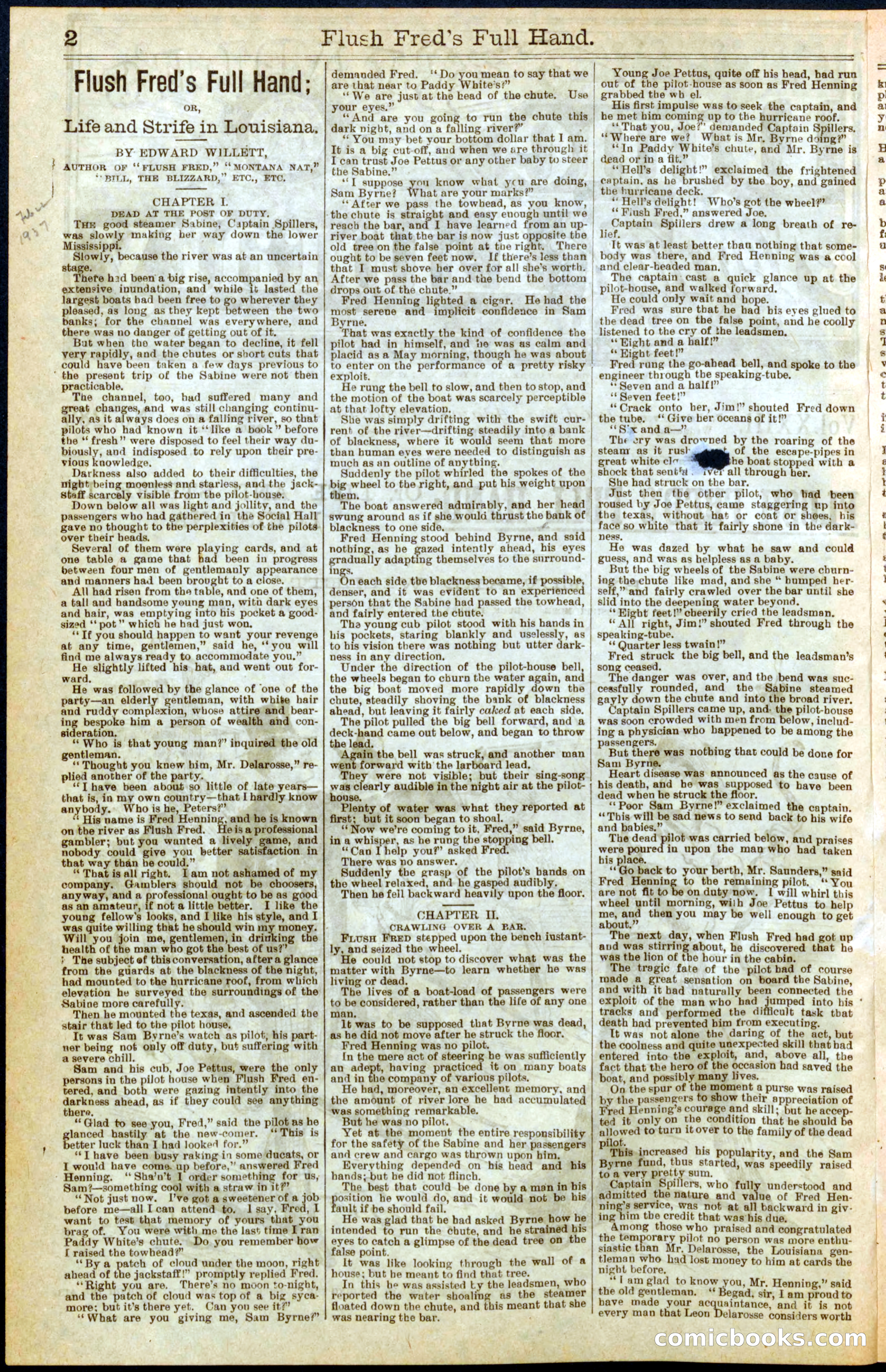
A restored page from Pulp Fiction, 1884. Page through the whole issue in the reader above.
📄 Transcribed text from this page (OCR, searchable)
Machine-transcribed from the original scan — historical spelling and the odd misread are preserved.
2 meee > a ee wee Flush Fred's. Full Hand: Life and Strife in Louisiana, BY EDWARD WILLETT, ' auTHOR or “ FLUSH FRED,” ‘‘ MONTANA NAT,” ‘* BILL, THE BLIZZARD,” ETC,, ETC, CHAPTER I. DEAD AT THE POST OF DUTY. THE good steamer Sabine, Captain Spillers, was slowly making ber way down the lower Mississippi. Slowly, because the river was at an uncertain hefe had been a big rise, accompanied by an extensive inundation, and while it lasted the largest boats bad been free to go wherever they pleased, as long as they kept between the two banks; for the channel was everywhere, and there was no danger of getting out of it. But when tho water began to decline, it fell very rapidly, and the chutes or short cuts that could have been taken a few days previous to ‘ the present trip of the Sabine were not then practicable. The channel, too, had suffered many and great changes, and was still changing continu- ally, as it always does on a falling river, so that pilots who had known it ‘‘like a book” before the * fresh”’ were disposed to feel their way du- biously, and indisposed to rely upon their pre- vious knowledge, _ Darkness also added to their difficulties, the night;being moonless and starless, and the jack- Staff scarcely visible from the pilot-house. Down below all was light and jollity, and the passengers who had gathered in the Social Hall gave no thought to the perplexities of the pilots over their beads. Several of them were ei cards, and at one table a game that Se been in progress between four men of gentlemanly appearance and manners had been brovght to a close. All had risen from the table, and one of them, a tall and handsome young man, with dark eyes and hair, was emptying into his pocket a good- sized ‘‘ pot” which he had just won, ‘* Tf you should happen to want your revenge at any time, gentlemen,” said he, ‘‘ you will find me always ready to accommodate you.” slightly lifted his hat, and went out for- ward, He was followed by the glance of one of the party—an ware dap ap with white hair and ruddy complexion, whose attire and bear- ing bespoke him a person of wealth and con- sideration, wir | “Who is that young man?” inquired the old gentleman. Ter ‘Thought you knew him, Mr. Delarosse,” re- plied another of the party. ‘“T have been about so little of late years— that is, in my own country—that I hardly know anybody. Who is he, Peters?” ak His name is Fred Benning aa is known on the river as Flush Fred. is a professional gambler; but you wanted a lively game, and nobody could give you better sat on in that way than he could.” . “That is all right. Lam not ashamed of my company. Gamblers should not choosers anyway, anda | Moen ought to be as good as an amateur, if not a little better. I like the young fellow’s looks, and I like his style, and I was quite willing that he should win my money. | Will you join me, pentlesse) in drinking the health of the man who got the best of us?” } The subject of this conversation, after a glance from the guards at the blackness of the night, had mounted to the hurricane roof, from which elevation he surveyed the surroundings of the Sabine more carefull y- Then he mounted the texas, and ascended the stair that led to the pilot house, Tt was Sam Byrne’s watch as pilot, his part- ner being not only off duty, but suffering with asevere chill. — . ‘Sam and his cub, Joe Pettus, were the only persons in the pilot house when Flush Fred en- tered, and both were gazing intently into the _— ahead, as if they could see anything ere, “Glad to see you, Fred,” said the pilot as he lanced hastily at the new-comer. ‘ This is tter luck than I had looked for.” **T have been busy raking in some ducats, or I would have come. up before,” answered Fred ‘Henning. ‘ Sha’n’t 1 order something for us, Sam?—something cool with a straw in it?’ “Not just now. I’ve got a sweetener of a job before me—all I can attend to, 1 say, Fred, Ll want to test that memory of yours that you brag of. You were with me the last time I ran Paddy White’s chute. Do you remember how [ raised the towhead?” ‘By a patch of cloud under the moon, right abead of the jackstaff!” promptly replied Fred. _ “Right you are. There’s no moon to-night, and the patch of cloud was top of a big syca- - more; but it’s there yet. Can you see it?” ‘‘What are you giving me, Sam Byrne?” lush Fred’s Full Hand. —- té Do are that near to Paddy ‘‘We are just at the kead of the chute. your eyes,”’ | “And are you going to run the chute this | dark night, and on a falling river?” | ** You may bet your bottom dollar that I am. It is a big cut-off, and when we are through it | I can trust Joe Pettus or any other baby tw steer the Sabine.” ‘‘T suppose you know what ycu are doing, Sam Byrne? hat are your marks?” ‘* After we pass the towbead, as you know, the chute is straight and easy enough until we reach the bar, end I have learned from an up- river boat that the bar is now just kN the old tree on the false point at the right. There — ought to be seven feet now, If there’s less than | that I must shove her over for all she’s worth. | After we pass the bar and tie bend the bottom drops out of the chute.” | Fred Henning lighted a cigar. He had the most serene and implicit confidence in Sam | Byrne. | That was exactly the kind of confidence the | pilot had in himself, and ne was as calm and placid as a May morning, though he was about to enter on the performance of a pretty risky | exploit. He rung the bell to slow, and then to stop, and | the motion of the boat was scarcely perceptible | at that lofty elevation. | She was simply drifting with the swift cur- | rent of the river—drifting steadily into a bank of blackness, where it would seem that more than human eves were needed to distinguish as | much as an outline of anything. Suddenly the pilot whirled the spokes of the rhe wheel to the right, and put his weight upon them. The boat answered admirably, and her head swung around as if she would thrust the bank of blackness to one side. é- Fred Henning stood behind Byrne, and said nothing, as he gazed intently ahead, his eyes | gradually adapting themselves to the surround- | demanded Fred. hite’s?” Use | ings. On éach side the blackness became, if possible, | denser, and it was evident to an experience person that the Sabine had passed the towhead, and fairly entered the chute. Tha young cub pilot stood with his hands in his pockets, staring blankly and uselessly, as to his vision there was nothing but utter dark- ness in any direction. Under the direction of the pilot-house bell, the wheels began to churn the water again, and the big boat moved more rapidly down the chute, steadily shoving the bank of blackness ahead, but leaving it fairly caked at each side. The pilot pulled the big bell forward, and a deck-hand came out below, and began to throw the lead. Agee the bell was struck, and another man went forward with the larboard lead, They were not visible; but their sing-song was clearly audible in the night air at the pilot- se. Plenty of water was what they reported at first; but it soon began to shoal. “Now we're coming to it, Fred,” said Byrne, in a whisper, as he rung the stopping bell. “Can Lhelp you?’ asked Fr There was Do answer. Suddenly the grasp of the pilot’s bands on the wheel relaxed, and he gasped audibly. Then he fell backward heavily upon the floor. CHAPTER I, CRAWLING OVER A BAR. FiusH FRED ea me upon the bench iustant- ly, and seized the wheel He could not stop to discover what was the matter with Byrne—to learn whether he was The lives of a boat-load of passengers were to be considered, rather than the life of any one man, lt was to be supposed that Byrne was dead, as he did not move after he struck the floor. Fred Henning was no pilot. In the mere act of steering be was sufliciently an aa having practiced it on many boats and in the company of various pilots. He had, moreover, an excellent memory, and the amount of river lore he had accumulated ‘was something remarkable. But he was no pilot. | Yet at the moment the entire responsibility for the safety of the Sabine and her passengers and crew and cargo was thrown upon bim, Everything depended on ‘his head and his hands;-but be did not flinch. 98 The best that could be done by a man in bis osition he would do, and it would not be his ault if he should fail. “his _ He was glad that he had asked Byrne how he intended to run the ¢bute, and hes his eyes to catch a glimpse of the dead tree on the false point. It was like looking through the wall of a house; but be meant to find that tree. In this be was assisted Ly the leadsmen, who reported the water shoaling as the steamer floated down the chute, and this meant that she was nearing the bar. \ ~ mean to say that we | Young Joe Pettus, quite off his head, bad run out of the pilot-house as soon as Fred Henning grabbed the wh el. His first impulse was to seek the captain, and he met bim coming up to the hurricane roof. ‘That you, Joe?’ demanded Captain Spillers. ‘Where are we? What is Mr, Byrne doing?” “In Paddy White’s chute, and Mr. Byrne is dead or in a fit.” ‘‘Hell’s delight!” exclaimed the frightened captain, as he brushed by the boy, and gained the hurricane deck. * Hell’s delight! Who's got the wheel?” *Fiush Fred,” answered Joe, Conta Spillers drew a long breath of re- ief, It was af least better thau nothing that some- body was there, and Fred Henning was a cool and clear-headed man, The captain cast a quick glance up at the pilot-house, and walked forward. He could only wait and hope. Fred was sure that he had bis eves glued to the dead tree on the false point, and he coolly listened to the cry of the leadsmen, ‘Right and a half!” ** Hight feet!” Fred rung the go-ahead bell, and spoke to the _ engineer through the speaking-tube, ‘* Seven and a half!” ‘* Seven feet!” ‘““Crack onto ber, Jim!” shouted Fred down the tube, ‘‘ Give ber oceans of it!” “*S'x and a—” The ery was drowned by the roaring of the steany as it rush of the escape-pipes in great white cle ®. boat stopped with a shock that sent. ivevT all through her, She had struck on the bar. Just then the other pilot, who Wad ‘been roused by Joe Pettus, came staggering up into the texas, without hat or coat or shoes, his face so white that it fairly shone in the dark- ness, He was dazed by what he saw and could guess, and was as helpless as a baby. _ But the big wheels of the Sabine were churn- ing the ehute like mad, and she “ bumped her- self,” and fairly crawled over the bar until she slid into the deepening water beyond, ‘* Bight feet!” cheerily cried the leadsman, * All right, Jim!” shouted Fred through the speaking-tube. ‘‘ Quarter less twain!” Fred struck the big bell, and the leadsman’s song ceased. The danger was over, and the bend was suc- cessfully rounded, and the Sabine steamed gayly down the chute and into the broad river. aptain Spillers came up, and: the pilot-house was soon crowded with men from below, includ- ing a physician who happened to be among the passengers. ‘ But hee was notbing that could be done for Sam Byrne ‘ bina aia Loe peecnuce the cause of s death, an 6 was supposed to ha dead when he struck the floor. raat ‘‘Poor Sam Byrne!” exclaimed the captain. “This will be sad news to send back to his wife and babies.” , The dead pilot was carried below, and praises were poured in upon the man who had taken his place. ‘*Go back to your berth, Mr. Saunders,” said Fred gn the remaining pilot. “ You are not fit to be on duty now. I will whirl this wheel ee morning, wiih Joe Pettus to help then you may be well enough to get The next day, when Flush Fred had got u avd was stirring about, he discovered that “4 was the lion of the hour in the cabin. The tragic fate of the pilot bad of course roade a great sensation on the Sabine, and with it bad naturally been connected the exploit of the man who had jumped into bis ‘ tracks and performed the difficult task tbat death had prevented bim from executing, It was not alone the daring of the act, but the coolness and quite unexpected skill that bad entered into the exploit, and, above all, the fact that the hero of the occasion had saved the boat, and possibly many lives. On the spur of ip moment a purse was raised by the passengers to show their appreciation of Fred Henning’s courage and skill; but he accep- ted it only on the condition that he should cs allowed to turn it over to the family of the dead Mhis-increased his popularity, and the Sam Byrne fund, thus started, was speedily raised to a very metty sum. Captain Spillers, who fully understood and admitted the nature and value of Fred Hen- ning’s service, was not at all backward in giv- ing him tbe credit that was’his due, Among those who praised and congratulated the ey eg pilot no person was more enthu- siastic than Mr. Delarosse, the Louisiana gen- tleman who had lost money to him at cards the ss before, ‘Tam glad to know you, Mr. ing,” the old gentleman. ‘“ Begad, ck tele tae have made your pe pamatatiee, and it is not larosse considers worth DOO ve eee every man that Leon com (E ' & 7. P a =. | . ‘s J LI bs ee BL POS © Set, gt : ‘ ai oe > Pp a a b f; a pe i fr He Dw se OB eo A ae = a hte ete ee ak 2 Le