
Pulp Fiction, 1884 · page 18 of 24
Beadle's New York Dime Library No. 289 — page 18: what you’re looking at
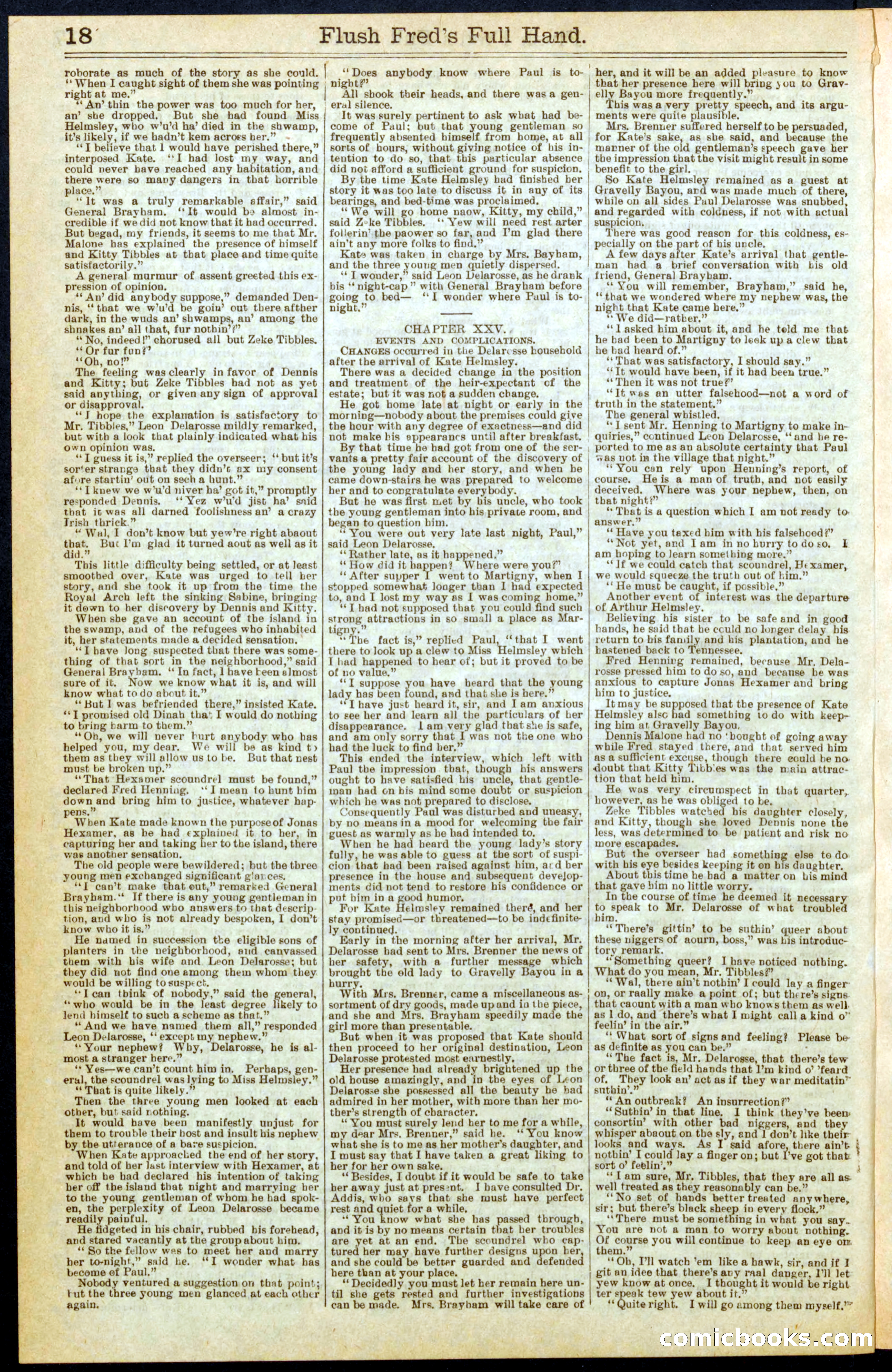
A restored page from Pulp Fiction, 1884. Page through the whole issue in the reader above.
📄 Transcribed text from this page (OCR, searchable)
Machine-transcribed from the original scan — historical spelling and the odd misread are preserved.
7 “ her to-night,” said he. - become of Paul.” 18° Flush Fred’s F ee ae 7 mc a ee ae roborate as much of the story as she could. [ ‘‘Does anybody know where Paul is to- : her, and it will be an added pleasure to know ‘* When I caught sight of them she was pointing , night?’ right at me.” All shook their heads, and there was a gen- ‘‘ An’ thin the power was too much for her, | eral silence. an’ she dropped. But she had found Miss Helmsley, who w’u’d ha’ died in the shwamp, it’s likely, if we hadn’t kem acroers her.” .- ‘*T believe that 1 would have perished there,” interposed Kate. ‘‘I had lost my way, and could never bave reached any habitation, and there were so many dangers in tbat borrible place.” “It was a truly remarkable affair,” said General Brayham. ‘It would be almost in- credible if we did not know that it had occurred. But begad, my friends, it seems to me that Mr. Malone has explained the presence of himself and Kitty Tibbles at that place and time quite satisfactorily.” A general murmur of assent greeted this ex- pression of opinion. ** An’ did anybody suppose,” demanded Den- nis, ‘‘ that we w’u’d be goin’ out there afther dark, in the wuds an’ shwamps, an’ among the shnakes an’ all that, fur nothin’?” * No, indeed!” chorused all but Zeke Tibbles. **Or fur fun?’ *€QOh, no!” The feeling wasclearly infavor of Dennis and Kitty; but Zeke Tibbles had not as yet said anything, or given any sign of approval or disapproval. ‘“*T hope the explanation is satisfactory to Mr. Tibbies,” Leon Delarosse mildly remarked, but with a look that plainly indicated what his own opinion was. ‘*T guess it is,” replied the overseer; ‘‘ but it’s sor‘er strange that they didn’s ax my consent afore startin’ out on sech a hunt.” ‘*T_ knew we w’u'd niver ha’ got it,” promptly responded Dennis, ‘‘ Yez w’u'd jist ha’ said that ic was all darned foolishness an’ a crazy Trish thrick.” “ Wal, I don’t know but yew’re right abaout ag! But ’m glad it turned aout as well as it This little difficulty being settled, or at least smoothed over, Kate was urged to tell ber story, and she took it up from the time the Royal Arch left the sinking Sabine, bringing it dewn to her discovery by Dennis and Kitty. When she gave an account of the island in the swamp, and of the refugees who inhabited it, her statements made a decided sensation, ‘‘T have Jong suspected that there was some- thing of that sort in the neighborhood,” said General Braybam. “ In fact, 1 have been almost sure of it. Now we know what it is, and will know what todo about it.” ** But I was befriended there,” insisted Kate. ‘**T promised old Dinah tha’ I would do nothing to bring barm to them.” “Oh, we will never burt anybody who has helped you, my dear. We will be as kind t> them as they will allow usto be. But that nest must be broken up.” ‘“‘That Hexamer scoundrel must be found,” declared Fred Henning. ‘‘ I mean to hunt bim down and bring him to justice, whatever hap- ns, When Kate made known the purposeof Jonas examer, as be had explained it to her, in capturing her and taking her to the island, there was another sensation. The old people were bewildered; but the three _-- young men exchanged significant g'ances, Tf can’t make that out,” remarked General Braybam.* If there is any young gentleman in y Ez this neighborbood who answers to that descrip- tion, and who is not already bespoken, I don’t know who it is.” He named in succession the eligible sons of planters in the neighborbood, and canvassed them with bis wife and Leon Delarosse; but they did not find one among them whom they. - would be willing to suspect. “Ican tbink of nobody,” said the general, “who would be in the least degree likely to lend himself to such a scheme as that.” ‘And we have named them all,” responded Leon Delarosse, ‘‘ except my nephew.” “Your nephew? Why, Delarosse, he is al- _ most a stranger here.” ‘* Yes—we can’t count him in. Perhaps, gen- the scoundrel was ] ying to Miss Helmsley.” That is quite likely.” Then the three young men looked at each other, but said nothing. It would bave been manifestly unjust for _ them to trouble their bost and insult bis nephew by the utterance of a bare suspicion. “When Kate approacbed the end of her story, and told of ber Jast interview with Hexamer, at which be had declared his intention of taking ber off the island that night and marrying her to the young gentleman of whom he had spok- en, the perplexity of Leon Delarosse became readily painful, He fidgeted in his chair, rubbed bis forehead, , and stared vacantly at the groupabout him. ‘¢ So the fellow was to (pet nef apes erag hs wonder what has Nobody ventured a suggestion on that point; but the three young men glanced at each ether It was surely pertinent to ask what had be- | that her presence here will bring )ou to Grav- come of Paul; but that young gentleman so frequently absented himself from home, at all sorts of hours, without giving notice of bis in- tention to do so, that this particular absence did noi afford a sufficient ground for suspicion. story it was too late to discuss it in any of its bearings, and bed-time was proclaimed, ‘*We will go home naow, Kitty, my child,” said Zeke Tibbles. ‘* Yew will need rest arter folierin’ the paower so far, and I’m glad there | ain’t any more folks to find,” Kate was taken in charge by Mrs. Bayham, and the three young men quietly dispersed. ‘* T wonder,” said Leon Delarosse, as he drank bis *‘ night-cap” with General Brayham before going to bed— ‘I wonder where Paul is to- night.” CHAPTER XXYV. EVENTS AND COMPLICATIONS. CHANGES occurred in the Delarcsse household after the arrival of Kate Helmsley. There was a decided change in the position and treatment of the heir-expectant of the estate; but it was not a sudden change. He got home late at night or early in the morning—nobody about the premises could give the hour with any degree of exactness—and did not make his sppearancs until after breakfast. By that time he had got from one of the ser- vants a pretty fair account of the discovery of the young lady and her story, and when he came down-stairs he was prepared to welcome her and to congratulate everybody. But he was first met by bis uncle, who took the young gentleman into bis private room, and began to question bim. ‘* You were out very late last night, Paul,” said Leon Delarosse, ‘*Rather late, as it happened.” ‘‘ How did it happen? Where were you?” ‘‘ After supper I went to Martigny, when I stopped somewhat longer than I saws expected to, and I lost my way as I was coming home,” ‘‘T had not supposed that you could find such strong attractions in so small a place as Mar- tigny.” “The fact is,” replied Paul, ‘that I went there to look up a clew to Miss Helmsley which I had happened to hear of; but it proved to be of no value,” ‘‘T suppose you have heard that the young lady has been found, and that she is here.” ‘*T have just heard it, sir, and [am anxious to see her and learn all the particulars of ber disappearance. lam very glad that she is safe, and am only sorry that I was not the one who had the luck to find ber,” This ended the interview, which left with Paul the impression that, though his answers ought to have satisfied his uncle, that gentie- inan had on his mind some doubt or suspicion which he was not prepared to disclose, Consequently Paul was disturbed and uneasy, by no means ina mood for welcoming the fair guest as warmly as be had intended to. When he had heard the young lady’s story fully, he was able to guess at the sort of suspi- cion that had been raised against bim, ard ber presence in the house and subsequent develop- ments did not tend to restore his confidence or put him in a good humor, For Kate Helmsley remained theré, and ber stay promised—or threatened—to be indefinite- ly continued. Early in the morning after her arrival, Mr. Delarosse bad sent to Mrs. Brenner the news of her safety, with a further message which brought the eld lady to Gravelly Bayou in a hurry. With Mrs, Brenner, came a miscellaneous as- sortment of dry goods, made upand ia the piece, and she and Mrs. Brayham speedily made the girl more than presentable. But when it was proposed that Kate should then proceed to her original destination, Leon Delarosse protested most earnestly, Her presence had already brightened up the old house amazingly, and in the eyes of Leon Delarosse she possessed all the beauty be had admired in her mother, with more than her mo- ther’s strength of character. “You must surely lend ber to me for a while, my dear Mrs. Brenner,” said he. ‘*‘ You know what she is to me as her mother’s daughter, and I must say that I have taken a great liking to her for her own sake. ‘* Besides, I doubt if it would be safe to take ber away just at pressnt. I bave consulted Dr. Addis, wbo says that she must have perfect rest and quiet for a while, ‘You know what she has passed through, and it is by no means certain that ber troubles are yet at an end. The scoundrel who cap- tured her may have further designs upon ber and she could be better guarded and efended here than at your place. “Decidedly you mast let her remain here un- til she gets rested and further investigations can be made. Mrs. Braybam will take care of ' man nen rr nen ene neem en eee EE Ss elly Bayou more frequently.” his was a very pretty speech, and its argu- ments were quite plausible. Mrs. Brenner suffered herself to be persuaded, for Kate’s sake, as she said, and because the manner of the old gentleman’s speech gave her the impression that the visit might result in some . benefit to the girl. By the time Kate Helmsley bad finished ber | So Kate Helmsley remained as a guest at Gravelly Bayou, and was made much of there, while on all sides Puul Delarosse was snubbed, and regarded with coldness, if not with actual suspicion, There was good reason for this coldness, es- | pecially on the pert of bis uncle, A few days after Kate’s arrival that gentle- had a brief conversation with his old friend, General Braybam. ‘* You will remember, Brayham,” said he, ‘that we wondered where my nepbew was, the night that Kate came bere,” ‘** We did—ratber,” ‘*l asked him about it, and he teld me that he bad been to Martigny to leck up a clew that he bad heard of.” ‘* That was satisfactory, I should say.” ‘‘It would have been, if it had been true.” ‘*Then it was not true?’ “It was an utter falsehood—not a word of truth in the statement.” The general whistled, ‘| sent Mr. Henning to Martigny to make in- quiries,” continued Leon Delarosse, ‘and he re- ported to me as an absolute certainty that Paul was not im the village that night.” ‘You can rely upon Henning’s report, of course. Heis a man of truth, and not easily deceived. Where was your nepbew, then, on that night?” “That is a question which I am not ready to answer,” “Have you taxed him with his falsehood?” ‘Not yet, and Lam in noburry todoso, I am hoping to Jearn something more.” ‘If we could catch that scoundrel, He xamer, we would squeeze the truth out of him.” ‘He must be caught, if possible.” Another event of interest was the departure of Arthur Helmsley. Believing his sister to be safe and in good hands, he said that be could no longer delay bis return to bis family and his plantation, and he hastened back to Tennessee. Fred Henning remained, because Mr, Dela- rosse pressed him to do so, and because be was anxious to capture Jonas Hexamer and bring him to justice, It may be oy ee that the presence of Kate Helmsley alsc had something to do with keep- ne Oe at Gravelly Bayou, ennis Malone bad no ‘bought of going away while Fred stayed there, and that served him as a sufficient excuse, though there eould be no doubt that Kitty Tibb'es was the main attrac- tion that held him. He was very circumspect in that however, as he was obliged to be, Zeke Tibbles watched his daughter closely, and Kitty, though she loved Dennis none the less, was determined to be patient and risk no more escapades, But the overseer had something else to do with his “78 besides keeping it on bis daughter. About this time he bad a matter on his mind that gave him no little worry. In the course of time he deemed it necessary to speak to Mr. Delarosse of what troubled quarter, im. ‘“There’s gittin’ to be suthin’ queer about these niggers of aourn, boss,” was his introduc- tory remark, “Something queer? I have noticed nothing. What do you mean, Mr. Tibbles?” “Wal, there ain’t nothin’ I could lay a finger on, or raally make a point of; but there’s signs that caount witb a man who knows them as well. as | do, and there’s what I might calla kind o” feelin’ in the air.” ‘* What sort of signs and feeling? Please be as definite as you can be.” . “The fact is, Mr. Delarosse, that there’s tew or three of the field hands that I’m kind o° ’feard of, They look an’ act asif they war meditatin™ suthin’.” . “An outbreak? An insurrection?” ““Sutbio’ in that line, 1 think they’ve beem consortin’ with other bad niggers, and the whisper abaout on the sly, and | don’t like their lookh pee wa . ag I said ateoenere rine nothin’ 1 could Jay a finger on; but I’ve got tha sort o’ feblin’,” x , ’ : ‘“‘l am sure, Mr, Tibbles, that they are all as well treated as they reasonably can be.” ‘‘No set of hands better treated anywhere, sir; but there’s black sheep in every flock.” — ‘There must be something in what you say. You are not a man to worry about nothing. Of course you will continue to keep an eye om them.” ‘Ob, I'll watch ’em like a hawk, sir, and if I git an idee that there’s any raal danger, I’]l Jet yew know at once, I thought it would be right ter speak tew yew aboutit.” | Ae ) =a a a > ‘Quite right. I will go among them myself.” Re ~ were