
Pulp Fiction, 1878 · page 27 of 32
Beadle's New York Dime Library No. 28 — page 27: what you’re looking at
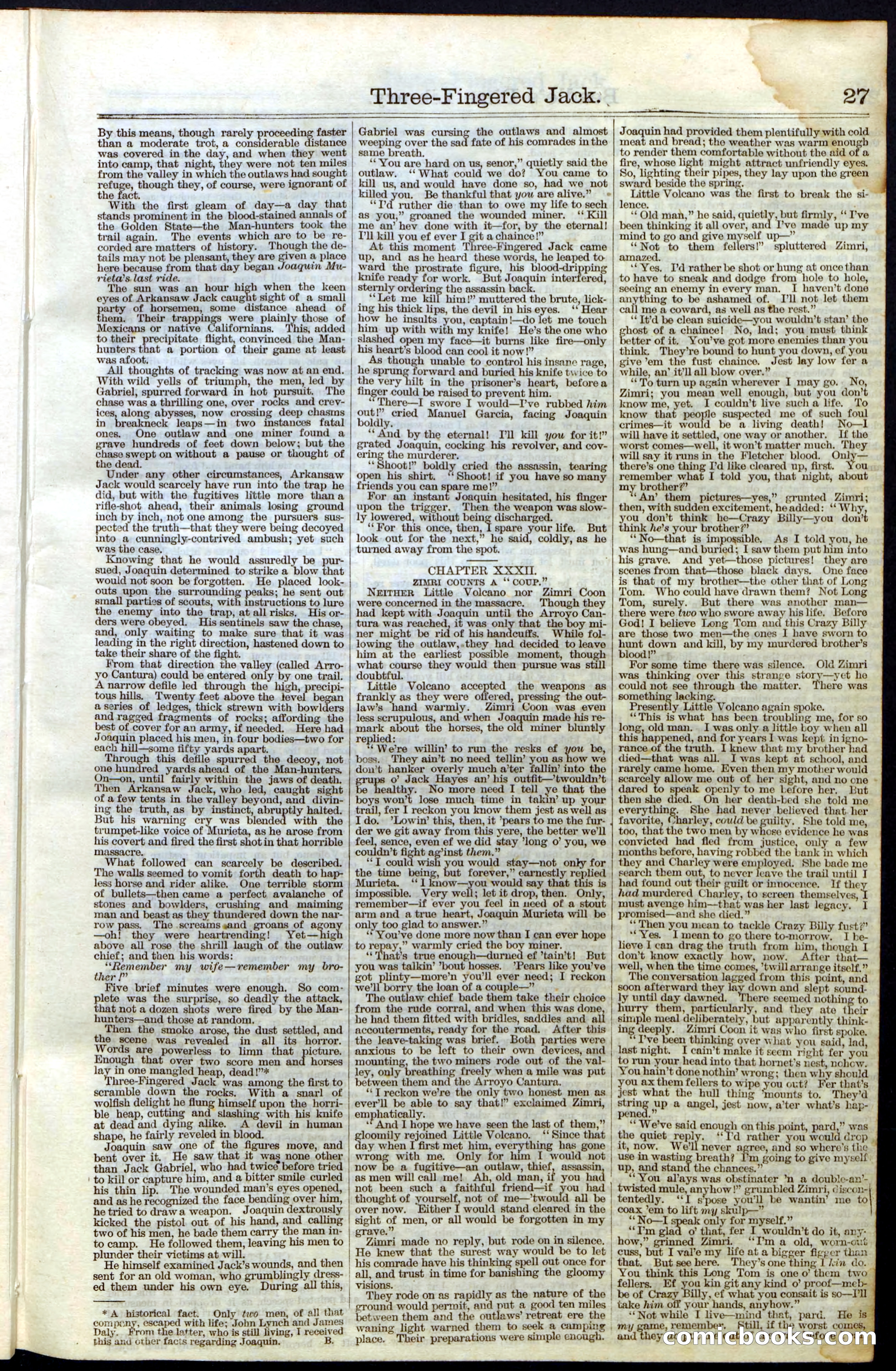
A restored page from Pulp Fiction, 1878. Page through the whole issue in the reader above.
📄 Transcribed text from this page (OCR, searchable)
Machine-transcribed from the original scan — historical spelling and the odd misread are preserved.
le . By this means, though rarely proceeding faster than a moderate trot, a considerable distance was covered in the day, and when they went into camp, that night, they were not ten miles from the valley in which the outlaws had sought the With the first gleam of day—a day that stands prominent in the blood-stained annals of the Golden State—the Man-hunters took the trail again. The events which are to be re- corded are matters of history. Though the de- tails may not be pleasant, they are an a place here because from that day began Joaquin Mu- rieta’s. last ride. The sun was an hour high when the keen eyes of Arkansaw Jack caught sight of a small pares of horsemen, some distance ahead of hem. Their trappings were plainly those of Mexicans or native Californians. This, added to their a flight, convinced the Man- hunters that a portion of their game at least was afoot, _ All thoughts of tracking was now at an end. With wild yells of triumph, the men, led by Gabriel, spurred forward in hot pursuit. The chase was a thrilling one, over rocks and crev- ices, along abysses, now crossing deep chasms in breakneck leaps—in two instances fatal ones. One outlaw and one miner found a vrave hundreds of feet down below; but the chase swept on without a pause or thought of the dead. Under any other circumstances, Arkansaw Jack would scarcely have run into the trap he did, but with the fugitives little more thana rifle-shot ahead, their animals losing ground inch by inch, not one among the pursuers sus- pected the truth—that they were being decoyed into a cunningly-contrived ambush; yet such was the case. Knowing that he would assuredly be pur- sued, Joaquin determined to strike a blow that would not soon be forgotten. He placed look- outs upon the pacgnaing peaks; he sent out small parties of scouts, with instructions to lure the enemy into the trap, at allrisks. His or- ders were obeyed. His sentinels saw the chase, and, only waiting to make sure that it was leading in the right direction, hastened down to take their share of the fight. From that direction the valley (called Arro- yo Cantura) could be entered only by one trail. A narrow defile led through the high, precipi- tous hills. Twenty feet above the level be aseries of ledges, thick strewn with bowlders and ragged fragments of rocks; affording the best of cover for an army, if needed. Here had Joaquin placed his men, in four bodies—two for each hill—some fifty yards apart. Parongs this defile spurred the decoy, not one hundred yards ahead of the -hun On—on, until fairly within the jaws of death. Then Arkansaw Jack, who led, caught sight of a few tents in the valley beyond, and _ divin- ing the truth, as by instinct, abruptly halted. But his warning te was blended with the trumpet-like voice of Murieta, as he arose from his covert and fired the first shot in that horrible massacre. What followed can scarcely be described. The walls seemed to vomit forth death to hap- less horse and rider alike. One terrible storm of bullets—then came a perfect avalanche of stones and bowlders, crushing and maiming man and beast as they thundered down the nar- row pass. The screamssand groans of agony —oh! they were heartrending! Yet—hig above all rose the shrill laugh of the outlaw chief; and then his words: ‘‘Remember my wife—remember my bro- ther |” Five brief minutes were enough. So com- plete was the surprise, so deadly the attack, that not a dozen shots were fired by the Man- hunters—and those at random. Then the smoke arose, the dust settled, and the scene was revealed in all its horror. Words are powerless to limn that Knough that over two score men an lay in one mangled heap, dead!”* hree-Fingered Jack was among the first to scramble down the rocks, With a snarl of wolfish delight he flung himself upon the horri- ble heap, cutting and slashing with his knife at dead and dying alike. A devil in human shape, he fairly reveled in blood. icture. horses Joaquin saw one of the figures move, and bent over it. He saw that it was none other than Jack Gabriel, who had twice before tried ‘to kill or capture him, and a bitter smile curled his thin lip. The wounded man’s eyes opened, and as he recognized the face bending over him, he tried to drawa weapon. Joaquin dextrously kicked the pistol out of his hand, and calling two of his men, he bade them carry the man in- tocamp. He followed them, leaving his men to plunder their victims at will. He himself examined Jack’s wounds, and then Three-Fingered Jack. | Gabriel was cursing the outlaws and almost weeping over the sad fate of his comrades in the same breath. ‘*'You are hard on us, senor,” quietly said the outlaw. ‘ What could we do? You came to reegey Uaoege they, of course, were ignorant of | kill us, and would have done so, had we not act. killed you. Be thankful that you are alive.” =» “I'd ruther die than to owe my life to sech as you,” groaned the wounded miner. ‘“ Kill me an’ hev done with it—for, by the eternal! Pll kill you ef ever I git a chaince!” At this moment Three-Fingered Jack came up, and as he heard these words, he leaped to. ward the prostrate figure, his blood-dripping knife ready for work. But Joaquin interfered, sternly ordering the assassin back. _ ‘Let me kill him!” muttered the brute, lick- ing his thick lips, the devil in hiseyes. ‘‘ Hear how he insults you, captain!—do let me touch him up with with my knife! He’s the one who slashed open my face—it burns like fire—only his heart’s blood can cool it now!” As though unable to control his insane rage, he sprung forward and buried his knife twice to the very hilt in the prisoner’s heart, before a finger could be raised to prevent him. ‘There—I swore I would—I’ve rubbed him out!” cried Manuel Garcia, facing Joaquin boldly. ‘‘And by the eternal! Ill kill you for it!” grated Joaquin, cocking his revolver, and cov- ering the murderer. ** Shoot!” boldly cried the assassin, tearing open his shirt. ‘Shoot! if you have so many friends you can s me!” For an instant Joaquin hesitated, his finger upon the trigger. Then the weapon was slow- ly lowered, without Dente discharged. ‘For this once, then, I spare your life. But look out for the next,” he said, coldly, as he turned away from the spot. CHAPTER XXXII. ZIMRI COUNTS A ‘‘ COUP.” NEITHER Little Volcano nor Zimri Coon were concerned in the massacre. Though they had kept with mar at until the Arroyo Can- tura was reached, it was only that the boy mi- ner might be rid of his handcuffs. While fol- lowing the outlaw,.they had decided to leave him at the earliest possible moment, though what course they would then pursue was doubtful. Little Volcano a ‘i the weapons as frankly as they were offered, pressing the out- law’s hand warmly. Zimri Coon was even less scrupulous, and when Jo made his re- mark about the horses, the old miner bluntly replied: ‘* We're willin’ to run the resks ef you be, boss. They ain’t no need tellin’ you as how we don’t hanker overly much a’ter fallin’ into the o’ Jack Hayes an’ his outfit—’twouldn’t be ‘healthy. No more need I tell ye that the boys won’t lose much time in takin’ up your trail, fer I reckon you know them jest as well as Ido. ’Lowin’ this, then, it pears to me the fur- der we git away from this yere, the better we'll feel, sence, even ef we did stay ‘long 0’ you, we couldn’t fight ag’inst them.” __ “*T coul wish ou would stay—not onky for the time being, but forever,” earnestly replied Murieta. ‘‘ 1 know—you would say that is impossible. Very well; let it drop, then. Only remember—if ever you feel in need of a stout arm and a true heart, Joaquin Murieta will be only too glad to answer.” ‘** You’ve done more now than I can ever hope to repay,” warmly cried the boy miner. ‘*That’s true enough—du ef ’tain’t! But you was talkin’ "bout hosses. ’Pears like you’ve ot plinty—more’n you'll ever need; I reckon we'll borry the loan of a couple—” The outlaw chief bade them take their choice from the rude corral, and when this was done he had them fitted with bridles, saddles and ali accouterments, ready for the road. After this the leave-taking was brief. Both parties were anxious to be left to their own devices, and mounting, the two miners rode out of the val- ley, only breathing freely when a mile was put between them and the Arroyo Cantura. ““T reckon we're the only two honest men as ever’ll be able to say that!” exclaimed Zimri, emphatically. ‘‘ And I hope we have seen the last of them,” gloomily rejoined Little Voleano, ‘Since that ay when I first met him, everything has gone thea, with me. Only for him I would not now be a fugitive—an outlaw, thief cg | as men will call me! Ah, old man, if you ha not been such a faithful friend—if you had thought of yourself, not of me—’twould all be over now. ‘Either I would stand cleared in the sight of men, or all would be forgotten in my grave.” 3h Zimri made no reply, but rode on in silence. He knew that the surest way would be to let his comrade have his thinking spell out once for sent for an old woman, who grumblingly dress- | all, and trust in time for banishing the gloomy ed them under his own eye. During all this, * A historical fact. Only two men, of all that company, escaped with life; John Lynch and James Daly. From the latter, who is still living, I received this and other facts regarding Joaquin. B. visions. They rode on as rapidly as the nature of the ground would permit, and put a good ten miles | take him off your hands, any ws’ retreat ere the — waning light warned them to seek a camping , between them and the ou place. Their preparations were simple enough. EEE = ee - ewe + J Sen 3 had provided them plentifully with cold meat and bread; the weather was warm enough to render them comfortable without the aid of a fire, whose light might attract unfriendly eyes. So, lighting their pipes, they lay upon the green sward beside the spring. es Little Volcano was the first to break the si- ence. , ‘Old man,” he said, quietly, but firmly, “ I’ve been thinking it all over, and I’ve made up my mind to go and give myself up—” rant “Not to them fellers!” spluttered Zimri, amazed. ‘“Yes. I’d rather be shot or hung at once than to have to sneak and dodge from hole to hole, seeing an enemy in every man. I haven’t done anything to be ashamed of. I'll not let them call me a coward, as well as the rest.” ‘* Tt’d be clean suicide—you wouldn’t stan’ the host of a chaince! No, lad; you must think tter of it. You've got more enemies than you think. They’re bound to hunt you down, ef you give ’em the fust chaince. Jest lay low fer a while, an’ it’ll all blow over.” “To turn up again wherever I may go. No, Zimri; you mean well enough, but you don’t know me, yet. I couldn’t live such a life. To know that people suspected me of such foul crimes—it would be a living death! No—l will have it settled, one way or another, If the worst comes—well, it won’t matter much. They will say it runsin the Fletcher blood, Only— there’s one thing Id like cleared up, first. You, remember w I told you, that night, about my brother?” ‘An’ them pictures—yes,” grunted Zimri; then, with sudden excitement, he added: ‘‘ Why you don’t think he—Crazy Billy—you don’ think he’s your brother?” ‘‘No—that is impossible, As I told you, he was hung—and buried; I saw them put him into is grave. And yet—those pictures! they are scenes from that—those black days. One face is that of my brother—the other that of Long Tom. Who could have drawn them? Not Long Tom, surely. But there was another man— there were two who swore away his life. Before God! I believe Long Tom and this Crazy Billy are those two men—the ones I have sworn to hunt down and kill, by my murdered brother’s blood!” For some time there was silence. Old Zimri was thinking over this strange story—yet he could not see through the matter. There was sg ee lacking. Presently Little Voleano again spoke. “This is what has been troubling me, for so long, old man. I was only a little boy when all this hap ed, and for years 1 was kept in igno- rance.of the truth. I knew that my brother had died—that was all. I was kept at school, and rarely came home. Even then my mother would scarcely allow me out of her sight, and no one dared openly to me before her. But then she died. On her death-bed she told me eve a had never believed that. her favorite, Vharley, could be guilty, She told me, too, that the two men by whose evidence he was convicted fled from justice, only a few months before, having robbed the bank in which they and Charley were scaplosert: She bade me search them out, to never leave the trail until I had found out their guilt or innocence. If the had murdered Charley, to screen themselves, must avenge him—that was her last legacy. I promised—and she died.” ‘Then you mean to tackle Crazy Billy fust?” _““Yes. Imean to go there to-morrow. I he- lieve 1 can drag the truth from him, though I don’t know exactly how, now. After that— well, when the time comes, ‘twill arrange itself.” The conversation lagged from this point, and soon afterward they any gown and slept sound- ly until day dawned. ere seemed nothing to h them, particularly, and they ate their : simple meal deliberately, but apparently think- ing deeply. Zimri Coon it was who first spoke. ‘I’ve been thinking over what you said, lad, last night. I cain’t make it seem right fer you to run your head into that hornet’s nest, nohow. You hain’t done nothin’ wrong; then why should hat ax them fellers to wipe you out? Fer that’s est what the hull thing ‘mounts to. They’d oe ing up a angel, jest now, a’ter what's hap-. ‘ We've said enough on this poin d,” was _ the quiet reply, ‘Td rather’ 3 woul drop it, now. Weill never aan and so where's the — use in wasting breath? going to give myself. up, and stand the chances.” “You al’ays was obstinater ’n a double-an’- twisted mule, anyhow !” grumbled Zimri, Ciscon- tentedly. ‘‘I s'pose you'll be wantin’ me to} “Tm Q’ inate ter I_wouldn’t do it, any- cuss, e my life ata er figger . that. Butsee here. They’s ane wae ite do. You think this Long Tom is one o’ them twe fellers. Ef you kin git any kind o’ proof—me be of Cr pats 2 EDGY Oe ree t is so—I’l ow. e- ‘*Not while I live—mind that, pard. ce omiche if the worst i COMICDOOKS:. CO 4 ee ~ . if J