
Pulp Fiction, 1884 · page 21 of 32
Beadle's New York Dime Library No. 271 — page 21: what you’re looking at
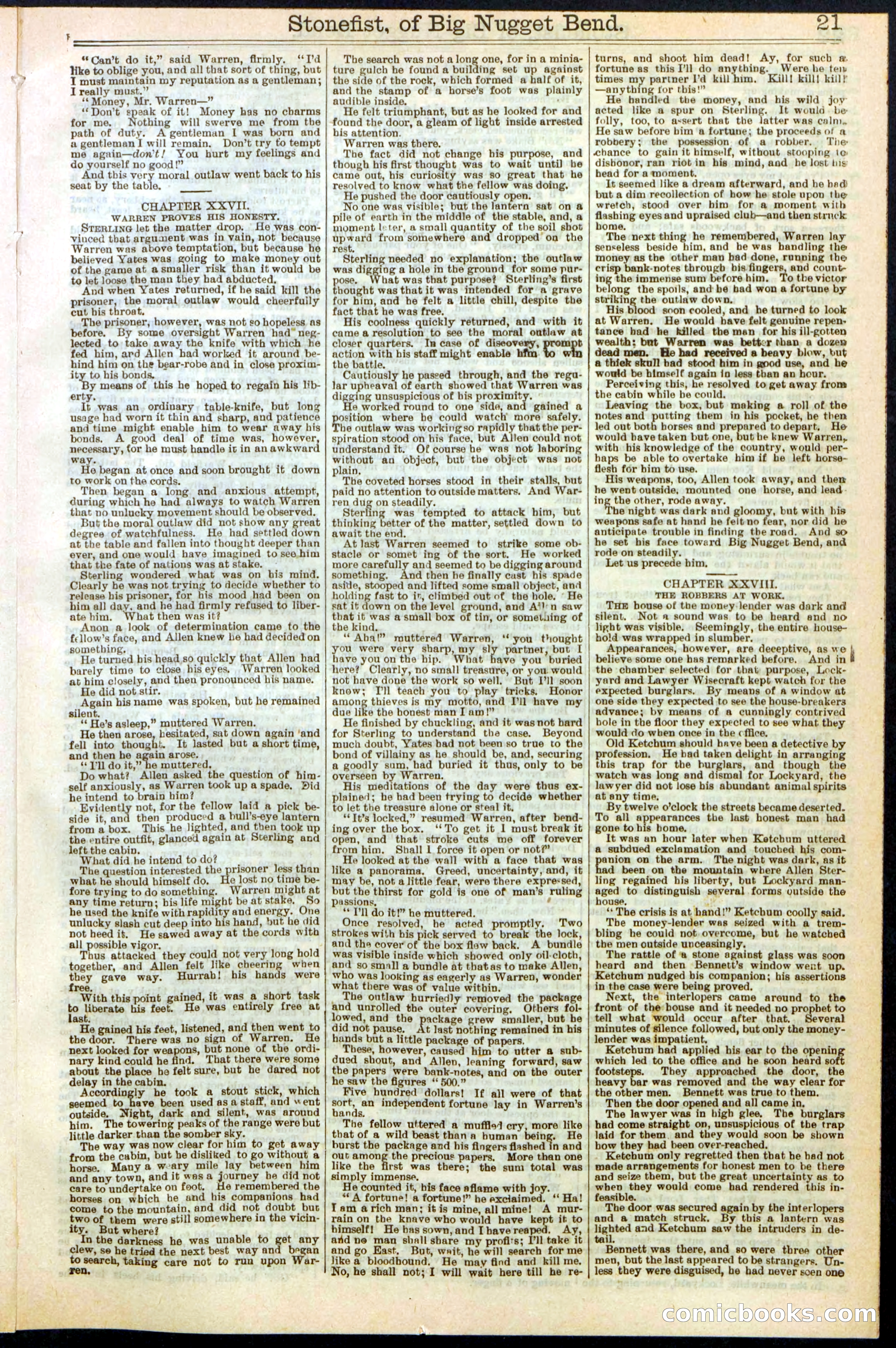
A restored page from Pulp Fiction, 1884. Page through the whole issue in the reader above.
📄 Transcribed text from this page (OCR, searchable)
Machine-transcribed from the original scan — historical spelling and the odd misread are preserved.
ae “Can’t do it,” said Warren, firmly. ‘I'd like to oblige you, and all that sort of thing, but T must maintain my reputation as a gentleman; I really must.” ‘« Money, Mr. Warren—” ‘‘Don’t speak of it! Money has no charms for me. Nothing will swerve me from the path of duty. A gentleman I was born and a gentleman! will remain. Don’t try to tempt me again—don’t/ You hurt my feelings and do yourself no good!” And this very moral outlaw went back to his seat by the table, CHAPTER XXVII. WARREN PROVES HIS HONESTY. STERLING let the matter drop. He was con- vinced that argument was in vain, not because Warren was above temptation, but because he believed Yates was going to make money out of the game at asmaller risk than it would be to let loose the man they had abducted, And when Yates returned, if he said kill the risoner, the moral outlaw would cheerfuily cut his throat, The prisoner, however, was not so hopeless. as before. By some oversight Warren had” neg- lected to take away the knife with which he fed him, ard Allen bad worked it around be- hind him on the bear-robe and in close proxim- in a his bonds, y means of this he hoped to regain his lib- erty. It was an ordinary table-knife, but long usage had worn it thin and sharp, and patience and time might enable him to wear away his bonds, A good deal of time was, however, necessary, for he must handle it in an awkward way. Ho began at once and soon brought it down to work on the cords. Then began a long and anxious attempt, during which he had always to watch Warren that no unlucky movement should be observed. But the moral outlaw did not show any great degrea of watchfulness. He had settled down at the table and fallen into thought deeper than ever, and one would have imagined to see,him that the fate of nations was at stake. Sterling wondered what was on bis mind. Clearly be was not trying to decide whether to release his prisoner, for his mood had been on bim all day. and he had firmly refused to liber- ate him. hat then was it? Anon a look of determination came to the fellow’s face, and Allen knew he had decided on something, ; He turned his head.so quickly that Allen had barely time to close his eyes. Warren looked at him closely, and then pronounced his name. He did not stir. Again his name was spoken, but he remained silent. ‘‘ He’s asleep,” muttered Warren. He then arose, hesitated, sat down again ‘and fell into thought. It lasted but a short time, and then he again arose. ‘‘1'll do it,” he muttered, Do what? Allen asked the question of him- self anxiously, as Warren took up a spade. Did he intend to brain him? : Evidently not, for the fellow laid a pick be- side it, and then produced a bull’s-eye lantern from a box. This he lighted, and then took up the entire outfit, glanced again at Sterling and left the cabin. What did he intend todo? | The question interested the prisoner less than what he should himself do, He lost no time be- fore trying to do something. Warren might at any time return; bis life might be at stake, So he used the knife with rapidity and energy. One unlucky slash cut deep into his hand, but he did not heed it. He sawed away at the cords with all possible vigor. Thus attacked they could not very long hold together, and Allen felt like cheering when they gave way. MHurrab! his hands were With this point gained, it was a short task to liberate tis fect He was entirely free at ast. He gained his feet, listened, and then went to the door. There was no sign of Warren. He next looked for weapons, but none of the ordi- nary kind could he find. That there were some about the place he felt sure, but he dared not delay in the cabin. Accordingly he took a stout stick, which seemed to have been used as a staff, and went outside. Wight, dark and silent, was around him. The towering peaks of the range were but little darker than the somber sky. The way was now clear for him to get away from the cabin, but he disliked to go without a horse. Many a weary mile lay between him and any town, and it wasa qourney he did not care to undestake on foot, He remembered the horses on which he and his companions had come to the mountain, and did not doubt but twoof them were still somewhere in the vicin- In the darkness he was unable to get any clew, se he tried the next best way and began to search, taking care not to run upon War- Stonefist, of Big Nugget Bend. , 2 The search was not a long one, for in a minia- ture guich he found a building set up against the side of the rock, which formed a half of it, and the stamp of a horse’s foot was plainly audible inside, ' He felt triumphant, but as he looked for and found the door, a gleam of light inside arrested bis attention. Warren was there. The fact did not change his purpose, and though his first thought was to wait until be came out, his curiosity was so great that he resolved to know what the fellow was doing, He pushed the door cautiously open. No one was visible; but the lantern sat on a pile of earth in the middle of the stable, and, a moment leter, a small quantity of the soil shot upward from somewhere and dropped on the rest, Sterling needed no explanation; the outlaw was digging a hole in the ground for some pur- ose. What was that purpose? Sterling’s first hought was thatit was intended for a grave for him, and he felt a little chill, despite the fact that he was free. His coolness quickly returned, and with it came & eon sea ee pei outlaw at closer quarters. Incase o seovery, b action vith bis staff might enable hfm to win the battle. Cautiously he passed through, and the regu- lar upheaval of earth showed that Warren was digging unsuspicious of bis Nag nc 8 He worked round to one side, and gained a sition where he could watch more safely. The outlaw was workingso rapidly that the per- spiration stood on his face, but Allen could not understand it. Of course he was not laboring MAb ahi an object, but the object was not ain, . The coveted horses stood in their stalls, but paid no attention to outside matters. And War- ren dug on steadily. Sterling was tempted to attack him, but thinking better of the matter, settled down to await the end, At last Warren seemed to strike some ob- stacle or somet ing of the sort. more carefully and seemed to be digging around something. nd then he finally cast his spade aside, stooped and lifted some small object, and holding fast to ir, climbed out of the hole. ‘He sat it down on the level ground, and A‘!'n saw that if was a small box of tin, or sometuing of the kind. ‘““Abal” routtered Warren, “‘ you thought you were very sharp, my sly partner, but | have you on the hip. What have you buried here? Clearly, no small treasure, or you would not have done the work so well. But I'll soon know; Tl teach you to play tricks. Honor among thieves is my motto, and Pll have my due like the bonest man I am!” He finished by chuckling, and it was not bard for Sterling to understand the case. Beyond much doubt, Yates bad not been so true to the bond of villainy as he should be, and, securing a goodly sum, had buried it thus, only to be overseen by Warren. His meditations of the day were thus ex- plained; be bad been trying to decide whether to let the treasure alone or steal it, ‘*Tt’s locked,” resumed Warren, after bend- ing over the box. ‘To get it 1 must break it open, and that stroke cuts me off forever from him. Shall Ll force it open or not?’ He looked at the wall with a face that was like a panorama, Greed, uncertainty, and, it may be, not alittle fear, were there expressed, but the thirst for gold is one of man’s ruling assions, . ** T'll do itl’? he muttered. Once resolved, he acted promptly. Two strokes with bis pick served to break the lock, and the cover of the box flaw back. A bundle was visible inside which showed only oil-cloth, and so small a bundle at thatas to make Allen, who was looking as eagerly as Warren, wonder what there was of value within. The ontlaw burried)y removed the package and unrolled the outer covering, Others fol- lowed, and the package grew smaller, but he did not pause, At last nothing remained in his hands but a little package of papers. These, however, caused him to utter a sub- dued shout, and Allen, leaning forward, saw the papers were bank-notes, and on the outer he saw the figures “500.” Five hundred dollars! If all were of that “1g an independent fortune lay in Warren’s ands. The fellow uttered a muffled cry, more like that of a wild beast than a buman oe He burst the package and his fingers flashed in and out among the precious papers, More than one like the first was there; the sum total was simply immense. He counted it, his face aflame with joy. ““A fortune! a fortune!” he exciaimed. ‘‘ Ha! Tam arich man; it is mine, all mine! A mur- rain on the knave who would have kept it to himself! He bas sown, and IThavereaped. Ay, and ne man shall sbare my profi's; I'll take it and go East, But, wait, he will search for me like a bloodhound. He may find and kill me. No, he shall not; I will wait here till he re- He worked | turns, and shoot him dead! Ay, for such @& fortune as this I’ll do anything. Were he tem times my partner I'd kill him. Kill! kill! kill! —anything for this!” He handled the money, and his wild jov acted like a spur on Sterling. It would. be folly, too, to assert that the latter was caln. He saw before bim a fortune; the proceeds of a robbery; the possession of a robber. The chance to gain it bimself, without stooping to dishonor, ran riotin his mind, and he lost tis head for a moment. It seemed like a dream afterward, and he bad but a dim recollection of bow he stole upon the wretch, stood over bim for a moment with flashing eyes and upraised club—and then struck home. The next thing he remembered, Warren lay senseless beside him, and he was bandling the money as the other man bad done, running the crisp bank-notes througb bis fingers, and count- ing the immense sum before him. To the victor belong the spoils, and be bad won a fortune by striking the outlaw down, His blood soon cooled, and he turned to look at Warren. He would bave felt genuine repen- tance had he killed the man for his ill-gotten wealth: but Warren was better than a dozen dead men. He had received a beavy blow, but a thiek skull bad stood him in good use, and he would be himself again in less than an hour. Perceiving this, he resolved to get away from the cabin while be could. Leaving the box, but making a roll of the notes and ape them in his pocket, be then led out both horses and prepared to depart, He would have taken but one, but he knew Warren, with his knowledge of the country, would per- haps be able to overtake him if be left horse- flesh for him to use. His weapons, too, Allen took away, and ther he went outside, mounted one horse, and lead- ing the other, rode away. e nigbt was dark and gloomy, but with bis weapons safe at hand he felt-no fear, nor did he anticipate trouble in finding the road. And so he set his face toward Big Nugget Bend, and rode on steadily. Let us pr e him, CHAPTER XXVIII. THE ROBBERS AT WORK. THE bouse of the money lender was dark and silent. Not a sound was to be heard and no light was visible. Seemingly, the entire house- hold was wrapped ip slumber. Appearances, however, are deeeptive, as we believe some one has remarked before. And in the chamber selected for that) purpose, Lock- yard and Lawyer Wisecraft kept watch for the expected burglars. By means of a window at one side they expected to see the house-breakers advance; by means of a cunningly contrived bole in the floor they expected to see what they would do when once in the cflice. Old Ketchum should have been a detective by profession. He bad taken delight in arranging this trap for the burglars, and though the watch was long and dismal for Lockyard, the law yer did not lose his abundant animal spirits at any time. By twelve o’clock the streets became deserted. To all appearances the last honest man had gone to his home, It was an hour later when Ketchum uttered a subdued exclamation and touched his com- nion on the arm. The night was dark, as it been on the mountain where Allen Ster- ling regained his liberty, but ard man- ae to distinguish several forms outside the ouse, af ‘* The crisis is at hand!” Ketchum coolly said. Tbe money-lender was seized with a trem- bling he could not. overcome, but he watched the men outside unceasingly. The rattle of ‘a stone against glass was soon heard and then Bennett’s window wert up. Ketchum nudged bis companion; his assertions in the case were being proved. Next, the interlopers came around to the front of nee and it needed no propbet to tell what would occur after that. veral minutes of silence followed, but only the money- Ket contbet applied his ear to the openin tchum app ear to the ope which led to the office and he soon heard ott foots They approached the door, the heavy was removed and the way clear for the other men. Bennett was true to them. Then the door opened and all came in, The lawyer was in high glee, The burglars had come straight on, unsuspicious of tbe trap laid for them. and they would soon be shown bow they had been over-reached, . Ketehum only regretted then that he had not made arrangements for honest men to be there and seize them, but the great uncertainty as to when they would come bad rendered this in- feasible. The door was secured again by the interlopers and a match struck. By this a lantern was peneee and Ketchum saw the intruders in de- Bennett was there, and so were , three other men, but the last appeared to be strangers. Un- less they were « be had never soen one EORNICOOOKS (EO) & *