
Pulp Fiction, 1884 · page 15 of 32
Beadle's New York Dime Library No. 271 — page 15: what you’re looking at
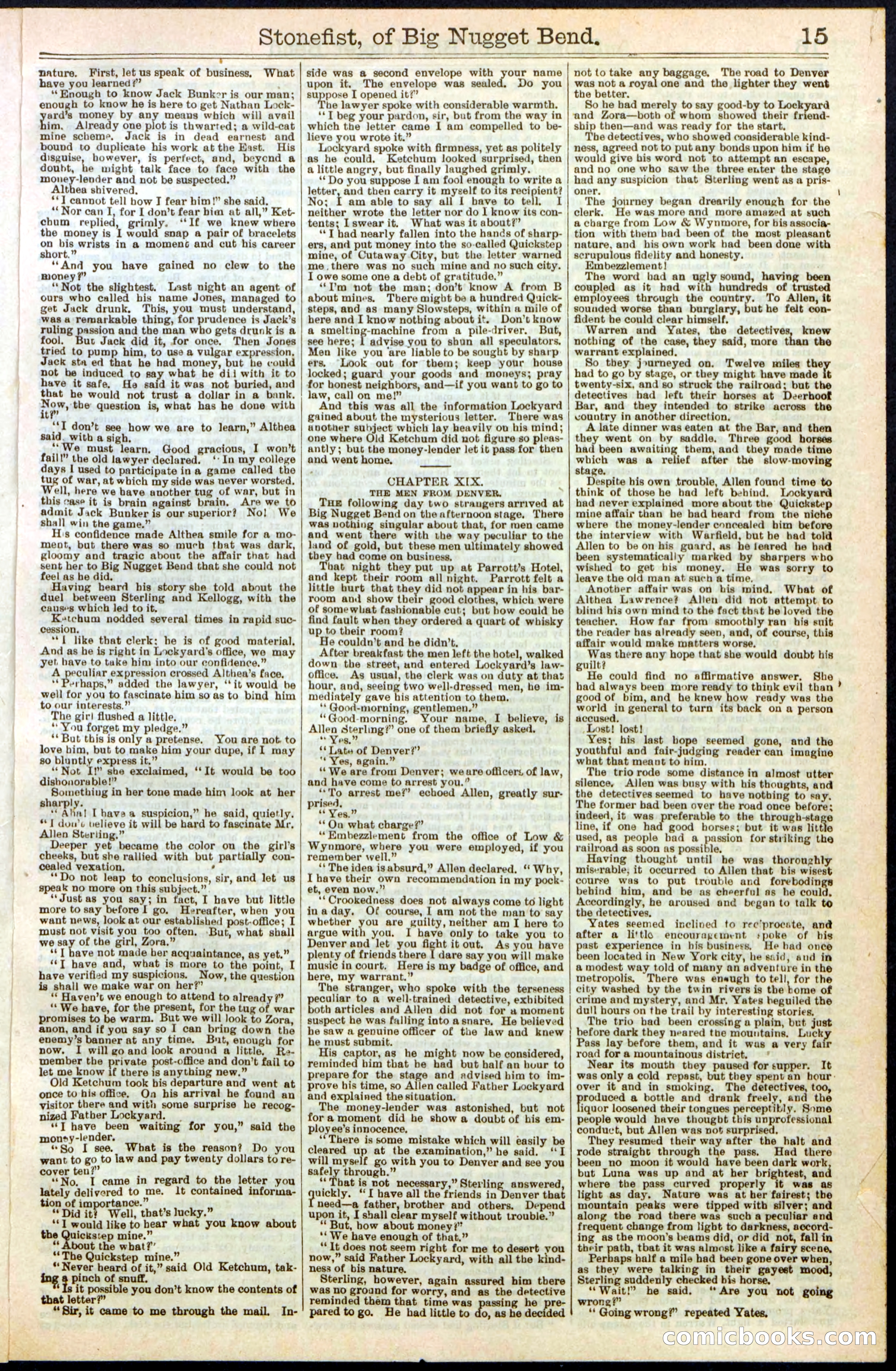
A restored page from Pulp Fiction, 1884. Page through the whole issue in the reader above.
📄 Transcribed text from this page (OCR, searchable)
Machine-transcribed from the original scan — historical spelling and the odd misread are preserved.
Stone nature. First, let us speak of business, What have you learned ¢”’ ‘Enough to know Jack Bunker is our man; enough to know he is here to get Nathan Lock- ard’s money by wot means which will avail him. Already one plot is thwarted; a wild-cat mine scheme, Jack is in dead earnest and bound to duplicate his work atthe Hast. His disguise, however, is perfect, and, beyond a doubt, be wight talk face to face with the money-lender and not be suspected.” Althea shivered. **] cannot tell bow I fear him!” she said. ‘Nor can I, for I don’t fear bim at all,” Ket- chum replied, grimly. ‘‘1f we knew where the money is I would snap a pair of bracelets on bis wrists in a momené and cut his career short.” ‘‘And you have gained no clew to the money ?” ‘* Not the slightest. Last night an agent of ours who called his name Jones, managed to get Jack drunk. This, you must understand, was a remarkable thing, for prudence is Jack’s ruling passion and the man who gets drunk is a fool. But Jack did it, for once. Then Jones tried to pump him, to use a vulgar expression. Jack sta ed that he had money, but he could not be induced to say what he dii with it to have it safe, He said it was not buried, and that be would not trust a dollar in a bank. agi the question is, what has he done with ‘I don’t see how we are to learn,” Althea said. with a sigh, **We must learn. Good gracious, I won't fail!” the old lawyer declared. ‘In my college days | used to participate ina game called the we of war, at which my side was never worsted, ell, here we bave another tug of war, but in this case it is brain against brain. Are we to admit Jack Bunker is our superior? No} We shall win the game.” His confidence made Althea smile for a mo- meot, but there was so much tbat was dark, gloomy and tragic about the affair that had sent her to Big Nugget Bend that she could not feel as be did, Having heard his story she told about the duel between Sterling and Kellogg, with the causes which led to it, K»tchum nodded several times in rapid suc- cession. ‘*| like that clerk: he is of good material. And as he is right in Lockyard's office, we may yet. bave to take him into our confidence,” culiar expression crossed Althea’s face, ‘* Perhaps,” added the lawyer, ‘it would be well for you to fascinate him so as to bind him to our interests.” The gir! flushed a little, * You forget my pledge,” ‘* But this is only a pretense. You are not. to love bim, but to make him your dupe, if 1 may so bluntly express it.” ‘*Not I!” she exclaimed, ‘‘It would be too dishonorable!” Somethiuvg in ber tone made him look at her sharply. ‘Aha! [havea a suspicion,” he said, quietly. ** I dou’t believe it will be hard to fascinate Mr, Allen Sterting,” Deeper yet became the color on the girl’s cheeks, but she rallied with but partially con- cealed vexation, , **Do not leap to conclusions, sir, and let us speak no more on this subject.” ‘Just as you say; in fact, I have but little more to say before I go. Hereafter, when you want news, look at our established post-office; I must not visit you too often. But, what shall we say of the girl, Zora,” ‘‘ | bave not made ber acquaintance, as yet.” ‘‘T have and, what is more to the point, I have verified my suspicions. Now, the question is shall we make war on her?” ‘“ Haven’t we enough to attend to already?” ‘‘ We have, for the present, for the tug of war promises to be warm. But we will look oa Zora, anon, and if you say so I can bring down the enemy’s banner at any time. But, enough for now. I will go and look around a little, Re- wember the private post-office and don’t fail to let me know if there is anything new.” Old Ketchum took bis departure and went at once to his office, On his arrival he found an visitor there and with some surprise he recog- nized Fatber Lockyard. | ‘“T have been waiting for you,” said the monsy-lender, “So I see. What is the reason? Do you want to go to law and pay twenty dollars to re- ver teu?” Or No. I came in regard to the letter you lately delivered to me. 1t contained informa- tion of importance.” rt “Did it? Well, that’s lucky, ‘*] would like to hear what you know about uickstep mine.” t the what?’ “The Quickstep mine.” *“ Never heard of it,” said Old Ketchum, tak- ing pinch of snuff. that TS you don’t know the contents of “ Sir, it came to me through the mail. In- ee er ree oeememssinasiinsenensiaepammmmmmaipematamnacitiiimmnntinenensiagagananeama ee ————_ side was a second envelope with upon it. The envelope was seale ye 9 I opened it?’ be lawyer spoke with considerable warmth. ‘*T beg your pardon, sir, but from the way in which the letter came I am compelled to be- lieve you wrote it.” Lockyard spoke with firmness, yet as politely as he could, Ketchum looked surprised, then a little angry, but finally laughed grimly. ‘*Do you suppose I am fool enough to write a letter, and then carry it myself to its gs gen, No; I am able to say all | bave to tell. I neither wrote the letter nor do | know its con- tents; [swear it. What was it about?’ ‘“‘T had nearly fallen into the hands of sharp- ers, and put money into the so-called Quickstep mine, of Cutaway City, but the letter warned me ,there was no such mine and no such city. I owe some one a debt of gratitude.” ‘‘l’'m not the man; don’t know A from B about mines. There might be a hundred Quick- steps, and as many Slowsteps, within a mile of here and I know nothing about it. Don’t know a smelting-machine from a pile-driver. But, see here; 1 advise you to sbun all speculators, Men like you are liable to be sought by sharp ers. Look out for them; keep your house locked; guard your goods and moneys; pray for honest neighbors, and—if you want to go to law, call on me!” And this was all the information Lockyard gained about the mysterious letter. There was another subject which lay heavily ov his mind; one where Old Ketchum did not figure so pleas- antly; but the money-lender let it pass for then and went home, CHAPTER XIX. THE MEN FROM DENVER. THE following day two strangers arrived at Big Nugget Bend on the afternoon stage, There was nothing singular about that, for men came and went there with uhe way peculiar to the land of gold, but these men ultimately showed they bad come on business, bat night they put up at Parrott’s Hotel, and kept their room all night. Parrott felt a little burt that 98 did not appear in his bar- room and show their good clothes, which were of some what fashionable cut; but bow could he find fault when they ordered a quart of whisky up to their room? He couldn’t and he didn’t. After breakfast the men left the hotel, walked down the street, und entered Lockyard’s law- office. As usual, the clerk was on duty at that hour, and, seeing two well-dressed men, he im- mediately gave his attention to them, ‘* Good-morning, gentlemen.” “Good-morning. Your name, I believe, is see Sterling!” one of them briefly asked, a) Ps ? ‘* Late of Denver?” ‘“* Yes, again.” ‘* We are front Denver; weare officer: of law, and have come to arrest you.” ‘To arrest mef’ echoed Allen, greatly sur- our name Do you ‘*On what charge?’ “Embezzlement from the office of Low & Wynmore, where you were employed, if you remember well.” ‘‘ The idea isabsurd,” Allen declared. “ Why, I have their own recommendation in my pock- et, even now.” ‘*Crookedness does not always come to light inaday. Of course, I am not the man to say whether hi are guilty, neither am I here to argue with you. I have only to take you to Denver and let you signe itout. As you have plenty of friends there | dare say you will make music in court. Here is my badge of office, and here, my warrant.” The stranger, who spoke with the terseness pecana to a well-trained detective, exhibited th articles and Allen did not for a moment suspect he was falling into asnare. He believed be saw a genuine officer of the law and knew he must submit. His captor, as he might now be considered, reminded him that be had but half an huur to prepare for the stage and advised him to im- prove his time, so Allen called Father Lockyard and explained the situation. The money-lender was astonished, but not fora moment did he show a doubt of his em- ploy ee’s innocence, ‘“There is some mistake which will easily be cleared up at the examination,” he said. ‘I will myself go with you to Denver and see you safely through.” “That is not necessary,” Sherting: angovered, goto de “T have all the friends in Denver that need—a father, brother and others. Depend upon it, I shall clear myself without trouble.” * But, bow about money?” ‘* We have enough of that,” “‘ It does not seem right for me to desert you now,” said Father Lockyard, with all the kind- ness of bis nature. Sterling, however, again assured him there was no ground for worry, and as the detective reminded them that time was ng he pre- pared to go. He had little to do, as he decided fist, of Big Nugget Bend, 15 not to take any baggage. The road to Denver was not a royal one and the lighter they went the better. So he bad merely to say Spi to sg a and Zora—botb of whom showed their friend- ship then—and was ready for the start, The detectives, who showed considerable kind- ness, agreed not to put any bonds upon him if he would give bis word not to attempt an escape, and no one who saw the three enter the stage had any suspicion that Sterling went as a pris- oner. The journey began drearily enough for the clerk. He was more and more amazed at such a charge from Low & Wynmore, for bis associa- tion with them bad been of the most pleasant nature, and his own work had been done with scrupulous fidelity and honesty. Embezzlement! The word bad an ugly sound, having been coupled as it had with hundreds of trusted employees through the sa To Allen, it sounded worse than burglary, but he felt con- fident he could clear himself. Warren and Yates, the detectives, knew nothing of the case, they said, more the warrant explained. So they journeyed on. Twelve miles ~— had to go by stage, or they might have made it twenty-six, and so struck the railroad; but the detectives bad left their horses at Deerhoof Bar, and they intended to strike across the country in another direction, A late dinner was eaten at the Bar, and then they went on by saddle. Three good horses had been awaiting them, and they made time which was a relief after the slow-moving stage. Despite his own trouble, Allen found time to think of those he bad left behind, Lockyard had never explained more about the Quickstep mine affair than be bad heard from the niche where the money-lender concealed him before the interview with Warfield, but be bad told Allen to be on his guard, as he feared he had been systematically marked by sharpers who wished to get bis money. He was sorry to leave the old man at such a time. Anotber affair was on bis mind, What of Althea Lawrence? Allen did not attempt to blind his own mind to the fact that be loved the teacher. How far from smoothly ran bis suit the reader bas ml seen, and, of course, this affair would make matters worse. bei there any hope that she would doubt his guilt? He could find no affirmative answer, She had always been more ready to think evil than good of bim, and he knew how ready was the world in general to turn its back on a person accused, Lost! lost! Yes; his last bope seemed gone, and the youthful and fair-judging reader can imagine what that meant to bim. The trio rode some distance in almost utter silence, Allen was busy with his thoughts, and the detectives seemed to have nothing to say, The former bad been over the road once before: indeed, it was Fg ys el the through-stage line, if one had good horses; but it was litt used, as people bad a passion for striking the railroad as soon as possible, Having thought until he was thoroughly miserable, it occurred to Allen that bis wisest course was to Mars trouble and forebodin behind him, and be as cheerful as he could, Accordingly, be aroused and began to talk to the detectives, Yates seemed inclined to ree’procate, and after a littlo encouragement spoke of bis pews experience in his business, He bad once een located in New York city, he said, aud in a modest way told of many an adventure in the metropolis. There was ensugh to tell, for the city washed by the twin rivers is the bome of crime and mystery, and Mr. Yates beguiled the dull hours on the trail by interesting stories, The trio bad been crossing a plain, but just before dark they neared the mountains, Luck Pass lay before them, and it was a very fa road for a mountainous distriet. * Near its mouth they paused for supper. It was only a cold repast, but they spent an bour: over it and in smoking. The detectives, too, peotnne a bottle and drank freely, and the iquor loosened their tongues perceptibly. Some people would have thougbt this unprofessional conduct, but Allen was not surprised, They resumed their way after the halt and rode straight through the pass. Had there been no moon it would have been dark work but Luna was up and at her lg yar an where the pass curved properly was as light as day. Nature was at her fairest; the mountain peaks were tipped witb silver; and along the road there was such a peculiar and frequent change from light to darkness, accord- ing as the moon’s beams did, or did not, fall in their path, tbat it was almost like a fairy scene, Perbaps half o oa ~" _— gone a when, as they were og in their mood, checked bis Ns Sterling suddenly “Are you not going wrong?” “‘ Going wrong?” repeated Yates, “Wait!” he said, AMCELOCKO) (C(O) CS. (E()