
Pulp Fiction, 1878 · page 7 of 28
Beadle's Dime Library No. 27 — page 7: what you’re looking at
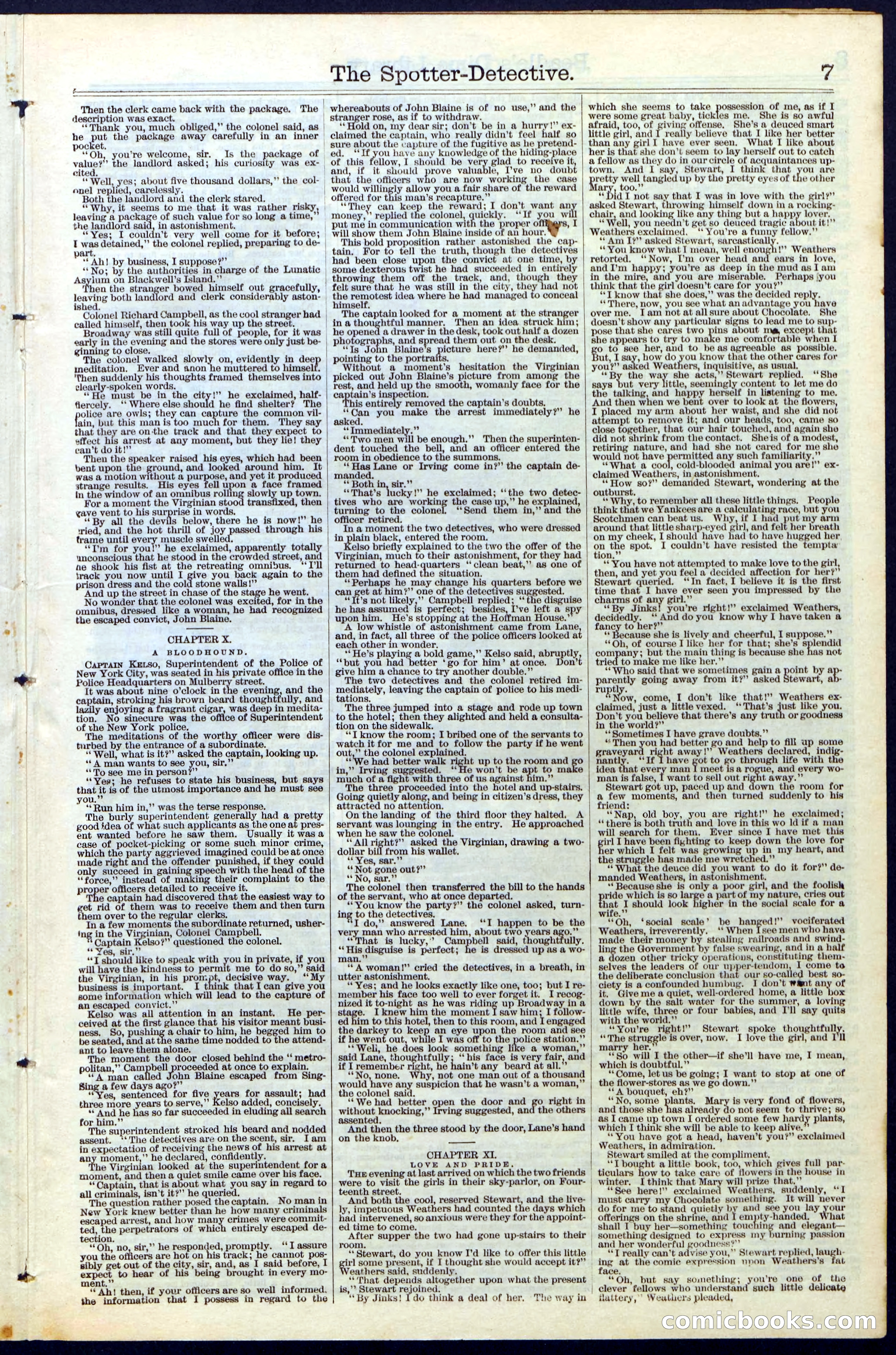
A restored page from Pulp Fiction, 1878. Page through the whole issue in the reader above.
📄 Transcribed text from this page (OCR, searchable)
Machine-transcribed from the original scan — historical spelling and the odd misread are preserved.
“<—<—- - eS description was exac AY TAs MaUaessetet tat tf Then the clerk came back with the package. The | t. “Thank you, much obliged,” the colonel said, as | he put the package away carefully in an inner pocket. : “Oh, ou’re welcome, sir. Is the package of value?”’ the landlord asked; his curiosity was ex- cited, “Well, yes; about five thousand dollars,” the col- onel replied, carelessly. Both the landlord and the clerk stared. ‘Why, it seems to me that it was rather risky leaving a a soy of such value for so long a time, the landlord said, in astonishment. © ees. couldn't very well come for it before; I was detained,” the colonel replied, preparing to de- part, ‘*Ah! by business, I suppose?”’ ‘‘No; by the authorities in charge of the Lunatic Asylum on Blackwell's Island.”’ Then the stranger bowed himself out gracefully, leaving both landlord and clerk considerably aston- ished. Colonel Richard Campbell, as the cool stranger had called himself, then took his way up the street. Broadway was still quite full of people, for it was early in the evening and the stores were only just be- ginning to close. The colonel walked slowly on, evidently in dee ineditation, Ever and anon he muttered to himself. 'Then suddenly his thoughts framed themselves into tlearly-spoken words. “He must be in the city!” he exclaimed, half- fiercely. ‘* Where else should he find shelter? The pole are owls; they can capture the common vil- ain, but this manis too much for them, They say that they are on-the track and that they expect to effect his arrest at any moment, but they lie! they can’t do it!” Then the speaker raised his eyes, which had been bent upon the ground, and looked around him. It was a motion without a purpose, and yet it produced strange results. His eyes fell upon a face framed in the window of an omnibus rolling slowly up town. For a moment the Virginian stood transfixed, then gave vent to his surprise in words. ‘By all the devils below, there he is now!” he ‘ried, and the hot thrill of joy permed through his trame until every muscle swelled. ‘I’m for you!” he exclaimed, apparently totally unconscious that he stood in the crowded street, and ne shook his fist at the retreating omnibus. “Tl track you now until I give you back again to the prison dress and the cold stone walls!” And up the street in chase of the stage he went. No wonder that the colonel was excited, for in the omnibus, dressed like a woman, he had recognized the escaped convict, John Blaine. CHAPTER X. A BLOODHOUND. Caprain Kuso, Superintendent of the Police of New York City, was seated in his private office in the Police Headquarters on Mulberry street. It was about nine o’clock in the evening, and the captain, stroking his brown beard thoughtfully, and lazily enjoying a fragrant cigar, was deep in medita- tion. No sinecure was the office of Superintendent of the New York police. The meditations of the worthy officer were dis- turbed by the entrance of a subordinate. “Well, what is it?” asked the captain, looking up. ‘*A man wants to see yous sir,’’ ‘‘To gee me in person?”’ ‘“Yes; he refuses to state his business, but says that it is of the utmost importance and he must see “Run him in,”’ was the terse response. The burly superintendent generally had a pushy good idea of what such applicants as the one at pres- ent wanted before he saw them. Usually it wasa case of pocket-picking or some such minor crime, which the party aggrieved imagined could be at once made right and the offender punished, if they could only succeed in gaining speech with the head of the “force,” instead of making their complaint to the proper officers detailed to receive it. The captain had discovered that the easiest way to et rid of them was to receive them and then turn hike over to the regular clerks, In a few moments the subordinate returned, usher- ing in the Virginian, Colonel Campbell. Captain Kelso?’’ questioned the colonel. ae ss “T should like to speak with “hg in pris will have the kindness to permit me to do so,” said the Virginian, in his prom pt, decisive way. ‘‘My business is important. I think that Ican give you some information which will lead to the capture of an escaped convict.” Kelso was all attention in an instant. He per- ceived at the first glance that his visitor meant busi- ness, So, pushing a chair to him, he begged him to be seated, and at the sarhe time nodded to the attend- ant to leave them alone. The moment the door closed behind the ‘*‘ metro- politan,”” Campbell proceeded at once to explain. ‘A man called John Blaine escaped from Sing- Sing a few days ago?” ‘“Yes, sentenced for five years for assault; had three more years to serve,’’ Kelso added, concisely. ** And he has so far succeeded in eluding all search for him,” The superintendent stroked his beard and nodded assent. ‘The detectives are on the scent, sir. Iam in expectation of receiving the news of his arrest at any moment,” he declared, confidently. he Virginian looked at the superintendent for a moment, and then a quiet smile came over his face. “Captain, that is about what you say in regard to all criminals, isn’t it?’’ he queried. The question rather posed the captain. No man in New York knew better than he how many criminals escaped arrest, and how many crimes were commit- ted, the perpetrators of which entirely escaped de- tection. ‘Oh, no, sir,’’ he responded, promptly. ‘‘I assure you the officers are hot on his track; he cannot pos- sibly get out of the city, sir, and, as I said before, I nae to hear of his being brought in every mo- ate, if you ment.” “Ah! then, if your officers are so well informed. the information that I possess in regard to the and, if it should i himself. i ee _ tain. | pointing to the portra whereabouts of John Blaine is of no use,” and the stranger rose, as if to withdraw. ‘*Hold on, my dear sir; don't be in a hurry!” ex- claimed the captain, who really didn’t feel half so sure about the capture of the fugitive as he pretend- ed, “If you have any knowledge of the hiding-place of this fellow, I should be very glad to receive it, yrove valuable, I’ve no doubt that the officers who are now working the case would willingly allow you a fair share of the reward offered for this man’s recapture.” “They can keep the reward; I don’t want any money,” replied the colonel, quickly. “If you will put me in communication with the proper ow I will show them John Blaine inside of an hour. This bold proposition rather astonished the cap- For to tell the truth, though the detectives had been close upon the convict at one time, by some dexterous twist he had succeeded in entirely throwing them off the track, and, though they felt sure that he was still in the city, they had not the remotest idea where he had managed to conceal The captain looked for a moment at the stranger in a thoughtful manner. Then an idea struck him; he opened a drawer in the desk, took out half a dozen pho Srepha, and spread them out on the desk. “Is John Blaine’s ae here?’ he demanded, Without a moment's hesitation the Virginian picked out John Blaine’s picture from among the rest, and held up the smooth, womanly face for the captain's inspection. his entirely removed the captain's doubts. ty oan you make the arrest immediately?” he asked. ‘‘Immediately.”’ “Two men will be enough.’’ Then the superinten- dent touched the bell, and an officer entered the room in obedience to the summons. Lane or Irving come in?’’ the captain de- oe . in 99 *'That’s lucky !” he exclaimed; ‘“‘the two detec- tives who are bog too the case up,’ he explained, turning to the colonel. ‘Send them in,” and the officer retired. In a moment the two detectives, who were dressed in plain black, entered the room. elso briefly explained to the two the offer of the Virginian, much to their astonishment, for they had returned to head-quarters “clean beat,’? as one of them had defined the situation. ‘*Perhaps he may change his quarters before we can get at him?’’ one of the detectives suggested. “It’s not likely,’’ Campbell replied; “the disguise he has assumed is perfect; besides, Ive left a Spy upon him. He’s stopping at the Hoffman House.’ A low whistle of astonishment came from Lane and, in fact, all three of the police officers looked at each other in wonder. **He’s gets Som bold game,” Kelso said, abruptly “but you had better ‘go for him’ at once. on’t give him a chance to try another double.” The two detectives and the colonel retired im- a pe leaving the captain of police to his medi- ‘ions. The three jumped into a stage and rode up town to the hotel; then they alighted and held a consulta- tion on the sidewalk. “IT know the room; I bribed one of the servants to watch it for me and to follow the party if he went out,’’ the colonel explained. ‘We had better walk a up to the room and in,” Irving ma me rag “He won't be apt to make much of a fight with three of us against him.” The three proceeded into the hotel and up-stairs. Going quietly along, and being in citizen's dress, they attracted no attention. : On the landing of the third floor they halted, A servant was lounging in the entry. He approached weenitright?” asked the Virginian, drawing a t : I ?”’ as e , drawing a two- dollar b from his wallet. sc es, - ** Not gone out?”’ ** No, sar.” The colonel then transferred the bill to the hands of the servant, who at once de ; ‘You know the party?” the colonel asked, turn- ing to the detectives. I do,” answered Lane. “I happen to be the very man who arrested him, about two years vy we “That is lucky,” Campbell said, thoughtfully. “His disguise is perfect; he is up as a Wo- man.’ ‘*A woman!” cried the detectives, in a breath, in utter astonishment. “Yes; and he looks exactly like one, too; but I re- member his face too well to ever forget it, I recog- nized it to-night as he was riding up Broadway in a ange. I knew the moment I saw him; I follow- ed him to this hotel, then to this room, and TLengaged the darkey to keep an eye upon the room and see if he went out, while I was off to the police station.” ‘* Weli, he does look something like a woman,” said Lane, sen Aly og “his face is very fair, and if lremember right, he hain’t any beard at all.” ‘* No, none, y, not one man out of a thousand would have any suspicion that he wasn't a woman,” the colonel said. ‘*We had better open the door and & right in without knocking,” Irving suggested, and the others assented. And then the three stood by the door, Lane’s hand on the knob, CHAPTER XI. LOVE AND PRIDE. Tue evening at last arrived on which the two friends teenth street. And both the cool, reserved Stewart, and the live- ly, impetuous Weathers had counted the days which had intervened, so anxious were they for the appoint- ed time to come. After supper the two had gone up-stairs to their | room. ‘Stewart, do you know I'd like to offer this little | girl some present, if I thought she would accept it?” eathers said, suddenly. ‘That depends altogether upon what the present is,’? Stewart rejoined. ‘By Jinks! Ido think a deal of her, were to visit the girls in their sky-parlor, on Four- | The way in ee ee meee te a t a which she seems to take pomoanr” of me, as if I were some great baby, tickles me. She is so awful afraid, too, of piving offense, She's a deuced smart little girl, and I really believe that I like her better than any girl I have ever seen. What I like about her is that she don’t seem to lay herself out to catch a fellow as they do in our circle of acquaintances up- town. And I say, Stewart, I think that you are retty pean tangled up by the pretty eyes of the other ary, too.’ “Did I not say that I was in love with the girly” asked Stewart, throwing himself down in a rocking- chair, and looking like any thing but a happy lover. “Well, you needn’t get so deuced tragic about it!” Weathers exclaimed, ‘ You're a funny fellow.” ‘**Am IT?’ asked Stewart, sarcastically. “You know what I mean, well enough!’’ Weathers retorted. ‘Now, I’m over head and ears in love, and I’m happy; you're as deep in the mud as lam in the mire, and you are miserable. Perhaps /you think that the girl doesn’t care for you?” **T know that she does,”’ was the decided reply. ‘There, now, you see what an advantage you ‘have over me. Iam not at all sure about Chocolate. She doesn’t show any particular signs to lead me to sup- pose that she cares two pins about ma, except that she appears to try to make me comfortable when I ro to see her, and to be as agreeable as possible. ut, I say, how do you know that the other cares for you?” ed Weathers, inquisitive, as usual, “By the wee she acts,’ Stewart replied. ‘She says but very little, seemingly content to let me do the talking, and happy herself in listening to me. And then when we bent over to look at the flowers, I placed my arm about her waist, and she did not attempt to remove it; and our heads, too, came so close together, that our hair touched, and again she did not shrink from the contact. Sheis of a modest, retiring nature, and had she not cared for me she would not have permitted any such familiarity.” ‘““What a cool, cold-blooded animal you are!’ ex- claimed Weathers, in astonishment. ‘How so?’ demanded Stewart, wondering at the outburst. ‘* Why, to remember all these little things. People think that we Yankees are a calculating race, but you Scotchmen can beat us. Why, if I had py my arm around that little sharp-eyed girl, and felt her breath on my cheek, I should have had to have hugged her om the spot. I couldn't have resisted the tempta tion.” **- You have not attempted to make love to the girl, then, and yet you feel a decided affection for her?’ Stewart queried. “In fact, I believe it is the first time that I have ever seen you impressed by the charms of “ot girl.” ‘““By Jinks! you're right!’ exclaimed Weathers, decidedly. ‘* And do you know why I have taken a fancy to her?” “ use she is lively and cheerful, I suppose.” ‘Oh, of course I like her for that; she’s splendid company; but the main thing is because she not tried to make me like her,” ‘Who said that we sometimes gain a it by a peneney going away from it?” asked Stewart, ab- ruptly. is ow, come, I don’t like that!” Weathers ex- claimed, just a little vexed. ‘That's just like you. Don't you believe that there’s any truth or goodness in the world?” ‘*Sometimes I have grave doubts,” * a had better go and help to fill up some pravey ht away!" Weathers declared, indig- we “Tf I have got to go through life with the idea that every m meet isa one and every wo- man is false, I want to sell out right away.” Stewart got up, paced up and down the room for Fo moments, and then turned suddenly to his riend: “Nap, old boy, you are right!”’ he exclaimed; “there is both truth and love in this wo ld if a man will search for them, Ever since I have met this girl I have been fighting to keep down the love for er which I felt was growing up in my heart, and the struggle has made me wretched.” ‘‘ What the deuce did you want to do it for?’’ de- manded Weathers, in astonishment. ‘Because she is only a poor girl, and the foolish beg which is so é a partof my nature, cries out nee Ri should look higher in the social scale for a wife “Oh, ‘social scale’ be hanged!’’ vociferated Weathers, irreverently. ‘* When [see men who have made their money by stealing railroads and swind- ling the Government by false swearing, and in a half a dozen other tricky operations, constituting them- selves the leaders of our upper-tendom, I come to the deliberate conclusion that our so-called best s0- ciety is a confounded humbug. J don’t want of it. Give me a quiet, well-ordered home, a little box down by the salt water for the summer, a loving little wife, three or four babies, and I'll say quits with the world.” “You're right!’ Stewart spoke thoughtfully. “The mrvegie is over, now. I love the girl, and I'll er. **So will I the other—if she'll have me, I mean, which is doubtful.” **Come, let us be going; I want to stop at one of the flower-stores as we go down.” “A bouquet, eh?” “No, some plants, pon is very fond of flowers, and those she has already do not seem to thrive; so as I came up town I ordered some few hardy plants, which I think she will be able to keep alive.” “You have got a head, haven’t you?” exclaimed Weathers, in admiration. Stewart smiled at the compliment, “T bought a little book, too, which gives full par- ticulars how to take care of flowers in the house in winter. I think that Mary will prize that,” ” here!" exclaimed Weathers, suddenly, “I must carry my Chocolate something. It will never do for me to stand quietly by and see you lay your offerings on the shrine, and I empty-handed. What shall I buy her—something toue ny and elegant— something designed to express my burning passion and her wonderful goodness?”’ “T really can't advise you,” Stewart replied, laugh- ree) at the comie expression npon Weathers’s fat ace. “Oh, but say something; you're one of the | clever fellows who understand such little delicate flattery,’ Weathers pleaded, Gomilcboo <S (E(o)