
Pulp Fiction, 1878 · page 25 of 28
Beadle's Dime Library No. 27 — page 25: what you’re looking at
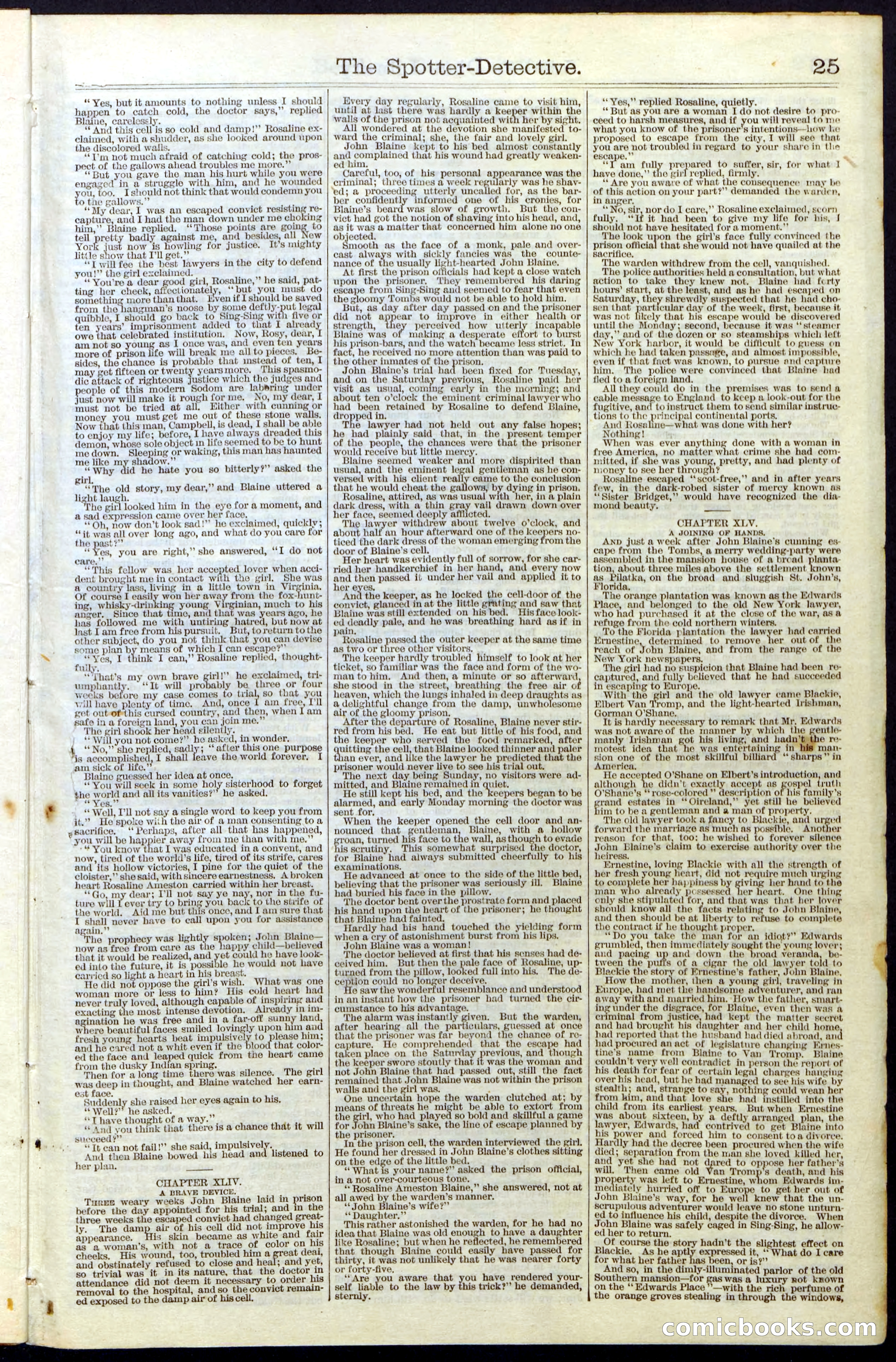
A restored page from Pulp Fiction, 1878. Page through the whole issue in the reader above.
📄 Transcribed text from this page (OCR, searchable)
Machine-transcribed from the original scan — historical spelling and the odd misread are preserved.
~ ‘ » Sacrifice, “Yes, but it amounts to nothing unless I should happen to catch cold, the doctor says,” replied Blaine, carelessly. * And this cell is so cold and damp!"’ Rosaline ex- claimed, with a shudder, as she looked around upon the discolored walls. “I'm not much afraid of catching cold; the pros- pect of the gallows ahead troubles me more.” “But you gave the man his hurt while you were engaged in a struggle with him, and he wounded “ou, too. Ishould not think that would condemn you o the gallows.” ; noe “My dear, I was an escaped convict resisting re- capture, and I had the man down under me choking him,” Blaine replied. ‘‘Those points are going to tell pretty badly against me, and besides, all New York just now is howling for justice. It’s mighty litle show that I'll get.” ‘ ‘““T will fee the best lawyers in the city to defend you!” the girl exclaimed. = ; “You're a dear good girl, Rosaline,’’ he said, pat- ting her cheek, affectionately, “but you must do something more thanthat, Kvenif I should be saved from the hangman’s noose by some deftly- ut, legal quibble, I should go back to Sing-Sing with five or ten years’ imprisonment added to that I already owe that celebrated institution. Now, Rosy, dear, I am not so young as I once was, and even ten years more of prison life will break me all to pieces. Be- sides, the chance is probable that instead of ten, I may get fifteen or twenty years more, This spasmo- dic attack of righteous justice which the judges and eople of this modern Sodom are labering under just now will make it rough for me, No, my dear, I must not be tried at all. Either with cunning or money you must get me out of these stone walls, Now that this man, Campbell, is dead, I shall be able to enjoy my life; before, I have always dreaded this demon, whose sole object in life seemed to be to hunt me down. Sleeping or waking, this man has haunted me like my shadow.”’ “Why did he hate you so bitterly?’ asked the irl. . “The old story, my dear,’ and Blaine uttered a light laugh. The girl looked him in the eye for a moment, and a sad expression came over her face, — ‘Oh, now don’t look sad!” he exclaimed, quickly ; “it was allover long ago, and what do you care for the past?” = oa, eare,”’ : “This fellow was her accepted lover when acci- dent brought me in contact with the girl, She was a country lass, living in a little town in Virginia. Of course I easily won her away from the fox-hunt- ing, whisky-drinking young Virginian, much to his anger. Since that time, and that was years ago, he has followed me with untiring hatred, but now at last I am free from his pursuit. But, toreturn to the other subject, do you not think that you can devise some plan by means of which I can escape?’ ‘*Yes, I think I can,” Rosaline replied, thought- fully. ‘"That’s my own brave girl!’ he exclaimed, tri- umphantly. © ‘It will probably be three or four woeks before my case comes to trial, so that you vill have plenty of time. And, once I am free, I'll get out-ofthis cursed country, and then, when lam safe in a foreign land, you can join me.’ The girl shook her head silently. “Will you not come?” he asked, in wonder, \ ‘* No,” sho replied, sadly; “* after this one purpose is accomplished, I shall leave the world forever, I am sick of life." Blaine guessed her idea at once, ‘You will seek in some holy sisterhood to forget the world and all its vanities?’ he asked, lie fe: ‘Well, I'll not say a single word to keep you from it.”’ He spoke wiih the air of a man consenting to a * Perhaps, after all that has happened, you will be happier away from me than with me.” ** You know that I was educated in a convent, and now, tired of the world’s life, tired of its strife, cares and its hollow victories, I pine for the quiet of the cloister,’’ she said, with sincere earnestness. A broken heart Rosaline Ameston carried within her breast. ‘Go, my dear; I'll not say ye ney nor in the fu- ture will t ever try to bring you back to the stxife of the world. Aid me but this once, and I am sure that I shall never bave to call upon you for assistance again.” The prophecy was lightly a John Blaine— now as free from care as the happy child—believed that it would be realized, and yet could he have look- ed into the future, it is possible he would not have carried so light a heart in his breast. THe did not oppose the girl’s wish. What was one woman more or less to him? His cold heart had never truly loved, although capable of inspiring and exacting the most intense devotion. Already in im- agination he was free and in a far-off sunny om Na beautiful faces smiled lovingly upon him au fresh young hearts beat impulsively to lease him; and he eared not a whit even if the blood that color- ed the face and leaped quick from the heart came from the dusky Indian spring. ; : Then for along time there was silence. The girl was deep in thought, and Blaine watched her earn- est face. . . Suddenly she raised her eyes again to his. ‘* Well?” he iccial - “Thave thought of a way. . : * And you think that there is a chance that it will succeed?” Stal ia: ivopulatvel “Tt can not fail!” she said, It a And then Blaine bowed his head and listened to her plan. you are right,” she answered, “I do not CHAPTER XLIV. A BRAVE DEVICE. : Tune weary weeks John Blaine laid in prison before the day appointed for his trial; and the three weeks the escaped convict had changed great- ly. The Gareh air of his cell did not improve his appearance. is skin became as white and fair as a woman's, with not a trace of color on his cheeks. His wound, too, troubled him a at deai, and obstinately refused to close and heal; and yet, so trivial was it in its nature, that the doctor in attendance did not deem it necessary to order his removal to the hospital, and so the convict remain- ed exposed to the damp air of his cell. The Spotter-Detective. iivery day regularly, Rosaline came to visit him, until at last there was hardly a keeper within the walls of the prison not acquainted with her by sight. All wondered at the devotion she manifested to- ward the criminal; she, the fair and lovely girl. John Blaine kept to his bed almost constantly and complained that his wound had greatly weaken- ed him, Careful, too, of his personal appearance was the criminal; three times a week regularly was he shay- ‘ed; a proceeding utterly uncalled for, as the bar- ber confidently informed one of his cronies, for Blaine’s beard was slow of growth. But the con- vict had got the notion of shaving into his head, and, as it was a matter that concerned him alone no one objected, Smooth as the face of a monk, pale and over- cast always with sickly fancies was the counte- nance of the usually light-hearted John Blaine. At first the prison officials had kept a close watch upon the prisoner, They remembered his daring escape from Sing-Sing and seemed to fear that even the gloomy Tombs would not be able to hold him, But, as day after day passed cn and the prisoner did not a aps to improve in either health or strength, ey perceived how utterly incapable Blaine was of making a desperate effort to burst his prison-bars, and the watch became less strict. In fact, he received no more attention than was paid to the other inmates of the prison. John Blaine’s trial had been fixed for Tuesday, and on the Saturday previous, Rosaline paid her visit as usual, coming early in the morning; and about ten o’clock the eminent criminal lawyer who had been retained by Rosaline to defend Blaine, me ag in. The lawyer had not held out any false hopes; he had plainly said that, in the present temper of the people, the chances were that the prisoner would receive but little mercy. Blaine seemed weaker and more dispirited than usual, and the eminent legal gentleman as he con- versed with his client really came to the conclusion that he would cheat the gallows, by dying in prison. Rosaline, attired, as was usual with her, in a plain dark dress, with a thin gray vail drawn down over her face, seemed deeply afflicted. The lawyer withdrew about twelve o’clock, and about half an hour afterward one of the keepers no- ticed the dark dress of the woman emerging from the door of Blaine’s cell. Her heart was evidently full of sorrow, for she car- ried her handkerchief in her hand, and every now and then passed it under her vail and applied it to her eyes. And the keeper, as he locked the cell-door of the convict, glanced in at the little grating and saw that Blaine was still extended on his bed. His face look- odenelix pale, and he was breathing hard as if in un, Rosaline passed the outer keeper at the same time as two or three other visitors. The keeper hardly troubled himself to look at her ticket, so familiar was the face and form of the wo- man to him, And then, a minute or so afterward she stood in the street, breathing the free air of heaven, which the lungs inhaled in deep draughts as a delightful change from the damp, unwholesome air of the gloomy prison, After the departure of Rosaline, Blaine never stir- red from his bed. He eat but little of his food, and the keeper who served the food remarked, after uitting the cell, that Blaine looked thinner and paler lan ever, and like the lawyer he predicted that the prisoner would never live to see his trial out. The next day being Sunday, no visitors were ad- mitted, and Blaine remained in quiet, He still kept his bed, and the keepers began to be alarmed, and early Monday morning the doctor was sent for, When the keeper opened the cell door and an- nounced that gentleman, Blaine, with a hollow rroan, turned his face to the wall, as though to evade iis scrutiny. This somewhat surprised the doctor, for Blaine had always submitted cheerfully to his examinations. He advanced at once to the side of the little bed, believing that the prisoner was seriously il. Blaine bad buried his face in the pillow. The doctor bent over the prostrate form and placed his hand upon the heart of the prisoner; he thought that Blaine had fainted. Hardly had his hand touched the yielding form when a cry of astonishment burst from his lips. John Blaine was a woman! The doctor believed at first that his senses had de- ceived him, But then the pale face of Rosaline, up- turned from the pillow, looked full into his, The de- ception could no longer deceive. te saw the wonderful resemblance and understood in an instant how the prisoner had turned the cir- cumstance to his advantage. The alarm was instantly given. But the warden, after hearing all the particulars, guessed at once that the prisoner was far beyond the chance of re- capture. He comprehended that the sat b's had taken place on the Saturday previous, and though the keeper swore stoutly that it was the woman and not John Blaine that had passed out, still the fact remained that John Blaine was not within the prison walls and the girl was. . One uncertain hope the warden clutched at; by means of threats he might be able to extort from the girl, who had played so bold and skillful a game for John Blaine’s sake, the line of escape planned by the prisoner. In the prison cell, the warden interviewed the girl. He found her dressed in John Blaine’s clothes sitting on the edge of the little bed. “What is your name?” asked the prison official, in a not over-courteous tone, * Rosaline Ameston Blaine,” she answered, not at all awed by the warden’s manner. ‘* John Blaine’s wife?” ** Daughter.” This rather astonished the warden, for he had no idea that Blaine was old enough to have a daughter like Rosaline; but when he reflected, he remembered that though Blaine could easily have passed for thirty, it was not unlikely that he was nearer forty or forty-five. ‘““Are you aware that self liable to the law by sternly. ou have rendered your- s trick?’ he demanded, a ee ‘ 2p we a me ee ees a ee “Yes,” replied Rosaline, quietly. * But as you are a woman I do not desire to pro- ceed to harsh measures, and if you will reveal to me what you know of the prisoner's intentions—how he proposed to escape from the city, I will see that you are not troubled in regard to your share in thie escape,” “T am full have done,” the girl replied, firmly, ‘Are you aware of what the consequence may be of this action on your part?” demanded the warden, in anger, ** No, sir, nor do I care,’’ Rosaline exclaimed, scorn fully. “I? it had been to give my life for his, f should not have hesitated for a moment.” The look upon the girl's face fully convinced the prison official that she would not have quailed at the sacrifice, The warden withdrew from the cell, vanquished. The police authorities held a consultation, but what action to take they knew not. Blaine had ferty hours’ start, at the least, and as he had escaped on Saturday, they shrewdly suspected that he had cho- sen that particular day of the week, first, because it was not likely that his escape would be discovered until the Monday; second, because it was “steamer day,’ and of the dozen or so steamships which left New York harbor, it would be difficult to guess on which he had taken passage, and almost impossible, even if that fact was known, to pursue and capture him. The police were convinced that Blaine had fled to a foreign land. All they could do in the premises was to send a cable message to England to keep a look-out for the fugitive, and to instruct them to send similar instrue- tions to the principal continental ports, And Rosaline—what was done with her? Nothing! When was ever anything done with a woman in free America, no matter what crime she had com- mitted, if she was young, pretty, and had plenty of money to see her through? Rosaline escaped “scot-free,"’ and in after years few, in the dark-robed sister of mercy known as “Sister Bridget,’? would have recognized the dia- mond beauty. CHAPTER XLV. A JOINING OF HANDS. Anpb just a week after John Blaine’s cunning es- cape from the Tombs, a merry wedding-party were assembled in the mansion house of a broad planta- tion, about three miles above the settlement known as Pilatka, on the broad and sluggish St. John’s, Florida, The orange plantation was known as the Edwards Place, and belonged to the old New York lawyer, who had purchased it at the close of the war, as a refuge from the cold northern winters. To the Florida plantation the lawyer had carried Ernestine, determined to remove her outof the reach of John Blaine, and from the range of the New York newspapers. The girl had no suspicion that Blaine had been re- captured, and fully believed that he had sueceeded in escaping to Europe. With the girl and the old lawyer came Blackie, Elbert Van Tromp, and the light-hearted Irishman, Gorman O’Shane, It is hardly necessary to remark that Mr, Edwards was not aware of the manner by which the gentle- manly Irishman got his living, and hadn ® re- motest idea that he was entertaining in bis man- sion one of the most skillful bi “ sharps” in America. He accepted O’Shane on Elbert's introduction, and although he didn’t exactly accept as gospel truth O’Shane’s “rose-colored” description of his family’s rrand estates in ‘Oireland,’’ yet still he believed him to be a gentleman and a man of property. The old lawyer took a fancy to Blackie, and urged forward the marriage as much as possible. Another reason for that, too: he wished to forever silence Joka Blaine’s claim to exercise authority over the 1eiress. Ernestine, loving Blackie with all the strength of her fresh young heart, did not require much urging to complete her happiness se giving her hand to the man who already possessed her heart. One thing only she stipulated for, and that was that her lover should know all the facts relating to John Blaine, and then should be at liberty to refuse to complete the contract if he thought proper. ’” Edwards “Do you take the man for an idi grumbled, then immediately sought the young lover; and pacing up and down the broad veranda, be- tween the pufls of a cigar the old lawyer told to Blackie the story of Hrnestine’s father, John Blaine, How the mother, then a young girl, traveling in Europe, had met the handsome adventurer, and ran away with and married him. How the father, smart- ing under the disgrace, for Blaine, even then was a criminal from justice, had kept the matter secret and had brought his daughter and her child home had reported that the husband had died abroad, anc had procured an act of legislature changing Krnes- tine’s name from Blaine to Van Tromp. Blaine couldn't very well contradict in person the report of his death for fear of certain legal charges hanging over his head, but he had m ed to see his wife by stealth; and, strange to say, nothing could wean her from him, and that love she had instilled into the child from its earliest years, But when Ernestine was about sixteen, by a deftly arranged plan, the lawyer, Edwards, had contrived to get Blaine into his power and forced him to consent toa divorce. Hardly had the decree been procured when the wife died; separation from the man she loved killed her, and yet she had not ag to oppose her father’s will, Then came old Van Tromp's death, and his pro y was left to Ernestine, whom Edwards im- mediately hurried off to genet ig to get her out of John Blaine’s way, for he well knew that the un- scrupulous adventurer would leave no stone unturn- ed to influence his child, es BM the divorce. When John Blaine was safely caged in Sing-Sing, he allow- ed her to return, Of course the story hadn't the htest effect on Blackie, As he aptly expressed it. Wink do I care for what her father been, or is?” And so, in the dimly-illuminated parlor of the old Southern eeereter WAS & luxury 808 known on the “‘ Edwards Place '’—with the rich perfume of the orange groves stealing in through the windows, x prepared to suffer, sir, for what I nNiGcDoOoKS (E(0) (E(0) =