
Pulp Fiction, 1878 · page 16 of 28
Beadle's Dime Library No. 27 — page 16: what you’re looking at
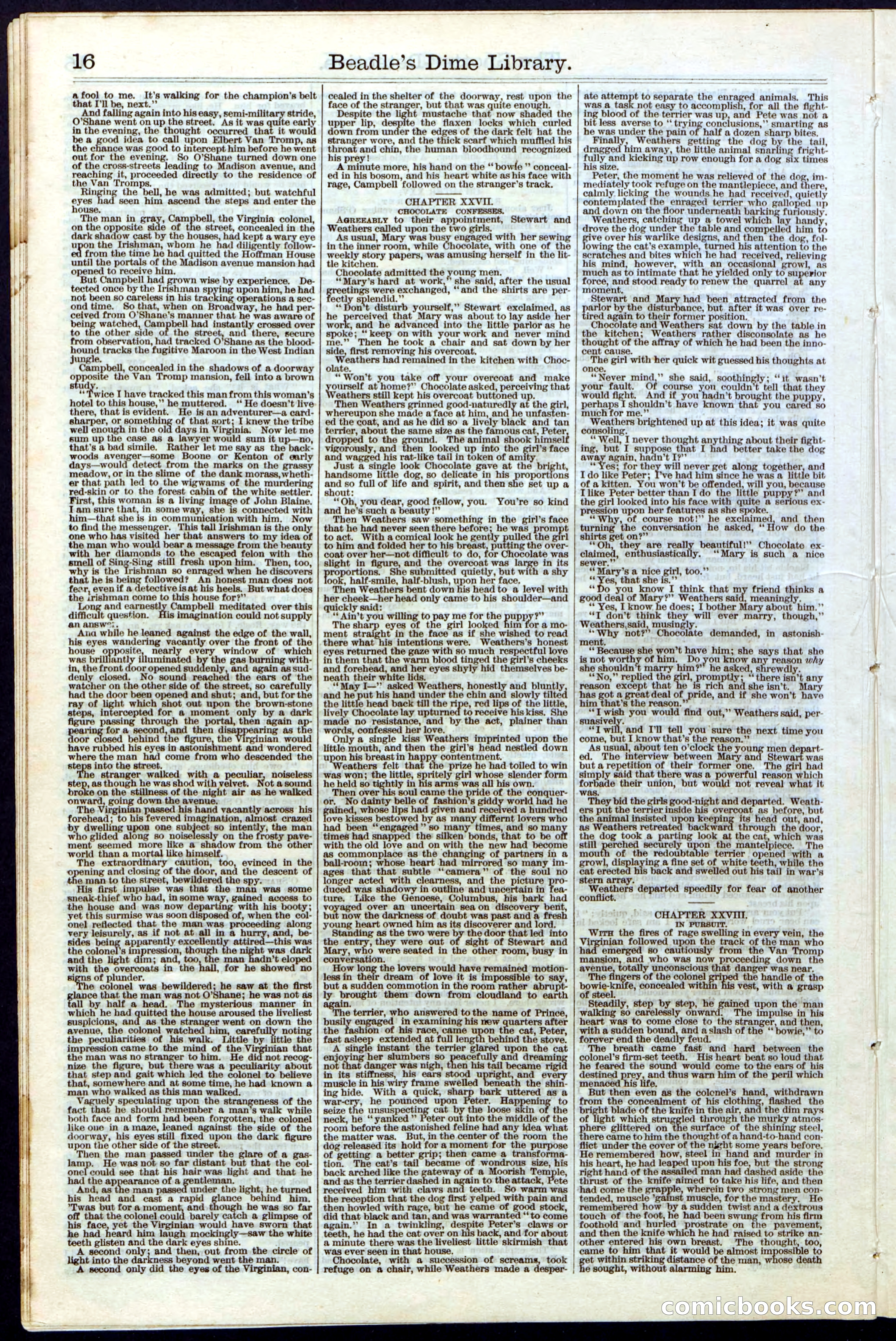
A restored page from Pulp Fiction, 1878. Page through the whole issue in the reader above.
📄 Transcribed text from this page (OCR, searchable)
Machine-transcribed from the original scan — historical spelling and the odd misread are preserved.
; ] | ' —— 16 a fool to me. It’s walking for the champion’s belt that I'll be, next.”’ And falling again into his easy, semi-milit stride, O’Shane went on up the street. As it was q te early in the evening, the thought occurred that it would be a good idea to call upon Elbert Van Tromp, as the chance was good to intercept him before he went out for the evening. So O’Shane turned down one of the cross-streets leading to Madison avenue, and reaching it, proceeded directly to the residence of the Van Tromps. Ringing the bell, he was admitted; but watchful eyes iad seen him ascend the steps and enter the ouse. The man in Bray, Campbell, the Virginia colonel, on the opposite side of the street, concealed in the dark shadow cast by the houses, had kept a wary eye upon the Irishman, whom he had diligently follow- from the time he had quitted the Hoffman House until the portals of the Madison avenue mansion had opened to receive him. But Campbell had wn wise by experience. De- tected once by the Irishman spying upon him, he had not been so careless in his tracking operations a sec- ond time. So that, when on Broadway, he had per- ceived from O’Shane's manner that he was aware of being watched, Campbell had instantly crossed over to the other side of the street, and there, secure from observation, had tracked O’Shane as the blood- eee tracks the fugitive Maroon in the West Indian ungle. epee concealed in the shadows of a doorway o _ the Van Tromp mansion, fell into a brown udy. " Twice I have tracked this man from this woman's hotel to this house,’ he muttered. ‘“‘ He doesn’t live there, that is evident. He is an adventurer—a card- sharper, or something of that sort; I knew the tribe well enough in the old days in Virginia. Now let me sum up the case as a lawyer would sum it up—no, that’s a bad simile. Rather let me say as the back- woods avenger—some Boone or Kenton of early days—would detect from the marks on the grassy meadow, or in the slime of the dank morass,wheth- er that path led to the wigwams of the murdering red-skin or to the forest cabin of the white settler. First, this woman is a living im of John Blaine. Tam sure that, in some way, she is connected with him—that she is in communication with him. Now to find the messenger. This tall Irishman is the only one who has visi her that answers to my idea of the man who would bear a message from the beauty with her diamonds to the escaped felon with the smell of Sing-Sing still fresh upon him. Then, too, why is the Irishman so enraged when he discovers that he is being followed? An honest man does not fear, even if a detective isat his heels. But what does the irishman come to this house for?” song and earnestly Campbell meditated over this difficult question. His imagination could not supply an answ*:. Ana while he leaned against the edge of the wall, his eyes wandering vacantly over the front of the house opposite, nearly every window of which was brilliantly illuminated a, the gas burning with- in, the front door opened suddenly, and again as sud- denly closed. No sound reached the ears of the watcher on the other side of the street, so carefully had the door been opened and shut; and, but for the ray of nem which shot out upon the brown-stone steps, intercepted for a moment only by a dark figure passing through the portal, then again ap- peering: Sore. Seger Ane Wren disa ring as the oor closed behind the figure, the Virginian would have rubbed his eyes in astonishment and wondered where the man had come from who descended the ateps into the street. e stranger walked with a peculiar, noiseless step, as though he was shod with velvet. Not a sound b on the stillness of the night air as he walked par = going down the avenue, The passed his hand vacantly across his forehead; to his fevered imagination, almost crazed 2,4 dwelling upon one subject so intently, the man who glided along so noiselessly on the frosty pave- ment seemed more like a shadow from the other world than a mortal like himself. The extraordinary caution, too, evinced in the opening and closing of the door, and the descent of e man to the street, bewildered the spy. His first impulse was that the man was some sneak-thief who bad, insome way, gained access to the house and was now depa with his booty; yet this surmise was soon disposed of, when the col- onel reflected that the man was g along very leisurely, as if not at all in a h , and, be- sides being apparently excellent] —this was the colonel’s impression, though the night was dark and the light dim; and, too, the man *t elo with 7 Sg mat ead in the hall, for he owns aigns of plunder. e colonel was bewildered; he saw at the first ce that the man was not o’Shane; he was not as ll by half a head. The mysterious manner in which he had quitted the house aroused the liveliest suspicions, and as the stranger went on down the avenue, the colonel watched him, caref noting the peculiarities of his walk. Little by little the impression came to the mind of the V that the man was no stranger to him. He not recog- nize the figure, but there was a peculiarity about that step and gait which led the colonel to believe that, somewhere and at some time, he had known a man wae spans | this man —— A aguely speculating upon the strangeness of the fact that he should remember a man’s walk while both face and form had been forgotten, the colonel like one in a maze, leaned against the side of the doorway, his eyes still fixed am the dark figure upon the other side of the street. Then the man under the glare of a gas- lamp. He was not so far distant but that the col- onel could see that his hair was light and that he had the ap ce of a gentleman. And, as the man under the light, he turned his head and cast a rapid glance behind him. *Twas but for a moment, and though he was so far off that the colonel could barely ca a glimpse of his face, yet the Virginian would have sworn that he had heard him laugh mockingly—saw the white teeth glisten and the dark eyes shine. A second only; and then, out from the circle of light into the darkness beyond went the man. A second only did the eyes of the Virginian, con- Beadle’s Dime Library. cealed in the shelter of the doorway, rest upon the face of the stranger, but that was quite enough. Despite the light mustache that now shaded the upper lip, despite the flaxen locks which curled down from under the edges of the dark felt hat the stranger wore, and the thick scarf which muffled his throat and chin, the human bloodhound recognized his prey! A minute more, his hand on the “ bowfe ” conceal- ed in his bosom, and his heart white as his face with rage, Campbell followed on the stranger's track. CHAPTER XXVIII. CHOCOLATE CONFESSES. AGREEABLY to their appointment, Stewart and Weathers called upon the two girls. As usual, Mary was busy engaged with her sewing in the inner room, while Chocolate, with one of the weekly story papers, was amusing herself in the lit- tle kitchen. Chocolate admitted the young men. “*Mary’s hard at work,” she said, after the usual etings were exchanged, ‘‘and the shirts are per- ectl splendid.’ f t disturb yourself,” Stewart exclaimed, as he perceived that Mary was about to lay aside her work, and he advanced into the little parlor as he spoke; “keep on with your work and never mind Then he took a chair and sat down by her side, first removing his overcoat. Weathers had remained in the kitchen with Choc- olate. “Won't you take off your overcoat and make ourself at home?’’ Chocolate asked, perceiving that eathers still kept his overcoat buttoned ig Then Weathers grinned good-naturedly at the girl, whereupon she made a face at him, and he unfasten- ed the coat, and as he did so a lively black and tan terrier, about the same size as the famous cat, Peter. dropped to the ground. The animal shook himself vigorously, and then looked up into the girl’s face and wagged his rat-like tail in token of amity Just a single look Chocolate gave at the bright, handsome little dog, so delicate in his proportions — so full of life and spirit, and then she set up a shout: ““Oh, you dear, good fellow, you. You're so kind and he’s such a beauty!" Then Weathers saw something in the girl's face that he had never seen there before; he was eh t to act. With a comical look he gently ulled the girl to him and folded her to his breast, putting the over- coat over her—not difficult to do, for Chocolate was slight in and the overcoat was | in its ait rtions. She submitted quietly, but with a shy ook, half-smile, half-blush, upon her face. Then Weathers bent down his head to a level with her cheek—her head only came to his shoulder—and Xt ‘Arcee willing to for th ? ** Ain’t you n pay me for the puppy?” The hee eyes of the girl looked Finn for a mo- ment straight in the face as if she wished to read there what his intentions were. Weathers’s honest eyes returned the gaze with so much respectful love in them that the warm blood tinged the girl’s cheeks and forehead, and her eyes shyly hid themselves be- neath their white lids. ‘*May I—”’ asked Weathers, honestly and bluntly. and he put his hand under the chin and slowly tilted the little head back till the ripe, red lips of the little, lively Chocolate lay upturned to receive his kiss. She made no resistance, and by the act, plainer than words, confessed her love. Only a single kiss Weathers imprinted upon the little mouth, and then the girl’s head nestled down upon his breast in happy contentment. eathers felt that the prize he had toiled to win was won; the little, spritely girl whose slender form he held so tightly in his arms was all his own. Then over soul came the pride of the conquer- or. No dainty belle of fashion's giddy world had he —— whose lips had given and ved a hundred ove kisses bestowed by as many differnt lovers who had been “ ” s0 many times, and so man times had snapped the silken bonds, that to be o with the old love net on with the new had at as commonplace as the changing of partners in a ball-room; whose heart had mirrored so many im- ages that that subtle “‘camera”’ of the soul no longer acted with clearness, and the picture pro- duced was shadowy in outline and uncertain in fea- ture. Like the Genoese, Columbus, his bark had voy over an uncertain sea on discovery bent, but now the darkness of doubt was past and a fresh young heart owned him as its discoverer and lord. Standing as the two were by the door that led into the sg 4 they were out sight of Stewart and Mary, who were seated in the other room, busy in conversation. How long the lovers would have remained motion- less in their dream of love it is impossible to say, but a sudden commotion in the room rather abrupt- ly brought them down from cloudland to earth e terrier, who answered tothe name of Prince, busil in examining his new quarters after the on of his race, came upon the cat, Peter, fast asleep extended at full length behind the stove. A single instant the terrier glared upon the cat one her slumbers so fully and d no danger was nigh, then his tail became rigi in its stiffness, ears stood mpright, and every muscle in his wiry frame swelled eath the shin- ing hide. With a quick, bark uttered as a war-cry, he pounced upon Peter. Happening to seize the pte ay cat 3 the loose skin of the neck, he “yanked ’’ Peter out into the middle of the room before the astonished feline had any idea what the matter was. But, in the center of the room the dog released its hold for a moment for the purpose of getting a better grip; then came a transforma- tion. The cat’s tail became of wondrous size, his back arched like the gateway of a Moorish Te and as the terrier dashed in = orem to the attack, Pete received him with claws and teeth. So warm was the reception that the dog first yelped with pain and then howled with rage, but he came of good stock, did that black and tan, and was warranted *‘ to come again.’’ In a twinkling, despite Peter’s claws or teeth, he had the cat over on back, and for about a minute there was the liveliest little skirmish that was ever seen in that house. _ Chocolate, with a succession of screams, took refuge on a chair, while Weathers made a desper- i | i ate attempt to separate the enraged animals. This was a task not easy to accomplish, for all the fight- ing blood of the terrier was up, and Pete was not a bit less averse to “ tryin conclusions,” smarting as he was under the pain of half a dozen sharp bites. Finally, Weathers getting the dog by the tail, dragged him away, the little animal snarling fright- Sg and kicking up row enough for a dog six times S size. Peter, the moment he was relieved of the dog, im- mediately took refuge on the mantlepiece, and ere, calmly licking the wounds he had received, quietly contemplated the enraged terrier who galloped up and down on the floor underneath barking furiously. Weathers, catching up a towel which yf handy, drove the dog under the table and compelled him to ve over his warlike designs, and then the dog, fol- owing the cat’s example, turned his attention to the scratches and bites which he had received, relieving his mind, however, with an occasional growl, as much as to intimate that he yielded only to superior foree, and stood ready to renew the quarrel at any moment, Stewart and Mary had been attracted from the pee by the disturbance, but after it was over re- ired again to their former position. Chocolate and Weathers sat down by the table in the kitchen; Weathers rather disconsolate as he thought of the affray of which he had been the inno- cent cause. The girl with her quick wit guessed his thoughts at once. “Never mind,”’ she said, soothingly; “it wasn't your fault. Of course yon couldn't tell that they would fight. And if you hadn't brought the puppy, perhaps I shouldn’t have known that you cared so much for me.” Weathers brightened up at this idea; it was quite consoling. “Well, I never thought anything about their fight- ing, but I sup that I had better take the dog away again, hadn't I?’ “Yes; for they will never get along together, and I do like Peter; I've had him since he was a little bit of a kitten. You won't be offended, will you, because Tlike Peter better than I do the little puppy?” and the girl looked into his face with quite a serious ex- pression upon her features as she spoke. “Why, of course not!’’ he exclaimed, and then turning the conversation he asked, “ How do the shirts get_on?”’ **Oh, they are really beautiful!l’’ Chocolate ex- claimed, enthusiastically. ‘‘Mary is such a nice "sa nice sewer.” girl, too.” “Yes, that she is."’ : t “ Mary “Do you know I think that my friend thinks a good deal of Mary?’ Weathers said, meaningly. ** Yes, I know he does; I bother Mary about him.” “T don’t think they will ever marry, though,” Weathers,said, musingly. saat y not?” Chocolate demanded, in astonish- ment. ** Because she won’t have him; she says that she is not worthy of him. Do you know any reason why she shouldn’t marry him?” he asked, shrewdly. “No,” replied the girl, promptly; “there isn’t any reason except that he is rich and she isn’t. Mary has got a great deal of pride, and if she won't have him that’s the reason.’ ‘“*T wish you would find out,’’ Weathers said, per- jpn ot hal “T will, and I'll tell you sure the next time you come, but I know that’s the reason.” As usual, about ten o’clock the young men depart- ed. The interview between Mary and Stewart was but a repetition of their former one, The girl had ey said that there was a powerful reason which forbade their union, but would not reveal what it was. They bid the girls good-night and departed. Weath- ers put the terrier inside hie overcoat as before, but the animal insisted Hal keeping its head out, and, as Weathers retrea backwant through the door, the dog took a parting look at the cat, which was still perched securely upon the mantelpiece. The mou i pin 1 Ane gs ns cnt opened ae a grow g a fine set of whi , while the cat Shootel his back and swelled out his tail in war's stern array. Weathers departed speedily for fear of another conflict. CHAPTER XXVIII. Ww the fires ot rege quciiing? in, th ITH n every vein, the Vi followed upon the track of pnt Abie who had emerged so cautiously from the Van Tromp mansion, and who was now proceeding down the avenue unconscious that danger was near. The rs of the colonel the handle of the bowie-knife, concealed wit vest, with a grasp of steel. . Steadily, step by step, he ed upon the man walking so carelessly Rivard’ The impulse in his heart was to come close to the stranger, and then, with a sudden bound, and a slash of the “bowie,” to forever end the deadly feud. The breath came fast and hard between the colonel’s firm-set teeth. His heart beat so loud that he feared the sound would come to the ears of his destined prey, and thus warn him of the peril which menaced his life. But then even as the colenel’s hand, withdrawn from the concealment of his clothing, flashed the peri blade of the knife in the air, and the dim rays of light which led through the murky atmos- here glittered on the surface of the shining steel, here came to him the thought of a hand-to-hand con- flict under the cover of the nirht some years before. He remembered how, steel in hand and murder in his heart, he had leaped upon his foe, but the strong right hand of the assailed man had dashed aside the thrust of the knife aimed to take his life, and then had come the grapple, wherein two strong men con- tended, muscle ’ muscle, for the mastery. He remembered how by a sudden twist and a dextrous touch of the foot, he had been swung from his firm foothold and hurled prostrate on e pavement, and then the knife which he had raised to strike an- other entered his own breast. The thought, too, came to him that it would be almost im ible to t within striking distance of the man, whose death e sought, without alarming him. e’ EGomilichboo <SiGOo