
Pulp Fiction, 1883 · page 26 of 32
Beadle's New York Dime Library No. 262 — page 26: what you’re looking at
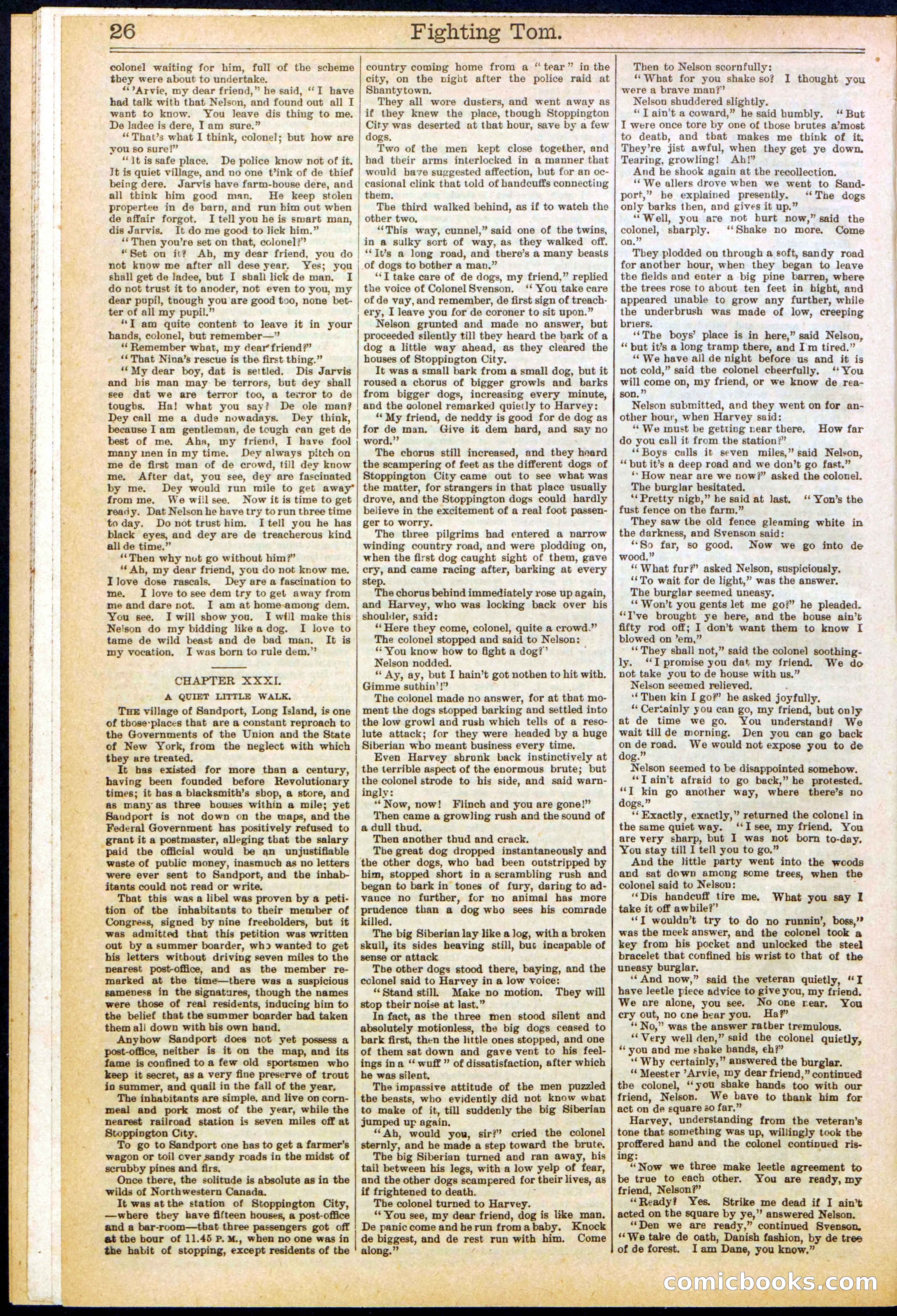
A restored page from Pulp Fiction, 1883. Page through the whole issue in the reader above.
📄 Transcribed text from this page (OCR, searchable)
Machine-transcribed from the original scan — historical spelling and the odd misread are preserved.
=== — ee ale eS aS a ~ ow a e - ~ ~ sw SSLT SSS Sen +-~ — * ase Sea Oe oe —. . } ad * A» TT O47 > SOT ’ < an 26 ‘today. Do not trust him. —* ~ A & e, —, _-_ Tom. 3} Se fw eens ee colonel waiting for him, full of the scheme they were about to undertake. “Arvie, my dear friend,” he said, ‘I have had talk with that Nelson, and found out all I want to know. You leave dis thing to me. De ladee is dere, I am sure.” **That’s what I think, colonel; but how are you so sure?” “lt is safe place. De police know not of it. It is quiet village, and no one t’ink of de thief being dere. all think him good man. He keep stolen propertee in de barn, and run him out when de affair forgot. I tell you he is smart man, dis Jarvis. It do me good to lick him.” ‘*Then you’re set on that, colonel?” “Set on it? Ab, my dear friend, you do | not know me after all dese year. Yes; you shall get de Jadee, but I shall lick de man. I do not trust it to anoder, not even to you, my dear pupil, tnough you are good too, none bet- ter of all my pupil.” “T am quite content to leave it in your hands, colonel, but remember—” “Remember what, my dear’ friend?” ~ “That Niva’s rescue is the first thing.” ‘My dear boy, dat is settled. Dis Jarvis and his man may be terrors, but dey shall see dat we are terror too, a terror to de tougbs. Ha! what you say? De ole man? Dey call me a dude nowadays. Dey think, because Iam gentleman, de tough can get de best of me. Aha, my friend, I have fool many inen in my time. Dey always pitch on me de first man of de crowd, till dey know me. After dat, you see, dey are fascinated by me. Dey would run mile to get away* from me. Wewillsee. Now it is time to get ready. Dat Nelson he have try torun three time I tell you he has black eyes, and dey are de treacherous kind all de time.” “Then why not go without him?” ‘Ab, my dear friend, you do not know me. I Jove dose rascals. Dey are a fascination to me. I love to see dem try to get away from me and dare not. I am at homeamong dem. You see. I will show you. I will make this Nelson do my bidding like adog. I love to tame de wild beast and de bad man, It is my vocation, I was born to rule dem,” CHAPTER XXXI. , A QUIET LITTLE WALK. THE village of Sandport, Long Island, is one of those-places that are a constant reproach to the Governments of the Union and the State of New York, from the neglect with which they are treated. It bas existed for more than a century, _ having been founded before Revolutionary times; it bas a blacksmith’s shop, a store, and as many as three houses within a mile; yet Bandport is not down on the maps, and the Federal Government has positively refused to grant it a postmaster, alleging that tbe salary ‘paid the official would be an unjustifiable waste of public money, inasmuch as no letters were ever sent to Sandport, and the inhab- itants could not read or write. That this was a libel was proven by a peti- tion of the inhabitants to their member of Congress, signed by nine freebolders, but it was admitted that this petition was written out by a summer boarder, wh) wanted to get his letters without driving seven miles to the nearest post-office, and as the member re- marked at the time—there was a suspicious sameness in the signatures, though the names were those of real residents, inducing him to the belief that the summer boarder had taken them all down with bis own hand. Anyhow Sandport does not yet possess a post-office, neither is it on the map, and its fame is confined to a few old sportsmen who keep it secret, as a very fine preserve of trout in summer, and quail in the fall of the year, The inhabitants are simple, and live on corn- meal and pork most of the year, while the nearest railroad station is seven miles off at Stoppington City. To go to Sandport one has to get a farmer’s wagon or toil over sandy roads in the midst of scrubby pines and firs. Once there, the solitude is absolute as in the wilds of Northwestern Canada. It was at the station of Stoppington City, —where they have fifteen houses, a post-o and a bar-room—tbat three passengers got off at the bour of 11.45 P.M., when no one was in the habit of stopping, except residents of the country coming home from a “tear” in the city, on the night after the police raid at Shantytown, They all wore dusters, and went away as if they knew the place, though Stoppington City was deserted at that hour, save by a few dogs. Two of the men kept close together, and had their arms interlocked in a manner that would bave suggested affection, but for an oc- Jarvis have farm-house dere, and | casional clink that told of handcuffs connecting them. The third walked behind, as if to watch the other two, “This way, cunnel,” said one of the twins, in a sulky scrt of way, as they walked off. ‘‘Itv’s a long road, and there’s a many beasts of dogs to bother a man,” ‘*T take care of de dogs, my friend,” replied the voice of ColonelSvenson. ‘‘ You take care of de vay, and remember, de first sign of treach- ery, I leave you for de coroner to sit upon.” Nelson grunted and made no answer, but proceeded silently till they heard the bark of a dog a little way ahead, as they cleared the houses of Stoppington City. It was a small bark from a small dog, but it roused a chorus of bigger growls and barks from bigger dogs, increasing every minute, and the colonel remarked quietly to Harvey: ‘* My friend, de neddy is good for de dog as for de man. Give it dem hard, and say no word,”’ The chorus still increased, and they heard the scampering of feet as the different dogs of Stoppington City came out to see what was the matter, for strangers in that place usually drove, and the Stoppington dogs could hardly believe in the excitement of a real foot passen- ger to worry. The three pilgrims bad entered a narrow winding country road, and were plodding on, when the first dog caught sight of them, gave cry, and came racing after, barking at every step. The chorus behind immediately rose up again, and Harvey, who was looking back over his shoulder, said: ‘Here they come, colonel, quite a crowd.” The colonel stopped and said to Nelson: ** You know how to fight a dog?’ Nelson nodded. “ Ay, ay, but I hain’t got nothen to hit with. Gimme suthin’!” The colonel made no answer, for at that mo- ment the dogs stopped barking and settled into the low growl and rush which tells of a reso- lute attack; for they were headed by a huge Siberian who meant business every time. Even Harvey sbronk back instinctively at the terrible aspect of the enormous brute; but the colonel strode to bis side, and said warn- ingly: ‘Now, now! Flinch and you are gone!” Then came a growling rush and the sound of a dull thud. Then another thud and crack. The great dog dropped instantaneously and the other dogs, who bad been outstripped by him, stopped short in a scrambling rush and began to bark in tones of fury, daring to ad- vance no further, for no animal has more prudence than a dog who sees his comrade killed, The big Siberian lay like a Jog, with a broken skull, its sides heaving still, buc incapable of sense or attack The other dogs stood there, baying, and the colonel said to Harvey in a low voice: ‘* Stand still Make no motion, They will stop their noise at last.” In fact, as the three men stood silent and absolutely motionless, the big dogs ceased to bark first, then the little ones stopped, and one of them sat down and gave vent to his feel- ings ina ‘“ wuff ” of dissatisfaction, after which he was silent. The impassive attitude of the men puzzled the beasts, who evidently did not know what to make of it, till suddenly the big Siberian jumped up again. ‘Ah, would you, sir?’ cried the colonel sternly, and he made a step toward the brute, The big Siberian turned and ran away, bis tail between his legs, with a low yelp of fear, and the other dogs scampered for their lives, as if frightened to death. ; The colonel turned to Harvey. ‘You see, my dear friend, dog is like man. De panic come and herun fromababy. Knock de biggest, and de rest run with him. Come along.” aes = , . . - = “es ¥ iy re Ase ee ot ee + ES ou me: A» . ies ‘ PS ore . 4, ; Then to Nelson scornfully: ‘* What for you shake so? were a brave man?” Nelson shuddered slightly. * T ain’t a coward,” he said humbly. “ But I were once tore by one of those brutes a’most to death, and tbat makes me think of it, They’re jist awful, when they get ye down. Tearing, growling! Ah!” And he shook again at the recollection. ‘¢ We allers drove when we went to Sand- port,” be explained presently. ‘The dogs only barks then, and gives it up.” ‘““Well, you are not hurt now,” said the colonel, sharply. ‘‘Shake no more. Come on.” They plodded on through a soft, sandy road for another hour, when they began to leave the fields and enter a big pine barren, where the trees rose to about ten feet in hight, and appeared unable to grow any further, while the underbrush was made of low, creeping briers. ‘‘The boys’ place is in here,” said Nelson, ‘‘ but it’s a long tramp there, and I'm tired.” ‘““ We have all de night before us and it is not cold,” said the colonel cheerfully, ‘‘ You will come on, my friend, or we know de rea- son.” Nelson submitted, and they went on for an- other hour, when Harvey said: ‘‘ We must be getting near there, How far do you call it from the station?” ‘Boys calls it seven miles,” said Nelson, ‘but it’s a deep road and we don’t go fast,” ‘‘ How near are we now?’ asked the colonel. The burglar hesitated. “* Pretty nigb,” he said at last, fust fence on the farm.” They saw the old fence gleaming white in the darkness, and Svenson said: “So far, so good. Now we go into de wood,” * What fur?’ asked Nelson, suspiciously. ‘*To wait for de light,” was the answer. The burglar seemed uneasy. ‘‘ Won’t you gents let me go?” he pleaded. “‘T’ve brought ye here, and the bouse ain’t fifty rod off; I don’t want them to know I blowed on ’em,” ‘‘ They shall not,” said the colonel soothing- ly. ‘‘I promise you dat my friend. We do not take you to de house with us,” Nelson seemed relieved. : ‘Then kin I go?’ he asked joyfully. “Certainly you can go, my friend, but only at de time we go. You understand? We wait tillde morning. Den you can go back on de road. We would not expose you to de dog.” Nelson seemed to be disappointed somehow. ‘‘Tain’t afraid to go back,” he protested. ““T kin go another way, where thbere’s no dogs.” ‘Exactly, exactly,” returned the colonel in the same quiet way. ‘‘I see, my friend, You are very sharp, but I was not born to-day. You stay till I tell you to go,” And the little party went into the woods and sat down among some trees, when the colonel said to Nelson: ‘““Dis handeuff tire me, take it off awhile?’ ‘*T wouldn’t try to do no runnin’, boss,’ was the meek answer, and the colonel took a key from his pocket and unlocked the steel bracelet that confined bis wrist to that of the uneasy burglar. ‘‘And now,” said the veteran quietly, “I have leetle piece advice to give you, my friend. We are alone, you see. No one rear, You cry out, no one bear you. Ha?” ‘* No,” was the answer ratber tremulous. ‘“‘ Very well den,” said the colonel quietly, ‘you and me shake hands, eh?” ‘Why certainly,” answered the burglar. ““ Meester ’Arvie, ny dear friend,” continued the colonel, ‘‘you shake hands too with our friend, Nelson. We bave to thank him for act on de square <0 far,” Harvey, understanding from the veteran’s tone that something was up, willingly took the proffered hand and the colonel continued ris- ing: “Now we three make leetle agreement to be true to each other, You are ready, my friend, Nelson?” “Ready? Yes. Strike me dead if I ain't acted on the square by ye,’’ answered Nelson. “Den we are ready,” continued Svenson, ‘*We take de oath, Danish fashion, by de tree of de forest. Iam Dane, you know,” ‘comicbooks. i o> | he A ~ ‘a & a = . >” aks 4! = 1 thought. you ‘‘ Yon’s the What you say I oo” t . . . %, . - es we ts JF ag?