
Pulp Fiction, 1883 · page 21 of 32
Beadle's New York Dime Library No. 262 — page 21: what you’re looking at
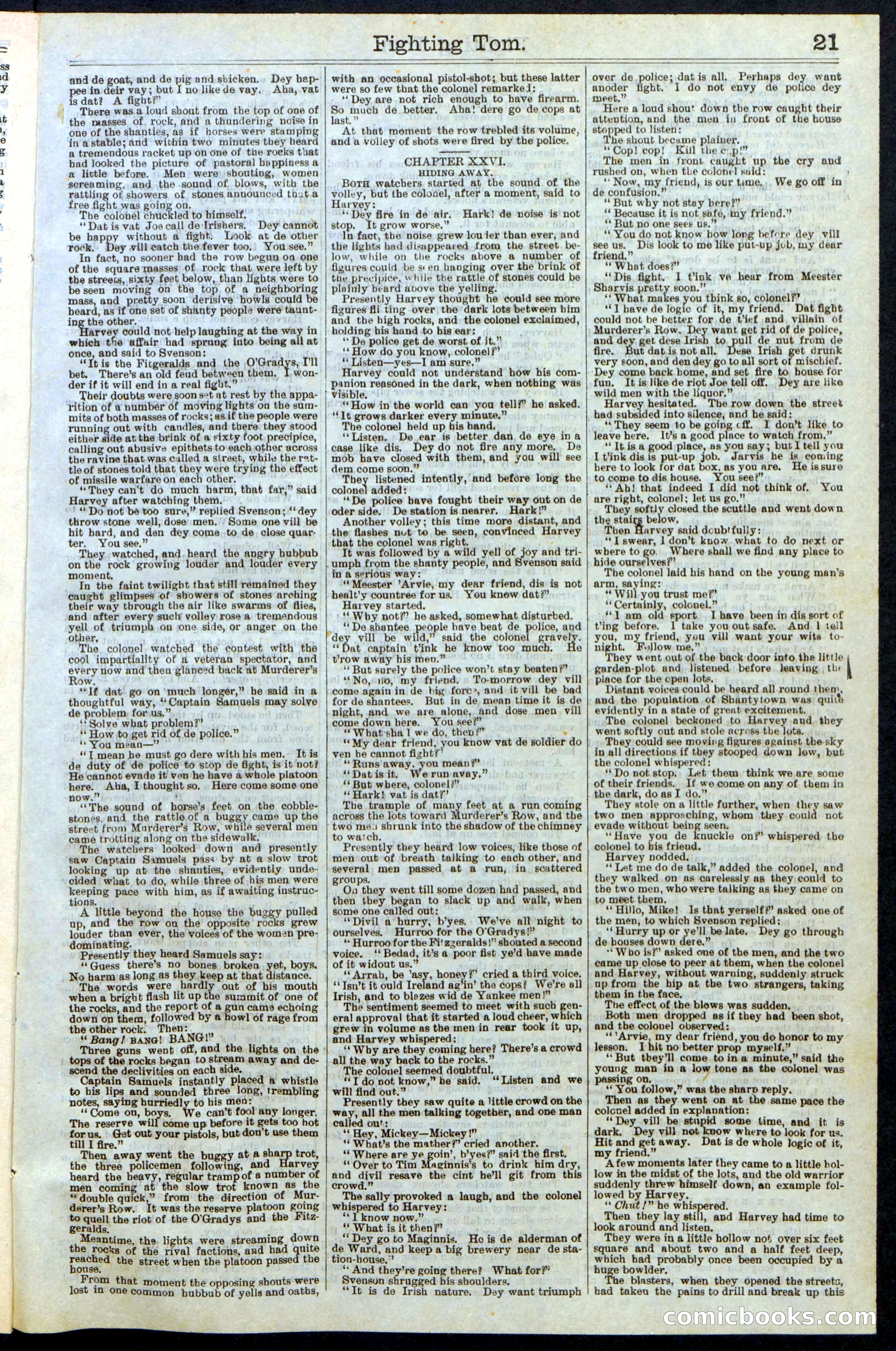
A restored page from Pulp Fiction, 1883. Page through the whole issue in the reader above.
📄 Transcribed text from this page (OCR, searchable)
Machine-transcribed from the original scan — historical spelling and the odd misread are preserved.
if Ss id < cr Wi Oe i et ae _____—_-——~.y— ———_ ———_- Dey bep- and de goat, and de pig and sbicken. Aha, vat in deir vay; but I no like de vay. is dat? A fight?” There was a loud shout from the top of one of the masses of. rock, and a thundering noise in one of the shanties, as if horses were stamping in astable; and within two minutes they heard a tremendous racket up on one of the roeks that bad looked the picture of pastoral happiness a a little before. Men were sbouting, women sereaming, and the sound of blows, with the rattling of showers of stones announced thuta free fight was going on, The colonel chuckled to bimself. ‘‘Dat is vat Joe call deIrishers. Dey cannot be happy without a fight: Look at de other ro¢k. Dey vill catch thefever too.. You see.” In fact, no sooner had the row begun oa one of the square masses’ Of rock that were left by the streets, sixty feet below, than lights were to be seen moving on the top of a neighboring mass, and pretty soon derisive howls could be heard, as if one set of shanty people were taunt- ing the other. dye could not help laughing at the way in which the affair had sprung into being all at once, and said to Svenson: . “Tt is the Ficgeralds and the O’Gradys, I'll bet, There’s an old feud between them, I won- der if it will end in a real fight.” Their doubts were soon set at rest by the appa- rition of a number of moving lights on the sum- mits of both masses of rocks; as. if the people were runving out with candles, and there they stood either side at the brink of a sixty foot precipice, calling out abusive epithets to each other across the ravine that was called a street, while the rat- tle of stones told that they were trying the effect of missile warfare on each other. “They can't do much harm, that far,” said Harvey after watching them. '* Do not be too sure,” replied Svenson; ‘‘ dey throw stone well, dose men. Some one vill be hit hard, and den dey come to de close quar- ter. You see,” They watched, and. heard the angry bubbub on the rock growing louder and louder every moment, In the faint twilight that still remained they caught glimpses of showers of stones arching their way tbrough the air like swarms of flies, and after pears sucli volley rosea tremendous yell of triumph on one side, or anger on the other, The colonel watched the contest with the cool impartiality of a veteran spectator, and every now and then glanced back at Murderer’s ow. “If dat. go on much longer,” he said in a thoughtful way, “Captain Samuels may solve de problem, for us.” ‘* Solve what problem?” ‘* How to get rid of de police.” “You mean—” ‘‘T mean he must go dere with his men. It is de duty of de police to stop de fight, is it not? He cannot evade it ven he have a whole platoon here. Aba, lL thoughtso. Here come some one now.” ; “The sound of horse’s feet on the cobble- stones, and the rattle of a buggy came up the street from Murderer’s Row, while several men came trotting along on the sidewalk. The watchers looked down and presently saw Captain Samuels pass by at a slow trot looking up at the shanties, evidently unde- cided what to do, while three of his men were keeping pace with him, as if awaiting instruc- tions. A little beyond the house the buggy pulled up, and the row on the opposite rocks grew louder than ever, the voices of the women pre- dominating. Presently they heard Samuels say: ‘Guess there’s no bones broken yet, boys. No barm as long as they keep at that distance. The words were hardly out of his mouth when a bright flash lit up the summit of one of the rocks, and the report of a gun came echoing down on them, followed by a howl of rage from the other rock. Then: “ Bang! Bana! BANG! EEE ——— oe Three guns went off, and the lights on the ' tops of the rocks began to stream away and de- scend the declivities on each side, Captain Samuels instantly placed a whistle to his lips and sounded three long, trembling notes, saying hurriedly to his men: ‘‘Come on, boys. We can’t fool any longer, The reserve will come up before it gets too hot forus. Get out your pistols, but don’t use them till I fire.” Then away went the buggy at 4 shaep stot, the three policemen following, and rvey heard the heavy, regular trampof a number of men coming at the slow trot known as the “double quick,” from the direction of Mur- derer’s Row, It was the reserve platoon going to wilt the riot of the O'Gradys and the Fitz- Meantime, the. lights were streaming down the rocks of the rival factions, and had quite ee the street when the platoon passed the From that moment the opposing shouts were lost IN One common bubbub of yells and oaths, Fighting Tom: with an occasional pistol-shot;, but these latter were so few that the colonel remarked: ‘Dey are not rich enough to have firearm. So much de better. Aha! dere go de cops at last.” At that moment the row trebled its volume, and a volley of shots were fired by the police, CHAPTER XXVI. HIDING AWAY, Botu watchers started at the sound of the volley, but the colonel, after a moment, said to Harvey: ‘* Dey fire in de air. stop. It grow worse,” In fact, the noise grew louler than ever, and the lights had disappeared from the street. be- low, while on the rocks above a number of figures could be sen banging over the brink of the precipice, while the rattle of stones could be plainly beard avove the yelling. Presently Harvey thought he could see more fizures fli ting over the dark lots between him and the high rocks, and the colonel exclaimed, holding bis hand to his ear: ‘* De police get de worst of it.” ‘* How do you know, colonel?” ‘* Listen—yes—I am sure.” Harvey could not understand how his com- oc reasoned in the dark, when nothing was visible, ‘‘How in the world can you tell?” he asked, ‘It grows darker every minute,” The colonel held up bis band, ‘‘Listen. De ear is better dan. de eye ina case like dis. Dey do not fire any more, De mob have closed with them, and you will see dem come soon.” They listened intently, and before long the colonel added: ‘De police bave fought their way out on de oder side. De station is nearer. Hark!” Another volley; this time more distant, and the flashes nut to be seen, convinced Harvey that the colonel was right. , It was followed by a wild yell of joy and tri- umph from the shanty people, and Svenson said in a serious way: “Meester ’Arvie, my dear friend, dis is not healt’y countree for us, You knew dat?’ Harvey started. ‘‘Why not?’ he asked, somewhat disturbed. ‘‘De shantee people have beat de police and dey vill be wild,” said the colonel gravely. “Dat captain tink he know too much. ) vrow away his meu.” ‘‘But surely the police won’t stay beaten?” ‘(No, 110, my friend. To-morrow dey vill come again in de big fore», and it vill be bad for de shantees. But in de mean time it is de night, and we are alone, and dose men vill come down here. You see?” ‘“* What sha 1 we do, then?” . “My dear friend, you know vat de soldier do ven be cannot fight? “Runs away, you mean?” ‘* Dat is it, erun avay.” ‘‘ But where, colonel?’ ‘‘ Hark) vat is dat?’ The trample of many feet at a run coming across the lots toward Murderer’s Row, and the two me.) shrunk into the shadow of the chimney to watch. Presently they heard low voices, like those of men out of breath talking to each other, and several men passed at a run, in scattered groups. On they went till some dozen had passed, and then they began to slack up and walk, when some one called out: “Divil a hurry, b’yes. We've all night to ourselves. Hurroo for the O’'Gradys!” “ Hurroo for the Fit zzeralds!” shouted a second voice. ‘' Bedad, it’s a poor fist ye’d have made of it widout us.” ‘* Arrah, be ‘asy, honey f° cried a third voice. ‘‘Tsn’t it ould Ireland ag’in’ the cops? We're all Irish, and to blezes wid de Yankee men!” The sentiment seemed to meet with such gen- eral approval that it started a loud cheer, which grew in volume as the men in rear took it up, and Harvey whispered; ‘Why are they coming here? There’s a crowd all the way back to the rocks.” The colonel seemed doubtful, “T do not know,” he said. “Listen and we will find out.” Presently they saw quite a little crowd on the way, all the men talking together, and one man called out: ‘* Hey, Mickey— Mickey!” ‘* What’s the mather?”’ cried another. ‘‘ Where are ye goin’, b’yes?”’ said the first, “Over to Tim Maginnis’s to drink him dry, and divil resave the cint he'll git from this crowd,” The sally provoked a laugh, and the colonel wh to Harvey: **T know now.” ** What is it then?” ‘Dey go to Maginnis. Ho is de alderman of de Ward, and keep a big brewery near de sta- tion-house,”’ ** And they’re going there? What for?’ Svensoun shrugged his shoulders, “It is de Irish nature. Dey want triumph Hark! de noise is not 21 — Perhaps dey want over de police; dat is all, anoder fight. I do not envy de police dey meet,” Here a loud shout down the row caught their attention, and the men in front of the house eee to listen: he shout became plainer, “Cop! cop! Kill the ep!” The men in front caught up the cry and rushed on, when the colonel suid: ‘' Now, my friend, is our tame, de confusion.” “But why not stay bere?” ** Because it is not safe, my friend.” ** But no one sees us.” ** You do not know bow long before dey vill see us. Dis look to me like put-up job, my dear friend.” ‘* What does?” “Dis fight. I t’ink ve hear from Meester Sharvis pretty soon.” ‘‘ What makes you tbink 80, colonel?’ ‘T have de logic of it, my friend. Dat fight could not be better for de tief and villain of Murderer’s Row. Dey want get rid of de police, and dey get dese Irish to. pull de nut from de fire. But datis not all. Dese Irish get drunk very soon, and den dey go to all sort of mischief. Dey come back home, and set fire to bouse for fun, It is like de riot Joe tell off. Dey are like wild men with the liquor.” mer vey hesitated. The row down the street had subsided into silence, and he said: ‘They seem to be going cff. I don’t like to leave bere, It’s a good place to watch from,” ‘‘ It is a good place, as you say; but 1 tell you I tink dis is put-up job. Jarvis be is coming bere to look for dat box, as you are. He is sure to come to dis house. You see?” ‘‘ Ah! that indeed I did not think of. You are right, colonel; let us go.” They soft y closed the scuttle and went down the a below, Tben Harvey said dcubtfully: ‘‘IT swear, 1 don’t know what to do next or where to go Where shall we find any place to hide ourselves?” The colonel laid his hand on the young man’s arm, saying: “ Will you trust me?” ‘*Certainly, colonel.” ‘*] am old sport, I have been in dis sort of ting before. 1 take you out safe. And | tell you, my friend, you vill want your wits to- night. Follow me,” hey went out of the back door into the little garden-plot and listened before leaving , th: place for the open lots, : Distant voices could be heard all round them, and the population of Shantytown was quit evidently in a state of great excitement, The colonel beckoned to Harvey and, they went softly out and stole across the lots. They could see moving figures against the sky in all directions if they stooped down lew, but the colonel whispered: '*Do not stop. Let them think we are some of their friends. If we come on any of them in the dark, do as I do.” They stole on a little further, when they saw two men approsching, whom they could not evade without being seen. ‘Have you de knuckle on?’ whispered the colonel to bis friend. Harvey nodded, ‘* Let me do de talk,” added the colonel, and they walked on as carelessly as they could to the two men, who were talking as they came on to meet them, ‘* Hillo, Mike! Is that yerself?’ asked one of the men, to which Svenson replied; ‘‘ Hurry up or ye’ll be late.. Dey go through de houses down dere,” ** Wbo is?” asked one of the men, and the two came up close to peer at them, when the colonel and Harvey, without warning, suddenly struck up from the hip at the two strangers, taking them in the face. The effect of the blows was sudden. Both men dropped as if they had been shot, and the colonel observed: ‘“Arvie, my dear friend, you do honor to my lesson. I hit no better prop myself,” ‘But they'll come toina minute,” said the young man in a low tone as the colonel was on, ** You follow,” was the sharp reply. Then as they went on at the same pace the colonel added in explanation: “Dey vill be stupid some time, and it is dark. Dey vill not know where to look for us. Hit and get away. Dat is de whole logic of it, my friend.” A few moments later they came to a little hol- low in the midst of the lots, and the old warrior suddenly threw himself down, an example fol- lowed by Harvey, ‘* Chut /” he whispered. Then they lay still, and Harvey had time to look around and listen, They were in a little hollow not over six feet square and about two and a half feet deep, which had probably once been occupied by a a bowlder. e blasters, when they opened the streets, bad taken the pains to drill and break up this We go off in _— NiGbDoo (E(o) SAL Ele)