
Pulp Fiction, 1883 · page 17 of 32
Beadle's New York Dime Library No. 262 — page 17: what you’re looking at
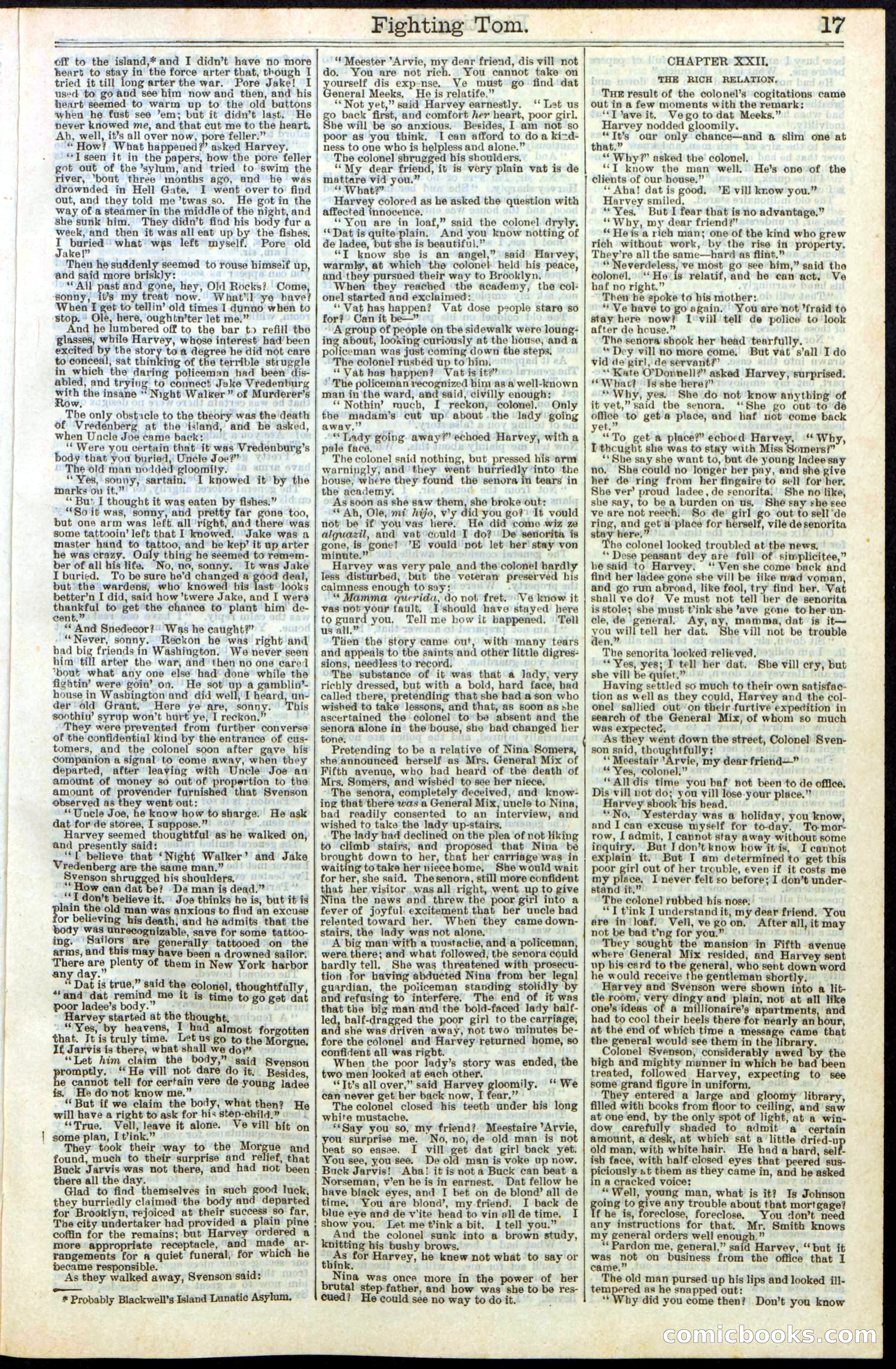
A restored page from Pulp Fiction, 1883. Page through the whole issue in the reader above.
📄 Transcribed text from this page (OCR, searchable)
Machine-transcribed from the original scan — historical spelling and the odd misread are preserved.
— Fighting Tom. 17 oe off to the island,* and I didn’t have no more heart to a in the force arter that, though I tried it till long arter the war. Pore Jake! I used to go and see him now and then, and his heart seemed to warm up to the old buttons when he fust see ’em; but it didn’t last. He never knowed me, and that cut me to the heart, Ah, well, it’s all over now, pore feller.” “How? What happened?’ asked Harvey. “I seen it in the papers, how the pore feller got out of the ’sylum, and tried to swim the river, ‘bout three months ago, and he was drownded in Hell Gate. I wenf over to find out, and they told me’twas so. He got in the way of a steamer in the middle of the night, and She sunk him. They didn’t find his body fur a week, and then it was all eat up by the fishes. I buried what was left myself. Pore old Jake!” Then he a. seemed to rouse himseif up, and said more briskly: ‘All past and gone, hey, Old Rocks?) Come, sonny, it’s my treat now. What'll ye have? When I get to tellin’ old times I dunno when to stop. - Ole, here, oughtn’ter let me.” And he lumbered off to the bar t» refill the glasses, while Harvey, whose interest’ had’ been excited by the eae to a degree he did not care to conceal, sat thinking of the terrible struggle in which the daring policeman had been dis- abled, and trying to connect Jake Vredenburg with the insane * Night Walker” of Murderer’s ow, The only obstacle to the theory was the death of Vredenberg at the island, and be asked, when Uncle Joe came back: ‘* Were you certain that it was Vredenburg’s body that you buried, Unele Joe?” The old man nodded gloomily. ‘Yes, sonny, sartain. I knowed it by the marks ow it.” “Bu I thought it was eaten by fishes.” “So it was, sonny, and pretty far gone too, but one arm was left. all right, and there was some tattooin’ left that I knowed. Jake was a master hand to tattoo, and he kep’ it up arter he was crazy. Ouly thing he seemed to remem- ber of all his life. No, no, sonny. It was Jake I buried. To be sure he'd changed a good deal, but the wardens, who knowed his last looks better’n I did, said how ’twere Jake, and I wers ———s to get the chance to plant him de- cent. “And Snedecor?) Was he caught?” “Never, sonny. Reckon he was right and had big friends in Washington. We never seen bim till arter the war, and then no one cared ‘bout what any one else had done while the fightin’ were goin’ on. He sot up a gamblin’- house in Washington and did well, I heard, un- der old Grant. Here ye are, sonny. This soothiw’ syrup won’t burt ye, I reckon.” They were prevented from further converse of the confidential kind by the entrance of cus- tomers, and the colonel soon after gave his companion a signal to come away, when they departed, after leaving with Uncle Joe an amount of money so out of propertion to the amount of provender furnished that Svenson observed as they went out: **Uncle Joe, he know how to sharge. He ask dat for de storee, I ose.” Harvey seemed thoughtful as he walked on, and presently said: ‘*L believe that ‘Night Walker’ and Jake redenberg are the same man.” Svenson shrugged his shoulders. ¢ sow can dat be? De man is dead.” .. I don’t believe it. Joo thinks he is, but it is lain the old man was anxious to find an excuse or believing his death, and he admits that the body was unrecognizable, save for some tattoo- ing. Sailors’ are Beperally tattooed on the arms, and this may have been a drowned sailor. There are plenty of them in New York harbor any day.” * Dat is true,” said the colonel, thoughtfally, “‘and dat remind me it is time to go get dat poor ladee’s body.” Harvey started at the thought, ‘Yes, by heavens, I had almost forgotten that. Jt is truly time. Let us go to the Morgue, ItJ stg ec! ey ateaan dor” “Let him claim the y;"_ said Svenson romptly. ‘He vill not dare do it, Besides, e cannot tell for certain vere de young ladee is. He donot know me.” “But if we claim the body, what then? He will have a right to ask for his step-child.” “True. Vell, leave it alone. Ve vill hit on some plan, I t’ink.” They took their way to the Morgue and found, much to their surprise and relief, that Buck Jarvis was not there, and had not been there all the day. . Glad to find themselves in such good luck, they burriedly claimed the body and departed for Brooklyn, rejoiced at their success so far, The city undertaker had provided a plain pine coffin for ne semete = a Spe a more ate receptacle, an r eanguindate Tor a quiet funeral, for which he became responsible. ; As they walked away, Svenson said: oa * Probably Blackwell’s Island Lunatic Asylum, ** Meester “Arvie, my dear friend, dis vill not do. You are not rich. You cannot take on yourself dis exp-nse. Ve must go find dat eneral Meeks, He is relatife.” ‘* Not yet,” said Harvey earnestly. ‘‘ Lot us g° back first, and comfort her heart, poor girl. he will be so anxious. Besides, 1 am not so poor as you think. I can afford to doa ki-d- ness to one who is helpless and alone.” The colonel shrugged his shoulders. “My dear friend, it is very plain vat is de mattare vid you.” “* What?” Harvey colored as he asked the question with affected innocence. ‘You are in loaf,” said the colonel dryly. **Dat is quite plain. And you know notting of de ladee, but she is beautiful.” “T know sbe is an angel,” said Harvey, warmly, at which the colonel held his peace, and they pursved their way to Brooklyn. When they reached the academy, the col- onel started and exclaimed: ** Vat has happen? Vat dose people stare so for? Can it be—” A group of people on the sidewalk were loung- ing about, looking curiously at the house, and a policeman was just coming down the steps. The colonel rushed up to him. “Vat has happen? Vat is it?’ ' The policeman recognized bim as a well-known man in the ward, and said, civilly enough: ** Nothin’ much, I reckon, colone). Only the madam’s cut up about the lady going away.” “Lady going away?’ echoed Harvey, with a pale face. The colonel said nothing, but pressed his ‘arm warningly, and they went he ess 4 into the house, where they found the senora in tears in the academy. As soon as she saw them, she broke out: * Ah, Ole, mit hijo, v’y did you go? It vould not be if you vas here. He did come wiz ze alguazil, and vat could I do? De senorita is gone, is gone! ’E vould not let her stay von minute.” Harvey was very pale and the colonel bardl less disturbed, but the veteran preserved his calmness enough to say: “ Mamma querida, do not fret. Ve know it vas nob-your tault. Ishould have stayed here to guard you, Tell me how it bappened. Tell us all,” Tien the story came out, with many tears and appeals to the saints and other little digres- sions, needless tu record. The substance of it was that a lady, very richly dressed, but with a bold, hard face, had called there, pretending that she had a son who wished to take lessons, and that, as soon as she ascertained the colonel to be absent and the senora alone in the bouse, she bad changed her ne. Pretending to be a relative of Nina Somers, she announced herself as Mrs. General Mix of Fifth avenue, who had heard of the death of Mrs. Somers, and wished to see her niece, The senora, completely deceived, and know- ing that there was a General Mix, uncle to Nina bad readily consented to an interview, an wished to take the lady up-stairs. The lady had declined on the plea of not liking to climb stairs, and proposed that Nina be brought down to her, that her carriage was in waiting totake her niecehome, She would wait for her, she said. Thesenora, still more confident hat her visitor was all right, went to give na the news and threw the poor girl into a fever of joyful excitement that ber uncle bad relented toward her. When they came down- stairs, the lady was not alone. A big man with a mustache, and a policeman were. tere: and what followed, the senora could og 4 tell. She was threatened with prosecu- tion for having abducted Nina from ber legal guardian, the poiiceman standing stolidly by and refusing to interfere. The end of it was that the big man and the bold-faced lady balf- led bal eaten the poor girl to the carriage, and she was driven away, not two minutes be- fore the colonel and Harvey returned home, so confident all was rigbt. When the poor lady’s story was ended, the two men looked at each other. **Tt’s all over,” said Hervey gicumaty: “We can never get her back now, fear,” The colonel closed his teeth under his long white mustache. . ‘*‘Say you so, my friend?. Meestaire ’Arvie, = surprise me. No, no, de old man is not eat so easee, I vill get dat girl back yet. You see, you see. De old man is voke up now. Buck Jarvis! Aba! it is not a Buck can beat a Norseman, v’en he is in earnest. Dat fellow he have black eyes, and I bet on de blond’ all de time. You are blond’, my friend. I back de blue eye and de vite head to vin all de time, I show you. Let me tink a bit, I tell you.” And the colonel sunk into a brown study, knitting his bushy brows. ‘veh for Harvey, he knew not what to say or Nina was once more in the power of her brutal step-father, and how was she to be res- cued? could see no way to do it. Ey CHAPTER XXIL THE RICH RELATION, Tue result of the colonel’s cogitations came out in a few moments with the remark: ‘*T’ave it. Vegotodat Meeks.” Harvey nodded gloomily. “It’s our only chance—and a slim one at that.” “Why?” asked the colonel. *“T know the man well. clients of our house.” ** Aha! dat is good, Harvey smiled, * Yes, But I fear that is no advantage.” ‘Why, my dear friend?’ **Heis a rich man; one of the kind who grew rich without work, by the rise in property. They’re all the same—haréd as flint.” *” lnovorddlars ve most go see him,” said the Ve He’s one of the ’B vill know you.” colonel. ‘He is relatif, and he can act. haf no right.” . Then he spoke to his mother: ‘** Ve have to go again. You are not 'fraid to stay here now? 1 vill tell de police to look after de house.” The senora shook her head tearfully. *“ Dey vill no more Come, But vat s’all I do vid de girl, de servant?” ‘Kate O'Donnell?’ asked Harvey, surprised. ‘*Whac? Is she here?” “Why, yes. She do not know anything of it yet,” said the senora. ‘‘She go out 'to de office to get a place, and haf not come back et.’ “To get a place?” echoed Harvey. “ Why, I thought she was to stay with Miss Somers?” ‘* She say she want to, but de young ladee say no, She could no longer ber pay, and she give her de ring from her fingaire to sell for her. She ver’ proud ladee, de senorita. She no like, she say, to be a burden on us, Shé say she ceo ve are not reech. So de girl go out to sell ‘de ring, and get a place for herself, vile de senorita stay here. The colonel looked troubled at the news, ** Dese nt dey are full of simplicitee,” he said to Harvey. ‘' Ven she come back and find her ladee gone she vill be iike nvad voman, and go run abroad, like fool, try find her, Vat shall ve dof Ve must not tell ber de senorita is stole; she must tink she ’ave gone to her un- cle, de general. Ay, ay, mamma, dat is it~ Me will tell her dat. She vill not be trouble en. The senorita looked relieved, “Yes, yes; I tell her dat. She vill ery, but she vill be quiet.” Having settled so much to their own satisfac- tion as well as they could, Harvey and the col- onel sallied out on their furtive expedition in search of the General Mix, of whom so much was expected, As they went down the street, Colonel Sven- son said, ey pa ; ** Meestair *Arvie, my dear friend—” * Yes, colonel.” “Alldis time you baf not been to de office. Dis vill not do; you vill lose-your place.” Harvey shook his bead. “No, Yesterday was a holiday, you know, and I can excuse myself for to-day. To mor- row, [ admit, I cannot stay away without some inquiry. But I don’t know how itis, I cannot explain it. But I am determined to get this poor girl out of her trouble, even if it costs me my place. I never felt so before; I don’t under- stand it.” . The colonel rubbed bis nose; ‘*I tink I understand it, my dear friend. You are in loaf. Vell, vegoon. After all, it may not be bad t’ng for you.” ; They sought the mansion in Fifth avenue where General Mix resided, and Harvey sent up bis card to the general, who sent down word he would receive the gentleman shortly. Harvey and Svenson were shown into a lit- tle room, very dingy and plain, not at all like one’s ideas of a millionairé’s apartments, and had to cool their heels there for nearly an hour, at the end of which time a message came that the general would see them in the library. Colonel Svenson, considerably awed by the high and ee manner in which he bad been treated, followed Harvey, expecting to see some grand figure in uniform. They entered a large and gloomy library, filled with books from floor to ceiling, and saw at one end, by the only spot of light, at a win- dow carefully shaded to admit a certain amount, a desk, at which sat a little dried-u old man, with white hair. He had a hard, self- ish face, with balf-closed eyes that peered sus- iciously at them as they came in, and he asked n a cracked voice: “Well, young man, what is it? Is Johnson going to give any trouble about that mortgage? f he is, foreclose, foreclose. You don’t need any instructions for that. Mr. Smith knows my general orders well enough.” **Pardon me, general,” said Harvey, “but it was not on business from the office that 1 ac 5 old e old man pursed up his lips and looked ill- nt as ib senppad utr R> “Why did you come then? Don’t you know AMLCEL OVO) (E(©) Cc SS (E(@)