
Pulp Fiction, 1883 · page 2 of 24
Beadle's Dime Library, No. 261 — page 2: what you’re looking at
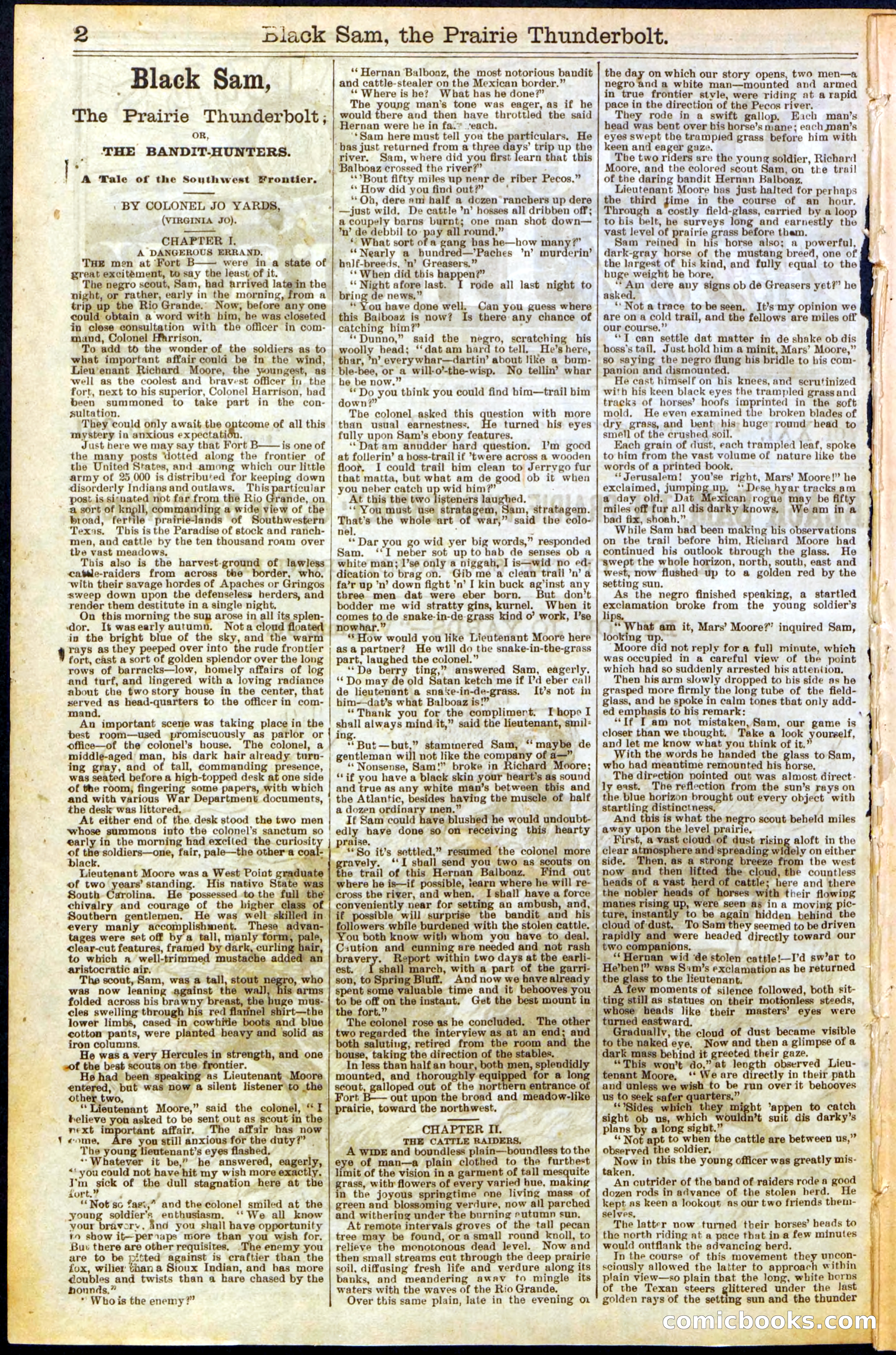
A restored page from Pulp Fiction, 1883. Page through the whole issue in the reader above.
📄 Transcribed text from this page (OCR, searchable)
Machine-transcribed from the original scan — historical spelling and the odd misread are preserved.
* Black Sam, The Prairie Thunderbolt; OR, THE BANDIT-HUNTERS. } é ' A Wale of the Southwest Prontier. . BY COLONEL JO YARDS, (VIRGINIA JO), wy CHAPTER I, re A DANGEROUS ERRAND. THE men at Fort B—— were in a state of great excitément, to say the least of it. — The negro scout, Sam, had arrived late in the night, or rather, early in the morning, from a trig pt be Rio Grande. Now, before any one could obtain a word with him, he was closeted in close consultation with the officer in com- mand, Colonel Hh&rrison, To add to the wonder of the soldiers as to what important affair could be in the wind, Lieu’enant Richard Moore, the youngest, as well as the coolest and bravest officer in. the fort, next to his superior, Colonel Harrison, bad been summoned to take part in the con- sultation. They could only await the ontcome of all this mystery in anxious expectation. Just here we may say that Fort B—— is one of the many posts dotted along the frontier of the United States, and among which our little army of 25.000 is distribu‘ed for keeping down disorderly Indians and outlaws. This particular post is sisuated not far from the Rio Grande, on ’ asort of knp 3 broad, fertile prairie-lands of Southwestern Texas. This isthe Paradise of stock and ranch- men, and cattle by the ten thousand roam over the vast meadows. This also is the harvest-ground of lawless catele-raiders from across the border, who. ‘with their savage hordes of Apaches or Gringos sweep down upon the defenseless herders, and render them destitute in a single night. On this morning the sup arose in all its splen- dor. It wasearly autumn. Nota cloud floa in the bright blue of the sky, and the warm rays as they peeped over into the rude frontier fort, cast a sort of golden splendor over the long rows of barracks—low, homely affairs of log and turf, and lingered with a loving radiance about the fwostory house in the center, that served as head-quarters to the officerin com- mand, An important scene was taking place in the best room—used promiscuously as parlor or office—of the colonel’s bouse. The colonel, a middle-aged man, bis dark hair already turn- ing gray, and of tall, commanding presence, was seated before a high-topped desk at one side of the room, fingering some papers, with which and with various War Department documents, the desk was littered... At either end of the desk stood the two men whose mops into the colonel’s sanctum so early in the morning had exciled the curiosit = oj soldiers—one, fair, pale—the other-a coal- ack, a oe Lieutenant Moore was a West Point g ate of two years’ standing. His native State was Sout arolina. He ‘possessed tothe full tk chivalry and courage of the higher cla Southern gentlemen. He was well s every manly accomplishment. hese adve tages were set off by a tall, manly form clear-cut features, framed by d to which a well-trimmed mustac aristocratic air, * The scout, Sam, was a tall was now leaning egainss ‘the wal folded across bis brawny reast, fi i cles swelling thro red fla lower limbs, cased in cowhitie boo cotton pants, were planted heayy ar iron columns. . ¢ He was a very Hercules in stre nd of beat scouts on the. BBaticr. “ae =. ad been eons 2 Lieutenant re entered, but was now a silent Hstenet Pagina other two, “7 : ‘Lieutenant Moore,” said the ll, commanding a wide view of the the cross the river, and when. of convenie ied in | if possibl | , © | prairie, Diack Sam, the Prairie Thunderbolt. ‘* Hernan Balboaz, the most notorious bandit and cattle-stealer on the Mexican border.” ** Where is he? What has he done?” The young man’s tone was eager, as if he would there and then have throttled the said Hernan were he in fa.* ‘each. ‘*Sam here must tell you the particulars. He ‘bas just returned from a three days’ trip up the river. Sam, where did you first learn that this .| Balboaz crossed the river?” ‘*’Bout fifty miles up near de riber Pecos.” ** How did you find out?” ' “Oh, dere am half a dozen ranchers up dere ‘| —just wild, De cattle ’n’ hosses all dribben off; a coupely barns burnt; one man shot down— "n’ de debbil to pay all round.” | * What sort ofa gang bas he—how many?” ‘* Nearly a bundred—’Paches ’n’ murderin’ half-breeds, ’n’ Greasers,” ‘*When did this happen?” ‘* Night afore last. rode all last night to bring de news,” ** You have done well. Can you guess where this Baiboaz is now? Is there any chance of catching him?” . ‘*Dunno,” said the negro, scratching his woolly bead; ‘‘dat am hard to tell, He’s here, ‘thar, ’n’ everywhar—dartin’ about like a bom- ble-bee, or a will-o’-the-wisp. No tellin’ whar he be now.” **Do you think you could find bim—trail bim down?” The colonel asked this question with more than usual earnestness. e turned his eyes fully upon Sam’s ebony features. ‘*Dat am annudder hard question. I’m good at follerin’ a boss-trail if ’twere across a wooden floor. I could trail him clean to Jerrygo fur that matta, but what am de good ob it when you neber catch up wid him?’ At this the two listeners laughed. ‘* You must use stratagem, Sam, stratagem. That’s the whole art of war,” said the colo- nel. ; ‘Dar you go wid yer big words,” responded 'Sam. ‘‘I neber sot up to bab de senses ob a white man; l’se only a niggah, I is—wid no ed- dication to brag on. Gib me a clean trail ’n’a fa’r up ’n’ down fight ’n’ I kin buck ag’inst any three men dat were eber born. But don’t bodder me wid stratty gins, kurnel. When it comes to de snake-in-de grass kind o’ work, I’se nowhar.” “How would you like Lieutenant Moore here asa partner? He will do the snake-in-the-grass part, laughed the colonel.” ‘‘De berry ting,” answered Sam, eagerly. ‘*Do may de old Satan ketch me if I’d eber cal! de lieutenant a snake-in-de-grass. It’s not in bim—dat’s what Balboaz is!” “Thank you for the compliment: Thope I shall always mind it,” said the lieutenant, smil- ing. ~ oe ‘*But—but,” stammered Sam, “‘ maybe de gentleman will not like the sone, of a—”, ‘‘ Nonsense, Sam!” broke in Richard Moore; ‘if you have a black skin your heart's me sound and true as any white man’s between this and the Atlantic, besides having the muscle of half a dozen ordina n.” ‘ A if Sam could have blushed he would undoubt- ‘edly bave done so on receiving this hearty raise. i “So it’s settled,” resumed “the colonel more Ygravely. ‘I shall send you as scouts on | the trail of this Hernan Bal wud out where he is—if possible, tearn where he will re- / shall nae \ os ntly near for g an ambush, and, 2 will 8 tr bandit and his dened with the stolen cattle, vy with whom you have to deal. cul ey needed and not rash shall m , with a part of uff. And now we havea 4 mounted, and thoro y equipped | scout, galloped out of the northern en Fort B— out upon the broad and me toward the northwest. believe you asked to be sent out as scout in the |” olin next im t affair. e affair has now CHAPTER II. 4 1 «ome, 6 still anxious forthe duty?” | THE CATTLE RAIDERS, The young lieutenant’s eyes flashed. _A WIDE and boundless plain—boundless to the ‘Whatever it be,” he answered, erly, “you could not have hit my wish more exte r. ies gick of the dull stagnation here at the ort, ‘ ; ** Not so faev,” and the colonel smiled at the young soldier’s enthusiasm. ‘‘We all know your bravery. ind you shall have opportunity 19 show it—per»aps more than you wish for. Bu there are other requisites. The enemy you are to be pitted against is craftier than the fox, wilier than a Sioux Indian, and has more doubles and twists than a hare chased by the bounds,” * Whois the enemy?” ore of man—a plain clothed to the furthest mit of the vision in a garment of tall mesquite rass, with flowers of every varied hue, making n the joyous springtime one living mass of green and blossoming verdure, now all parched and withering under the burning eutumn sun. At remote intervals groves of the tall pecan tree may be found, ora small round knoll, to relieve the monotonous dead level. Now and then small streams cut through the deep prairie soil, diffusing fresh life and verdure along its banks, and meandering awav to mingle its waters with the waves of the Rio Grande. Over this same plain, late in the evening two days at the earli- | the garri- yi t some valuable time and it behooves you to be off on instant. Get the best mount in | 9. 39?" a “eb \ ? “ne two re the int ry : ) end; and. house, taking the direction of t In less than half an hour, bot the day on which our story opens, two men—a negro and a white man—mounted and armed in true frontier stvle, were riding at a rapid pace in the direction of the Pecos river. They rode in a swift gallop, Each man’s head was bent over bis horse’s mane; each man’s eyes swept the trampied grass before him with keen and eager gaze. The two riders are the young soldier, Richard Moore, and the colored scout Sam, on the trail of the daring bandit Hernan Balboaz, Lieutenant Moore has just halted for perhaps the third fime in the course of an hour. Through a costly field-glass, carried by a loop to bis belt, be surveys long and earnestly the vast level of prairie grass before them. Sam reined in his horse also; a powerful, dark-gray horse of the mustang breed, one of the largest of his kind, and fully equal to the huge weight be bore, ‘*Am dere any signs ob de Greasers yet?” he asked, ‘‘ Not a trace tobe seen, It’s my opinion we are on a cold trail, and the fellows are wiles off our course,” **T can settle dat matter in de shake ob dis hoss’s tail, Just hold him a minit, Mars’ Moore,” 80 saying the negro flung his bridle to his com- panion and dismounted. He cast himself on bis knees, and serutinized witb his keen black eyes the trampled grass and tracks of horses’ hoofs imprinted in the soft mold. He even examined the broken blades of dry grass, and bent his» huge’ round head to smell of the crushed soil. | Each grain of dust, each trampled leaf, spoke to him from the vast volume of nature like the words of a printed book. ‘* Jerusalem! you’se right, Mars’ Moore!” he exclaimed, Jump gD *\Dese hyar tracks am a day old. “Dat Mexican rogue may be fifty miles off fur all dis darky knows, Weam in a bad fix, shoah.” While Sam had been making his observations on the trail before him, Richard Moore had continued his outlook through the glass. He swept the whole horizon, north, south, east and west, now flushed up to a golden red by the setting sun. As the negro finished speaking, a startled Cee mse broke from the young soldier's ips. “What am it, Mars’ Moore?’ inquired Sam, \ looking ys Moore did not reply for a full minute, which was occupied in a careful view of the point which had so suddenly arrested his attention. Then his arm slowly dropped to bis side as he grasped more firmly the long tube of the field- glass, and be spoke in calm tones that only add- ed emphasis to his remark: ‘ “If IT am not mistaken, Sam, our game is closer than we thought. Take a look yourself, and let me know what you think of it.’ With the words he handed the glass to Sam, who had meantime remounted his horse. The direction pointed out was almost direct- ly east. The reflection from the sun’s rays on the blue horizon brought out every object’ with startling distinctness, And this is what the ne away upon the level prairie, First, a vast cloud of dust risi clear atmosphere and spr . side. Then, as a strong now = 4 Sosy Ye scout beheld miles aloft in the heads of a vast erd of cattle: here and there the nobler heads of hc eS With their flowing manes ris ere seen as in a moving pic- tareein to again hidden behind the cloud of dust. To Sam they seemed to be driven gerne. and were headed directly toward our bw a) Ds. ae fe an wid ‘de stolen cattle!—I’d sw’ar to He’ben!” was Sums exclamation as he returned the g ass to the lieutenant. P ww moments of silence followed, both sit- , ill as statues on their motio steeds, ! beads like their masters’ i al were ward, Ky A v, the cloud of dust became visible ——. eye, Nowandthenaglimpseofa |— behind it greeted their gaze. ta on’t “do,” at len observed Lieu- | Ve are directly in their path we wish to be run over it behooves | which 1 hey m bt ’appen to catch > sight | , wv wouldn’t suit dis darky’s | plans by a long sight.” ye ch = “Not apt to when the cattle are between us,” 4 observed the soldier, ; Now in this the young officer was greatly mis- | - The latter now turned their horses’ heads to 3 the north riding at a pace that ina few minutes | would ontflank the advancing herd. zt 7 ise E€omicbooks.com) = ua ss m" "i taken. . . An cutrider of the band of raiders rode a good dozen rods in advance of the stolen herd. He kept as keen a lookout as our two friends them- selves, Tn the course of this movement they uncon- | | - sciously allowed the latter to approach within | plain view—so plain that the long, white horns | of the Texan steers glittered under the last golden rays of the setting sun and the thunder |