
Pulp Fiction, 1883 · page 3 of 32
Beadle's Dime Library No. 260: The Masked Mystery; or, The Black Crescent — page 3: what you’re looking at
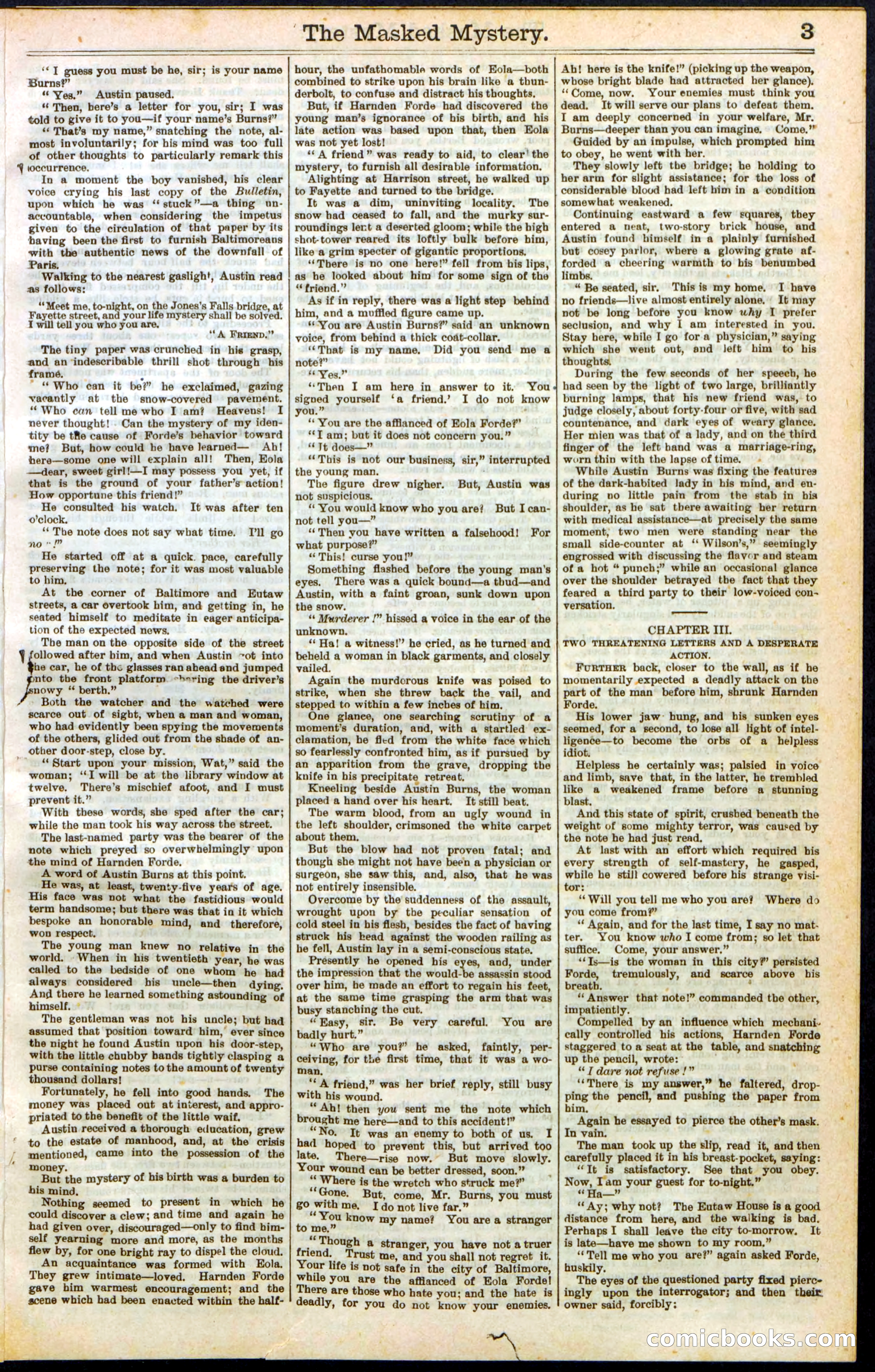
A restored page from Pulp Fiction, 1883. Page through the whole issue in the reader above.
📄 Transcribed text from this page (OCR, searchable)
Machine-transcribed from the original scan — historical spelling and the odd misread are preserved.
‘*T guess you must be he, sir; is your name Burns?” ‘‘' Yes.” Austin paused. ‘‘ Then, bere’s a letter for you, sir; I was told to give it to you—if your name’s Burns?” ‘‘ That’s my name,” snatching the note, al- most involuntarily; for his mind was too full of other thoughts to particularly remark this ¥ wccurrence, In a moment the boy vanished, his clear voice crying his last copy of the Bulletin, upon which he was ‘‘ stuck”—a thing un- accountable, when considering the impetus given to the circulation of that paper by its baving been the first to furnish Baltimoreans with the authentic news of the downfall of Paris. Walking to the nearest gaslight, Austin read as follows: “Meet me, to-night, on the Jones’s Falls bridge, at Fayette street, and your life mystery shall be solved. I will tell you who you are, ‘‘A Frrenp.” The tiny paper was crunched in his grasp, and an ‘indescribable thrill shot through his framé. f ' “Who can it be?” he exclaimed, gazing vacantly at the snow-covered pavement. “Who can tell me who I am? Heavens! I never thought! . Can the mystery of my iden- tity be tRe cause of Forde’s behavior toward me? But, how could he have learned— Ah! here—some one will explain all! Then, Eola —dear, sweet girl!—I may possess you yet, if that is the ground of your father’s action! How opportune this friend!” He consulted his watch. o'clock. ‘* The note does not say what time. no”! He started off at a quick. pace, carefully preserving the note; for it was most valuable to him. At the corner of Baltimore and Eutaw streets, a car overtook him, and getting in, he seated himself to meditate in eager anticipa- tion of the expected news, Tbe man on the opposite side of the street It was after ten Pll go ¥ followed after bim, and when Austin ~ot into e car, he of the glasses ran ahead and jumped nto the front platform ~>°ring the driver’s nowy “ berth.” Both the watcher and the watched were scarce out of sight, when a man and woman, who had evidently been spying the movements of the others, glided out from the shade of an- _ other door-step, close by. “Start upon your mission, Wat,” said the woman; ‘‘I will be at the library window at twelve. There’s mischief afoot, and I must prevent it.” With these words, she sped after the car; while the man took his way across the street. The last-named party was the bearer of the note which preyed so overwhelmingly upon the mind of Harnden Forde. A word of Austin Burns at this point. He was, at least, twenty-five years of age. His face was not what the fastidious would term handsome; but there was that in it which bespoke an honorable mind, and therefore, won respect. The young man knew no relative in the world. When in his twentieth year, he was called to the bedside of one whom he had always considered his uncle—then dying. And there he learned something astounding of himself. © The gentleman was not his uncle; but had assumed that position toward him, ever since the night he found Austin upon his door-step, with the little chubby bands tightly clasping a purse containing notes to the amount of twenty thousand dollars! ‘ Fortunately, he fell into good hands. The money was placed out at interest, and appro- priated to the benefit of the little waif. Austin received a thorough education, grew to the estate of manhood, and, at the crisis mentioned, came into the possession of the money. But the mystery of bis birth was a burden to bis mind Nothing seemed to present in which he could discover a clew; and time and again he had given over, discouraged—only to find him- self yearning more and more, as the months flew by, for one bright ray to dispel the cloud. An acquaintance was formed with Eola. They grew intimate—loved. Harnden Forde gave him warmest encouragement; and the scene which had been enacted within the half- ‘The Masked } hour, the unfathomable words of Eola—both combined to strike upon his brain like a thun- derbolt, to confuse and distract his thoughts. But, if Harnden Forde had discovered the young man’s ignorance of his birth, and his late action was based upon that, then Eola was not yet lost! ‘‘ A friend” was ready to aid, to clear’ the mystery, to furnish all desirable information. Alighting at Harrison street, he walked up to Fayette and turned to the bridge. It was a dim, uninviting locality. The snow had ceased to fall, and the murky sur- roundings lert a deserted gloom; while the high shot-tower reared its loftly bulk before him, like a grim specter of gigantic proportions. ‘There is no one here!” fell from his lips, as he looked about him for some sign of the “friend.” As if in reply, there was a light step behind him, and a muffled figure came up. **-You are Austin Burns?” said an unknown voice, from behind a thick coat-collar. ‘That is my name. Did you send me a note?” oY ou,”” “Then I am here in answer to it, You signed yourself ‘a friend.’ I do not know you.” ‘ ** You are the afflanced of Eola Forde?’ “T am; but it does not concern you.” “Tt does—” “This is not our business, sir,” interrupted the young man. ' The figure drew nigher. not suspicious. «You would know who you are? not tell you—” ‘‘Then you have written a falsehood! what purpose?” “This! curse you!” Something flashed before the young man's eyes. There was a quick bound—a thud—and Austin, with a faint groan, sunk down upon the snow. ‘* Murderer !” hissed a voice in the ear of the unknown. ‘* Ha! a witness!” he cried, as he turned and beheld a woman in black garments, and closely vailed. Again the murdorous knife was poised to strike, when she threw back the vail, and stepped to within a few inches of him. One gianee, one searching scrutiny of a moment's duration, and, with a startled ex- clamation, he fied from the white face which so fearlessly confronted him, as if pursued by an apparition from the grave, dropping the knife in bis precipitate retreat. Kneeling beside Austin Burns, the woman placed a hand over his heart. It still beat. The warm blood, from an ugly wound in the left shoulder, crimsoned the white carpet about them, But the blow had not proven fatal; and though she might not have been a physician or surgeon, she saw this, and, also, that he was not entirely insensible. Overcome by the suddenness of the assault, wrought upon by the peculiar sensation of cold steel in bis flesh, besides the fact of baving struck his head against the wooden railing as he fell, Austin lay in a semi-conscious state. Presently he opened his eyes, and, under the impression that the would-be assassin stood over him, he made an effort to regain his feet, at the same time grasping the arm that was busy stanching the cut. “Easy, sir. Be very careful. You are badly hurt.” “Who are you?” he asked, faintly, per- ceiving, for the first time, that it was a wo- man, “* A friend,” was her brief reply, still busy with his wound. “Ah! then you sent me the note which brought me here—and to this accident!” “No. It was an enemy to both of us. I had hoped to prevent this, but arrived too late. There—rise now. But move slowly. Your wound can be better dressed, soon.” ~ Where is the wretch who struck me?” Gone. But, come, Mr. Burns, you must Sea an Ido not live far.” ou know borne my name? You are a stranger “Though a stranger, you have not a truer friend. Trust me, and you shall not regret it. Your life is not safe in the city of Baltimore, while you are the affianced of Eola Forde! There are those who hate you; and the hate is deadly, for you do not know your enemies. meay But, Austin was But I can- For 3 Ab! here is the knife!” (picking up the weapon, whose bright blade had attracted her glance). “Come, now. Your enemies must think you dead. It will serve our plans to defeat them. I am deeply concerned in your welfare, Mr. Burns—deeper than you can imagine, Come,’” Guided by an impulse, which prompted him to obey, he went with her. They slowly left the bridge; be holding to her arm for slight assistance; for the loss of considerable bloud had left bim in a condition somewhat weakened. Continuing eastward a few squares, they entered a neat, two-story brick house, and Austin found himself in a plainly furnished but cosey parlor, where a glowing grate af- forded a cheering warmth to bis benumbed limbs. “ “ Be seated, sir. This is my home, I have no friends—live almost entirely alone. It may not be long before you know why I prefer seclusion, and why | am interested in you. Stay here, while I go for a physician,” saying which she went out, and left him to his thoughts, During the few seconds of her speech, he had seen by the light of two large, brilliantly burning lamps, that his new friend was, to judge closely, about forty-four or five, with sad countenance, and dark eyes of weary glance. Her mien was that of a lady, and on the third finger of the left hand was a marriage-ring, worn thin with the lapse oftime. - While Austin Burns was fixing the features of the dark-habited lady in his mind, and en- during po little pain from the stab in bis shoulder, as he sat there awaiting ber return with medical assistance—at precisely the same moment, two men were standing near the small side-counter at ‘‘ Wilson’s,” seemingly engrossed with discussing the flavor and steam of a hot “ punch;” while an occasional glance over the shoulder betrayed the fact that they feared a third party to their low-voiced con- versation. a ae CHAPTER III. TWO THREATENING LETTERS AND A DESPERATE ACTION. FurTHER back, closer to the wall, as if he momentarily expected a deadly attack on the part of the man before him, shrunk Harnden Forde. His lower jaw: hung, and his sunken eyes seemed, for a second, to lose all light of intel- ligencte—to become the orbs of a_ helpless idiot. 4 Helpless he certainly was; palsied in voice and limb, save that, in the latter, he trembled like a weakened frame before a stunning blast, And this state of spirit, crushed beneath the weight of some mighty terror, was caused by the note he had just read, At last with an effort which required bis . every strength of self-mastery, he gasped, while he still cowered before his strange visi- tor: ‘* Will you tell me who you are? Where do you come from?’ “‘ Again, and for the last time, I say no mat- ter. You know who I come from; so let that suffice. Come, your answer,” ‘‘Is—is the woman in this city?’ persisted Forde, tremulously, and scarce above his breath. ’ , ‘Answer that note!” commanded the other, impatiently. Compelled by an influence which mechani. - eally controlled his actions, Harnden Forde staggered to a seat at the table, and snatching up the pencil, wrote: . “T dare not refuse !” ‘There is my answer,” he faltered, drop- ping the pencil, and pushing the paper from bim. Again he essayed to pierce the other’s mask. In vain. : The man took up the slip, read it, and then carefully placed it in his breast-pocket, saying: “Ié is satisfactory. See that you obey. Now, Tam your guest for to-night.” “ Ha—” ; “Ay; why not? The Eutaw House is a good distance from here, and the walking is bad. Perhaps I shall leave the city to-morrow. It is late—have me shown to my room,” ‘Tell me who you are?” again asked Forde, buskily. The eyes of the questioned party fixed pierc- ingly upon the interrogator; and then their owner said, forcibly: COMMIELOOO Ss) (E(0) Pa