
Pulp Fiction, 1883 · page 27 of 32
Beadle's Dime Library No. 260: The Masked Mystery; or, The Black Crescent — page 27: what you’re looking at
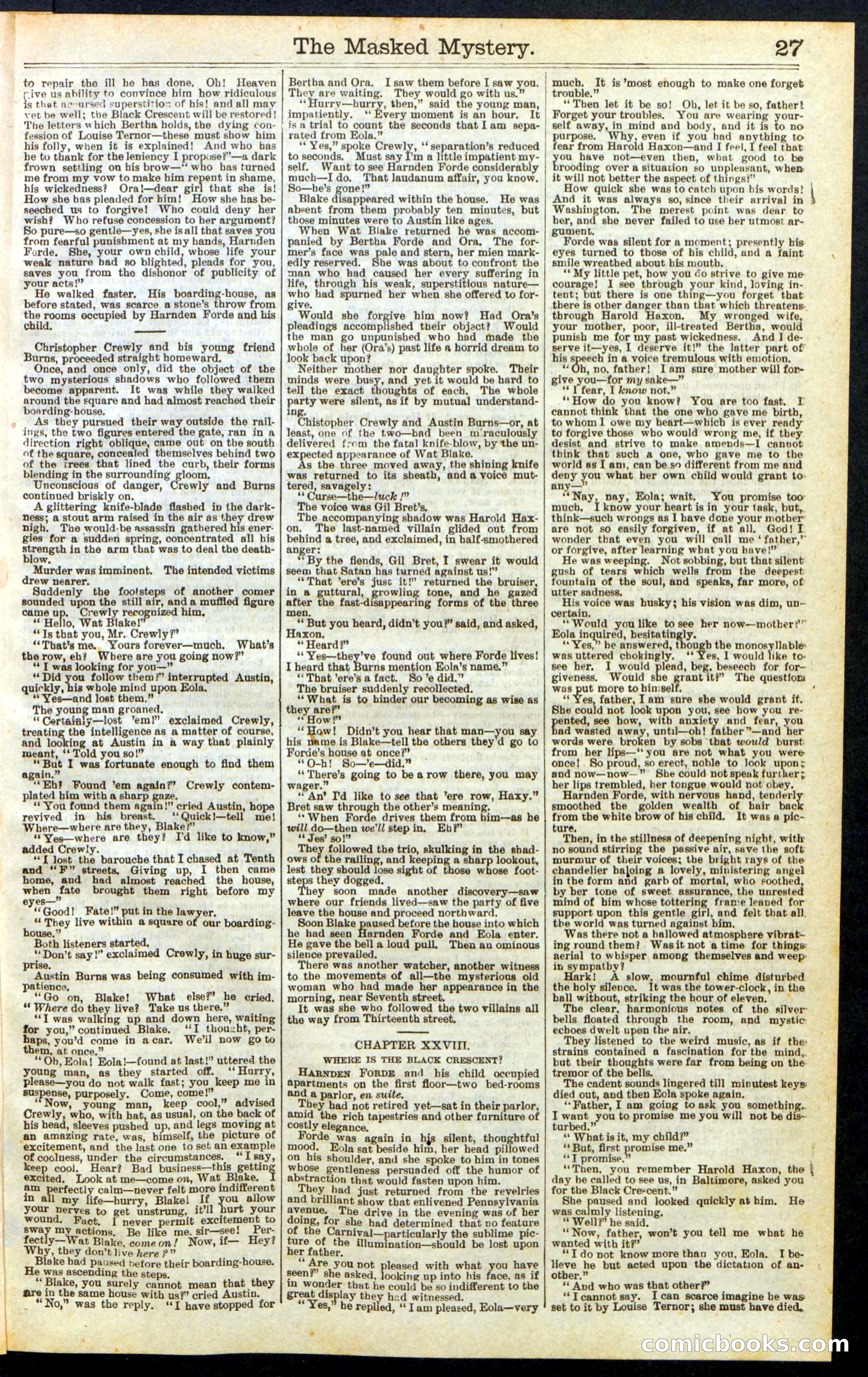
A restored page from Pulp Fiction, 1883. Page through the whole issue in the reader above.
📄 Transcribed text from this page (OCR, searchable)
Machine-transcribed from the original scan — historical spelling and the odd misread are preserved.
e oie —_ — — to repair the ill he has done, Oh! Heaven cive us ability to convince him how ridiculous is that accursed superstition of his! and all may vet be well; the Black Crescent will be restored! The letters which Bertha holds, the dying con- fession of Louise Ternor—these must show him his folly, when it is explained! And who bas he to thank for the leniency I propose?”—a dark frown settling on his brow—* who has turned me from my vow to make him repent in shame, his wickedness? Oral—dear girl that she is! How she bas pleaded for him! How she has be- seeched us to forgive! Who could deny her wish? Who refuse concession to her argument? So pure—so gentle—yes, she isall that saves you from fearful punishment at my hands, Harnden Forde. She, your own child, whose life your weak nature bad so blighted, pleads for you, saves you from the dishonor of publicity of your acts!” He walked faster. His boarding-house, as before stated, was scarce a stone’s throw from ee rooms occupied by Harnden Forde and his child. Christopher Crewly and bis young friend Burns, proceeded straight homeward. Once, and once only, did the object of the two mysterious shadows who followed them become apparent. It was while they walked around tbe square and had almost reached their bosrding-house. As they pursued their way outside the rail- ings, the two figures entered the gate, ran in a direction right oblique, came out on the south of the square, concealed themselves behind two of the trees that lined the curb, their forms blending in the surrounding gloom, Unconscious of danger, Crewly and Burns continued briskly on. A glittering knife-blade flashed iv the dark- ness; a stout arm raised in the air as they drew nigh. The would-be assassin gathered his ener- gies for a sudden spring, concentrated all his strength in the arm that was to deal the death- ow, Murder wasimminent. The intended victims drew nearer. Suddenly the footsteps of another comer sounded upon the still air, and a muffled figure came up. Crewly recognized him, a Hello, Wat Blake!’ “Ts that you, Mr. Crewly?”’ ‘*That’s me.. Yours forever—much, What’s the row, eh? bere are you going now?” “*T was looking for you—” “Did you follow them?” interrupted Austin, quickly, his whole mind upon Eola, “'Yes—and lost them,” The young man groaned, ‘“‘Certainiy—lost ’em!” exclaimed Crewly, treating the intelligence as a matter of course, and looking at Austin in a way that plainly meant, ‘* Told you so!” = fg I was fortunate enough to find them again. ‘*Eh? Found ’em again?’ Crewly contem- plated him with a sharp gaze, ‘You found them again!” cried Austin, hope revived in his breast. ‘‘Quick!—tell me! W here—where are they, Blake?’ ‘‘-Yes—where are they? I'd like to know,” added Crewly. “TI Jost ths barouche that I chased at Tenth and “F” streets, Giving up, then came home, and had almost reached the house, when fate brought them right before my eyes— MN ! Fate!” put in the lawyer, ‘“‘ They live within a square of our boarding- house,” Both listeners started, ‘* Don’t say!” exclaimed Crewly, in huge sur- rise. Austin Burns was being consumed with im- patience, “Go on, Blake! What else?’ he cried. ‘“‘ Where do they live? Take us there.” “T was waikion up and down here, waiting for you,” continued Blake, ‘I thouzht, per- haps, you’d come in acar. We'll now goto em, at once,” “Ob, Eola! Eola!—found at last!” uttered the young man, as they started off. ‘‘ Hurry, please—you do not wall fast ; you, keep me in suspense, purposely. me, come PNow, che aren keep cool,” advised Crewly, who, with hat, as usual, on the back of his head, sleeves pushed up, and legs moving at an amazing rate, was, himself, the picture of pacitament, and the last one to set an example of coolness, under the circumstances. “I say, seep cool. Hear? Bad business—this getting excited. Look at me—come on, Wat Blake, am perfect calm—never felt more indifferent in all my life—hurry, Blake! If you allow your nerves to get unstrung, it'll hurt your wound. Fact. I never permit excitement to sway my actions. Be like me. sir—see! Per- fectly—Wat Blake, comeon! Now, if— Hey? bie , they don’t live here ?” Blake had paused before their boarding-house. He was ascending the steps. “Blake, you surely cannot mean that they fre in the same house with us?” cried Austin. _ “No,” was the reply. “I have stopped for The Masked Mystery. Bertba and Ora, They are waiting. They would go with us.” ‘‘Hurry—hburry, then,” said the young man, impatiently. ‘‘ Every moment is an hour. It is a trial to count the seconds that Iam sepa- rated from Eola.” | Forget your troubles. 27 ——<—=a a Se ; I saw them before I saw you. | much, It is’most enough to make one forget trouble,” “Then let it be so! Oh, let it be so, father? You are wearing your- self away, in mind and body, and it is to no purpose, Why, even if you had anything to ‘* Yes,” spoke Crewly, ‘‘ separation’s reduced | fear from Harold Haxon—and I feel, I feel that to seconds. Must say I’m a little impatient my- self. Want to see Harnden Forde considerably much—I do. That Jaudanum affair, you know, So—he’s gone!” Blake disappeared within the house. He was absent from them probably ten minutes, but those minutes were to Austin like ages. When Wat Blake returned he was accom- panied by Bertha Forde and Ora, The for- mer’s face was pale and stern, her mien mark- edly reserved. she was about to confront the man who had caused her every suffering in life, through his weak, superstitious nature— who had spurned her when she offered to for- give. Would she forgive him now? Had Ora’s pleadings accomplished their object? Would the man go unpunished who had made the whole of her (Ora’s) past life a horrid dream to look back upon? Neither mother nor daughter spoke. Their minds were busy, and yet it would be hard to tell the exact thoughts of each. The whole party were silent, as if by mutual understand- ing. Chistopher Crewly and Austin Burns—or, at least, one of the two—bad been m/raculously delivered from the fatal knife-blow, by the un- a gee appearance of Wat Blake, s the three moved away, the shining knife was returned to its sheath, anda voice mut- tered, savagely: ** Curse—the—luck !” The voice was Gil Bret’s, The accompanying shadow was Harold Hax- on. The last-named villain glided out from behind a tree, and exclaimed, in half-smothered anger: ** By the fiends, Gil Bret, I swear it would seem that Satan has turned against us!” “That ’ere’s just it!” returned the bruiser, in a guttural, growling tone, and he gazed after the fast-disappearing forms of the three men. ** But you heard, didn’t you?” said, and asked, axon, “Heard?” ‘* Yes—they’ve found out where Forde lives! I heard that Burns mention Eola’s name.” “That ’ere’s a fact. So’e did.” The bruiser suddenly recollected. ‘‘What is to hinder our becoming as wise as they are?’ ‘* How?” ‘““How! Didn’t you hear that man—you say his name is Blake—tell the others they d go to Forde’s house at once?” ! **O-h! So—e—did.” ‘*There’s going to be arow there, you may ager. ‘An’ I'd like to see that ’ere row, Haxy.” Bret saw through the other’s meaning. ‘*When Forde drives them from bim—as he will do—then we'll step in, Eb?” se Jes’ so!” rng followed the trio, skulking in the shad- ows of the bey and keeping a sharp lookout, lest they should lose sight of those whose foot- steps they dogged. hey soon made another discovery—saw where our friends lived—saw the party of five leave the house and proceed northward. Soon Blake pee before the house into which he had seen Harnden Forde and Eola enter. He gave the bell a loud pull, Then an ominous silence prevailed, There was another watcher, another witness to the movements of all—the mysterious old woman who had made her appearance in the morning, near Seventh street, It was she who followed the two villains all the way from Thirteenth street. CHAPTER XXVIII. WHERE IS THE BLACK CRESCENT? HARNDEN ForRDE and his child occupied apartments on the first floor—two bed-rooms and a parlor, en suite, They had not retired yet—sat in their parlor, amid the rich tapestries and other furniture of orde was again in hijs silent, thoughtful mood. Eola ae beside hits, ber head pillowed on his shoulder, and she spoke to him in tones whose gentleness persuaded off the humor of abstraction that would fasten upon him. hey had just returned from the revelries and brilliant show tbat enlivened Pennsylvania avenue. The drive in the evening was of her doing, for she had determined that no feature of the Carnival—particularly the sublime pic- ture of the illumination—should be lost upon her father, Are you not pleased with what you have seen?” she asked, looking up into his face, as if in wonder that he could be so indifferent to the great display they had witnessed. Yes,” he rep ed, “‘ Iam pleased, Eola—very | “Sp have not—even then, what good to be rooding over a situation so unpleasant, when it will not better the aspect of things?” How quick she was to catch upon bis words! And it was always so, since their arrival in Washington. The merest point was dear to her, and she never failed to use her utmost ar- gument. Forde was silent for a moment; presently his eyes turned to those of his child, and a faint smile wreathed about bis mouth, ** My little pet, bow you do strive to give me- courage! I see through your kind, loving in- tent; but there is one thing—you forget that there is other danger than that which threatens. through Harold Haxon, My wronged wife, your mother, poor, ill-treated Bertha, would punish me for my past wickedness. And I de- serve it—yes, I deserve it!” the latter part of his speech in a voice tremulous with emotion. **QOh, no, father! Iam sure mother will for- give you—for my sake—” ‘* 1 fear, I know not,” ‘*How do you know? You are too fast. I cannot think that the one who gave me birth, to whom I owe my heart—which is ever ready to forgive those who would wrong me, if they desist and strive to make amends—I cannot think that such a ove, who gave me to the world as I am, can be so different from me and deny you what her own child would grant to any—” ‘Nay, nay, Eola; wait. You promise too much, I know your heart is in your task, but,. think—such wrongs as I bave done your mother are not so easily forgiven, if at all. God! I wonder that even you will call me ‘ father,” or forgive, after learning what you bave!” He was weeping. Not sobbing, but that silent gush of tears which wells from the deepest fountain of the soul, and speaks, far more, of utter sadness. His voice was husky; his vision was dim, un- certain, ‘Would you like tosee her now—mother?” | Eola inquired, besitatingly. ‘* Yes,” he answered, t og ty the pocea ere was uttered chokingly. ‘* Yes, I would like to see her. I would giveness. Would she grantit?” The questiom was put more to himself, ‘‘ Yes, father, Iam sure she would grant if. She could not look upon you, see how you re- pentes, Bee how, with anxiety and fear, you ad wasted away, until—oh! father”—and her words were broken by sobs that would burst from her lips—‘‘ you are not what you were once! So proud, so erect, noble to look upon; and now—now—” She could not speak further; her lips trembled, ber tongue would not obey, Harnden Forde, with nervous hand, tender] smoothed the golden wealth of hair bac from the white brow of his child. It was a pic- ture, Then, in the stillness of deepening night, with no sound stirring the passive air, save the soft murmur of their voices; the bright rays of the chandelier bajoing a lovely, ministering angel in the form and garb of mortal, who soothed by her tone of sweet assurance, the unrested mind of him whose tottering frame leaned for support upon this gentle girl, and felt that all. the world was turned against bim. Was there not a hallowed atmosphere vibrat- ing round them? Wasit not atime for things: aerial to whisper among themselves and weep: in sympathy? Hark! A slow, mournful chime disturbed the holy silence. It was the tower-clock, in the ball without, striking the hour of eleven, The clear, harmonious notes of the silver’ bells floated through the room, and mystic: echoes dwelt upon the air. They listened to the weird music, as if the strains contained a fascination for the mind,,. but their thoughts were far from being on the: tremor of the bells. The cadent sounds lingered till minutest keys: died out, and then Eola spoke again. ‘Father, I am going to ask you something.. I want you to promise me you will not bed turbed.” . ‘* What is it, my child?” ‘* But, first promise me,” “*T promise.” “Then, you remember Harold Haxon, the day he called to see us, in Baltimore, asked you for the Black Crescent.” She paused and looked quickly athim. He was mly listening, ** Well?” he said. “Now, father, won’t you tell me what he wanted with it?’ “T do not know more than you, Eola. I be- lieve he but acted upon the dictation of an- otber.” ** And who was that other?” ' ‘“‘Teannot say. Ican scarce imagine he was set to it by Louise Ternor; she must have died, EONNIKE OOO KS lead, beg, beseech for for—— oz 4 com