
Pulp Fiction, 1883 · page 25 of 32
Beadle's Dime Library No. 260: The Masked Mystery; or, The Black Crescent — page 25: what you’re looking at
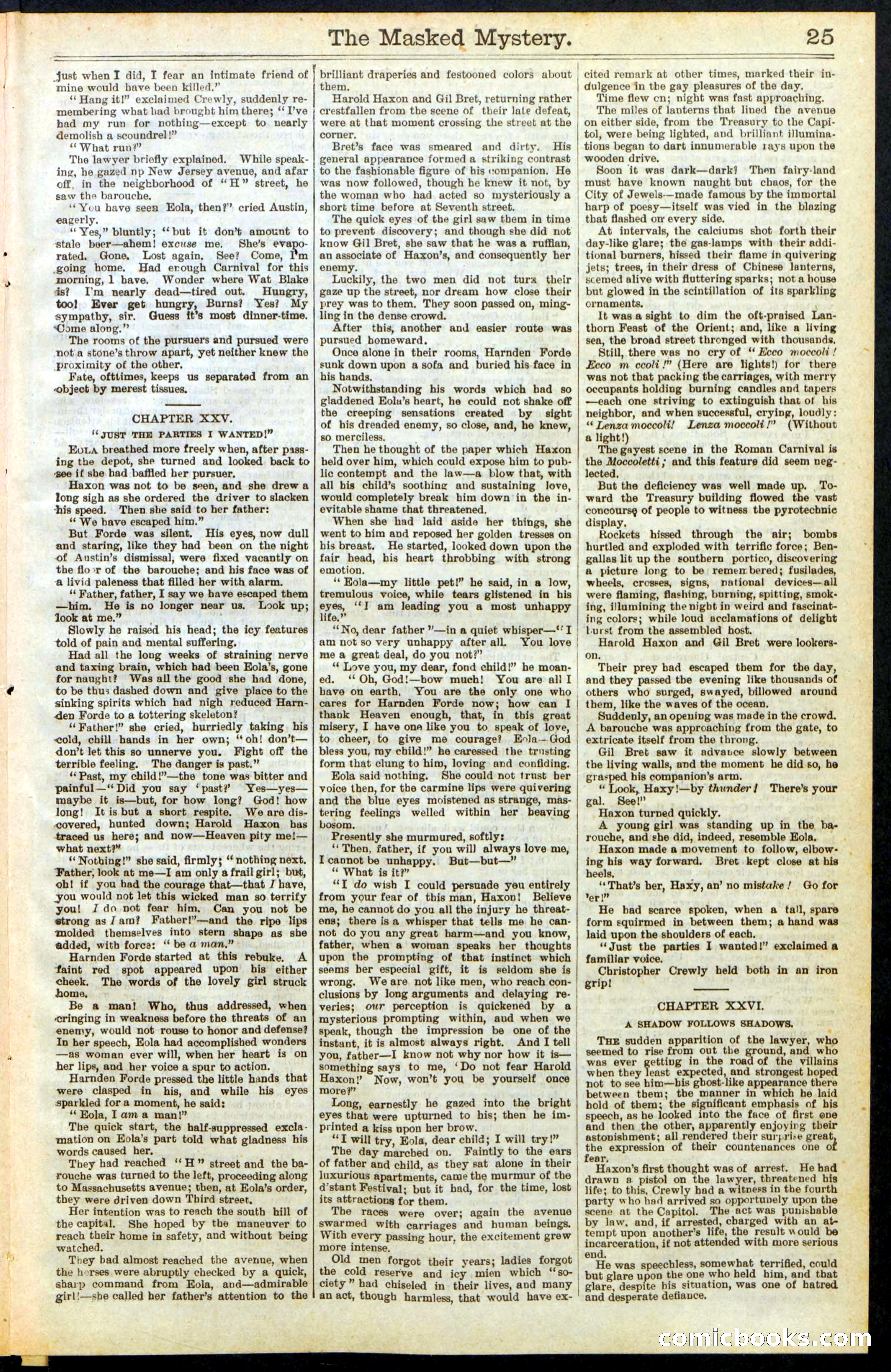
A restored page from Pulp Fiction, 1883. Page through the whole issue in the reader above.
📄 Transcribed text from this page (OCR, searchable)
Machine-transcribed from the original scan — historical spelling and the odd misread are preserved.
—— ——_ mine would bave been killed,” ‘‘ Hang it!” exclaimed Crewly, suddenly re- a them, Harold Haxon and Gil Bret, returning rather membering what had brought him there; ‘I’ve ; crestfallen from the scene of their late defeat, had my run for nothing—except to nearly | were at that moment crossing the street at the demolish a scoundrel!” “What run?” The lawyer briefly explained. While speak- corner. Bret’s face was smeared and dirty. His general appearance formed a striking contrast ing, he gazed np New Jersey avenue, and afar | to the fashionable figure of bis companion, He off, in the neigkborhood of “H™” street, he saw the barouche, ‘You have seen Eola, then?” cried Austin, eagerly. “Yes,” bluntly; ‘‘ but it don’t amount to stale beer—ahem! excuse me. She’s evapo- rated. Gone, Lost again. See? Come, I’m going home. Had erough Carnival for this morning, 1 have. Wonder where Wat Blake ds? I’m nearly dead—tired out. Hungry, too! Ever get hungry, Burns? Yes? My sympathy, sir. Guess it’s most dinner-time. Come along.” The rooms of the pursuers and pursued were not a stone’s throw apart, yet neither knew the proximity of the other, Fate, ofttimes, keeps us separated from an object by merest tissues, CHAPTER XXYV. ‘‘ JUST THE PARTIES I WANTED!” Eota breathed more freely when, after pass- ing the depot, she turned and looked back to see if she had baffled ber pursuer, Haxon was not to be seen, and she drew a long sigh as she ordered the driver to slacken this speed. Then she said to her father: ‘* We bave escaped him.” But Forde was silent. His eyes, now dull and staring, like they bad been on the night of Austin’s dismissal, were fixed vacantly on the floor of the barouche; and his face was of @ livid paleness that filled her with alarm. ‘‘ Father, father, I say we have escaped them —him. He is no longer near us. Look up; look at me.” Slowly he raised his head; the icy features told of pain and mental suffering. Had all the long weeks of straining nerve and taxing brain, which had been Eola’s, gone for naught? Was all the good she had done, to be thus dashed down and give place to the sinking spirits which had nigh reduced Harn- den Forde to a tottering skeleton? ‘‘Father!” she cried, hurriedly taking his cold, chill hands in her own; ‘oh! don’t— don’t let this so unnerve you. Fight off the terrible feeling. The danger is past.” “Past, my child!”—the tone was bitter and painful—‘“ Did you say ‘past? Yes—yes— maybe it is—but, for bow long? God! how long! It is but a short respite. We are dis- covered, hunted down; Harold Haxon bas traced us here; and now—Heaven pity me!— what next?” ‘‘ Nothing!” she said, firmly; ‘‘ nothing next. Father, look at me—I am only a frail girl; but, oh! if you had the courage that—that J have, you would not let this wicked man so terrify you! J do not fear him. Can you not be etrong as/am? Father!’—and the ripe lips molded themselves into stern shape as she added, with force: ‘“‘ be a man,” Harnden Forde started at this rebuke. A faint red spot appeared upon his either cheek. The words of the lovely girl struck home, ‘ Be a man! Who, thus addressed, when ringing in weakness before the threats of an enemy, would not rouse to honor and defense? In her speech, Eola had accomplished wonders —as woman ever will, when her heart is on her lips, and her voice a spur to action. Harnden Forde pressed the little hands that were clasped in his, and while his eyes sparkled fora moment, he said: ‘* Kola, Iam a man!” The quick start, the half-suppressed excla- mation on Eola’s part told what gladness his words caused her, They had reached “‘H™ street and the ba- rouche was turned to the left, proceeding along to Massachusetts avenue; then, at Eola’s order, they were driven down Third street, Her intention was to reach the south hill of the capital. She hoped by the maneuver to reach their home in safety, and without being watched. They bad almost reached the avenue, when the horses were abruptly checked by a quick, sharp command from Eola, and—admirable girl!—she called her father’s attention to the was now followed, though he knew it not, by the woman who had acted so mysteriously a short time before at Seventh street. The quick eyes of the girl saw them in time to prevent discovery; and though she did not | know Gil Bret, she saw that he was a ruffian, an associate of Haxon’s, and consequently her enemy. Luckily, the two men did not tura their | gaze up the street, nor dream how close their prey was to them. They soon passed on, ming- ling in the dense crowd. After this, another and easier route was pursued bomeward, Once alone in their rooms, Harnden Forde sunk down upon a sofa and buried his face in bis hands. Notwithstanding his words which had so gladdened Eolu’s heart, he could rot shake off the creeping sensations created by sight of his dreaded enemy, so close, and, he knew, so merciless, Then he thought of the paper which Haxon held over him, which could expose him to pub- lic contempt and the law—a blow that, with all his child’s soothing and sustaining love, would completely break him down in the in- evitable shame that threatened. When she had laid aside her things, she went to him and reposed her golden tresses on his breast. He started, looked down upon the fair head, his heart throbbing with strong emotion. ‘‘ Eola—my little pet!” he said, in a low, tremulous voice, while tears glistened in his see ‘‘T am Jeading you a most unhappy e.” The Masked Mystery. | just when I did, I fear an intimate friend of | brilliant draperies and festooned colors about | ‘No, dear father ’—in a quiet whisper—‘‘I | am not so very unhappy afterall. You love | me a great deal, do you not?” ed. ‘Oh, God!—bow much! You are all I 25 -§ = anees ee cited remark at other times, marked their in- dulgence in the gay pleasures of the day. Time flew cn; night was fast approaching. The miles of lanterns that lined the avenue on either side, from the Treasury to the Capi- tol, were being lighted, and brilliant i)lumina- tions began to dart innumerable rays upon the wooden drive. Soon it was dark—dark? Then fairy-land must have known naught but chaos, for the City of Jewels-—-made famous by the immortal harp of poesy—itself was vied in the blazing ' that flashed om every side. At intervals, the calciums shot forth their day-like glare; the gas-lamps with their addi- tional burners, hissed their flame in quivering jets; trees, in their dress of Chinese lanterns, scemed alive with fluttering sparks; not a house but glowed in the scintillation of its sparkling ornaments, It was a sight to dim the oft-praised Lan- thorn Feast of the Orient; and, like a living sea, the broad street thronged with thousands, Still, there was no cry of ‘ Ecco moccoli ! Ecco m ccoli!” (Here are lights!) for there was not that packing the carriages, with merry occupants holding burning candles and tapers —each one striving to extinguish that of his neighbor, and when successful, crying, loudly: “ Lenza moccoli! Lenza moccoli!” (Without a light!) The gayest scene in the Roman Carnival is the Moccoletti ; and this feature did seem neg- . lected, But the deficiency was well made up. | To- ward the Treasury building flowed the vast concourse of people to witness the pyrotechnic display. Rockets hissed through the air; bombs hurtled and exploded with terrific force; Ben- gallas lit up the southern portico, discovering a picture long to be remembered; fusilades, wheels, crosses, signs, national devices—all were flaming, flashing, burning, spitting, smok- ing, ilumining the night in weird and fascinat- ing colors; while Joud acclamations of delight Lurst from the assembled host. Harold Haxon and Gil Bret were lookers- | on. ** Love you, my dear, fond child!” he moan. | bave on earth, You are the only one who. cares for Harnden Forde now; how can I thank Heaven enough, that, in this great misery, I have one like you to speak of love, to cheer, to give me courage? Enla—God bless you, my child!” he caressed the trusting form that clung to him, loving and confiding. Eola said nothing. She could not trust ber voice then, for the carmine lips were quivering and the blue eyes moistened as strange, mas- tering feelings welled within her beaving bosom. Presently she murmured, softly: ‘‘ Then, father, if you wil) always love me, I cannot be unhappy. But—but—” ** What is it?” “I do wish I could persuade you entirely from your fear of this man, Haxon! Believe me, he cannot do you all the injury he threat- ens; there isa whisper that tells me he can- not do you any great barm—and you know, father, when a woman speaks her thoughts upon the prompting of that instinct which seems ber especial gift, it is seldom she is wrong. Weare not like men, who reach con- clusions by long arguments and delaying re- veries; our perception is quickened by a mysterious prompting within, and when we speak, though the impression be one of the instant, it is almost always right. And I tell you, father—I know not why nor how it is— something says to me, ‘Do not fear Harold Haxon!’ Now, won’t you be yourself once more?” Long, earnestly he gazed into the bright eyes that were upturned to his; then he im- printed a kiss upon her brow. “TI will try, Eola, dear child; I will try!” The day marched on. Faintly to the ears of father and child, as they sat alone in their luxurious apartments, came the murmur of the d’stant Festival; but it bad, for the time, lost its attractiong for them. The races were over; again the avenue swarmed with carriages and human beings. With every passing hour, the excitement grew more intense, Old men forgot their years; ladies forgot the cold reserve and icy mien which ‘“‘so- ciety ” had chiseled in their lives, and many an act, though harmless, that would have ex- | — eee OOOO TL Their prey bad escaped them for the day, and they passed the evening like thousands of others who surged, swayed, billowed around them, like the waves of the ocean. Suddenly, an opening was made in the crowd. A barouche was approaching from the gate, to extricate itself from the throng. Gil Bret saw it advauce slowly between the living walls, and the moment he did s0, he gras his companion’s arm. k, Haxy!—by thunder! There’s your gal. See!” Haxon turned quickly. A young girl was standing up in the ba- rouche, and she did, indeed, resemble Eola, Haxon made a movement to follow, elbow- ing his way forward, Bret kept close at his heels. : ‘“‘That’s ber, Haxy, an’ no mistake! Go for Yor |” He bad scarce spoken, when a tall, spare form squirmed in between them; a hand was laid upon the shoulders of each, “Just the parties I wanted!” exclaimed a familiar voice. rf Christopher Crewly held both in an iron grip! CHAPTER XXVI. A SHADOW FOLLOWS SHADOWS. * THE sudden apparition of the lawyer, who seemed to rise from out the und, and who was ever getting in the road of the villains when they least expected, and strongest hoped not to see him—bis ghost-like appearance there between them; the manner in which he laid hold of them; the significant emphasis of bis speech, as he looked into the face of first one and then the other, apparently enjoying their astonishment; all rendered their surprise grea the expression of their countenances one fear, F Haxon’s first thought was of arrest. He had drawn a pistol on the lawyer, threatened his life; to this, Crewly bad a witness in the fourth party who hed arrived so opportupely upon the scene at the Capitol. The act was punishable by law, and, if arrested, charged with an at- tempt upon another’s life, the result would be incarceration, if not attended with more serious end. He was s hless, somewhat terrified, could but glare upon the one who held him, and that glare, despite his situation, was one of hatred and desperate defiance. Eomichboo € <SriGO