
Pulp Fiction, 1883 · page 14 of 32
Beadle's Dime Library No. 260: The Masked Mystery; or, The Black Crescent — page 14: what you’re looking at
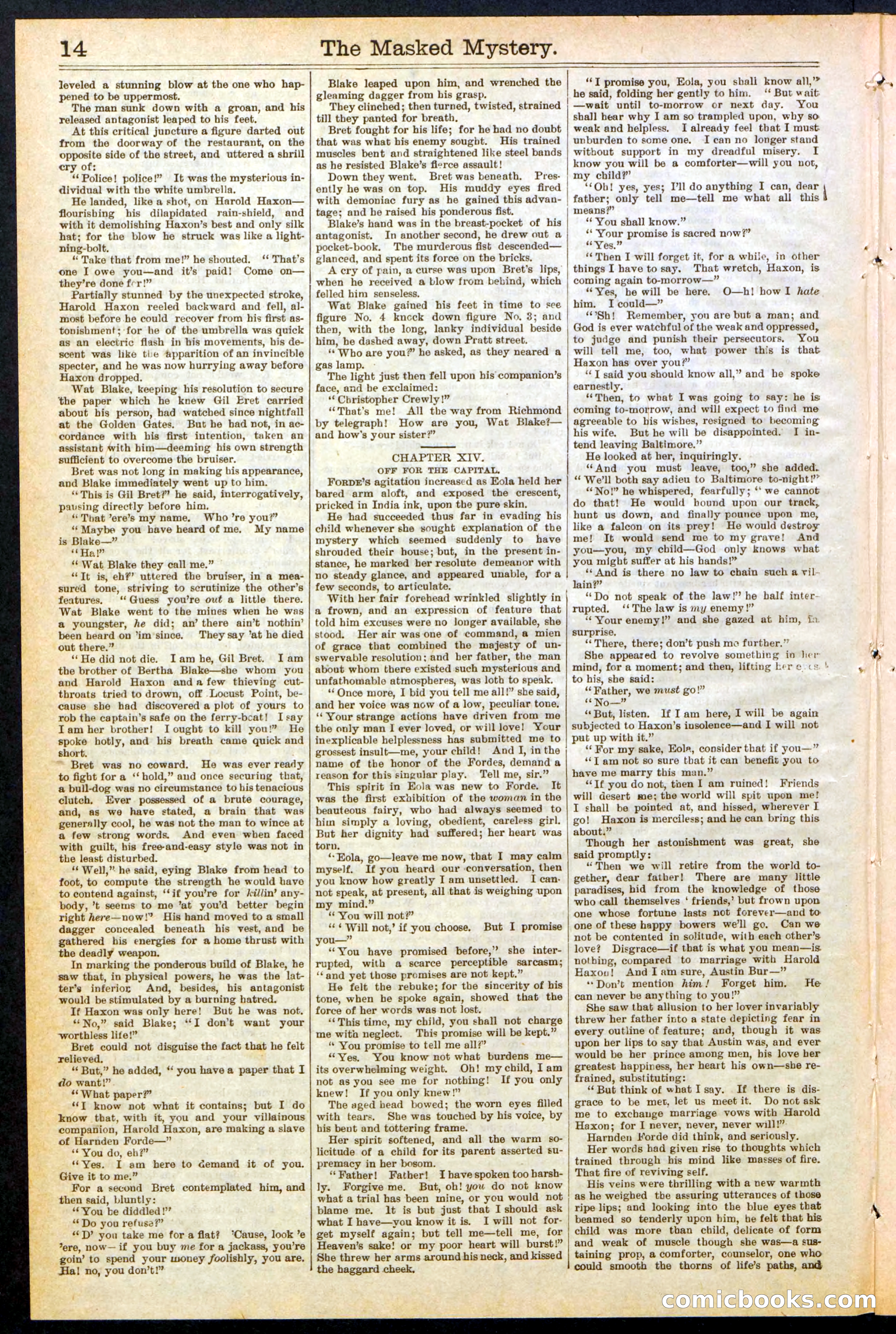
A restored page from Pulp Fiction, 1883. Page through the whole issue in the reader above.
📄 Transcribed text from this page (OCR, searchable)
Machine-transcribed from the original scan — historical spelling and the odd misread are preserved.
~ Bret was no coward. oa ve > - a ‘a ” 4. * “&- — A * + | at x 4 Y ows ahs a ¢ re - worthless life!” 14 leveled a stunning blow at the one who hap- pened to be uppermost. The man sunk down with a groan, and his released antagonist leaped to his feet. At this critical juncture a figure darted out from the doorway of the restaurant, on the opposite side of the street, and uttered a shrill cry of: ‘Police! police!” It was the mysterious in- dividual with the white umbrella. He landed, like a shot, on Harold Haxon— flourishing his dilapidated rain-shield, and with it demolishing Haxon’s best and only silk hat; for the blow he struck was like a light- ning-bolt. “Take that from me!” he shouted. ‘ That’s one I owe you—and it’s paid! Come on— they’re done fer!” Partially stunned by the unexpected stroke, Harold Haxon reeled backward and fell, al- most before he could recover from his first as- tovishment; for he of the umbrella was quick as an electric flash in his movements, bis de- scent was like the &pparition of an invincible specter, and he was now hurrying away before Haxon dropped. Wat Blake, keeping his resolution to secure the paper which he knew Gil Eret carried about his person, had watched since nightfall at the Golden Gates. But he bad not, in ac- cordance with his first intention, taken an assistant with him—deeming his own strength sufficient to overcome the bruiser. Bret was not long in making bis appearance, and Blake immediately went up to him. ‘‘This is Gil Bret?’ he said, interrogatively, pausing directly before him. “That ’ere’s my name, Who’re you?” ‘‘Maybe you have heard of me, My name is Blake—” ‘tHe!’ ‘* Wat Blake they call me.” ‘“‘Tt is, eh?’ uttered the bruiser, in a mea- sured tone, striving to scrutinize the other’s features. ‘‘ Guess you’re out a little there. Wat Blake went to the mines when he was a youngster, he did; an’ there ain’t nothin’ been heard on ’im’since. They say ‘at he died out there.” ‘‘ He did not die. Iam he, Gil Bret. Iam the brother of Bertha Blake—shbe whom you and Harold Haxon anda few thieving cut- throats tried to drown, off Locust Point, be- cause she had discovered a plot of yours to rob the captain’s safe on the ferry-bcat! I say Iam her brother! I ought to kill you!” He spoke hotly, and bis breath came quick and short. — — He was ever ready to fight for a ‘‘ hold,” aud once securing that, a bull-dog was no circumstance to his tenacious clutch. Ever possessed of a brute courage, and, as we have stated, a brain that was generally cool, he was not the man to wince at a few strong words. And even when faced with guilt, his free-and-easy style was not in the least disturbed. ‘¢ Well,” he said, eying Blake from head to foot, to compute the strength he would have to contend against, ‘‘if you’re for killin’ any- body, ’t seems to me ’at you’d better begin right here—now!” His hand moved to a small dagger concealed beneath his vest, and he _ gathered his energies for a home thrust with the deadly weapon. In marking the ponderous build of Blake, he saw that, in physical powers, he was the lat- ter’s inferior And, besides, his antagonist would be stimulated by a burning batred. If Haxon was only here! But he was not. “No,” said Blake; “I don’t want your Bret could not disguise the fact that he felt relieved. ‘“‘ But,” he added, “‘ you have a paper that I do want!”. ** What paper?” “TI know not what it contains; but I do know tbat, with it, you and your villainous companion, Harold Haxon, are making a slave of Harnden Forde—” ‘You do, eb?” ‘“Yes. I am here to Gemand it of you. Give it to me.” For a second Bret contemplated him, and - then said, bluntly: **You be diddled!”’ Do you refuse?” “PD” you take me fora flat? ‘Cause, look ’e ere, now— if you buy me for a jackass, you’re goin’ to spend your woney foolishly, you are, ra; Ha! no, you don’t!” =F © oe The Masked Mystery. Blake leaped upon him, and wrenched the gleaming dagger from bis grasp. They clinched; then turned, twisted, strained till they panted for breath. Bret fought for his life; for he had no doubt that was what his enemy sought. His trained muscles bent and straightened like steel bands as he resisted Blake’s fierce assault! Down they went. Bret was beneath. Pres- ently he was on top. His muddy eyes fired with demoniac fury as he gained this advan- tage; and he raised his ponderous fist. Blake’s hand was in the breast-pocket of his antagonist. In another second, he drew out a pocket-book. The murderous fist descended— glanced, and spent its force on the bricks. A ery of pain, a curse was upon Bret’s lips, when he received a blow from bebind, which felled him senseless. Wat Blake gained his feet in time to see figure No. 4 knceck down figure No. 3; and | | | | ‘‘T promise you, Eola, you shall know all,” he said, folding her gently to him. ‘‘ But wait —wait until to-morrow or next day. You shall hear why I am so trampled upon, why so weak and helpless. I already feel that I must unburden to some one. I can no longer stand without support in my dreadful misery. I know you will be a comforter—will you not, my child?’ ‘Ob! yes, yes; I’ll do anything I can, dear father; only tell me—tell me what all this means?” ‘* You shall know.” ‘‘ Your promise is sacred now?” ‘¢Yas,” ‘¢Then I will forget it, for a while, in other things I have to say. That wretch, Haxon, is coming again to-morrow—” “Yes, he will be here. him. I could—” ‘Sh! Remember, you are buf a man; and O—h! how I hate then, with the long, lanky individual beside | God is ever watchful of the weak and oppressed, him, he dashed away, down Pratt street. ‘* Who are you?’ he asked, as they neared a gas lamp. The light just then fell upon his companion’s face, and be exclaimed: ‘‘ Christopher Crewly!” “That’s me! All the way from Richmond by telegraph! How are you, Wat Blake?— and how's your sister?” CHAPTER XIV. OFF FOR THE CAPITAL. ForpDe’s agitation increased as Eola held her bared arm aloft, and exposed the crescent, pricked in India ink, upon the pure skin. He had succeeded thus far in evading his child whenever she sought explanation of the mystery which seemed suddenly to have shrouded their house; but, in the present in- stance, he marked her resolute demeanor with no steady glance, and appeared unable, fora few seconds, to articulate. With her fair forehead wrinkled slightly in a frown, and an expression of feature that told him excuses were no longer available, she stood. Her air was one of command, a mien of grace that combined the majesty of un- swervable resolution; and ber father, the man about whom there existed such mysterious and unfathomable atmospheres, was loth to speak. ‘‘Once more, I bid you tell me all!” she said, and her voice was now of a low, peculiar tone. ‘Your strange actions have driven from me the only man I ever loved, or will love! Your inexplicable helplessness has submitted me to grossest insult—me, your child! And I, in the name of tbe honor of the Fordes, demand a reason for this singular play. Tell me, sir.” This spirit in Eola was new to Forde. It was the first exhibition of the woman in the beauteous fairy, who had always seemed to him simply a loving, obedient, careless girl. But her dignity had suffered; her heart was torn. ‘Eola, go—leave me now, that I may calm myself. If you heard our conversation, then you know how greatly I am unsettled. I can- not speak, at present, all that is weighing upon my mind.” ‘You will not?’ * * Will not,’ if you choose. ou—” ‘““You have promised before,’ she inter- rupted, with a scarce perceptible sarcasm; ‘‘and yet those promises are not kept.” He felt the rebuke; for the sincerity of bis tone, when he spoke again, showed that the force of her words was not lost. ‘This time, my child, you shall not charge me with neglect. This promise will be kept.” ‘“ You promise to tell me all?” ; “Yes. You know not what burdens me— its overwhelming weight. Oh! my child, Iam not as you see me for nothing! If you only knew! If you only knew!” The aged head bowed; the worn eyes filled with tears. She was touched by his voice, by his bent and tottering frame. Her spirit softened, and all the warm s0- licitude of a child for its parent asserted su- premacy in her bosom. ‘‘Father! Father! I havespoken too harsh- ly. Forgive me. But, oh! you do not know what a trial has been mine, or you would not blame me. lt is but just that I should ask what I have—you know it is. I will not for- get myself again; but tell me—tell me, for Heaven’s sake! or my poor heart will burst!” She threw her arms around his neck, and kissed the haggard cheek, But I promise | egret TS en OE to judge and punish their persecutors. You will tell me, too, what power this is that Haxon has over you?” ‘<T said you should know all,” and he spoke earnestly. ‘Then, to what I was going to say: he is coming to-morrow, and will expect to find me agreeable to his wishes, resigned to becoming his wife. But he will be disappointed. I in- tend leaving Baltimore.” He looked at her, inquiringly. ‘‘And you must leave, too,” she added. ‘‘ We'll both say adieu to Baltimore to-night!’ ‘‘No!” he whispered, fearfully; ‘‘ we cannot do that! He would bound upon our track, hunt us down, and finally pounce upon me, like a faleon on its prey! He would destroy me! It would send me to my grave! And you—you, my ehild—God only knows what you might suffer at his hands!” ‘‘ And is there no law to chain such a vil- lain?” “Do not speak of the law!” he half inter- rupted. ‘‘ The law is my enemy!” ‘‘Your enemy!” and she gazed at him, in. surprise. ‘‘There, there; don’t push mo further.” She appeared to revolve something in her mind, for a moment; and then, lifting here .cs to his, she said: ‘Father, we must go!” “ce No—” ‘‘ But, listen. If I am here, I will be again subjected to Haxon’s insolence—and I will not put up with it.” ‘‘ For my sake, Eola, consider that if you—” ‘‘T am not so sure that it can benefit you to have me marry this man.” “Tf you do not, then I am ruined! Friends will desert me; the world will spit upon me! I shall be pointed at, and hissed, wherever I go! Haxon is merciless; and he can bring this about.” Though her astonishment was great, she said promptly: “Then we will retire from the world to- gether, dear father! There are many little paradises, hid from the knowledge of those who call themselves ‘ friends,’ but frown upon one whose fortune lasts not forever—and to one of these happy bowers we'll go. Can we not be contented in solitude, with each other’s love? Disgrace—if that is what you mean—is. nothing, compared to marriage with Harold Haxou! And Iam sure, Austin Bur—” ‘*Don’t mention him! Forget him. He can never be anything to you!” She saw that allusion to her lover invariably threw her father into a state depicting fear in every outline of feature; and, though it was upon ber lips to say that Austin was, and ever would be her prince among men, his love her greatest happiness, her heart his own—sbe re- frained, substituting: ‘¢ But think of what I say. If there is dis- grace to be met, let us meetit. Do not ask me to exchange marriage vows with Harold Haxon; for I never, never, never will!” Harnden Forde did think, and seriously. Her words had given rise to thoughts which trained through his mind like masses of fire. That fire of reviving self. His veins were thrilling with a new warmth as he weighed tbe assuring utterances of those ripe lips; and looking into the blue eyes that beamed so tenderly upon him, be felt that his child was more than child, delicate of form and weak of muscle though she was—a sus- taining prop, a comforter, counselor, one who could smooth the thorns of life’s paths, and aayice a TS * = : e(@ : . ws