
Pulp Fiction, 1883 · page 6 of 24
Beadle's New York Dime Library, No. 259 — page 6: what you’re looking at
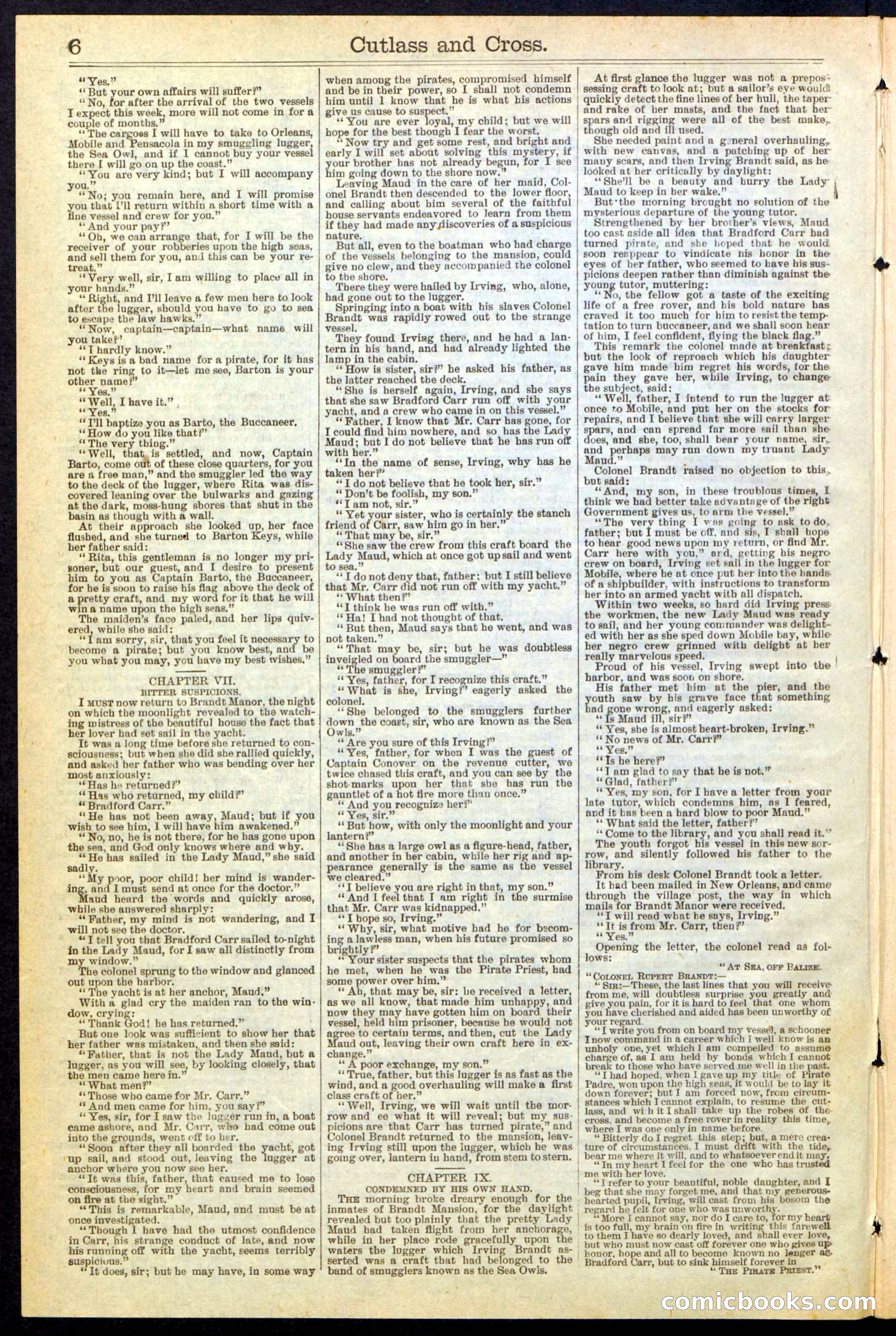
A restored page from Pulp Fiction, 1883. Page through the whole issue in the reader above.
📄 Transcribed text from this page (OCR, searchable)
Machine-transcribed from the original scan — historical spelling and the odd misread are preserved.
ce <— — *o* - - “ib>t, -- 6 “ Yes.” ‘‘But your own affairs will suffer?” “No, for after the arrival of the two vessels T expect this week, more will not come in fora couple of months.” ‘“‘The cargoes I will have to take to Orleans, Mobile and Pensacola in my smuggling lugger, the Sea Owl], and if I cannot buy your vessel there I will go on up the coast.” “You are very kind; but I will accompany ou,” - ‘*No; you remain here, and I will promise you that (ll return within a short time with a fine vessel and crew for you.” * And your pay?’ ‘‘Oh, we can arrange that, for I will be the receiver of your robberies upon the high seas, and sell them for you, and this can be your re- treat,” “Very well, sir, 1am willing to place all in your hands.” * Right, and I’ll leave a few men here to look after the lugger, should you have to go to sea to escape the law hawks.” “Now, captain—captain—what name will you take?’ ‘*T hardly know.” ‘‘ Keys is a bad name for a pirate, for it has not the ring to it—let me see, Barton is your other name?” ‘ee Yes.” ‘© Well, I have it.” . “Yes,” **T’ll baptize you as Barto, the Buccaneer, ‘* How do you like that?” ‘The very thing.” “Well, that,is settled, and now, Captain Barto, come out of these close quarters, for you are a free man,” and the smuggler led the way to the deck of the lugger, where Rita was dis- covered leaning over the bulwarks and gazing at the dark, moss-hung shores that shut in the basin as though with a wall. At their approach she looked up, her face flushed, and she turned to Barton Keys, while her father said: * Rita, this gentleman is no longer my pri- soner, but our guest, and I desire to present him fo you as Captain Barto, the Buccaneer, for he is soon to raise his flag above the deck of a pertty craft, and my word for it that he will win a name upon the high seas,” The maiden’s face paled, and her lips quiv- ered, while she said: “fam sorry, sir, that you feel it necessary to become a pirate; but you know best, and be you what you may, you have my best wishes.” CHAPTER VII. BITTER SUSPICIONS, I must now return to Brandt Manor, the night on which the moonlight revealed to the watch- ing wistress of the beautiful house the fact that her lover had set sail in the yacht. Tt was a long time before she returned to con- sciousness; but when she did she rallied quickly, and asked her father who was bending over her most anxiously: ‘*Has he returned?” ** Has who returned, my child?’ * Bradford Carr.” _ “He has not been away, Maud; but if you wish to see him, I will have him awakened.” “No, no, he is not there, for he has gone upon the sea, and God only knows where and why. ““He has sailed in the Lady Maud,” she said dly. “My B ta poor child! her mind is wander- ing, and I must send at once for the doctor.” aud heard the words and quickly arose, while she answered sharply: “Father, my mind is not wandering, and I will not see the doctor. “T tell you that Bradford Carr sailed to-night in the Lady Maud, for I saw all distinctly from my window.” 6 colonel sprung to the window and glanced out upon the harbor. ‘‘The yacht is at her anchor, Maud,” With a glad cry the maiden ran to the win- dow, erying: “Thank God! he has returned,” But one look was sufficient to show her that her father was mistaken, and then she ssid: “Father, that is not the Lady Maud, but a lugger, as you will see, by looking closely, that the men came here in.’ “What men?” **Those who came for Mr. Carr.” ‘* And men came for him, you say?” ‘* Yes, sir, for I saw the Jugzer run in, a boat came ashore, and Mr. Carr, who bad come out into the grounds, went cff to her. “Soon after they all boarded the yacht, got ‘up sail, and stood out, leaving the lugger at anchor where you now see her. “Tt was this, father, that caused me to lose consciousness, for my heart and brain seemed on fire at the sight.” “This is remarkable, Maud, and must be at once investigated. “Though I have had the utmost confidence in Carr, his strange conduct of late, and now his running off with the yacht, seems terribly suspicivus.” “It does, sir; but he may have, in some way Se eee - / Cutlass and Cross. ae a when among the pirates, compromised himself and be in their power, so I shall not condemn bim until 1 know that he is what his actions | quickly detect the fine lines of her hull, the taper and rake of ber masts, and the fact that her give us cause to suspect.” ‘‘You are ever loyal, my child; but we will hope for the best though I fear the worst, ee At first glance the lugger was not a prepos- sessing craft to look at; but a sailor’s eye would spars and rigging were all of the best make, | though old and ill used. ‘Now try and get some rest, and bright and | early I will set about solving this mystery, if your brother has not already begun, for I see him going down to the shore now.” Leaving Maud in the care of her maid, Col- onel Brandt then descended to the lower floor, and calling about him several of the faithful house servants endeavored to learn from them if they had made any discoveries of a suspicious nature. But all, even to the boatman who had charge of the vessels belonging to the mansion, could give no clew, and they accompanied the colonel to the shore. There they were hailed by Irving, who, alone, had gone out to the lugger. Springing into a boat with his slaves Colonel Seance was rapidly rowed out to the strange vessel, They found Irvirg there, and he had a lan- tern in his band, and had already lighted the lamp in the cabin. ‘* How is sister, sir?’ he asked his father, as the latter reached the deck. “She is herself again, Irving, and she says that she saw Bradford Carr run off with your yacht, and a crew who came in on this vessel.” ‘* Father, I know that Mr. Carr has gone, for I could find him nowhere, and so has the Lady Maud; but I do not believe that he bas run off with her.” ‘‘In the name of sense, Irving, why has he taken her?’ ‘‘T do not believe that he took her, sir.” ** Don’t be foolish, my son.” “Tam not, sir.” “Yet your sister, who is certainly the stanch friend of Carr, saw him go in her.” “That may be, sir.” “She saw the crew from this craft board the Lady Maud, which at once got upsail and went to sea.” ‘‘T do not deny that, father; but I still believe that Mr. Carr did not run off with my yacht.” ‘** What then?” “T think he was run off with.” ‘Ha! I had not thought of that. “But then, Maud says that he went, and was not taken.” “That may be, sir; but he was doubtless inveigled on board the smuggler—” “The smuggler?” “Yes, father, for I recognize this craft.” ‘What is she, Irving!’ eagerly asked the colonel. ‘She belonged to the smugglers further down the coast, sir, who are known as the Sea Owls.” ** Are you sure of this Irving?” “Yes, father, for when I was the guest of Captain Conover on the revenue cutter, we twice chased this craft, and you can see by the shot-marks upon her that she has run the gauntlet of a hot fire more than once,” ** And you recognize her?” “* Yes, sir.” ‘‘But how, with only the moonlight and your lantern?” ‘‘She has a large owl as a figure-head, father, and another in her cabin, while her rig and ap- pearance generally is the same as the vessel we cleared.” ‘*T believe you are right in that, my son.” ‘‘ And I feel that I am right in the surmise that Mr. Carr was kidnapped.” **T bope so, Irving.” ‘‘ Why, sir, what motive bad he for becom- ing a lawless man, when his future promised so brightly?’ ‘** Your sister suspects that the pirates whom he met, when he was the Pirate Priest, had some power over him.” ‘* Ah, that may be, sir: he received a letter, as we all know, that made him unhappy, and now they may have gotten him on board their vessel, held him prisoner, because he would not agree to certain terms, and then, cut the Lady aud out, leaving their own craft here in ex- change.” “* A poor exchange, my son.” ‘True, father, but this lugger is as fast as the wind, and a good overhauling will make a first class craft of her.” ‘Well, Irving, we will wait until the mor- row and ee what it will reveal; but my sus- picions are that Carr has turned pirate,” and } | i } | | | 85955 ae — Colonel Brandt returned to the mansion, leav- | ing Irving still upon the lugger, which he was | going over, lantern in hand, from stem tostern. CHAPTER IX. CONDEMNED BY HIS OWN HAND. THE morning broke dreary enough for the inmates of Brandt Mansion, for the daylight revealed but too plainly that the pretty Lady Maud had taken flight from her anchorage, while in her place rode gracefully upon the waters the lugger which rene Brandt as- serted was a craft that had belonged to the band of smugglers known as the Sea Owls. She needed paint and a general overhauling, with new canvas, and a patching up of her mavy scars, and then Irving Brandt said, as he looked at her critically by daylight: ‘She'll be a beauty and hurry the Lady Maud to keep in ber wake.” But*the morning brought no solution of the | mysterious departure of the young tutor. Strengthened by her brother’s views, Maud too cast aside all idea that Bradford Carr had turned pirate, and she hoped tbat he would soon reeppear to vindicate his honor in the eyes of her father, who seemed to have his sus- picions deepen rather than diminish against the young tutor, muttering: “No, the fellow got a taste of the exciting life of a free rover, and his bold nature bas craved it too much for him to resist the temp- tation to turn buccaneer, and we shall soon hear of him, I feel confident, flying the black flag.” This remark the colonel made at breakfast; but the look of reproach which his daughter gave him made him regret his words, for the pain they gave her, while Irving, to change the | said: ‘* Well, father, I intend to run the lugger at once to Mobile, and put her on the stocks for repairs, and I believe that she will carry larger spars, and can spread far more sail than she does, and she, too, shall bear your name, sir, and perhaps may run down my truant Lady Maud.” : Colonel Brandt raised no objection to this.. bot said: ‘“‘And, my son, in these troublous times, I think we had better take advantage of the right Government gives us, to arm the vessel.” “The very thing I wos going to ask to do, father; but I must be off, and sis, I shall bope to hear good news upon my return, or find Mr. Carr here with you,” ard, getting his negro crew on board, Irving set sail in the lugger for Mobile, where he at once put her into the hands. of a shipbuilder, with instructions to transform her into an armed yackt witb all dispatch, Within two weeks, so hard did Irving press the workmen, the new Lady Maud was read to sail, and her young commander was deli he ed with her as she sped down Mobile bay, while her negro crew grinned with delight at her really marvelous speed. Proud of his vessel, Irving swept into the harbor, and was soon on shore. His father met bim at the pier, and the Se saw by his grave face that something ad gone wrong, and eagerly asked: **Ts Maud ill, sir?” ‘* Yes, she is almost heart-broken, Irving.” ‘* No news of Mr, Carr?” ae Yes,” “Ts he here?” ‘*T am glad to say that he is not.” “Glad, father?’ ’ ** Yes, my son, for I have a letter from your late tutor, which condemns him, as I feared, and it bas been a bard blow to poor Maud.” ‘* What said the letter, father?” ‘* Come to the library, and you shall read it.’ The youth forgot his vessel in this new sor- row, and silently followed his father to the library. From bis desk Colonel Brandt took a letter, It had been mailed in New Orleans, and came through the village post, the way in which mails for Brandt Manor were received. ‘“‘T will read what he says, Irving.” ‘*Tt is from Mr. Carr, then?’ sé Yes.” Opening the letter, the colonel read as fol- Ows: “At SEA, OFF BALIZE. “CoLoNEL Rupert BRANDT:— * Srn:—These, the last lines that you will receive from me, will doubtless surprise you greatly and give you pain, for it is hard to feel that one whom you have cherished and aided has been unworthy of your regard. *T write you from on board my vessel, a schooner — TInow command in a career which I well know is an | unholy one, yet which I am compelled to assume charge of, as I am held by bonds which I cannot break to those who have served me well in the past. “‘T had hoped, when I gave up my title of Pirate Padre, won upon the high seas, it would be to lay it down forever; but I am forced now, from circum- stances which I cannot explain, to resume the cut- lass, and wih it I shall take “ the robes of the- cross, and become a free rover in reality this time, where I was one only in name before. “ Bitterly do I regret this step; but, a mere crea- ture of circumstances, I must drift with the tide, bear me where it will, and to whatsoever end it may. “In my heart I feel for the one who hast me with her love. ‘*T refer to your beautiful, noble daughter, and I beg that she may forget me, and that my generous- hearted pupil, Irving, will cast from his bosom the regard he felt for one who was On Wwosey ‘ ‘*More I cannot say, nor do I care to, for my heart is too full, my brain on fire in writing this farewell to them I have so dearly loved, and shall ever love, but who must now cast off forever one who gives Up honor, hope and all to become known no lenger ag. Bradford Carr, but to sink himself forever in “THe PrraTe Priest.” ~ a? (E S) GOING IOO | A. ‘\ | } p>) BER coh tnt 5