
Pulp Fiction, 1883 · page 14 of 24
Beadle's New York Dime Library, No. 259 — page 14: what you’re looking at
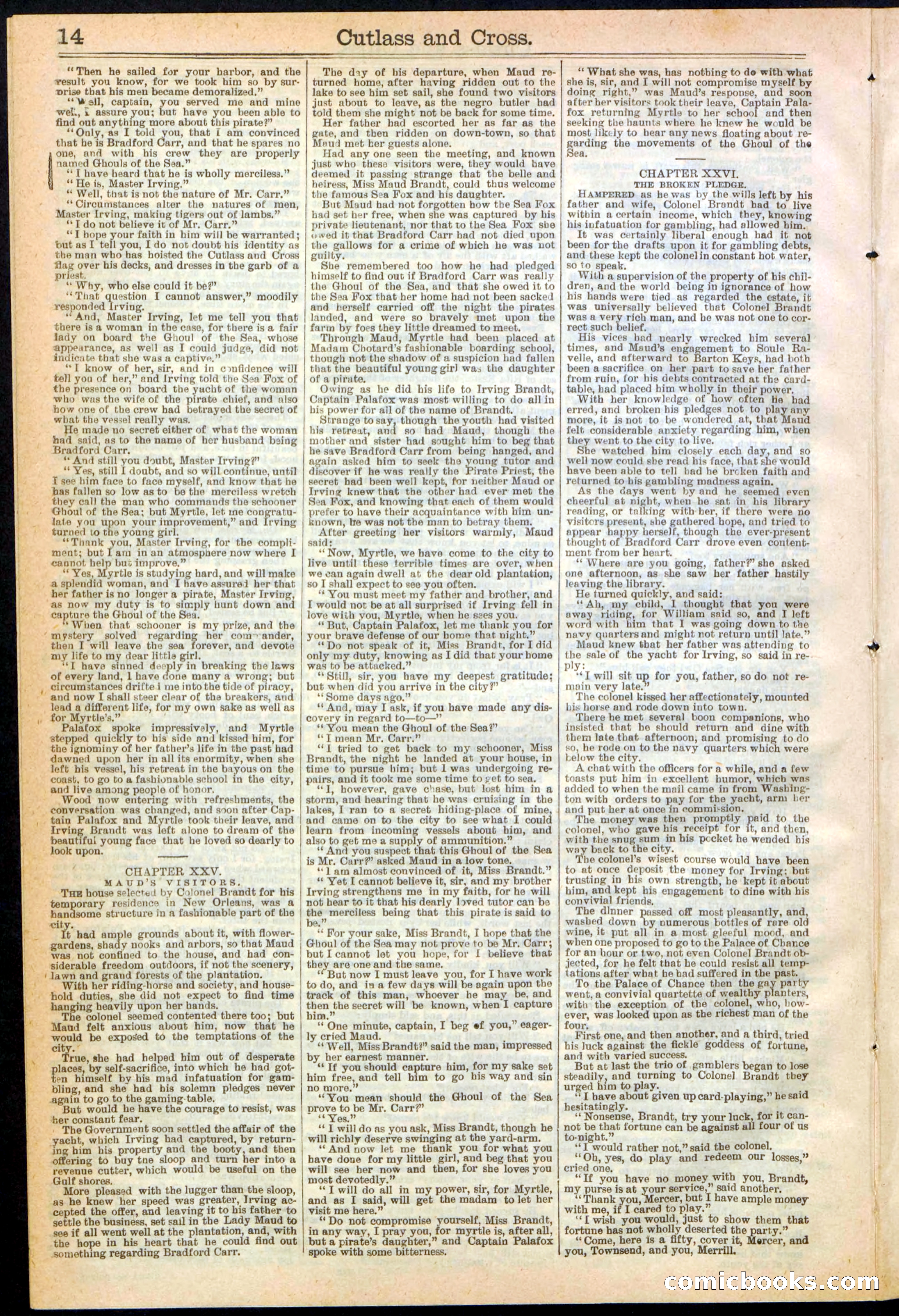
A restored page from Pulp Fiction, 1883. Page through the whole issue in the reader above.
📄 Transcribed text from this page (OCR, searchable)
Machine-transcribed from the original scan — historical spelling and the odd misread are preserved.
~~ _ ) mes aa i, 3 Cutlass and Cross. ‘Then he sailed for your harbor, and the result you know, for we took him so by sur- vrise that his men became demoralized.” *“Wesll, captain, you served me and mine wel., i assure you; but have you been able to find out anything more about this pirate?” “Only, as I told you, that i am convinced that he is Bradford Carr, and that he spares no one, and with his crew they are properly named Ghouls of the Sea.” 4% ‘I have heard that he is wholly merciless.” “* He is, Master Irving.” * Well, that is not the nature of Mr. Carr.” ’ ‘*Circumstances alter the natures of men, Master Irving, making tigers out of lambs.” **I do not believe it of Mr. Carr.” *“T hope your faith in him will be warranted; but as I tell you, Ido not doubt his identity as + tbe man who has hoisted the Cutlass and Cross flag over his decks, and dresses in the garb of a priest. *“ Why, who else could it be?” “*That question I cannot answer,” moodily ‘responded rving. ‘And, Master Irving, let me tell you that there is a woman in the case, for there is a fair lady on board the Ghoul of the Sea, whose appearance, as well as I could judge, did not indicate that she was a captive.” ae “I know of her, sir, and in confidence will - tell you of her,” and Irving told the Sea Fox of the presence on board the yucht of the woman who was the wife of the pirate chief, and also __ how one of the crew had betrayed the secret of — ? fy what the vessel really was. _ . He made no secret either of what the woman __ had said, as to the name of her husband being Bradford Carr, * And still you doubt, Master Irving?” ** Yes, still [ doubt, and so will continue, until _ Isee him face to face myself, and know that he has fallen so low as to be the merciless wretch "ory , i _ they call the man who commands the schooner _. Ghoul of the Sea; but Myrtle, let me congratu- late you upon your improvement,” and Irving turned to the young girl. “Thank you, Master Irving, for the compli- ‘ment; but Tam in an atmosphere now where I “mystery eannot help bué improve.” _ “Yes, Myrtle is studying hard, and will make ne asplendid woman, and I have assured her that her father is no longer a pirate, Master Irving, “as now my duty is to simply bunt down and tas capture the Ghoul of the Sea. et When that schooner is my prize, and the solved Seg her her com ander, _ then I will leave the sea forever, and devote my life to my dear little girl. ‘I have sinned deeply in breaking the laws _ of every land, 1 have done many a wrong; but eeeeeences drifte i me into the tide of piracy, and now I shall steer clear of the breakers, and _ lead a different life, for my own sake as well as , for Myrtle’s.” - Palafox spoke and Myrtle ope quickly to his side and kissed him, for _ the ignominy of her father’s life in the past had _ dawned upon her in all its enormity, when she impressively, -_ teft his vessel, his retreat in the bayous on the - coast, to go to a fashivnable school in the city, _ and live among people of honor. - Wood now entering with refreshments, the _ conversation was changed, and soon after Cap- , tain Palafox and Myrtle took their leave, and Irving Brandt was left alone to dream of the i beautiful young face that he loved so dearly to _look upon. . us Iw, CHAPTER XXV. é MAUD’S VISITORS. "Tre house selected by Colonel Brandt for his tem rary residence in New Orleans, was a o Banisome structure in a fashionable part of the eit: ay tt had ample grounds about it, with flower- gardens, shady nooks and arbors, so that Maud ‘was not confined to the house, and had con- _ siderable freedom outdoors, if not the scenery, Jawn and grand forests of the plantation. With her riding-horse and society, and house- hold duties, gabe did Rot spe to find time | ng hea upon her bands. bac SAtonel madd contented there too; but ‘Mand felt anxious about him, now that he would be exposed to the temptations of the ey ¢ os e, she had helped him out of desperate " a by self-sacrifice, into which he had got- Ron himself by his mad infatuation for gam- bling, and she had his solemn pledges never ss e to go to the gaming: table. But would he have the courage to resist, was ‘ber constant fear. . The Government soon settled the affair of the yacht, which Irving bad captured, by return- BA him his property and the booty, and then - (offering to buy tne sloop and turn her into a revenue cutter, which would be useful on the _ Gulf shores. _ More pleased with the lugger than the sloop, as he knew her speed was greater, Irving ac- epted the offer, and leaving it to his father to ‘settle the business, set sail in the Lady Maud to __see if all went well at the plantation, and, with ; in his heart that he could find out the mething regarding Bradford Carr. ee | | | The day of his departure, when Maud re- turned home, after having ridden out to the lake to see him set sail, she found two visitors just about to leave, as the negro butler had told them she might not be back for some time. Her father had escorted her as far as the gate, and then ridden on down-town, so that Maud met her guests alone. Had any one seen the meeting, and known just who these visitors were, they would bave deemed it passing strange that the belle and heiress, Miss Maud Brandt, could thus welcome the famous Sea Fox and his daughter. But Maud had not forgotten how the Sea Fox had set her free, when she was captured by his private lieutenant, nor that to the Sea Fox sbe owed it that Bradford Carr had not died upon the gallows for a crime of which he was not guilty. She remembered too how he had pledged himself to find out if Bradford Carr was really the Ghoul of the Sea, and that she owed it to the Sea Fox that her home had not been sacke and herself carried off the night the pirates landed, and were so bravely mef upon the farm by foes they little dreamed to meet. Through Maud, Myrtle had been placed at Madam Chotard’s fashionable boarding school, though not the shadow of a suspicion had fallen that the beautiful young gir) was the daughter of a pirate. Owing as he did his life to Irving Brandt, Captain Palafox was most willing to do allin his power for all of the name of Brandt. Strange tosay, though the youth had visited his retreat, and so had Maud, though the mother and sister had sought him to beg that he save Bradford Carr from being hanged, and again asked him to seek the young tutor and discover if he was really the Pirate Priest, the secret had been well kept, for neither Maud or | Irving knew that the other had ever met the | Sea Fox, and knowing that each of them would | prefer to have their acquaintance with him un- | known, be was not the man to betray them. | After greeting her visitors warmly, Maud said: _ “Now, Myrtle, we have come to the city to live until these terrible times are over, when we can again dwell at the dearold plantation, so I shall expect to see you often. ‘* You must meet my father and brother, and I would not be at all surprised if Irving fell in love with you, Myrtle, when he sees you. ‘But, Captain Palafox, let me thank you for your brave defense of our home that night.” ‘*Do not speak of it, Miss Brandt, for I did only in duty, knowing as I did that your home was to be attacked.” * Still, sir, you have my deepest gratitude; but when did you arrive in the city?” ‘*Some days ago.” ** And, may I ask, if you bave made apy dis- covery in regard to—to—” ** You mean the Ghoul of the Sea?” **T mean Mr. Carr.” ‘‘{ tried to get back to my schooner, Miss Brandt, the night be landed at your house, in time to pursue him; but 1 was undergoing re- pairs, and it took me some time to yet to sea. “7, however, gave chase, buf lost him in a storm, and hearing that he was cruising in the lakes, I ran to a secret hiding-place of mine and came on to the city to see what I could learn from incoming vessels about bim, and also to get me a supply of ammunition.” ‘* And you suspect that this Ghoul of the Sea is Mr. Carr?’ asked Maud in a low tone. ‘*] am almost convinced of it, Miss Brandt.” ‘“* Yet [ cannot believe it, sir, and my brother Irving strengthens me in my faitb, for he will not hear to it that his dearly loved tutor can be the merciless being that this pirate is said to be. “For your sake, Miss Brandt, I hope that the Ghoul of the Sea may not prove to be Mr, Carr; but I cannot let you hope, for I believe that they are one and the same, ‘But now I must leave you, for I have work to do, and in a few days will be again upon the track of this man, whoever he may be, and then the secret will be known, when I capture bim. ‘One minute, captain, I beg ef you,” eager- ly cried Maud. : ‘* Well, Miss Brandt?” said the man, impressed by her earnest manner. ** Tf you should capture him, for my sake set him free, and tell him to go his way and sin no more,” ‘““You mean should the Ghoul of the Sea prove to be Mr. Carr?” ee Pa ‘‘ T will do as you ask, Miss Brandt, though he will richly deserve swinging at the yard-arm. “And now let me thank you for what you have done for my little girl, and beg that you will see her now and then, for she loves you most devotedly.” } ‘‘] will do all in my power, sir, for Myrtle, and as I said, will get the madam to let her visit me here.” “Do not compromise yourself, Miss Brandt, in any way, I pray you, for myrtle is, after all, but a pirate’s daughter,” and Captain Palafox spoke with some bitterness. ’ = — —_ ~ — sts ——_— ee OOOO eee eee pl “What she was, has nothing to do with what she is, sir, and I will not compromise myself by doing right,” was Maud’s response, and soon after her visitors took their leave, Captain Pala- fox returning Myrtle to her school and then seeking the haunts where he knew he would be most likcly to bear any news floating about re- garding the movements of the Ghoul of the Sea, CHAPTER XXVI. THE BROKEN PLEDGE, HAMPERED as he was by the wills left by his father and wife, Colonel Brandt had to live witbin a certain income, which they, knowing his infatuation for gambling, had allowed him. It was certainly liberal enough bad it not been for the drafts upon it for gambling debts, and these kept the colonelin constant hot water, sO to speak, With a supervision of the property of his chil- dren, and the world being in ignorance of how his hands were tied as regarded the estate, it was universally believed that Colonel Brandt was a very rich man, and be was not one to cor- rect such belief, His vices_bad nearly wrecked him several times, and Msud’s engagement to Soule Ra- velle, and afterward to Barton Keys, had both been a sacrifice on her part to save her father from ruin, for his debts contracted at the card- table, had placed him wholly in their power. With her knowledge of how often He had erred, and broken his pledges not to play any more, it isnot to be wondered at, that Tent felt considerable anxiety regarding him, when they went to the city to live. She watched him closely each day, and so well now could she read his face, that she would have been able to tell bad he brcken faith and returned to his gambling madness again. As the days went by and he seemed even cheerful at night, when he sat in his library reading, or talking with her, if there were no visitors present, she gathered hope, and tried to appear happy herseJf, though the ever-present thought of Bradford Carr drove even content- ment from ber heart. ‘‘ Where are you going, father?’ she asked one afternoon, as she saw her father hastily leaving the library. He turned quickly, and said: ‘‘Ah, my cbild, 1 thought that you were away riding, for William said so, and I left word with him that I was going down to the navy quarters and might not return until late.” Maud knew that her father was attending to the sale of the yacht for Irving, so said in re- y: ‘*T will sit up for you, father, so do not re- main very late.” The colonel kissed her affectionately, mounted his horse and rode down iuto town. There he met several boon compsnions, who insisted that he should return and dine with them late that. afternoon, and promising to do so, he rode on to the navy quarters which were below the city. A chat with the officers for a while, and a few toasts put him in excellent bumor, which was added to when the mail came in from Washing- ton with orders to pay for the yacht, arm ber and put her at once in commission, | The money was then promptly paid to the colonel, who gave his receipt for it, and then, with the snug sum in his pocket he wended his way back to the city. The colonel’s wisest course would have been to at once deposit the money for Irving: but trusting in his own strength, he kept it about him, and kept his engagement to dine with his convivial friends, The dinner passed off most pleasantly, and, wasbed down by numerous bottles of rare old wine, it put all in a most gleeful mood, and when one proposed to go to the Palace of Chance for an bour or two, not even Colonel Brandt ob- jected, for he felt that he could resist all temp- tations after what he bad suffered in the past. To the Palace of Chance then the gay party went, a convivial quartette of wealthy planters, with the exception of the colonel, who, how- ever, was looked upon as the richest man of the four, First one, and then another, and a third, tried bis Juck against the fickle goddess of fortune, and with varied success. But at last the trio of gamblers began to lose steadily, and turning to Colonel Brandt they urged him to play. 4 “T bave about given up card-playing,” he said hesitatingly. ‘* Nonsense, Brandt, try your luck, for it can- not be that fortune can be against all four of us to-night.” ‘Tl would rather not,” said the colonel, “Oh, yes, do play and redeem our losses,” cried one, A “Tf you have no money with you, Brandt, my purse is at your service,” said another. “* Thank yeu. ercer, but I have ample money with me, if I cared to play.” ‘‘[ wish you would, just to show them that fortune has not wholly deserted the party.” “Come, here is a fifty, cover it, Mercer, and you, Townsend, and you, Merrill. EoOmiuc £ a ee i 7“ 900 VE ie y