
Pulp Fiction, 1883 · page 12 of 24
Beadle's New York Dime Library, No. 259 — page 12: what you’re looking at
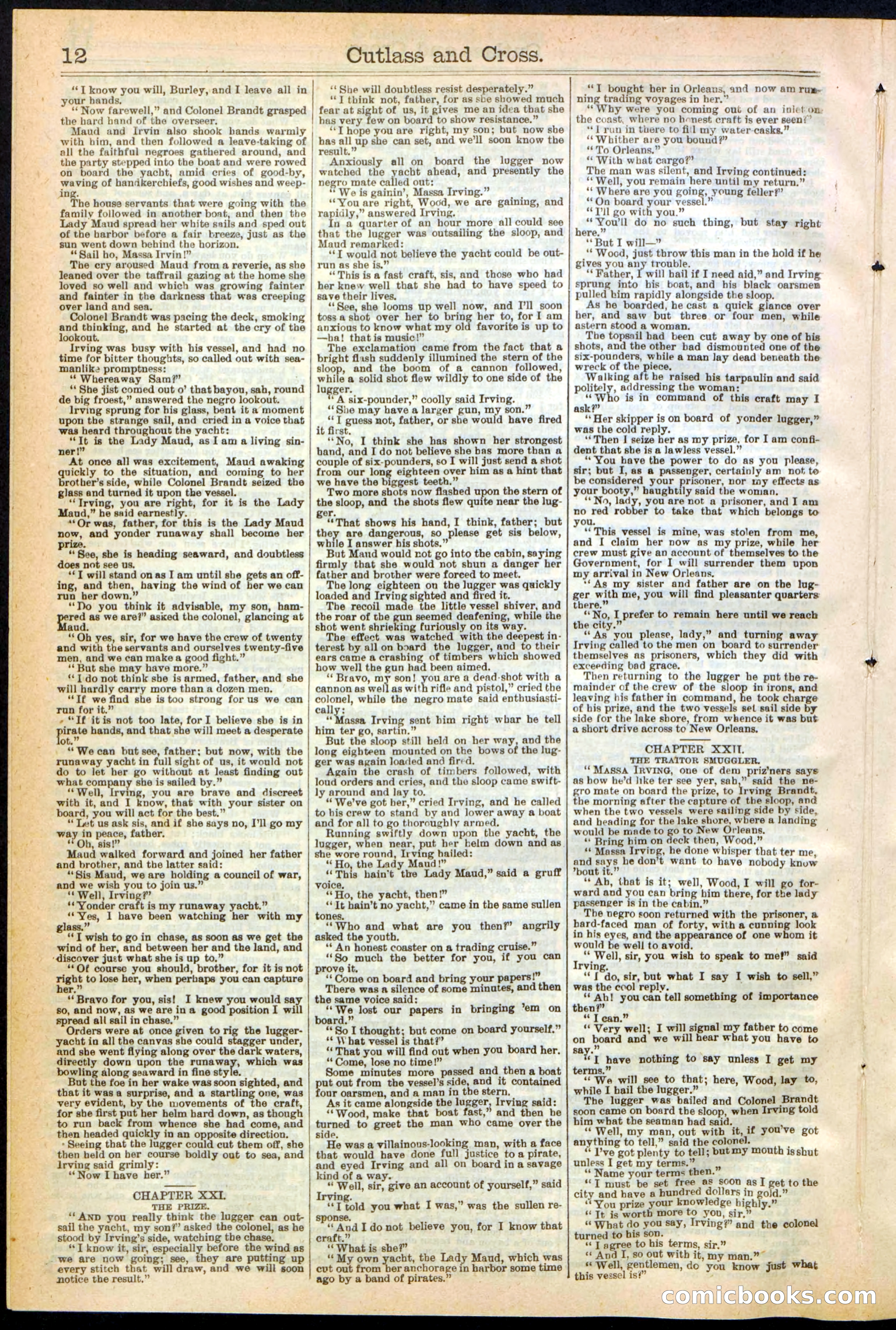
A restored page from Pulp Fiction, 1883. Page through the whole issue in the reader above.
📄 Transcribed text from this page (OCR, searchable)
Machine-transcribed from the original scan — historical spelling and the odd misread are preserved.
ed mat og 4 if ' } ; } ee - —— 7 to F ot . ¢ —* 4 "TAs ee — 4) -- i ¥; ‘a - _ yacht in all the canvas she could s we are now going; see, _ every stitch that will draw, and we will soon ‘*T know you will, Burley, and I leave all in your hands, ** Now farewell,” and Colonel Brandt grasped the hard hand of the overseer. Maud and Irvin also shook bands warmly with bim, and then followed a leave-taking of all the faithful negroes gathered around, and the party stepped into the boat and were rowed on board the yacht, amid cries of good-by, waving of handkerchiefs, good wishes and weep- An g. The house servants that were going with the family followed in another boat, and then the Lady Maud spread her white sails and sped out | of the barbor before a fair breeze, just as the sun went down behind the horizon. ** Sail ho, Massa Irvin!” The cry aroused Maud froma reverie, as she leaned over the taffrail gazing at the home she loved so well and which was growing fainter and fainter in the darkness that was creeping over land and sea. Colonel Brandt was pacing the deck, smoking and thinking, and he started at the cry of the lookout. Irving was busy with his vessel, and had no time for bitter thoughts, so called out with sea- manlike promptness: “ Whereaway Sam?” ** She jist comed out o’ that bayou, sah, round de big froest,” answered the negro lookout. Irving sprung for bis glass, bent it a moment upon the strange sail, and cried in a voice that was heard throughout the yacht: ‘*It is the Lady Maud, as I am a living sin- ner!” At once all was excitement, Maud awaking _ quickly to the situation, and coming to her brother’s side, while Colonel Brandt seized the glass and turned it upon the vessel. “Irving, you are right, for it is the Lady Maud,” he said earnestly. “Or was, father, for this is the Lady Maud now, and yonder runaway shall become her “See, she is heading seaward, and doubtless does not see us. **T will stand onas I am until she gets an off- ing, and then, having the wind of ber we can run ber down.” “Do you think it advisable, my son, ham- sad as we are?” asked the colonel, glancing at u ‘Oh yes, sir, for we have the crew of twenty and with the servants and ourselves twenty-five men, and we can make a good fight.” ‘*But she may have more.” ‘*] do not think sbe is armed, father, and she will hardly carry more than a dozen men. “Tf we find she is too strong for us we can run for it.” » “If itis not too late, for I believe sbe is in rece hands, and that she will meet a desperate ot. _ “Wecan but see, father; but now, with the runaway yacht in full sight of us, it would not do to let her go without at least finding out what pa eeny she is sailed by.” ‘*Well, Irving, you are brave and discreet with it, and I know, that with your sister on board, you will act for the best.” “ Let us ask sis, and if she says no, I'll go my way in peace, father. ** Oh, sis!” Maud walked forward and joined her father and brother, and the latter said: “Sig Maud, we are holding a council of war, and we wish you to join us.” ‘* Well, Irving?’ “Yonder craft is my runaway yacht.” is Yes, 1 have been watching her with my ‘*T wish to goin chase, as soon as we get the wind of her, and between her and the land, and ‘discover just what she is up to.” **Of course you should, brother, for it is not right to lose her, when perbaps you can capture er. ** Bravo for you, sis! I knew you would sa 80, and now, as we are ina good position I w spread all sail in chase.” Orders were at once given to rig the lugger- ger under, and she went flying along over the dark waters, directly down upon the a which was bowling along seaward in fine style. But the foe in her wake was soon sighted, and that it was a surprise, and a startling one, was very evident, by the movements of the craft, for she first put her helm hard down, as though to run back from whence she had come, and then headed quickly in an opposite direction. » Seeing that the lugger could cut them off, she then held on ber course boldly out to sea, and irving said grimly: “Now I have her.” CHAPTER XXI. THE PRIZE. ‘‘ AND you really think the lugger can out- sail the yacht, my son?” asked the colonel, as he stood by Irving’s side, watching the chase, * I know it, sir, eo the wind as ey are putting up notice the result,” eee at LLL LLL LRA LAL RRR RRR Sissel SUE > Cutlass and Cross. —_ —e —_— ‘* She will doubtless resist desperately.” ““T think not, father, for as sbe showed much fear at sight of us, it gives me an idea that she has very few on board to show resistance.” ‘*T hope you are right, my son; but now she has all up she can set, and we'll soon know the result.” Anxiously all on board the lugger now watched the yacht ahead, and presently the negro mate called out: ** We is gainin’, Massa Irving.” ‘“You are right, Wood, we are gaining, and rapidly,” answered Irving. In a quarter of an hour more all could see that the lugger was outsailing the sloop, and Maud remarked: ‘‘T would not believe the yacht could be out- run as she is.” “This is a fast craft, sis, and those who had her knew well that she had to have speed to save their lives. ‘‘See, she looms up well now, and I'll soon toss a shot over her to bring her to, for I am anxious to know what my old favorite is up to —ba! that is music!” The exclamation came from the fact that a bright flash suddenly illumined the stern of the sloop, and the boom of a cannon followed, while a solid shot flew wildly to one side of the lugger. ‘A six-pounder,” coolly said Irving. ‘‘She may have a larger gun, my son.” fs I guess not, father, or she would have fired it first. ‘‘No, I think she has shown her strongest band, and I do not believe she bas more than a couple of six-pounders, so I will just send a shot from our long eighteen over him as a hint that we have the biggest teeth.” Two more shots now flashed upon the stern of the sloop, and the shots flew quite near the lug- er. . ‘“‘That shows his hand, I think, father; but they are dangerous, so please get sis below, while I answer his shots.” But Mand would rot go into the cabin, saying firmly that she would not shun a danger her father and brother were foreed to meet. The long eighteen on the lugger was quickly loaded and Irving sighted and fired it. The recoil made the little vessel shiver, and the roar of the gun seemed deafening, while the shot went shrieking furiously on its way. The effect was watched with the deepest in- terest by all on board the lugger, and to their ears came a crashing of timbers which showed how well the gun had been aimed. , ‘Bravo, my son! you are a dead-shot with a cannon as well as with rifle and pistol,” cried the weed while the negro mate said enthusiasti- cally: “Massa Irving sent him right whar he tell him ter go, sartin.” But the sloop still held on her way, and the long eighteen mounted on the bows of the lug- ger was again loaded and fired. Again the crash of timbers followed, with loud orders and cries, and the sloop came swift- ly around and lay to. “We've got her,” cried Irving, and he called to his crew to stand by and lower away a boat and for all to go thoroughly armed. Running swiftly down upon the yacht, the lugger, when near, put her helm down and as she wore round, Irving hailed: ‘‘ Ho, the Lady Maud!” “This bain’t the Lady Maud,” said a gruff voice. ‘Ho, the yacht, then!” ‘“‘ Tt hain’t no yacht,” came in the same sullen tones. ‘‘Who and what are you then?’ angrily asked the youth. ‘** An honest coaster on a trading cruise.” ‘‘So much the better for you, if you can prove it. “ ‘‘ Come on board and bring your papers! There was a silence of some minutes, and then the same voice said: : me lost our papers in bringing ‘em on Tr . “So I thought; but come on board yourself.” ** What vessel is that?” “That you will find out when you board her. “* Come, lose no time!” Some minutes more passed and then a boat ut out from the vessel’s side, and it contained our oarsmen, and a man in the stern, As it came alongside the lugger, Irving said: ‘‘Wood, make that boat fast,” and then he turned to greet the man who came over the side. He was a villainous-looking man, with a face that would have done full justice toa pirate, and eyed Irving and all on board in a savage kind of a way. ; “ Well, sir, give an account of yourself,” said rving. ‘*T told you what I was,” was the sullen re- sponse. ‘ ‘And I do not believe you, for I know that craft.” ‘‘ What is she?” “* My own yacht, the Lady Maud, which was cut out from ber anchorage in harbor some time ago by a band of pirates.” s - - ate bought her in Orleans, and now am rum- ning trading voyages in her.” ‘“Why were you coming out of an inlet om the coast, where no honest craft is ever seen!’ ‘*] run in there to fill my water-casks.” ‘Whither are you bound?” ** To Orleans.” * ‘With what cargo?” The man was silent, and Irving continued: ‘* Well, you remain here until my return.” ‘* Where are you going, young feller?” **On board your vessel.” “Til go with you.” “You'll do no such thing, but stay right here.” ‘But I will—” _““ Wood, just throw this man in the hold if he gives you any trouble. “* Father, 1 will bail if I need aid,” and Irving sprung into bis boat, and his black oarsmen pulled bim rapidly alongside the sloop. As he boarded, he cast a quick glance over her, and saw but three or four men, while astern stood a woman. The topsail had been cut away by one of bis shots, and the other bad dismounted one of the six-pounders, while a man lay dead beneath the wreck of the piece, Walking aft he raised bis tarpaulin and said a addressing the woman: Ne o is in command of this craft may I as ‘‘Her skipper is on board of yonder lugger,” was the cold reply. ‘*Then I seize her as my prize, for I am confi- dent that she is a Jawless vessel,” “You have the power to do as you please, sir; but I, as a passenger, certainly am not te be considered your prisoner, nor my effects as your booty,” baugbtily said the woman. ‘* No, lady, you are not a prisoner, and I am no red robber to take that which belongs to you. ‘‘This vessel is mine, was stolen from me, and I claim her now as my prize, while her crew must give an account of themselves to the Government, for I will surrender them upon my arrival in New Orleans. ‘‘As my sister and father are on the lug- ger with me, you will find pleasanter quarters there.” ‘No, I prefer to remain here until we reach the city.” * As you please, lady,” and turning away Irving called to the men on board to surrender themselves as prisoners, which they did with exceeding bad grace. Then returning to the lugger he put the re- mainder of the crew of the sloop in irons, and leaving his father in command, he took charge of his prize, and the two vessels set sail side by side for the lake shore, from whence it was but a short drive across to New Orleans, CHAPTER XXIT. THE TRAITOR SMUGGLER. ‘MASSA IRVING, one of dem priz’ners says as how he’d like ter see yer, sab,” said the ne- gro mate on board the prize, to Irving Brandt, the morning after the capture of the sloop, and when the two vessels were sailing side by side, and beading for the lake shore, where a landing would be made to go to New Orleans. ‘* Bring him on deck then, Wood.” ‘¢ Massa Irving, he done whisper that ter me, and says he don’t want to have nobody know *bout it.” rect ‘* Ab, that is it; well, Wood, I will go for- ward and you can bring him there, for the lady passenger is in the cabin.” The uegro soon returned with the prisoner, a bard-faced man of forty, with a cunning look in his eyes, and the sepearen of one whom it would be well to avoid. ‘“* Well, sir, you wish to speak to me?” said Irving. ‘{ do, sir, but what I say I wish to sell,” was the cool reply. ‘* Ah! you can tell something of importance then?” “Very well; I will signal my father to come on board and we will hear what you have to sa dd z, I have nothing to say unless I get my terms. ‘‘ We will see to that; here, Wood, lay to, while I bail the lugger.” The lugger was bailed and Colonel Brandt soon came on board the sloop, when Irving told him what the seaman had said. . “ Well, my man, out with it, if you've got anything to tell,” said the colonel. ' “ lve got plenty to tell; but my mouth is shut unless I get my terms.” ‘‘ Name your terms then. ‘“T must be set free as soon as I get to the city and have a hundred dollars in gojd.” “You prize your knowledge highly.” ‘Tt is worth more to you, sir,” “ What do you say, Irving?’ and the colonel turned to bis son. “ | agree to his terms, sir.” « And I, so out with it, my man.”” * Well, gentlemen, do you know just what this vessel is?” AMUCe . (E() a of Bu Seiaie @) a