
Pulp Fiction, 1883 · page 9 of 32
Beadle's Dime Library No. 247 — page 9: what you’re looking at
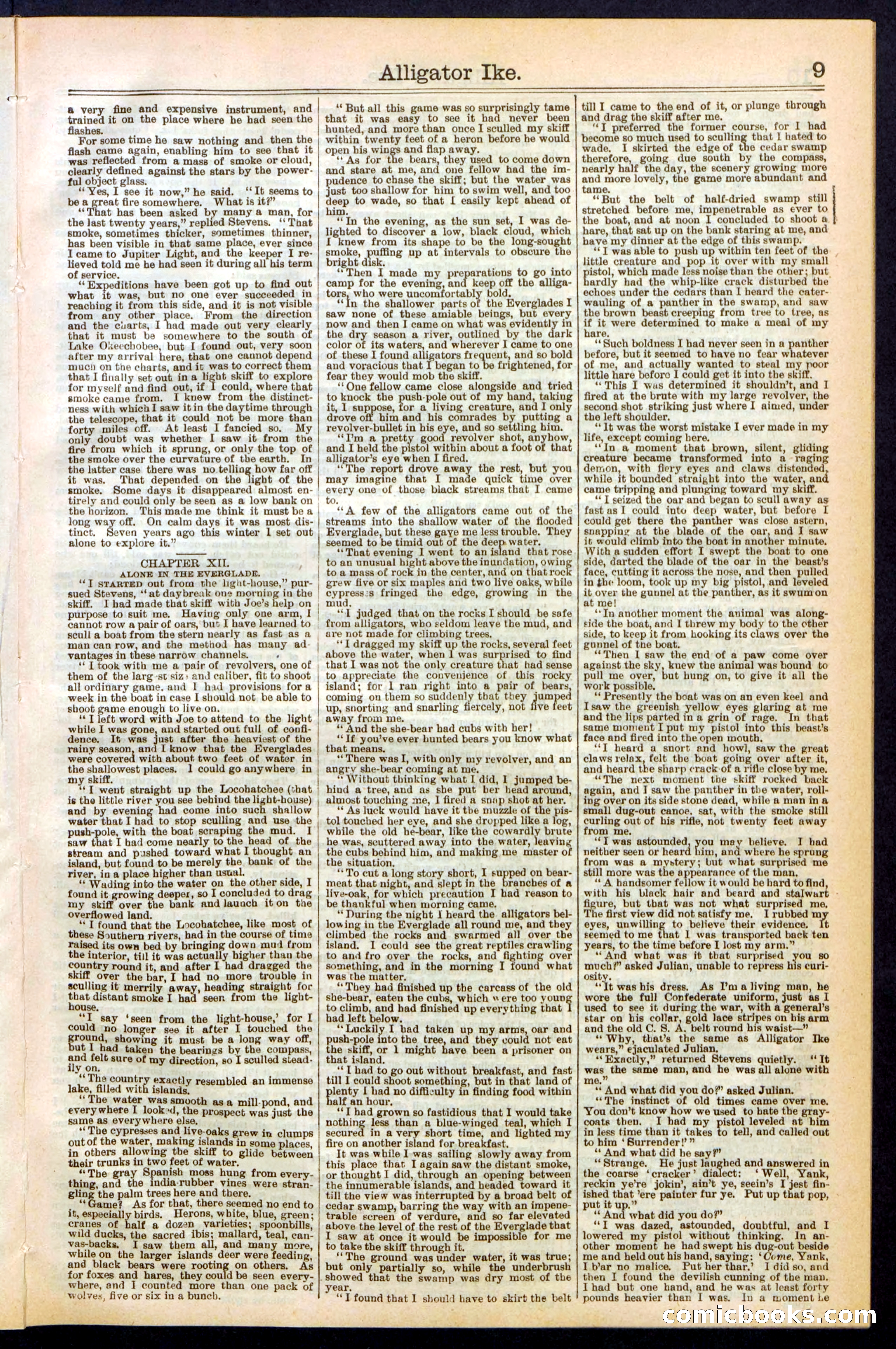
A restored page from Pulp Fiction, 1883. Page through the whole issue in the reader above.
📄 Transcribed text from this page (OCR, searchable)
Machine-transcribed from the original scan — historical spelling and the odd misread are preserved.
a very fine and expensive instrument, and trained it on the place where he had seen the flashes. For some time he saw nothing and then the flash came again, enabling him to see that it was reflected from a mass of smoke or cloud, clearly defined against the stars by the power- ful object glass. “Yes, I see it now,” he said. ‘‘It seems to be a great fire somewhere. What is it?” “That has been asked by many @ man, for the last twenty years,” replied Stevens. “ That smoke, sometimes thicker, sometimes thinner, has been visible in that same place, ever since Icame to Jupiter Light, and the keeper I re- lieved told me he had seen it during all his term of service. ‘* Expeditions have been got up to find out what it was, but no one ever succeeded in reaching it from this side, and it is not visible from any other place. From the direction and the cuarts, I had made out very clearly that it must be somewhere to the south of Lake Okecchobee, but I found out, very soon after my arrival here, that one cannot depend much on the charts, and in was to correct them that I finally set out in a 7. skiff to explore for myself and find out, if 1 could, where that smoke came from. I knew from the distinct- ness with which I saw itin the coecee through the telescope, that it could not be more than forty miles off. At least I fancied so. My only doubt was whether I saw it from the fire from which it sprung, or only the top of the smoke over the curvature of the earth. In the latter case there was no seting how far off it was. That depended on the light of the smoke, Some days it disappeared almost en- tirely and could only be seen as a low bank on the horizon. This made me think it must be a | | | Alligator Ike. “But all this game was so surprisingly tame that it was easy to see it had never been hunted, and more than once I sculled my skiff within twenty feet of a heron before he would open his wings and flap away. ‘‘ As for the bears, they used to come down and stare at me, and one fellow had the im- pudence to chase the skiff; but the water was just too shallow for him to swim well, and too deep to wade, so that [ easily kept ahead of him. ‘‘In the evening, as the sun set, I was de- lighted to discover a low, black cloud, which I knew from its shape to be the long-sought smoke, puffing up at intervals to obscure the bright disk. “Then I made my preparations to go into camp for the evening, and keep off the alliga- tors, who were uncomfortably bold, ‘In the shallower parts of the Everglades I saw none of these amiable beings, but every now and then I came on what was cig veg in the dry season a river, outlined by the dark color of its waters, and wherever I came to one of these I found alligators frequent, and so bold and voracious that 1 began to frightened, for fear they would mob the skiff. ‘‘One fellow came close alongside and tried to knock the push-pole out of my hand, taking it, 1 suppose, for a living creature, and I only drove off him and his comrades by putting a revolver-bullet in bis eye, and so settling him. ‘‘l’m a pretty good revolver shot, anyhow, and I held the pistol within about a foot of that alligator’s eye when I fired. ‘The report drove away the rest, but you may imagine that I made quick time over every one of those black streams that I came to. ‘‘A few of the alligators came out of the long way off. On calm days it was most dis- | streams into the shallow water of the flooded tinct. Seven years ago this winter 1 set out alone to explore it.” CHAPTER XIL. ALONE IN THE EVERGLADE. | “‘T sTartep out from the light-house,” pur- | sued Stevens, ‘fat daybreak one morning in the | skiff. purpose to suit me. Having only one arm, I cannot row a pair of oars, but I have learned to scull a boat from the stern nearly as fast as a man can row, and the method has many ad vantages in these narrow channels. ‘ ‘‘T took with me a pair of revolvers, one of them of the larg st siz: and caliber, fit to shoot all ordinary game, and | had provisions fora week in the boat in case I should not be able to shoot game enough to live on. ‘I left word with Joe to attend to the light while I was gone, and started out full of confi- dence. It was just after the heaviest of the rainy season, and I know that the Everglades were covered with about two feet of water in the shallowest places. 1 could go anywhere in my skiff. ‘*T went straight up the Locohatchee (‘hat is the little river you see behind the agesie Bouse) and by evening had come into such shallow water that I had to stop sculling and use the push-pole, with the boat seraping the mud. I saw that I bad come nearly to the head of the stream and pushed toward what I thought an island, but found to be merely the bank of the river, in a place higher than usual. i ‘“‘ Wading into the water on the other side, I found it growing deeper, so I concluded to drag my skiff over the bank and launch ifon the overflowed land. ' ‘* T found that the Locohatchee, like most of these Southern rivers, had in the course of time raised its own bed by bringing down mud from the interior, till it was actually higher than the country round it, and after 1 had dragged the over the bar, I had no more trouble in sculling it merrily away, heading straight for that distant smoke I had seen from the light- ouse, “I say ‘seen from the light-house,’ for I could no longer see it after I touched the gr ound, showing it must be a long way off, ut I had taken the bearings by the compass, a sure of my direction, so I sculled stead- ** The countr lake, filled wit exactly resembled an immense islands, The water was smooth asa mill-pond, and everywhere I looked, the prospect was just the et o everywhere bm ‘The cypresses and live-oaks grew in clum out of the water, making islands in some Sas. in others allowing the skiff to glide between their trunks in I Ne feet of gi “The gray nish moss hung from every- thing, and the a oh op vines were strane gling the palm trees here and there, _ “Game? As for that, there seemed no end to it, especially birds. Herons, white, blue, green; cranes of half a dozen varieties; spoonbills, wild ducks, the sacred ibis; mallard, teal, can- vas-backs, I saw them all, and many more, while on the larger islands deer were feeding, and black bears were rooting on others. As for foxes and hares, they could be seen every- where, and I counted more than one pack of wolves, five or six in a buncb. I had made that skiff with Joe’s help on |, i ] i Everglade, but these gaye me less trouble. They seemed to be timid out of the deep water. ‘That evening I went to anisland that rose to an unusual hight above the inundation, owin to a mass of rock in the center, and on that roc grew five or six maples and two live oaks, while cypresses fringed the edge, growing in the mud, ‘*] judged that on the rocks I should be safe from alligators, who seldom leave the mud, and are not made for climbing trees, ‘‘| dragged my skiff up the rocks, several feet above the water, when 1 was surprised to find that I was not the only creature that had sense to appreciate the convenience of this rocky island; for 1 ran right into a pair of bears, coming on them so suddenly that they Apnpes up, snorting and snarling fiercely, not five feet away from me. ** And the she-bear had cubs with her! ‘“‘If you’ve ever hunted bears you know what that means. ‘There was I, with only my revolver, and an angry she-bear coming at me. * Without thinking what I did, I jumped be- hind a tree, and as sbe put ber head around, almost touching me, I fired a snap shot at her. ‘** As luck would have it the muzzle of the pis- tol touched her eve, and she dropped like a log, while the old he-bear, like the cowardly brute he was, scuttered away into the water, leaving the cubs behind him, and making me master of the situation. “To cut a long story short, I supe on bear- meat that night, and slept in the branches of a live-oak, for which precaution I had reason to be thankful when morning came. “During the night 1 heard the alligators bel- lowing in the Everglade all round me, and they climbed the rocks and swarmed all over the island. I could see the great reptiles crawling to and fro over the i and fighting over something, and in the morning I found what was the matter. “They had finished up the carcass of the old she-bear, eaten the cubs, which » ere too youn to climb, and had finished up everything that had left below. ‘Luckily I bad taken up my arms, oar and posnpole into the tree, and they vould not eat he skiff, or 1 might have been a prisoner on that island. _“*Lhad to go out without breakfast, and fast till I could shoot something, but in that land of plenty: { had no difficulty in finding food within alf an hour, ‘I had grown so fastidious that I would take nothing less than a blue-winged teal, which I secured in a very short time, and lighted my fire on another island for breakfast. It was while I was sailing slowly away from this place that I again saw the distant smoke, or thought I did, through an opening between the innumerable islands, and headed toward it till the view was interrupted by a broad belt of cedar swamp, barring the way with an impene- trable screen of verdure, and so far elevated above the level of the rest of the Everglade that I saw at once it would be impossible for me to take the skiff through it. ; ‘The ground was under water, it was true; but only partially so, while the underbrush showed that the swamp was dry most of the year. “I found that 1 should have to skirt the belt yy L-_ till I came to the end of it, or plunge through and drag the skiff after me. “T preferred the former course, for I had become so much used to sculling that 1 hated to wade. I skirted the edge of the cedar swamp therefore, going due south by the compass, nearly half the day, the scenery growing more and more lovely, the game more abundant and tame. ‘‘But the belt of half-dried swamp still stretched before me, impenetrable as ever to the boat, and at noon I concluded to shoot a } hare, that sat up on the bank staring at me, and have my dinner at the edge of this swamp. ‘‘T was able to push up within ten feet of the | little creature and pop it over with my small istol, which made less noise than the other; but ardly had the whip-like crack disturbed the echoes under the cedars than I heard the cater- wauling of a panther in the swamp, and saw the brown beast creeping from tree to tree, as 3 it were determined to make a meal of my are. ‘*Such boldness I bad never seen jn a panther before, but it seemed to have no fear whatever of me, and actually wanted to steal my poor little hare before I could get it into the skiff, ‘This I was determined it shouldn’t, and I fired at the brute with my large revolver, the second shot striking just where I aimed, under the left shoulder. ‘It was the worst mistake I ever made in my life, except coming bere. ‘‘In a moment that brown, silent, gliding creature became transformed into a raging demon, with fiery eyes and claws distended while it bounded straight into the water, an came tripping and plunging toward my skiff. ‘‘T seized the oar and began to scull away as fast as I could into deep water, but before I could get there the panther was close astern, snapping at the blade of the oar, and I saw it would climb into the boat in another minute. With a sudden effort I swept the boat to one side, darted the blade of the oar in the beast’s face, cutting it across the nose, and then pulled in the loom, took up my big pistol, and leveled it over the gunnel at the panther, as it swumon at me! ‘‘In another moment the animal was along- side the boat, and I threw my body to the other side, to keep it from hooking its claws over the gunnel of the boat. “‘Then 1 saw the end of a paw come over against the sky, knew the animal was bound to pull me over, but hung on, to give it all the work possible, ** Presently the boat was on an even kee] and Isaw the greenish yellow eyes glaring at me and the lips parted in a grin of rage. In that same moment I put my pistol into this beast’s face and fired into the open mouth, “‘T heard a snort and howl, saw the great claws relax, felt the boat going over after it, and heard the sharp crack of a rifle close by me. “The next moment the skiff rocked back again, and I saw the panther in the water, roll- ing over on its side stone dead, while a man ina small dug-out canoe, sat, with the smoke still curling out of his rifle, not twenty feet away from me. ‘““T was astounded A mey believe. I bad neither seen or heard him, and where he sprong from was a mystery; but what surprised me still more was the appearance of the man, ‘* A handsomer fellow it w ould be hard to find with his black hair and beard and stalwart . Sa but that was not what surprised me, e first view did not satisfy me. I rubbed m eyes, unwilling to believe their evidence. It seemed to me that 1 was transported back ten years, to the time before I lost my arm.” “And what was it tbat surprised you so much?” asked Julian, unable to repress his curi- osity. Olt was his dress. As I’ma living man, he wore the full Confederate uniform, just as used to see it during the war, with a general’s star on his collar, gold Jace stripes on bis arm and the old C. 8. A. belt round his waist—” ‘Why, that’s the same as Alligator Ike wears,” ejaculated Julian, ‘*Exactly,” returned Stevens quietly. ‘It was the same man, and he was all alone with e, ** And what did you do?” asked Julian. “The instinct of old times came over me. ‘You don’t know how we used to bate the gray- coats then. I had my pistol leveled at him in less time than it takes to tell, and called out to him ‘ Surrender!’ ” “‘ And what did he say?” “Strange. He just laughed and answered in the coarse ‘cracker’ dialect: ‘ Well, Yank, reckin ye’re jokin’, ain’t ye, seein’s I jest fin- ished that ’ere painter fur ye. Put up that pop, - put it se ‘‘ And what did you do?” “IT was dazed, astounded, doubtful, and I lowered my — without thinking. In an- other moment he had swept his dug-out beside me and held out his hand, saying: ‘Come, Yank, I b’ar no malice. Put her thar,’ I did so, and then I found the devilish cunning of the man. I had but one hand, and he was at least forty pounds heavier than I was. In a moment Le Comichbooks e : en ww E