
Pulp Fiction, 1883 · page 7 of 32
Beadle's Dime Library No. 247 — page 7: what you’re looking at
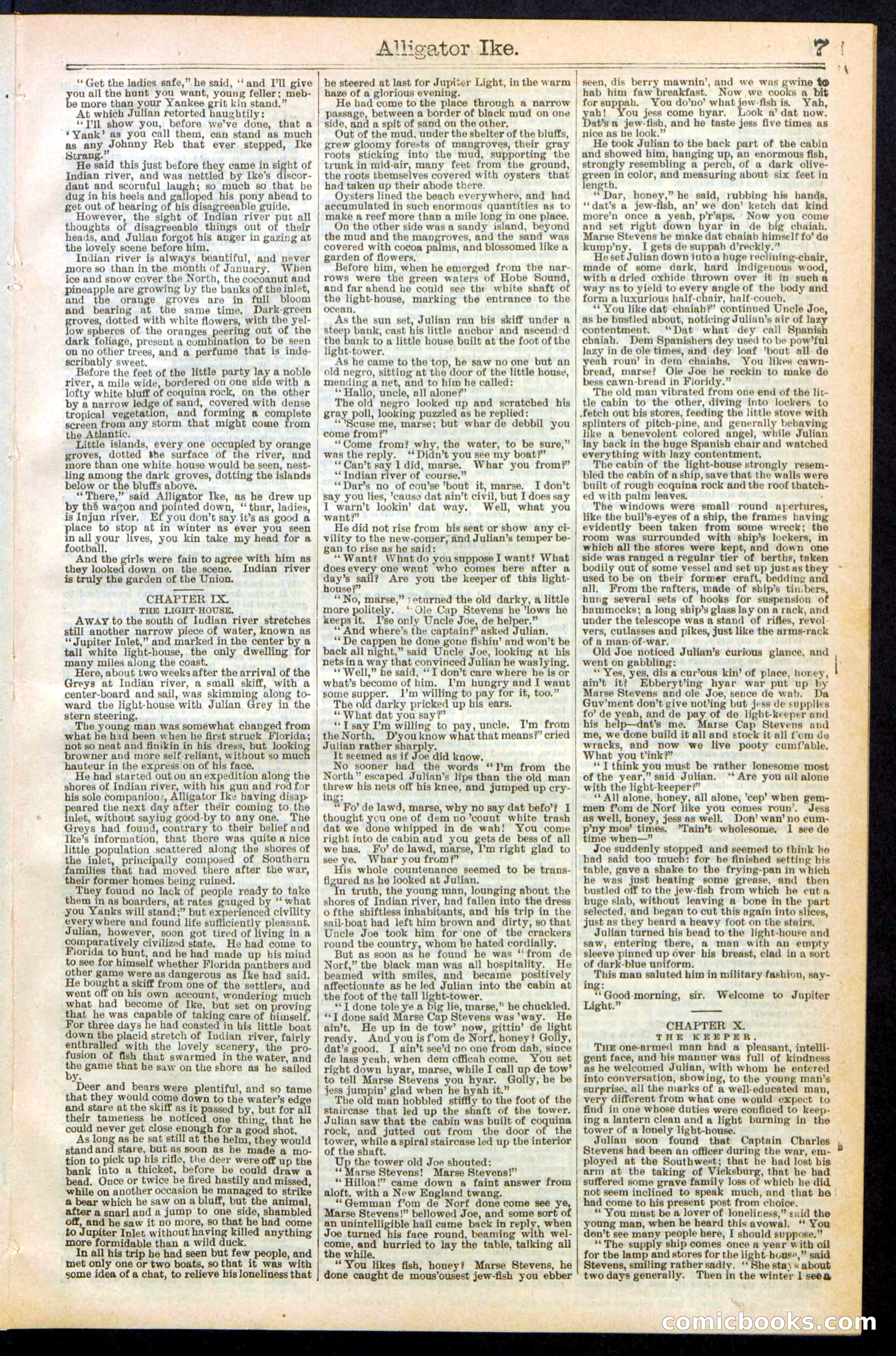
A restored page from Pulp Fiction, 1883. Page through the whole issue in the reader above.
📄 Transcribed text from this page (OCR, searchable)
Machine-transcribed from the original scan — historical spelling and the odd misread are preserved.
< Ye. -———_————™”~ a=—_ --—-— ——— ——__---- —-—_—_ ‘‘ Get the ladies safe,” he said, ‘‘and I’ll give ou all the hunt you want, young feller; meb- e more than your Yankee grit kin stand.” At which Julian retorted haughtily: ‘“TJL show you, before we’ve done, that a ‘Yank’ as you call them, can stand as much as any Johnny Reb that ever stepped, Ike Strang.” He said this just before they came in sight of Indian river, and was nettled by Ike’s discor- dant and scornful laugh; so much so that he dug in his heels and galloped his pony ahead to get out of hearing of his disagreeable guide. However, the sight of Indian river put all thoughts of disagreeable things out of their heads, and Julian forgot his anger in gazing at the lovely scene before him, Indian river is always beautiful, and never more so than in the month of January. When ice and snow cover the North, the cocoanut and pineapple are growing by the banks of the inlet, and the orange groves are in full bloom and bearing at the same time, Dark-green groves, dotted with white flowers, with the yel- low spberes of the oranges peering out of the dark foliage, present a combination to be seen on no other trees, and a perfume that is inde- scribably sweet. Before the feet of the little party lay a noble river, a mile wide, bordered on one side with a lofty white bluff of coquina rock, on the other Alligator Ike. gett ¢ a we mere —— ooo he steered at last for Jupiter Light, in the warm | seen, dis berry mawnin’, and we was gwine % haze of a glorious evening. He had come to the place through a narrow passage, between a border of black mud on one side, and a spit of sand on the other. Out of the mud, under the shelter of the bluffs, grew gloomy forests of mangroves, their gray roots sticking into the mud, supporting the trunk in mid-air, many feet from the ground, the roots themselves covered with oysters that had taken up their abode there. Oysters lined the beach everywhere, and had accumulated in such enormous quantities as to make a reef more than a mile long in one place. On the other side was a sandy island, beyond | the mud and the mangroves, and the sand was covered with cocoa palms, and blossomed like a garden of flowers. Before him, when he emerged from the nar- rows were the green waters of Hobe Sound, and far ahead he could see the white shaft of | the light-house, marking the entrance to the by a narrow ledge of sand, covered with dense | tropical vegetation, and forming a complete screen from any storm that might come from the Atlantic. Little islands, every one occupied by orange groves, dotted the surface of the river, and more than one white house would be seen, nest- ling among the dark groves, dotting the islands below or the bluffs above. “There,” said Alligator Ike, as he drew up by thS wagon and pointed down, “ thar, ladies, is Injun river, Ef you don’t say it’s as good a place to stop at in winter as ever you seen in all your lives, you kin take my head for a football, And the girls were fain to agree with him as they Lanieadl dinaktt on the scene. Indian river is truly the garden of the Union. CHAPTER IX. THE LIGHT-HOUSE, Away to the south of Indian river stretches still another narrow piece of water, known as * Jupiter Inlet,” and marked in the center by a tall white light-house, the only dwelling for many miles along the coast. Here, about two weeks after the arrival of the Greys at Indian river, a small skiff, with a center-board and sail, was skimming along to- ward the light-house with Julian Grey in the stern steering. The young man was somewhat changed from what he had been when he first struck Florida; not so neat and finikin in his dress, but lookin browner and more self-reliant, without so muc hauteur in the express on of his face, He had started out on an expedition along the shores of Indian river, with his gun and rod for his sole companion:, Alligator Ike having disap- ared the next day after their coming to the nlet, without saying good-by to any one. The Greys had found, contrary to their belief and Ike’s information, that there was quite a nice little population scattered along the shores of the inlet, principally composed of Southern families that had moved there after the war, their former homes being ruined. They found no lack of people ready to take them in as boarders, at rates gauged by ‘ what you Yanks will stand;” but experienced civility every where and found life sufficiently pleasant. Julian, however, soon got tired of living in a comparatively civilized state. He had come to Fiorida to hunt, and he had made up his mind to see for himself whether Florida pantbers and other game were as dangerous as lke had said. He bought a skiff from one of the settlers, and went off on his own account, wondering much what had become of Ike, but set on provin that he was a of taking care of himself. For three days he had coasted in bis little boat down the placid stretch of Indian river, fairly enthralled with the lovely scenery, the pro- fusion of fish that swarmed in the water, and es game that he saw on the shore as he sailed y Deer and bears were plentiful, and so tame that they would come down to the water’s edge and stare at the skiff as it passed by, but for all their tameness he idticed one thing, that he could never get close enough for a good shot. As long as he sat still at the helm, they would stand and stare, but as soon as he made a mo- tion to pick up bis rifle, the deer were off up the bank into a thicket, before be could draw a bead. Ounce or twice be fired hastily and missed, while on another occasion be managed to strike a bear which he saw on a bluff, but the animal after a snarl and a jump to one side, shambled off, and he saw it no more, so that he had come to Jupiter Inlet without having killed anything more formidable than a wild duck. In all his trip he had seen but few people, and met only one or two boats, sothat it was with some idea of a chat, to relieve his loneliness that ocean, As the sun set, Julian ran bis skiff under a rh bank, cast his little anchor and ascended the bank to a little house built at the foot of the light-tower. As he came to the top, he saw no one but an old negro, sitting at the door of the little house, mending a net, and to him he called: ‘** Hallo, uncle, all alone?’ The old negro looked up and scratched his gray poll, looking puzzled as he replied: ‘***Scuse me, marse; but whar de debbil you come from?” “Come from? why, the water, to be sure,” was the reply. ‘‘ Didn’t you see my boat?” **Can’t say 1 did, marse. Whar you from?” ‘Indian river of course.” ‘*Dar’s no of cou’se bout it, marse. I don’t say you lies, ’cause dat ain’t civil, but I does say 1 warn’t lookin’ dat way. Well, what you want?” He did not rise from his seat or show any ci- | vility to the new-comer,; and Julian’s temper be- gan to rise as he said: ‘“Want? Whatdo you suppose I want? What does oyety one want who comes here after a day’s sail? Are you the keeper of this light- house?” **No, marse,” } eturned the old darky, a little more politely. ‘ Ole Cap Stevens he ‘lows he keepsit. L’se only Uncle Joe, de helper.” ‘“ And where’s the captain?” asked Julian. ‘“* De cappen he done gone fishin’ and won’t be back all night,” said Uncle Joe, looking at his netsina way that convinced Julian he waslying. ‘** Well,” he said, *‘ I don’t care where he is or what’s become of him. U’m hungry and I want some supper. 1’m willing to pay for it, too.” The old darky pricked up bis ears. ‘* What dat you say?” ‘Tsay I’m willing to pay, uncle. I’m from the North. D’youknow what that means?” cried Julian rather sharply. It seemed as if Joe did know. No sooner had the words “I’m from the North” escaped Julian’s lips than the old man threw bis nets off his knee, and jumped up cry- ing: * Fo’ de lawd, marse, why no say dat befo’? I thought you one of dem no’count white trash dat we done whipped in de wah! right into de cabin and you gets de bess of all we bas. Fo’ de lawd, marse, I’m right glad to see ye, Whar you from?” His whole countenance seemed to be trans- figured as he looked at Julian. In truth, the young man, lounging about the shores of Indian river, had fallen into the dress ofthe shiftless inhabitants, and bis trip in the sail-boat had left him brown and dirty, so that Uncle Joe took him for one of the crackers round the country, whom be hated cordially, But as soon as he found he was ‘‘from de Norf,” the black man was all hospitality. He beamed with smiles, and became positively affectionate as he led Julian into the cabin at the foot of the tall light-tower. ‘**T done tole ye a big lie, marse,” he chuckled. ‘*T done said Marse Cap Stevens was’way. He ain’t. He up in de tow’ now, gittin’ de light ready. And you is f’om de Norf, honey? Golly, dat’s good. I ain’t see’d no one from dah, since de lass yeah, when dem officah come, You set right down hyar, marse, while I call up de tow’ to tell Marse Stevens you hyar. Golly, he be jess jumpin’ glad when he byah it.” The old man hobbled stiffly to the foot of the staircase that led up the shaft of the tower. Julian saw that the cabin was built of coquina rock, and jutted out from the door of the tower, while a spiral staircase led up the interior of the shaft. Up the tower old Joe shouted: ** Marse Stevens! Marse Stevens!” * Hilloa!” came down a faint answer from aloft, with a New England twang. ““Gemman f’om de Norf done come see ye Marse Stevens!” bellowed Joe, and some sort o an unintelligible hail came back in reply, when Joe turned his face round, beaming with wel- ne ee and hurried to lay the table, talking all e while. “You likes fish, honey? Marse Stevens, he done caught de mous’ousest jew-fish you ebber | } | | You come | | a hab him faw breakfast. Now we cooks a bit for suppah. You do’no’ what jew-fish is. Yah, yab! ou jess come hyar. ook a’ dat now. at’s a jew-fish, and he taste jess five times as nice as be look.” He took Julian to the back part of the cabin and showed him, hanging up, an enormous fish, strongly resembling a perch, of a dark olive- green in color, and measuring about six feet in length. **Dar, honey,” he said, rubbing his hands, ‘‘dat’s a jew-fish, an’ we don’ ketch dat kind more’n once a yeah, p’r’aps. Now you come and set rigut down byar in de big chaiah, Marse Stevens he make dat chaiah himself fo’ de kump’ny. I gets de suppah d’reckly.” He set Julian down intoa buge reclining-chair, made of some dark, hard indigenous wood, with adried oxbide thrown over it in sucha way as to yield to every angle of the body and form a luxurious half-chair, half-couch, ** You like dat chaiah?’ continued Uncle Joe, as he bustled about, noticing Julian’s air of lazy contentment. ‘Dat what dey call Spanish chaiah. Dem Spanishers dey used to be pow’ful lazy in de ole times, and dey loaf ‘bout all de eah roun’ in dem chaiahs. You likes cawn- oread, marse? Ole Joe he reckin to make de bess cawn-bread in Floridy.” The old man vibrated from one end of the lit- tle cabin to the other, diving into lockers to fetch out bis stores, feeding the little stove with splinters of pitch-pine, and generally bebaving like a benevolent colored angel, while Julian lay back in the huge Spanish chair and watched everything with mast contentment. The cabin of the light-house strongly resem- bled the cabin of aship, save that the walls were built of rough coquina rock and the roof thatch- ed with palm leaves. ' The windows were small round apertures, like the bull’s-eyes of a ship, the frames having evidently been taken from some wreck; the room was surrounded with ship’s lockers, in which all the stores were kept, and down one side was ranged a regular tier of berths, taken bodily out of some vessel and set up just as they used to be on their former craft, bedding and all, From the rafters, made of ship’s tin, bers hung several sets of hooks for suspension of hammocks; a long ship’s glass lay on a rack, and under the telescope was a stand of rifles, revol vers, cutlasses and pikes, just like the arms-rack of a man-of-war. Old Joe noticed Julian’s curious glance, and went on gabbling: “Yes, yes, dis a cur’ous kin’ of place, honey, ain’t it? Ebberyt’ing hyar war put up by Marse Stevens and ole Joe, sence de wah. Da Guv’ment don’t give not’ing but jess de supplies fo’ de yeah, and de pay. of de light-keeper and his he p—dat’s me. arse Cap Stevens and me, we done build it all and stock it all fom de wracks, and now we live pooty cumf’able, What you tink?” ‘*] think you must be rather lonesome most of the year,” said Julian. ‘‘ Are you all alone with the light-keeper?” ‘* All alone, honey, all alone, ’cep’ when gem- men f’om de Norf like you comes roun’. Jess as well, honey, jess as well. Don’ wan’ no cum- p’ny mos’ times, ’Tain’t wholesome, 1 see de time when—” Joe suddenly stopped and seemed to think he had said too much: for he finished setting his table, gave a shake to the frying-pan in which he was just beating some grease, and then bustled off to the jew-fish from which he cut a buge slab, without leaving a bone in the part selected, and began to cut this again into slices, just as they beard a heavy foot on the stairs, Julian turned his bead to the light-house and saw, entering there, a man with an empty sleeve pinned up over his breast, clad in a sort of dark-blue uniform. _ This man saluted him in military fashion, say- ing: ‘*Good-morning, sir. Welcome to Jupiter Light.” CHAPTER X. THE KEEPER. THE one-armed man had a pleasant, intelli- gent face, and his manner was full of kindness as he welcomed Julian, with whom he entered into conversation, showing, to the young man’s surprise, all the marks of a well-educated man, very different from what one would expect to find in one whose duties were confined to keep- ing a lantern clean and a light burning in the tower of a lonely light-house. Julian soon found that Captain Charles Stevens had been an officer during the war, em- ployed at the Southwest; that he had lost bis arm at the taking of Vieksburg, that he had suffered some grave family loss of which he did not seem inclined to speak much, and that he had come to his present post from choice. “You must be a lover of loneliness,” suid the | young man, when he heard this avowal. ‘ You don’t see many people here, I should suppose.” ‘*The supply ship comes once a year with oil for the lamp and stores for the light-hous9,” said Stevens, smiling rather sadly. ‘‘ She sta) « about two days generally. Then in the winter 1 seea ebooks (E(0) m