
Pulp Fiction, 1883 · page 5 of 32
Beadle's Dime Library No. 247 — page 5: what you’re looking at
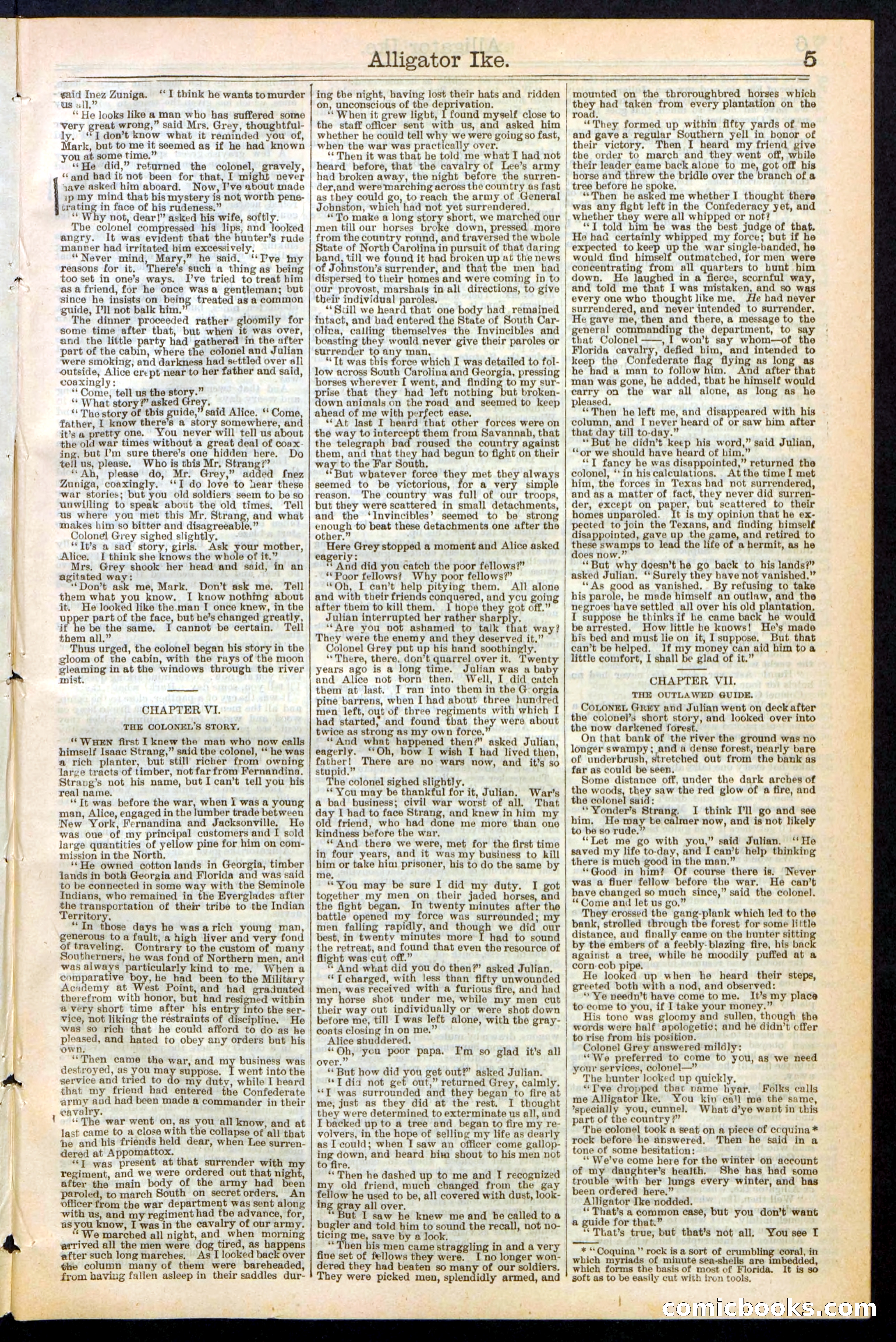
A restored page from Pulp Fiction, 1883. Page through the whole issue in the reader above.
📄 Transcribed text from this page (OCR, searchable)
Machine-transcribed from the original scan — historical spelling and the odd misread are preserved.
an r gaid Inez Zuniga. ‘I think he wants tomurder us ull,” ‘‘ He looks like a man who has suffered some very great wrong,” said Mrs, Grey, thoughtful- ly. “I don’t know what it reminded you of, Mark, but to me it seemed as if he had known you at some time.” ‘‘He did,” returned the colonel, gravely, ‘‘and bad it not been for that, I might never save asked him aboard. Now, I’ve about made ip my mind that bis mystery is not worth pene- trating in face of his rudeness.” ‘* Why not, dear!” asked his wife, softly. The colonel compressed his lips, and looked angry. It was evident that the hunter’s rude manner had irritated bim excessively. “Never mind, Mary,” he said. ‘I’ve my reasons for it. There’s such a thing as being too set in one’s ways. I’ve tried to treat him as a friend, for he once wasa gentleman; but since he insists on being treated as a common guide, [ll not balk him.’ The dinner proceeded rather’ gloomily for some time after that, but when it was over, and the little party had gathered in the after part of the cabin, where the colonel and Julian were smoking, and darkness had settled over all outside, Alice crept near to her father and said, coaxingly: ‘Come, tell us the story.” ‘ What story?” asked Grey, ‘‘ The story of this guide,’ said Alice. ‘* Come, father, I know there’s a story somewhere, and it’s a pretty one. You never will tell us about the old war times without a great deal of coax ing, but ’m sure there’s one hidden here. Do tell us, please. Who is this Mr, Strang?’ **Ah, please do, Mr. Grey,” added fnez Zuniga, coaxingly. ‘I do love to hear these war stories; but you old soldiers seem to be so unwilling to speak about the old times. ‘Tell us where you met this Mr. Strang, and what makes him so bitter and disagreéable,” Colonel Grey sighed slightly, “It’s a sad story, girls. Ask your mother, Alice. I think she knows the whole of it.” Mrs, Grey shook her head and said, in an agitated way: ‘*Don’t ask me, Mark. Don’t ask me. Tell them what you know. I know nothing about it. He looked like the.man I once knew, in the upper part of the face, but he’s changed greatly, if he be the same, I cannot be certain. Tell them all.” Thus urged, the colonel began his story in the gloom of the cabin, with the rays of the moon gleaming in at the windows through the river mist. CHAPTER VI. THE COLONEL’S STORY. ‘“ Wuen first [knew the man who now calls himself lsaac Strang,” said the colonel, ‘* he was a rich planter, but still richer from owning large tracts of timber, not far from Fernandina. Strapg’s not his name, but 1 can’t tell you his real name, ‘‘Tt was before the war, when I was a young man, Alice, engaged in the lumber trade between New York, Fernandina and Jacksonville. He was one of my principal customers and I sold large quantities of yellow pine for him on com- mission in the North, : ‘*He owned cotton lands in Georgia, timber lands in both Georgia and Florida and was said to be connected in some way with the Seminole Indians, who remained in the Everglades after the transportation of their tribe to the Indian Territory. “In those days he wasarich young man, generous toa fault, a high liver and very fond of traveling. Contrary to the custom of many Southerners, he was fond of Northern men, and was always particularly kind to me. When a eomparative boy, he had been to the Military Academy at West Point, and had graduated therefrom with honor, but had resigned within a very short time after his entry into the ser- vice, not liking the restraints of discipline. He was so rich that he could afford to do as he pleased, and hated to obey any orders but his own. “Then came the war, and my business was destroyed, as you may suppose. I went into the service and tried to do my duty, while I heard that my friend had entered the Confederate army aod had been made a commander in their cavalry. ‘The war went on, as you all know, and at last came to a close with the collapse of all that be and his friends held dear, when Lee surren- dered at Appomattox. ‘‘T was present at that surrender with m regiment, and we were ordered out that night, after the main body of the army had been paroled, to march South on secret orders, An officer from the war sil enone was sent along with us, and my regiment had the advance, for, as you know, I was in the cavalry of our army. ‘We marched all night, and when morning arrived all the men were dog tired, as happens after such long marches, As I looked back over ¢he column many of them were bareheaded, from having fallen asleep in their saddles dur- a) a ae " — ee nae eee ing the night, baving lost their hats and ridden on, unconscious of the deprivation. ‘When it grew light, when the war was practically over. ‘“Then it was that be told me what I had not heard before, that the cavalry of Lee’s army found myself close to the staff officer sent with us, and asked him | whether he could tell why we were going so fast, | 5 mounted on the throroughbred horses which they had taken from every plantation on the road. “They formed up within fifty yards of me and gave a regular Southern yell in bonor of their victory. Then I heard my friend give the order to march and they went off, while their leader came back alone to me, got off his had broken away, the night before the surren- | horse and threw the bridle over the branch of a der,and were marching across the country as fast | tree before he spoke. as they could go, to reach the army of General Jobnston, which had not yet surrendered, “To make a long story short, we marched our | men till our horses broke down, pressed more from the country ronnd, and traversed the whole State of North Carolina in pursuit of that daring band, till we found it bad broken up at the news of Johnston’s surrender, and that the men had dispersed to their homes and were coming in to our provost, marshals in all directions, to give their individual paroles. ‘‘Scill we heard that one body had_ remained intact, and bad entered the State of South Car- Olina, calling themselves the Invincibles and Pa they would never give their paroles or surrender to any man, “Tt was this force which I was detailed to fol- low across South Carolina and Georgia, pressing horses wherever [ went, and finding to my sur- fue that they had left nothing but broken- own animals on the road and seemed to keep ahead of me with perfect ease. ‘““At last I heard that other forces were on the way to intercept them from Savannah, that the telegraph bad roused the country against them, and that they had begun to fight on their way to the Far South, ‘But whatever force they met they always seemed to be victorious, for a very simple reason. The country was full of our troops, but they were scattered in small detachments, and the ‘Invincibles’ seemed to be strong enough to beat these detachments one after the other. Here Grey stopped a moment and Alice asked eagerly: . ** And did you catch the poor fellows?” **Poor fellows?) Why poor fellows?” “Oh, I can’t help pitying them. All alone and with their friends conquered, and ycu going after them to killthem, 1 hope they got off.” Julian interrupted ber rather sharply. ‘“*“Are you not ashamed to talk that way? They were the enemy and they deserved it.” Colonel Grey put up his hand soothingly. ‘There, there, don’t quarrel over it. Twenty years ago is a long time. Julian was a bab and Alice not born then, Well, I did cate them at last. T ran into them in the G orgia pine barrens, when I had about three hundred men left, out of three regiments with which [ had started; and found tbat they were about twice as strong as my own force.” ‘“‘And what happened then?” asked Julian, eagerly. ‘‘Oh, bow I wish I had lived then, eobes There are no wars now, and it’s so stupid.” The colonel sighed slightly. ‘* You may be thankful for it, Julian. a bad business; civil war worst of all. That day I had to face Strang, and knew in him my old friend, who had done me more than one kindness before the war. ‘And there we were, met for the first time in four years, and it was my business to kill him or take him prisoner, his to do the same by me, ‘You may be sure I did my duty. I got together my men on their jaded horses, and the fight began. In twenty minutes after the battle opened my force was surrounded; my men falling rapidly, and though we did our best, in twenty minutes more I had to sound the retreat, and found that even the resource of flight was cut off.” ‘And what did you do then?” asked Julian. I charged, with less than fifty unwounded men, was received with a furious fire, and had my horse shot under me, while my men cut their way out individually or were shot down before me, till I was left alone, with the gray- coats closing in on me.” Alice shuddered. “Oh, you poor papa. I’m so glad it’s all over.” ‘*But how did you get out?” asked Julian. **T did not get out,” returned Grey, calmly. ‘‘T was surrounded and they began to fire at me, just as they did at the rest. I thought they were determined to exterminate us all, and I backed up to a tree and began to fire my re- volvers, in the hope of selling my life as dearly as I could; when I saw an officer come gallop- ing down, and heard bim shout to his men not to fire. **Then he dashed up to me and I recognized my old friend, much changed from the gay fellow he used to be, all covered with dust, look- ing pray all over. ‘But I saw he knew me and be called toa bugler and told him to sound the recall, not no- ticing me, save by a look. “Then his men came straggling in and a very fine set of fellows they were. I no longer won- dered they had beaten so many of our soldiers. They were picked men, splendidly armed, and War's | | | | “Then he asked me whether I thought there was any fight left in the Confederacy yet, and whether they were all whipped or not? “I told bim he was the best judge of thaf. He had certainly whipped my force; but if he expected to keep up the war single-banded, he would find himself outmatched, for men were concentrating from all quarters to bunt him down. He laughed in a fierce, scornful way, and told me that I was mistaken, and so was every one who thought like me, He bad never surrendered, and never intended to surrender, He gave me, then and there, a message to the general commanding the department, to say that Colonel ——, I won’t say whom—of the Florida cavalry, defied him, and intended to keep the Confederate flag flying as long as he had a man to follow him. And after that man was gone, he added, that he himself would carry on the war all alone, as long as he pleased. “Then he left me, and disappeared with his column, and I never heard of or saw bim after that day till to-day.” ‘But be didn’t keep his word,” said Julian, ‘tor we should have heard of him,” ‘‘T fancy he was disappointed,” returned the colonel, ‘‘ in his calculations. At the time I met him, the forces in Texas bad not surrendered, and asa matter of fact, they never did surren- der, except on Paper, but scattered to their homes unparoled. It is my opiniun that he ex- pected to join the Texans, and finding himself disappointed, gave op the game, and retired to these swamps to lead the life of a hermit, as he does now.” “But why doesn’t he go back to his lands?” asked Julian. “Surely they have not vanished,” ‘As good as vanished. By refusing to take his parole, he made himself an outlaw, and the negroes have settled all over his old plantation, I suppose he thinks if he came back he would be arrested. How little he knows! He’s made his bed and must lie on it, I suppose, But that can’t be helped. If my money can aid him toa little comfort, I shall be glad of it.” CHAPTER VII, THE OUTLAWED GUIDE. CoLONEL GREY and Julian went on deck after the colonel’s short story, and looked over into the now darkened forest. On that bank of the river the ground was no longer swampy; and a dense forest, nearly bare of underbrush, stretched out from the bank as far as could be seen. Some distance off, under the dark arches of the woods, they saw the red glow of a fire, and the colonel said: *Yonder’s Strang. I think I'll go and see him, He way be calmer now, and is not likely to be so rude.” ‘Let me go with you,” said Julian. ‘‘He saved my life to-day, and I can’t help thinking there is much good in the man.” Good in him? Of course there is. Never was a finer fellow before the war. He can’t have changed so much since,” said the colonel. “Come and let us go.” They crossed the gang-plank which led to the bank, strolled through the forest for some little distance, and finally came on the bunter sittin by the embers of a feebly- blazing fire, his bac against a tree, while he moodily puffed at a corn-cob pipe. He looked up when he heard their steps, greeted both with a nod, and observed: “Ye needn’t have come to me. It’s my place to come to you, if I take your money.” His tono was gloomy and sullen, though the words were half apologetic; and he didn’t offer to rise from his position. Colonel Grey answered mildly: ‘“We preferred to come to you, as we need your services, colonel—” The hunter looked up quickly. “‘[Tve dropped that name hyar. Folks calls me Alligator Ike. You kin call me the same, ’specially you, cunnel. What d’ye want in this art of the country?’ The colonel took a seat on a piece of ecquina* rock before he answered. Then he said in a tone of some hesitation: ‘* We've come here for the winter on account of my daughter’s health. She has had some trouble with ber lungs every winter, and has been ordered here.” Alligator Ike nodded. ‘** That’s a common case, but you don’t want a guide for that.” ‘*That’s true, but that’s not all. You see [ * **OQoquina ”’ rock is a sort of crumb coral, in which myriads of minute sea-shells are imbedded, which forms the basis of most of Florida. It is so soft as to be easily cut with iron tools. "> ecomicboo <S