
Pulp Fiction, 1883 · page 28 of 32
Beadle's Dime Library No. 247 — page 28: what you’re looking at
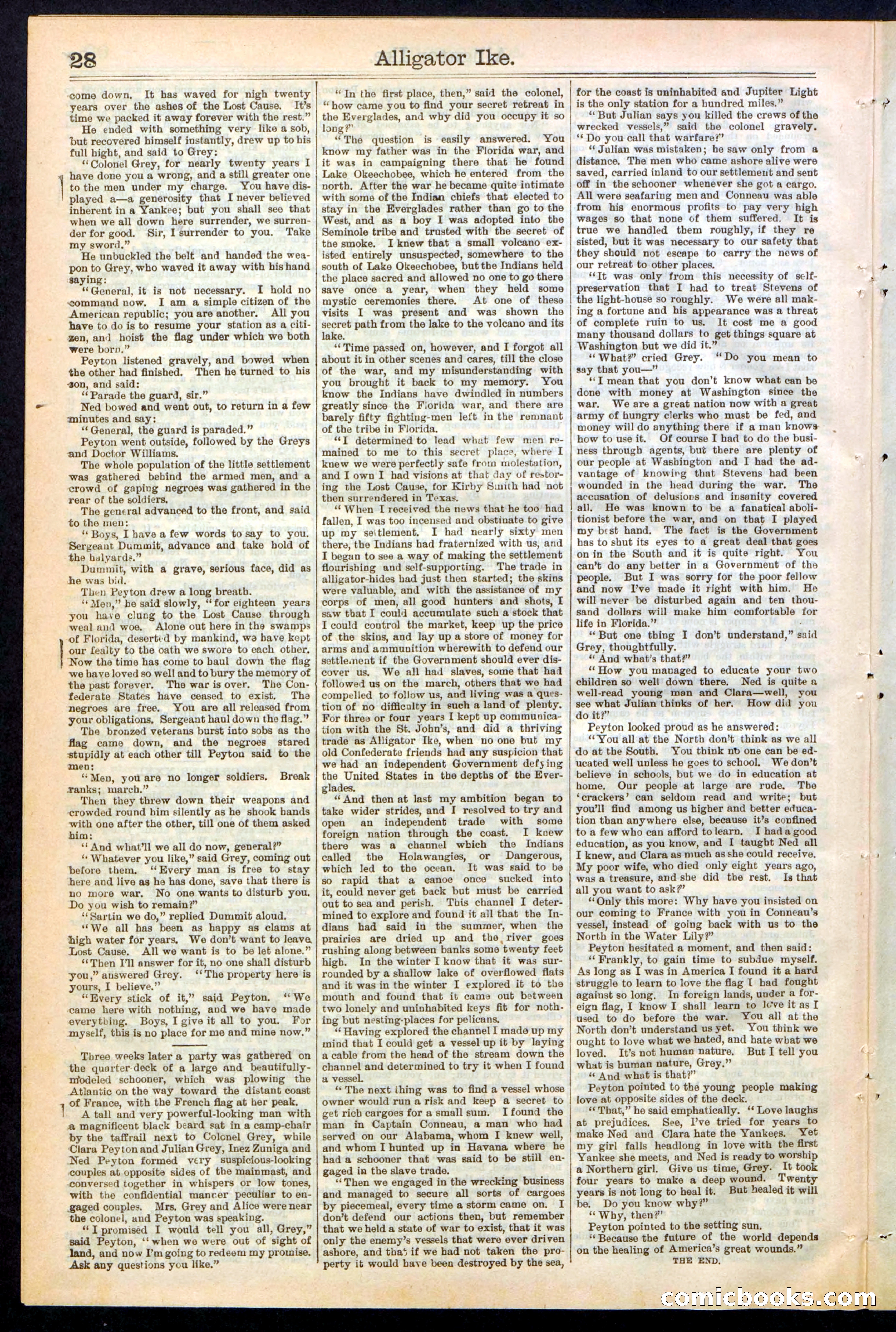
A restored page from Pulp Fiction, 1883. Page through the whole issue in the reader above.
📄 Transcribed text from this page (OCR, searchable)
Machine-transcribed from the original scan — historical spelling and the odd misread are preserved.
ens ——awT — | RN . oe ee ee ee come down, It bas waved for nigh twenty years over the ashes of the Lost Cause. It’s time we packed it away forever with the rest.” He ended with something very like a sob, but recovered himself instantly, drew up to bis full hight, and said to Grey: ‘‘Colonel Grey, for nearly twenty years I have done you a wrong, and a still greater one to the men under my charge. You have dis- played a—a generosity that I never believed inherent in a Yankee; but you shall see that when we all down here surrender, we surren- der for good. Sir, I surrender to you. Take my sword,” He unbuckled the belt and handed the wea- pon to Grey, who waved it away with bis hand saying: ‘‘General, it is not necessary. I hold no command now. I am a simple citizen of the American republic; you are another. All you have to dois to resume your station as a citi- zen, and hoist the flag under which we both were borp.” Peyton listened gravely, and bowed when the other had finished. Then he turned to his on, and said: ‘Parade the guard, sir.” Ned bowed and went out, to return in a few minutes and say; “General, the guard is paraded.” Peyton went outside, followed by the Greys and Doctor Williams, The whole population of the little settlement was gathered bebind the armed men, and a erowd of gaping negroes was gathered in the rear of the soldiers, The general advanced to the front, and said to the men: ‘ Boys, I have a few words tosay to you. Sergeant Dummit, advance and take hold of the balyards.” Dummit, with a grave, serious face, did as he was bid. Then Peyton drew a long breath. ‘* Men,” he said slowly, “‘for eighteen years you have clung to the Lost Cause through weal and woe. Alone out here in the swamps of Florida, deserted by mankind, wa bave kept our fealty to the oath we swore to each other. ‘Now the time has come to baul down the flag we bave loved so well and to bury the memory of the past forever. The warisover. The Con- federate States have ceased to exist. The negroes are free. You are all released from your obligations, Sergeant haul down the flag.” The bronzed veterans burst into sobs as the flag came down, and the negroes stared stupidly at each other till Peyton said to the men: “Men, you are no longer soldiers, Break Yanks; march.” Then they threw down their weapons and crowded round him silently as he shook bands with one after the other, till one of them asked him: **‘ And what'll we all do now, general?” ‘* Whatever you like,” said Grey, coming out before them, ‘Every man is free to stay here and live as he has done, save that there is no more war, No one wants to disturb you. Do you wish to remain?” ‘‘Sartin we do,” replied Dummit aloud. ‘‘We all has been as happy as clams at high water for years, We don’t want to leave Lost Cause. All we want is to be let alone.” ‘“Then I'll answer for it, no one shall disturb you,” answered Grey. ‘The property here is yours, I believe.” “Every stick of it,” said Peyton. ‘‘We came here with nothing, and we bave made everything. Boys, I give it all to you. For myself, this is no place for me and mine now.” Three weeks later a party was gathered on the quarter-deck of a large and beautifully- modeled schooner, which was plowing the Atlantic on the way toward the distant coast of France, with the French flag at her peak, A tall and very powerful-looking man with a@ Magnificent black beard sat in a camp-chair by the taffrail next to Colonel Grey, while Clara Peytonand Julian Grey, Inez Zuniga and Ned Peyton formed very suspicious-looking couples at opposite sides of the mainmast, and conversed together in whispers or low tones, with the confidential mancer peculiar to en- gaged couples. Mrs, Grey and Alice were near the colonel, and Peyton was speaking. ‘“T promised I would tell you all, Grey,” said Peyton, ‘‘ when we were out of sight of land, and now I’m going to redeem my promise, Ask any questions you like.” _ Alligator Ike. “Jn the first place, then,” said the colonel, | for the coast is uninhabited and Jupiter Light “how came you to find your secret retreat in the Everglades, and why did you occupy it so long?” “The question know my father was in the Florida war, and it was in campaigning there that he found Lake Okeechobee, which he entered from the north. After the war he became quite intimate with some of the Indian chiefs that elected to stay in the Everglades rather than go to the West, and as a boy I was adopted into the Seminole tribe and trusted with the secret of the smoke. I knew that a small volcano ex- isted entirely unsuspected, somewhere to the south of Lake Okeechobee, but the Indians held the place sacred and allowed no one to go there gave once a year, when they held some mystic ceremonies there. At one of these visits I was present and was shown the secret path from the lake to the volcano and its lake. ‘‘Time passed on, however, and I forgot all about it in other scenes and cares, till the close of the war, and my misunderstanding with you brought it back to my memory. You know the Indians have dwindled in numbers greatly since the Florida war, and there are barely fifty fighting-men left in the remnant of the tribe in Florida, “‘T determined to lead what few men re- mained to me to this secret place, where I knew we were perfectly safe from molestation, and I own I had visions at that day of restor- ing the Lost Cause, for Kirby Sinith had not then surrendered in Texas. ‘‘When I received the news that he too had fallen, I was too incensed and obstinate to give up my seitlement, I had nearly sixty men there, the Indians had fraternized with us, and I began to see a way of making the settlement flourishing and self-supporting. The trade in alligator-hides had just then started; the skins were valuable, and with the assistance of my corps of men, all good hunters and shots, I saw that I could accumulate such a stock that I could control the market, keep up the price of the skins, and lay up a store of money for arms and ammunition wherewith to defend our settlement if the Government should ever dis- cover us. We all had slaves, some that had followed us on the march, others that we had compelled to follow us, and living was a ques- tion of no difficulty in such a land of plenty. For three or four years I kept up communica- tion with the St. John’s, and did a thriving trade as Alligator [ke, when no one bub my old Confederate friends had any suspicion that we had an independent Government defying the United States in the depths of the Ever- glades. ‘‘ And then at last my ambition began to take wider strides, and I resolved to try and open an independent trade with some foreign nation through the coast. I knew there was a channel which the Indians called the Holawangies, or Dangerous, which led to the ocean, It was said to be so rapid that a eanoe once sucked into it, could never get back but must be carried out to sea and perish. This channel I deter- mined to explore and found it all that the In- dians had said in the summer, when the prairies are dried up and the river goes rushing along between banks some twenty feet high. In the winter I know that it was sur- rounded by a shallow lake of overflowed flats and it was in the winter I explored it to the mouth and found that it came out between two lonely and uninhabited keys fit for noth- ing but nesting-places for pelicans, ‘‘Having explored the channel I made up my mind that I could get a vessel up it by laying a cable from tbe head of the stream down the chanvel and determined to try it when I found a vessel. “The next thing was to find a vessel whose owner would run a risk and keep a secret to get rich cargoes for a smallsum. Ifound the man in Captain Conneau, a man who had served on our Alabama, whom I knew well, and whom I hunted up in Havana where he had a schooner that was said to be still en- gaged in the slave trade. “Then we engaged in the wrecking business and managed to secure all sorts of cargoes by piecemeal, every time a storm came on. I don’t defend our actions then, but remember that we held a state of war to exist, that it was only the enemy’s vessels that were ever driven ashore, and tha‘ if we had not taken the pro- perty it would baye been destroyed by the sea, is easily answered. You | a ————— NT ee EERE SL is the only station for a hundred miles,” ‘But Julian says you killed the crews of the wrecked vessels,” said the colonel gravely. ‘* Do you call that warfare?’ ** Julian was mistaken; he saw only from a distance, The men who came ashore alive were saved, carried inland to our settlement and sent off in the schooner whenever she got a cargo. All were seafaring men and Conneau was able from his enormous profits to pay very high wages so that none of them suffered. It is true we handled them roughly, if they re sisted, but it was necessary to our safety that they should not escape to carry the news of our retreat to other places. ‘It was only from this necessity of self- preservation that I had to treat Stevens of the light-house so roughly. We were all mak- ing a fortune and his appearance was a threat of complete ruin to us. It cost me a good many thousand dollars to get things square at Washington but we did it.” ‘What?’ cried Grey. “Do you mean to say that you—” ‘‘T mean that you don’t know what can be done with money at Washington since the war. We are a great nation now with a great army of hungry clerks who must be fed, and money will do anything there if a man knows how to use it. Of course I had to do the busi- ness through agents, but there are plenty of our people at Washington and I had the ad- vantage of knowirg that Stevens had been wounded in the head during the war. The accusation of delusions and insanity covered all. He was known to be a fanatical aboli- tionist before the war, and on that I played my best hand. The fact is the Government has to shut its eyes to a great deal that goes on in the South and it is quite right. You can’t do any better in a Government of the people. But I was sorry for the poor fellow and now I’ve made it right with him. He will never be disturbed again and ten thou- sand dollars will make him comfortable for life in Florida.” ‘But one thing I don’t understand,” said Grey, thoughtfully. * And what’s that?’ ‘‘How you mavaged to educate your two children so well down there. Ned is quite a well-read young man and Clara—well, you see what Julian thinks of her. How did you do it?” Peyton looked proud as he answered: ‘“You all at the North don’t think as we all do at the South. You think nb one can be ed- ucated well unless he goes to school. We don’t believe in schools, but we do in education at home, Our people at large are rude. The ‘crackers’ can seldom read and write; but you'll find among us higher and better educa- tion than anywhere else, because it’s confined to a few who can afford tolearn, I hada good education, as you know, and [| taught Ned all I knew, and Clara as much as she could receive. My poor wife, who died only eight years ago, was a treasure, and she did the rest. Is that all you want to ask?” “Only this more: Why have you insisted on our coming to France with you in Conneau’s vessel, instead of going back with us to the North in the Water Lily?’ Peyton hesitated a moment, and then said: “Frankly, to gain time to subdue myself. As long as I was in America I found it a hard struggle to learn to love the flag [ had fought against so long. In foreign lands, under a for- eign flag, I know I shall learn to lcve it as [ used to do before the war. You all at the North don’t understand us yet. You think we ought to love what we hated, and hate what we loved. It’s not human nature, But I tell you what is buman nature, Grey.” ‘ And what is that?” Peyton pointed to the young people making love at opposite sides of the deck. ‘‘That,” he said emphatically. ‘‘ Love laughs at prejudices, See, I’ve tried for years to make Ned and Clara hate the Yankees. Yet my girl falls headlong in love with the first Yankee she meets, and Ned is ready to worship a Northern girl. Give us time, Grey. It took four years to make a deep wound. Twenty years is not long to heal it, But healed it will be. Do you know why?’ “ Why, then?’ Peyton pointed to the setting sun. ‘Because the future of the world depends on the healing of America’s great wounds.” THE END. EOmMmIchboo (E <Si.G