
Pulp Fiction, 1883 · page 24 of 32
Beadle's Dime Library No. 247 — page 24: what you’re looking at
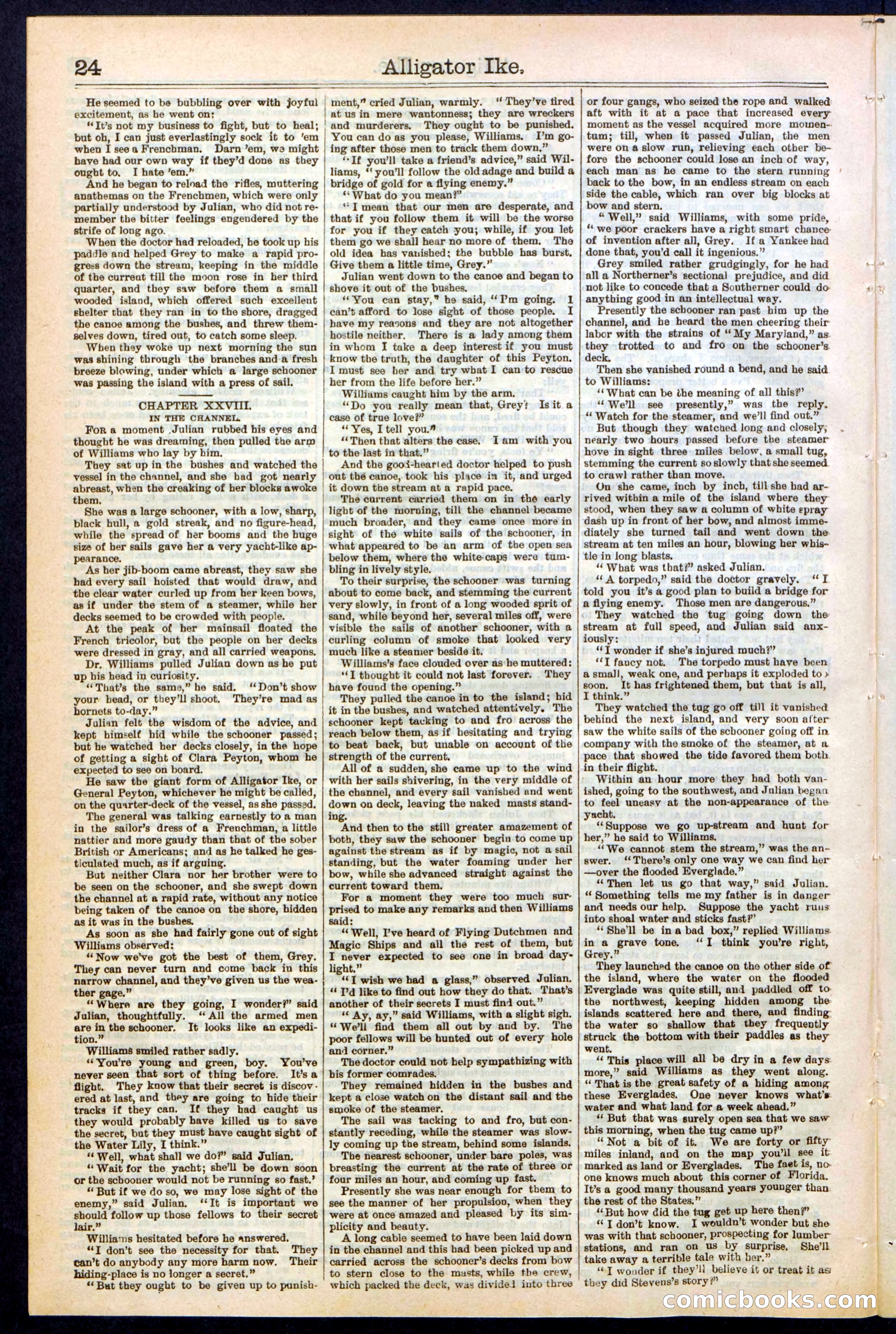
A restored page from Pulp Fiction, 1883. Page through the whole issue in the reader above.
📄 Transcribed text from this page (OCR, searchable)
Machine-transcribed from the original scan — historical spelling and the odd misread are preserved.
24 He seemed to be bubbling over with joyful | ment,” cried Julian, warmly. ‘ They’ve tired excitement, as he went on; | at us in mere wantonness; they are wreckers *Tt’s not my business to fight, but to heal; | and murderers. They ought to be punished. but oh, I can just everlastingly sock it to ‘em | You can do as you please, Williams. I’m go- when I seea Frenchman. Darn ’em, wea might | ing after those men to track them down,” Alligator Ike. ee = —— or four gangs, who seized the rope and walked aft with it at a pace that increased every moment as the vessel acquired more momen-: tum; till, when it passed Julian, the men were on a slow run, relieving each other be- have had our own way if they’d done as they ought to. I hate ’em.” “If you'll take a friend’s advice,” said Wil- liams, “‘ you’ll follow the old adage and build a And he began to reload the rifles, muttering | bridge of gold for a flying enemy.” anathemas on the Frenchmen, which were only partially understood by Julian, who did not re- ‘*What do you mean?” ‘*T mean that our men are desperate, and member the bitter feelings engendered by the | that if you follow them it will be the worse strife of long ago. When the doctor had reloaded, be took up his paddle and helped Grey to make a rapid pro- gress down the stream, keeping in the middle of the current till the moon rose in her third quarter, and they saw before them a small wooded island, which offered such excellent shelter that they ran in to the shore, dragged the canoe among the bushes, and threw them- selves down, tired out, to catch some sleep. When they woke up next morning the sun was shining through the branches anda fresh breeze blowing, under which a large schooner was passing the island with a press of sail. CHAPTER XXVIII. IN THE CHANNEL. For a moment Julian rubbed his eyes and thought he was dreaming, then pulled the arm of Williams who lay by him, They sat up in the bushes and watched the vessel in the channel, and she bad got nearly abreast, when the creaking of her blocks awoke them. She was a large schooner, with a low, sharp, black hull, a gold streak, and no figure-head, while the spread of her booms and the huge size of ber sails gave her a very yacht-like ap- pearance, As her jib-boom came abreast, they saw she had every sail hoisted that would draw, and the clear water curled up from her keen bows, as if under the stem of a steamer, while her decks seemed to be crowded with people. At the peak of her mainsail floated the French tricolor, but the people on her decks were dressed in gray, and all carried weapons, Dr. Williams pulled Julian down as he put up bis head in curiosity. ‘“‘That’s the same,” he said. ‘Don’t show your head, or they'll shoot, They’re mad as hornets to-day.” Julian felt the wisdom of the advice, and kept himself hid while the schooner passed; but he watched her decks closely, in the hope of getting a sight of Clara Peyton, whom he expected to see on board. He saw the giant form of Alligator Ike, or General Peyton, whichever he might be called, on the quarter-deck of the vessel, as she passed. The general was talking earnestly to a man in the sailor’s dress of a Frenchman, a little nattier and more gaudy than that of the sober British or Americans; and as he talked he ges- ticulated much, as if arguing. But neither Clara nor her brother were to be seen on the schooner, and she swept down the channel at a rapid rate, without any notice being taken of the canoe on the shore, hidden as it was in the bushes. As soon as she had fairly gone out of sight Williams observed: “Now we've got the best of them, Grey. They can never turn and come back in this narrow channel, and they’ve given us the wea- ther gage.” “Where are they going, I wonder?” said Julian, thoughtfully. ‘All the armed men are in the schooner. It looks like an expedi- tion. Williams smiled rather sadly. ‘“‘You’re young and green, boy. You’ve never seen that sort of thing before. It’sa flight. They know that their secret is discov- ered at last, and they are going to hide their tracks if they can. If they had caught us they would probably have killed us to save the secret, but they must have caught sight of the Water Lily, I think.” “Well, what shall we do?” said Julian. ‘‘ Wait for the yacht; she’ll be down soon or the schooner would not be running so fast.’ “But if we do so, we may lose sight of the enemy,” said Julian, ‘‘It is important we should follow up those fellows to their secret lair.” Williams hesitated before he answered. “T don’t see the necessity for that. They can’t do anybody any more harm now. Their -place is no longer a secret,” “But they ought to be given up to punish- 4 rr Oa ssssssssa—oqo-—_—_iS«CS IS IT iT for you if they catch you; while, if you let them go we shall hear no more of them. The old idea has vanished; the bubble has burst, Give them a little time, Grey.” Julian went down to the canoe and began to shove it out of the bushes. ‘‘You can stay,” he said, ‘I’m going. 1 can’t afford to lose sight of those people. I have my reasons and they are not altogether hostile neither, There is a lady among them in whom I take a deep interest if you must know the truth, the daughter of this Peyton. I must see her and try what I can to rescue her from the life before her.” Williams caught him by the arm. “Do you really mean that, Grey‘ case of true love?” “Yes, I tell you.” ‘Then that alters the case. to the last in that.” And the gooi-hearted doctor helped to push out thé canoe, took his place in it, and urged it down the stream at a rapid pace. The current carried them on in thé early light of the morning, till the channel became much broader, and they came once more in sight of the white sails of the schooner, in what appeared to be an arm of the open sea below them, where the white-caps were tum- bling in lively style. To their surprise, the schooner was turning about to come back, and stemming the current very slowly, in front of a long wooded sprit of sand, while beyond her, several miles off, were visible the sails of another schooner, with a curling column of smoke that looked very much like a steamer beside it. Williams’s face clouded over as he muttered: ‘*T thought it could not last forever. They have found the opening.” They pulled the canoe in to the island; hid it in the bushes, and watched attentively, The schooner kept tacking to and fro across the reach below them, as if hesitating and trying to beat back, but unable on account of the strength of the current. All of a sudden, she came up to the wind with her sails shivering, in the very middle of the channel, and every sail vanished and went down on deck, leaving the naked masts stand- ing. And then to the still greater amazement of both, they saw the schooner begin to come up against the stream as if by magic, not a sail standing, but the water foaming under her bow, while she advanced straight against the current toward them. For a moment they were too much sur prised to make any remarks and then Williams said: ‘Well, ’ve heard of Flying Dutchmen and Magic Ships and all the rest of them, but I never expected to see one in broad day- light.” ‘“‘T wish we had a glass,” observed Julian. ‘‘ I'd like to find out how they do that. That’s another of their secrets I must find out.” ““ Ay, ay,” said Williams, with a slight sigh. “We'll find them all out by and by. The poor fellows will be hunted out of every hole and corner.” The doctor could not belp sympathizing with bis former comrades. They remained hidden in the bushes and kept a close watch on the distant sail and the smoke of the steamer. The sail was tacking to and fro, but con- stantly receding, while the steamer was slow- ly coming up the stream, behind some islands. The nearest schooner, under bare poles, was breasting the current at the rate of three or four miles an hour, and coming up fast. Presently she was near enough for them to see the manner of her propulsion, when they were at once amazed and pleased by its sim- plicity and beauty. A long cable seemed to have been laid down in the channel and this had been picked up and carried across the schooner’s decks from bow to stern close to the musts, while the crew, which packed the deck, was divide into three Is it a Iam with you fore the schooner could lose an inch of way, each man as he came to the stern running back to the bow, in an endless stream on each side the cable, which ran over big blocks at bow and stern. “Well,” said Williams, with some pride, ‘we poor crackers have a right smart chance of invention after all, Grey. If a Yankee had done that, you’d call it ingenious.” Grey smiled rather grudgingly, for he had all a Northerner’s sectional prejudice, and did not like to concede that a Southerner could do anything good in an intelectual way. Presently the schooner ran past him up the channel, and be heard the men cheering their labor with the strains of ‘My Maryland,” as they trotted to and fro on the schooner’s deck, Then she vanished round a bend, and he said to Williams: ‘‘ What can be the meaning of all this?’ ‘We'll see presently,” was the reply. ‘‘ Watch for the steamer, and we’ll find out.” But though they watched long and closely; nearly two hours passed befure the steamer hove in sight three miles below, a small tug, stemming the current soslowly that she seemed to craw) rather than move. On she came, inch by inch, till she bad ar- rived witbin a mile of the island where they stood, when they saw a column of white epray dash up in front of her bow, and almost imme- diately she turned tail and went down the stream at ten miles an hour, blowing her whis- tle in long blasts. ‘What was that?” asked Julian. ‘‘ A torpedo,” said the doctor gravely. “I told you it’s a good plan to build a bridge for a flying enemy. Those men are dangerous.” They watched the tug going down the stream at full speed, and Julian said anx- iously: ‘‘T wonder if she’s injured much?” ‘*T fancy not. The torpedo must have been a small, weak one, and perbaps it exploded to» soon. It has frightened them, but that is all, I think.” They watched the tug go off till it vanished behind the next island, and very soon after saw the white sails of the scbooner going off in company with the smoke of the steamer, at a pace that showed the tide favored them both in their flight. Within an hour more they had both van- ished, going to the southwest, and Julian began to feel uneasy at the non-appearance of the yacht. ‘‘Suppose we go up-stream and hunt for her,” he said to Williams, ‘‘We cannot stem the stream,” was the an- swer. ‘*There’s only one way we can find her —over the flooded Everglade.” “Then let us go that way,” said Julian. “ Something tells me my father is in danger and needs our help. Suppose the yacht ruus into shoal water and sticks fast?’ ‘She'll be in a bad box,” replied Williams in a grave tone. ‘I think you're right, Grey.” They launched the canoe on the other side of the island, where the water on the flooded Everglade was quite still, and paddled off to the northwest, keeping hidden among the islands scattered here and there, and finding the water so shallow that they frequently struck the bottom with their paddles as they went. ‘‘' This place will all be dry in a few days more,” said Williams as they went along. “ That is the great safety of a hiding among these Everglades. One never knows what's water and what land for a week ahead.” ‘* But that was surely open sea that we saw this morning, when the tug came up?” “Not a bit of it. We are forty or fifty miles inland, and on the map you'll see it marked as land or Everglades. The faet is, no one knows much about this corner of Florida. It’s a good many thousand years younger than. the rest of the States.” ‘But how did the tug get up here then?” “J don’t know. I wouldn’t wonder but she was with that schooner, prospecting for lumber stations, and ran on us by surprise, She’ll take away a terrible tale with ber.” ‘“©T wonder if they’ll believe it or treat it as com Cc they did Stevens’s story?” Gbooks —# 2 a Vy ooo