
Pulp Fiction, 1883 · page 19 of 32
Beadle's Dime Library No. 247 — page 19: what you’re looking at
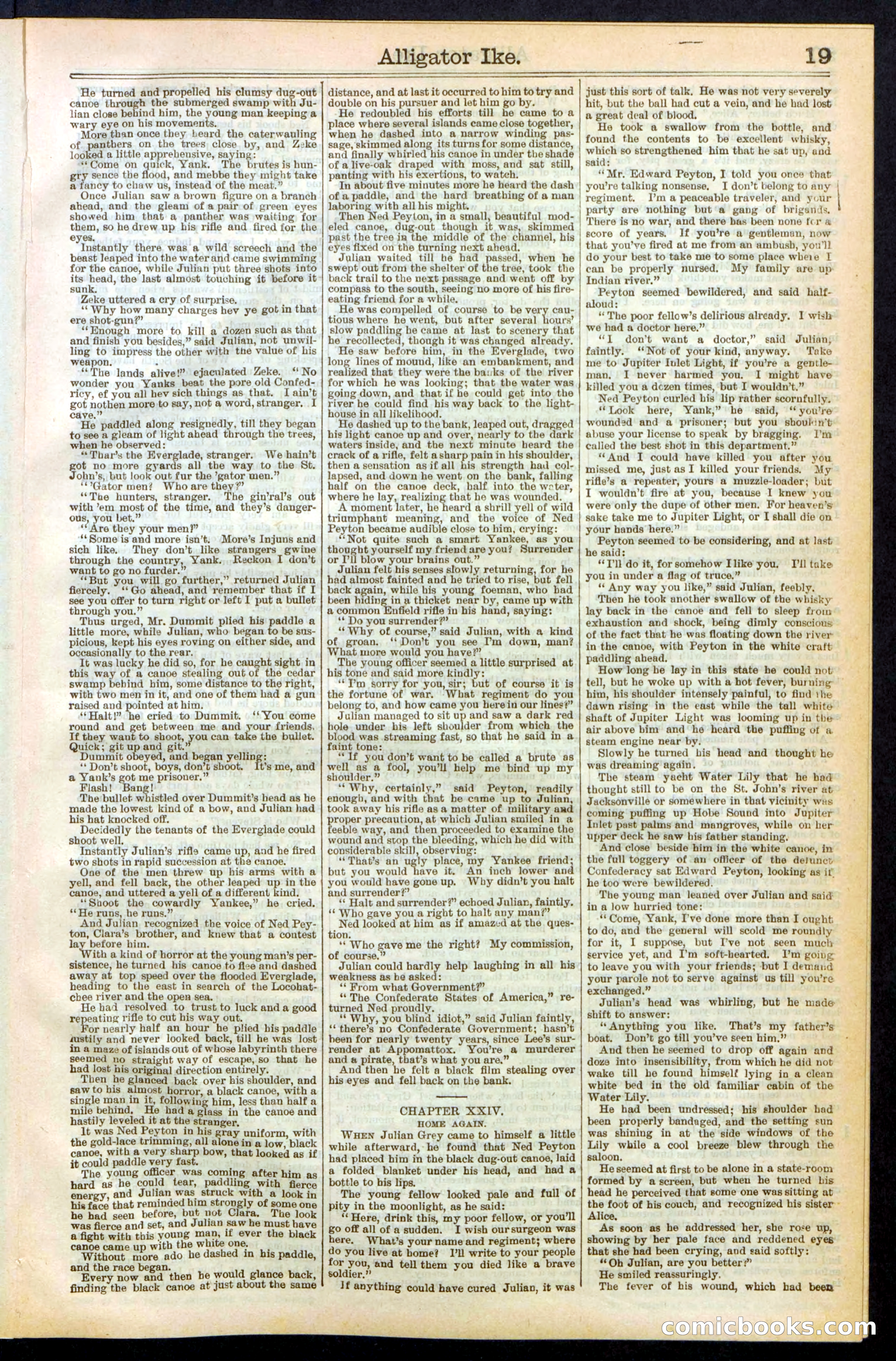
A restored page from Pulp Fiction, 1883. Page through the whole issue in the reader above.
📄 Transcribed text from this page (OCR, searchable)
Machine-transcribed from the original scan — historical spelling and the odd misread are preserved.
Alligator Ike. He turned and propelled his clumsy dug-out canoe through the submerged swamp with Ju- lian close bebind him, the young man keeping a wary eye on his movements. More than once they heard the caterwauling of panthers on the trees close by, and Zeke looked a little apprehensive, saying: **‘Come on quick, Yank. The brutes is hun- gry sence the flood, and mebbe they might take a fancy to chaw us, instead of the meat.” Once Julian saw a brown figure on a branch ahead, and the gleam ofa pair of green eyes showed him that a panther was waiting for them, so he drew up his rifle and fired for the eyes. “Tndtantly there was a wild screech and the beast Jeaped into the water and came swimming for the canoe, while Julian put three shots into its head, the last almost touching it before it sunk. Zeke uttered a cry of surprise, : ‘“ Why how many charges hev ye got in that ere shot-gun?”’ ‘‘Enough more to kill a dozen such as that and finish you besides,” said Julian, not unwil- ling to impress the other with the value of his weapon. . “The lands alive!” ejaculated Zeke. * No wonder you Yanks beat the pore old Confed- ricy, ef you all hev sich things as that. I ain’t got nothen more to say, not a word, stranger, I cave.” He paddled along resignedly, till they began to see a gleam of light ahead through the trees, when he observed: *“Thar’s the Everglade, stranger. We hain’t got no more gyards all the way to the St. John’s, but look out fur the ’gator men.” ‘Gator men? Who are they?’ ‘*The hunters, stranger. The gin’ral’s out with ’em most of the time, and they’s danger- ous, you bet,” ‘* Are they your men?” **Some is and more isn’t. More’s Injuns end sich like. They don’t like strangers gwine through the country, Yank. Reckon I don’t want to go no furder.” ‘But you will go further,” returned Julian fiercely. ‘'Go ahead, and remember that if I see you offer to turn right or left 1 put a bullet through you.” Thus urged, Mr. Dummit plied his paddle a little more, while Julian, who began to be sns- picious, kept his eyes roving on either side, and occasionally to the rear. It was lucky he did so, for he caught sight in this way of a canoe stealing out of the cedar swamp behind him, some distance to the right, with two men in it, and one of them had a gun raised and pointed at him. ‘*Halt!” he eried to Dummit. ‘' You come round and get between me and your friends, If they waut to shoot, you can take the bullet. Quick; git teas git.’ Dummit obeyed, and began yelling: ‘* Don’t shoot, boys, don’t shoot. It’s me, and a Yank’s got me prisoner,” Flash! Bang! The bullet whistled over Dummit’s head as he made the lowest kind of a bow, and Julian had his hat knocked off. Decidedly the tenants of the Everglade could shoot well. Instantly Julian’s rifls came up, and he fired two shots in rapid succession at the canoe. One of the men threw up his arms with a yell, and fell back, the other leaped up in the canoe, and uttered a yell of a different kind. ‘‘Shboot the cowardly Yankee,” he cried. **He runs, he runs,” And Julian recognized the voice of Ned Pey- ton, Clara’s brother, and knew that a contest lay before him. ‘With a kind of horror at the young man’s per- sistence, he turned his canoe to flee and dashed away at top speed over the flooded Everglade, heading to the east in search of the Locohat- chee river and the open sea, He had resolved to trust to luck and a good repeating rifle to cut bis way out. or nearly half an hour he plied his paddle zustily and never looked back, till he was lost in a maze of islands out of whose labyrinth there seemed no straight way of escape, so that he had lost his original direction entirely. Then he glanced back over his shoulder, and saw to his almost horror, a black canoe, with a single man in it, following him, less than half a mile behind, He had a giass in the canoe and hastily leveled it at the stranger, lt was Ned Peyton in his gray uniform, with the gold-lace trimming, all alone in a low, black canoe, with a very sharp bow, that looked as if it could paddle very fast. The young officer was coming after him as hard as he could tear, paddling with fierce energy, and Julian was struck with a look in his face that reminded him strongly of some one he bad seen before, but not Clara, The look was fierce and set, and Julian saw he must have a fight with this youpg man, if ever the black canoe came up with the white one, Without more ado he dashed in his paddle, and the race began. Every now and then he would glance back, finding the black canoe at just about the same distance, and at last it occurred to him to try and double on his pursuer and let him go by. He redoubled his efforts till he came to a place where several islands eame close together, when he dashed into a narrow winding pas- sage, skimmed along its turns for some distance, and finally whirled his canoe in under the shade of a live-oak draped with moss, and sat still, panting with his exertions, to watch. In about five minutes more he heard the dash of a paddle, and the hard breathing of a man laboring with all his might, Then Ned Peyton, in a small, beautiful mod- eled canoe, dug-out though it was, skimmed past the tree in the middle of the channel, his eyes fixed on the turning next ahead. Julian waited till he had passed, when he swept out from the shelter of the tree, took the back trail to the next passage and went off by compass to the south, seeing no more of his fire- eating friend for a while. He was compelled of course to be very cau- tious where he went, but after several hours’ slow paddling he came at last to scenery that he recollected, though it was changed already. He saw before him, in the Everglade, two long lines of mound, like an embankment, and realized that they were the bauks of the river for which he was looking; that the water was going down, and thatif he could get into the river he could find his way back to the light- house in all likelihood. He dashed up to the bank, leaped out, dragged his light canoe up and over, nearly to the dark waters inside, and the next minute heard the crack of a rifle, felt asharp pain in his shoulder, then a sensation asifall his strength had col- lapsed, and down he went on the bank, falling half on the canoe deck, balf into the weter, where he lay, realizing that he was wounded. A moment later, he heard a shrill yell of wild triumphant meaning, and the voice of Ned Peyton became audible close to him, crying: **Not quite such a smart Yankee, as you thought yourself my friend are you? Surrender or ’ll blow your brains out.” Julian felt his senses slowly returning, for he had almost fainted and he tried to rise, but fell back again, while his young foeman, who bad been hiding in a thicket near by, came up with a eoriinbn Wanted rifle in his hand, saying: ‘** Do you surrender?” ‘Why of course,” said Julian, with a kind of groan. ‘' Don’t you see 'm down, man? What more would you have?’ The young officer seemed a little surprised at his tone and said more kindly: ‘Tm sorry for you, sir; but of course it is the fortune of war. -What regiment do you belong to, and how came you herein our lines?’ Julian managed to sit up and saw a dark red hole under bis left shoulder from which the blood was streaming fast, so that he said in a faint tone: ““If you don’t want to be called a brute as well as a fool, you’ help me bind up my shoulder.” ‘Why, certainly,” said Peyton, readily enough, and with that be came up to Julian, took away his rifle asa matter of military and proper precaution, at which Julian smiled in a feeble way, and then proceeded to examine the wound and stop the bleeding, which he did with considerable skilJ, observiug: ‘*That’s an ugly place, my Yankee friend; but you would have it. An inch lower and you would have gone up. Why didn’t you halt and surrender?’ , ‘‘ Halt and surrender?” echoed Julian, faintly. ‘“ Who gave you a right to halt any man?” Ned looked at him as if amazed at the ques- tion. ‘* Who gave me the right? My commission, of course.” : Julian could crc help laughing in all his weakness as he asked: ‘From what Government?” “The Confederate States of America,” re- turned Ned proudly. ** Why, you blind idiot,” said Julian faintly, ‘* there’s no Confederate Government; hasn’t been for nearly twenty years, since Lee’s sur- render at Appomattox. You’re a murderer and «# pirate, that’s what you are.” And then he felt a black film stealing over his eyes and fell back on the bank. CHAPTER XXIV. HOME AGAIN. WHEN Julian Grey came to himself a little while afterward, he found that Ned Peyton had placed him in the black dug-out canoe, laid a folded blanket under his head, and had a bottle to bis lips. The young fellow looked pale and full of pity in the moonlight, as he said: “Here, drink this, my poor fellow, or you'll go off all of a sudden. I wish oursurgeon was here. What’s your name and regiment; where do you live at home? I'll write to your people for you, and tell them you died like a brave soldier,” if anything could have cured Julian, it was ws ; bd < bs - y » =! . ‘ EEE EEE. ee ee —————— a ——————————————————————————————— oe ea, i a ee + ey just this sort of talk. He was not very severely hit, but the ball had cut a vein, and he had lost a great deal of blood. He took a swallow from the bottle, and found the contents to be excellent whisky, which so strengthened him that he sat up, and said: ‘Mr. Edward Peyton, I told you once that you're talking nonsense, I don’t belong to any regiment, I’m a peaceable traveler, and your party are nothing but’ a gang of brigands, There is no war, and there bas been none fcr @ score of years. If you’re a gentleman, now that you’ve fired at me from an ambush, you'll do your best to take me to some place whee I can be properly nursed. My family are up Indian river.” Peyton seemed bewildered, and said half- aloud: “The poor fellow’s delirious already. I wish we had a doctor here.” “J don’t want a doctor,” said Julian; faintly. ‘Not of your kind, anyway. Take me to Jupiter Inlet Light, if you’re a gentle- man, I never harmed you. I might have killed you a dozen times, but I wouldn’t,” Ned Peyton curled his lip rather scornfully. Look here, Yank,” he said, “ you're woundsd and a prisoner; but you shoulin’t abuse your license to speak by bragging. I’m called the best shot in this department.” “And I could have killed you after you missed me, just asI killed your friends. My rifle’s a repeater, yours a muzzle-loader; but I wouldn’t fire at you, because I knew you were only the dupe of other men. For heaven’s sake take me to Jupiter Light, or I shall die on your hands here.” Peyton seemed to be considering, and at last he said: **T'll do it, for somehow I like you, you in under a flag of truce,” ‘* Any way you like,” said Julian, feebly. Then he took another swallow of the whisky lay back in the canoe and fell to sleep from exhaustion and shock, being dimly conscious of the fact that he was floating down the river y in the canoe, with Peyton in the white craft paddling ahead. How long be lay in this state he could not tell, but he woke up with a hot fever, burning — him, his shoulder intensely painful, to find the dawn rising in the east while the tall white shaft of Jupiter Light was looming up in the ifs air above bim and he heard the puffing of a } steam engine near by. Slowly he turned bis head and thought he was dreaming again. The steam yacht Water Lily that he had thought still to be on the St. John’s river at Jacksonville or somewhere in that vicinity was coming puffing up Hobe Sound into Jupiter Inlet past palms and mangroves, while on her upper deck he saw his father standing. And close beside him in the white canoe, in the full toggery of an officer of the delunct Confederacy sat Edward Peyton, looking as it he too were bewildered. The young man leaned over Julian and said in a low hurried tone: **Come, Yank, I’ve done more than I ought to do, and the general will scold me roundly for it, I suppose, but I’ve not seen much service yet, and I’m soft-hearted. I’m going to leave you with your friends; but I demand your parole not to serve against us till you’re exchanged.” Julian’s head was whirling, but he made — shift to answer: : “Anything you like. That’s my father’s boat. Don’t go till you’ve seen him,” And then he seemed to drop off again and doze into insensibility, from which he did not wake till he found himself lying in a clean white bed in the old familiar cabin of the Water Lily. He had been undressed; his shoulder had been properly bandaged, and the setting sun was shining in at the side windows of the Lily while a cool breeze blew through the saloon. ? He seemed at first to be alone in a state-room formed by a screen, but when he turned his head he perceived that some one was sitting at the foot of his couch, and recognized his sister ~ Alice, As soon as he addressed her, she rose up, showing by her pale face and reddened eyes that she had been crying, and said softly: “Oh Julian, are you better?” : He smiled reassuringly. a as The fever of his wound, which had been « » + Se Tl take rian , be ' “ 4 * - * ‘ a ps EE Sy = ” s i et _ ca r . : a “ee rr. *. ee a oy & : — ~~ = Comilebooks (E