
Pulp Fiction, 1883 · page 16 of 32
Beadle's Dime Library No. 247 — page 16: what you’re looking at
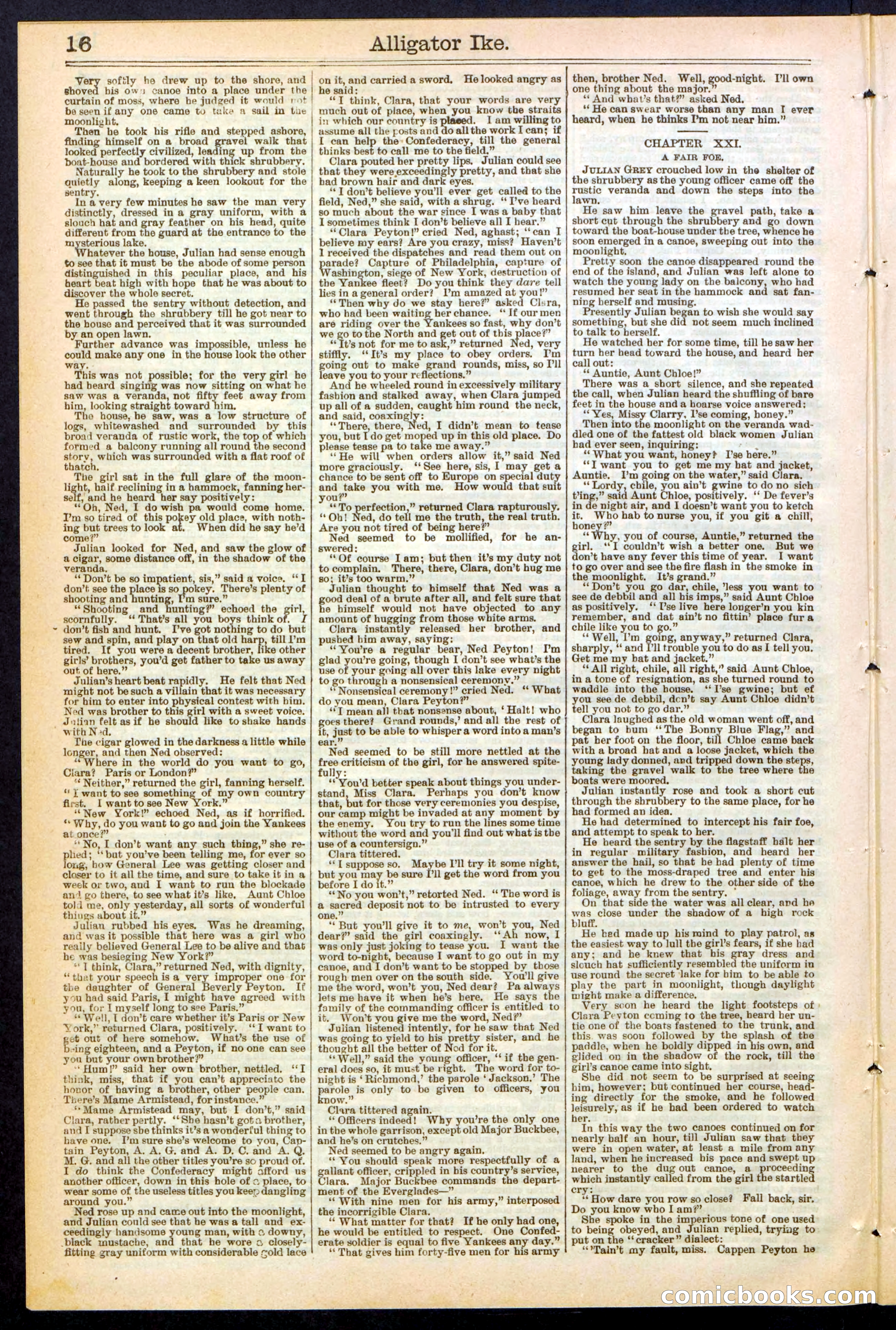
A restored page from Pulp Fiction, 1883. Page through the whole issue in the reader above.
📄 Transcribed text from this page (OCR, searchable)
Machine-transcribed from the original scan — historical spelling and the odd misread are preserved.
— ——— 7 ie = ve 16 Very softly he drew up to the shore, and shoved his ow canoe into a place under the curtain of moss, where he judged it would not be seen if any one came to take a sail in tue moonlight, Then he took his rifle and stepped ashore, finding himself on a broad gravel walk that looked perfectly civilized, leading up from the boat-house and bordered with thick shrubbery. Naturally he took to the shrubbery and stole quietly along, keeping a keen lookout for the sentry. In a very few minutes he saw the man very distinctly, dressed in a gray uniform, with a slouch hat and gray feather on his head, quite different from the guard at the entrance to the mysterious lake. hatever the house, Julian had sense enough to see that it must be the abode of some person distinguished in this peculiar place, and his heart beat high with hope that he was about to discover the whole secret. He passed the sentry without detection, and went through the shrubbery till he got near to the house and perceived that it was surrounded by an open lawn. Further advance was impossible, unless he could make any one in the house look the other way. This was not possible; for the very girl hoe had beard singing was now sitting on what he saw was a veranda, not fifty feet away from him, looking straight toward him. The house, he saw, was a low structure of logs, whitewashed and surrounded by this broad veranda of rustic work, the top of which formed a balcony running all round the second story, which was surrounded with a flat roof of thatch, The girl sat in the full glare of the moon- light, half reclining in a hammock, fanning her- self, and he heard her say positively: ** Oh, Ned, I do wish pa would come home. I’m so tired of this pokey old place, with noth- ing but trees to look at. When did he say he’d come?” Julian looked for Ned, and saw the glow of a cigar, some distance off, in the shadow of the veranda, ** Don’t be so impatient, sis,” said a voice. “I don’t see the place is so pokey. There’s plenty of shooting and pices Tm sure,” “Shooting and hunting?’ echoed the girl, scornfully. ‘“* That’s all you boys think of. J don’t fish and hunt. I’ve got nothing to do but sew and spin, and play on that old ing till l’'m tired. If you were a decent brother, like other girls’ brothers, you’d get father to take us away out of here.” Julian’s heart beat rapidly. He felt that Ned might not be such a villain that it was necessary for him to enter into physical contest with bim. Ned was brother to this girl with a sweet voice. Jatian felt as if he should like toshake hands ~ with Nod. The cigar glowed in the darkness a little while lone. and then Ned observed: “Where in the world do you want to go, Clara? Paris or London?” “* Neither,” returned the girl, fanning herself. *' ¥ want to see ga my own country first. I want to see New York.” ‘““New York!” echoed Ned, as if horrified. ** Why, do you want to go and join the Yankees at once?’ ‘**No, I don’t want any such thing,” she re- hed; ‘*bat you’ve been telling me, for ever so ong, how General Lee was getting closer and claser to it all the time, and sure to take itin a week or two, and I want to run the blockade an‘ go there, to see what it’s like, Aunt Chloe told me, only yesterday, all sorts of wonderful things about it.” Julian rubbed his eyes. Was he dreaming, and was it possible that here was a girl who really believed General Lee to be alive and that he was besieging New York?” *‘ | think, Clara,” returned Ned, with dignity, “thet your speech is a very improper one for the daughter of General Beverly Peyton. If you had said Paris, I might have agreed with you, for I myself long to see Paris.” ** Well, | don’t care whether it’s Paris or New York,” returned Clara, positively. ‘‘I want to et out of here somehow. What’s the use of sing eighteen, and a Peyton, if no one can see you but your own brother?” ** Hum!” said her own brother, nettled. ‘‘I think, miss, that if you can’t appreciato the honor of having a brother, other people can. ’ There’s Mame Armistead, for instance.” black mustache, an ‘**Mame Armistead may, but I don’t,” said Clara, rather pertly. ‘‘She hasn’t gota brother, and I suppose sbe thinks it’s a wonderful thing to have one. I’m sure she’s welcome to you, Cap- tain Peyton, A. A. G. and A. D.C. and A. Q. M. G. and all the other titles you’re so proud of. I do think the Confederacy might afford us another officer, down in this hole of o place, to wear some of the useless titles you keep dangling around you.” Ned rose up and came out into the moonlight, and Julian could see that he was a tall and ex- ceedingly handsome yoane man, with © downy, that he wore o closely- fitting gray uniform with considerable sold lace — — + a ee ee Alligator Ike. on it, and carried a sword, Helooked angry as | then, brother Ned. Well, good-night. Pll own he said: **T think, Clara, that your words are very much out of place, when you know the straits in which our country is plaeed. I am willing to assume all the posts and do all the work I can; if I can help the» Confederacy, till the general thinks best to call me to the field.” Clara pouted her pretty lips. Julian could see that they were exceedingly pretty, and that she had brown hair and dark eyes. ‘** I don’t believe you'll ever get called to the field, Ned,” she said, with a shrug. ‘I’ve heard so much about the war since I was a baby that I sometimes think I don’t believe all I hear.” ‘‘Clara Peyton!” cried Ned, aghast; ‘‘can I believe my ears? Are you crazy, miss? Haven’t 1 received the dispatches and read them out on paeer Capture of Philadelphia, capture of hie Sew siege of New York, destruction of the Yankee fleet? Do you think they dare tell lies in a general order? Vm amazed at you!” ‘Then why do we stay here?’ asked Clara, who had been waiting her chance. “ If ourmen are riding over the Yankees so fast, why don’t we go tothe North and get out of this place?’ ‘*Tt’s not for me to ask,” returned Ned, very stiffly. ‘It’s my place to obey orders. I’m going out to make grand rounds, miss, so Pll leave you to your reflections.” And he wheeled round in excessively military fashion and stalked away, when Clara jumped up all of a sudden, caught him round the neck, and said, coaxingly: ‘‘There, there, Ned, I didn’t mean to tease you, but I do get si oes up in this old place. Do please tease pa to take me away.” ‘‘He will when orders allow it,’ said Ned more graciously. ‘‘See here, sis, may get a chance to be sent off to Europe on special dut and take you with me. How would that suit ou?” ‘“*T'o perfection,” returned Clara rapturously. ‘*Oh! Ned, do tell me the truth, the real truth. Are you not tired of being here?” Ned seemed to be mollified, for be an- swered: **Of course Iam; but then it’s my duty not to complain. There, there, Clara, don’t hug me so; it’s too warm,” Julian thought to himself that Ned was a ood deal of a brute after all, and felt sure that ~ himself would not have objected to any amount of hugging from those white arms. Clara instantly released her brother, and pushed him away, saying: “You're a regular bear, Ned Peyton! I’m glad you’re going, though I don’t see what’s the use of your going all over this lake every night to go through a nonsensical ceremony.” ‘Nonsensical ceremony!” cried Ned. ‘* What do you mean, Clara Peyton?’ ‘*T mean all that nonsense about, ‘ Halt! who goes there? Grand rounds,’ and all the rest of ib, just to be able to whisper a word into a man’s ear. Ned seemed to be still more nettled at the 7 criticism of the girl, for he answered spite- ully: “You'd better speak about things you under- stand, Miss Clara. Perhaps you don’t know that, but for those very ceremonies you despise, our camp Ny be invaded at any moment by the enemy. ou try to run the lines some time without the word and you'll find out what is the use of a countersign.”’ Clara tittered. ‘*[ suppose so, Maybe I'll try it some night, but you may be sure Pll get the word from you before I do it.” ‘“No you won't,” retorted Ned. ‘“ The word is a sacred deposit not to be intrusted to every one,” ‘But you'll give it to me, won’t you, Ned dear?” said the girl coaxingly. ‘‘Ah now, I was only just joking to tease you. I want the word to-night, because I want to go out in my canoe, and I don’t want to be stopped by those rough men over on the south side. You'll give me the word, won’t you, Ned dear? Pa — lets me have it when he’s here, He says the family of the commanding officer is entitled to it. Won't you give me the word, Ned?” Julian listened intently, for he saw that Ned was going to yield to bis pretty sister, and he thought all the better of Nod for it. ‘* Well,” said the young officer, ‘if the gen- eral does so, it must be right. The word for to- night is ‘Richmond,’ the parole ‘ Jackson.’ The role is only to be given to officers, you now.” Clara tittered again. “ Officers indeed! Why you’re the only one in the whole garrison, except old Major Buckbee, and he’s on crutches.” Ned seemed to be angry again. ‘* You should speak more respectfully of a allant officer, crippled in bis country’s service, ‘lara. Major Buckbee commands the depart- ment of the Everglades—” ‘‘ With nine men for his army,” interposed the incorrigible Clara. ‘‘ What matter for that? If he only had one, he would be entitled to respect. One Confed- erate soldier is equal to five Yankees any day.” ‘That gives him forty-five men for his army one thing about the major. ** And what’s that?” asked Ned, ‘* He can swear worse than any man I ever heard, when he thinks I’m not near him.” CHAPTER XXII, A FAIR FOE, JULIAN GREY crouched low in the shelter of the shrubbery as the young officer came off the rustic veranda and down the steps into the lawn. He saw him leave the gravel path, take a short cut through the shrubbery and go down toward the boat-house under the tree, whence he soon emerged in a canoe, sweeping out into the moonlight, Pretty soon the canoe disappeared round the end of the island, and Julian was left alone to watch the young lady on the balcony, who had resumed ber seat in the hammock and sat fan- ning berself and musing. Presently Julian began to wish she would say something, but she did not seem much inclined to talk to herself. He watched her for some time, till he saw her turn her bead toward the house, and heard her call out: * Auntie, Aunt Chloe!” There was a short silence, and she repeated the call, when Julian heard the shuffling of bare feet in the house and a hoarse voice answered; ‘*'Yes, Missy Clarry, l’se coming, honey.” Then into the moonlight on the veranda wad- dled one of the fattest old black women Julian had ever seen, inquiring: ; ** What you want, honey? I’se here.” ‘“‘T want you to get me my bat and jacket, Auntie, [I’m going on the water,” said Clara. ‘Lordy, chile, you ain’t gwine to do no sich ting,” said Aunt Chloe, positively. ‘‘ De fever’s in de night air, and I doesn’t want you to ketch it. Who hab to nurse you, if you git a chill, honey ?” “Why, you of course, Auntie,” returned the irl. ‘I couldn’t wish a better one. But we on’t have any fever this time of year. I want to go over and see the fire flash in the smoke in the moonlight. It’s grand.” ‘Don’t you go dar, chile, ‘less you want to see de debbil and all his imps,” said Aunt Chloe as positively. ‘‘ se live here longer’n you kin remember, and dat ain’t no fittin’ place fura chile like you to go.” “Well, 'm going, anyway,” returned Clara, sharply, “ and I'll trouble Ae to do as I tell you. Get me my bat and jacket.” * All right, chile, all right,” said Aunt Chloe, in a tone of resignation, as she turned round to waddle into the bouse. ‘“‘l’se gwine; but ef you see de debbil, den’t say Aunt Chloe didn’t tell you not to go dar.” Clara laughed as the old woman went off, and began to bum “The Bonny Blue Flag,” and pat her foot on the floor, till Chloe came back with a broad hat and a loose jacket, which the young lady donned, and tripped down the steps, taking the gravel walk to the tree where the boats were moored, Julian instantly rose and took a short cut through the shrubbery to the same place, for he had formed an idea. He had determined to intercept his fair foe, and attempt to speak to her. He heard the sentry by the flagstaff halt her in regular military fashion, and heard her answer the hail, so that be had plenty of time to get to the moss-draped tree and enter his canoe, which he drew to the other side of the foliage, away from the sentry. ° On that side the water was all clear, and he sera close under the shadow of a high rock bluff. He hed made up his mind to play patrol, as the easiest way to lull the girl’s fears, if she had any; and he knew that his gray dress and slouch hat sufficiently resembled the uniform in use round the secret lake for bim to be able to play the part in moonlight, though daylight might make a difference, Very soon he heard the light footsteps of Clara Peyton ccming to the tree, beard ber un- tie one of the boats fastened to the trunk, and this. was soon followed by the splash of the paddle, when he boldly dipped in his own, and glided on in the shadow of the rock, till the girl’s canoe came into sight. She did not seem to be surprised at seeing him, however; but continued her course, head- ing directly for the smoke, and he followed Jeisurely, as if he bad been ordered to watch her. In this way the two canoes continued on for nearly balf an hour, till Julian saw that they were in open water, at least a mile from any land, when he increased his pace and swept up nearer to the dugout canoe, a proceedin which instantly called from the girl the startle cry: ‘‘ How dare you row so close? Fall back, sir. Do you know who I am?’ She spoke in the imperious tone of one used to being obeyed, and Julian replied, tryiag to put on the ‘‘cracker” dialect: “’Tain’t my fault, miss. Cappen Peyton he Comichboo (GE cS + ——— - —, . 7 Q !