
Pulp Fiction, 1883 · page 13 of 32
Beadle's Dime Library No. 247 — page 13: what you’re looking at
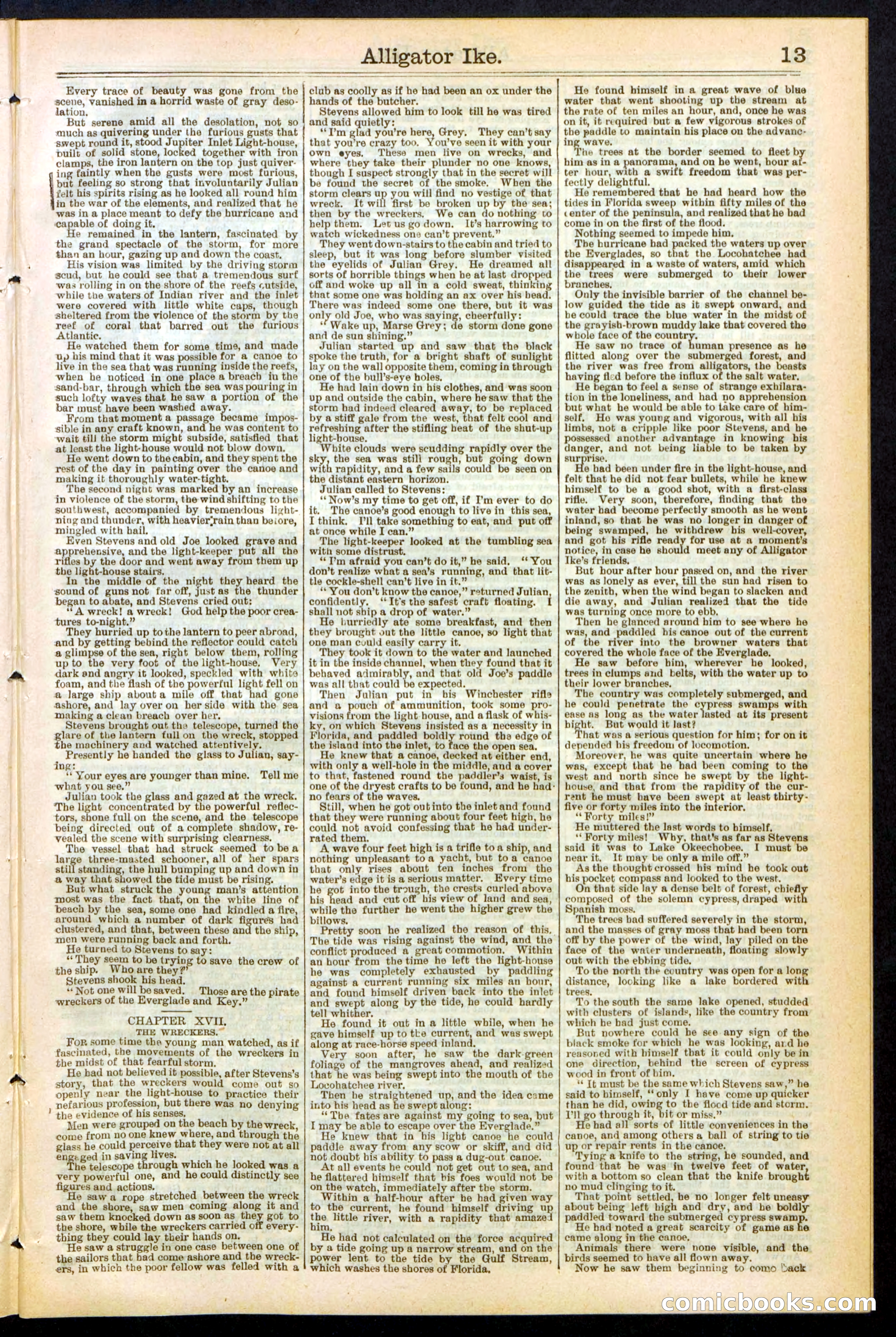
A restored page from Pulp Fiction, 1883. Page through the whole issue in the reader above.
📄 Transcribed text from this page (OCR, searchable)
Machine-transcribed from the original scan — historical spelling and the odd misread are preserved.
ms —— . ‘ i ie ks ——--—-—_ Every trace of beauty was gone from the scene, vanished in a horrid waste of gray deso- lation, But serene amid all the desolation, not so much as quivering under the furious gusts that swept round it, stood J opstek Inlet Ligbt-house, puilt of solid stone, locked together with iron clamps, the iron lantern on the top just quiver- but feeling so strong that involuntarily Julian felt his spirits rising as he looked all round him in the war of the elements, and realized that he was in a place meant to defy the burricane and capable of doing it. He remained in the lantern, fascinated by the grand spectacle of the storm, for more than an hour, gazing up and down the coast, His vision was limited by the driving storm scud, but he could see that a tremendous surf was rolling in on the shore of the reefs cutside, while the waters of Indian river and the inlet were covered with little white caps, though sheltered from the violence of the storm by the reef of coral that barred out the furious Atlantic. He watched them for some time, and made u, his mind that it was possible for a canoe to live in the sea that was running inside the reefs, when he noticed in one place a breach in the sand-bar, through which the sea was pouring in such lofty waves that he saw a portion of the bar must have been washed aren: From that moment a passage became impos- sible in any craft known, and he was content to wait till the storm might subside, satisfied that at least the light-house would not blow down. He went down to the cabin, and they spent the rest of the day in painting over the canoe and making it thoroughly water-tight. The second night was marked by an increase in violence of the storm, the wind shifting to the southwest, accompanied by tremendous light- ning and thunder, with heavier-rain than beiore, mingled with hail. Even Stevens and old Joe looked grave and apprehensive, and the light-keeper put all the rifles by the door and went away from them up the light-house stairs. In the middle of the night they heard the sound of guns not far off, just as the thunder began to abate, and Stevens cried out: ** A wreck! a wreck! God help the poor crea- tures to-night.” They hurried up tothe lantern to peer abroad, and by getting bebind the reflector could catch a glimpse of the sea, right below them, rolling up to the very foot of the light-house, Very dark and angry it looked, speckled with white foam, and the flash of the powerful light fell on a large ship abouta mile off that had gone ashore, and lay over on her side with the sea making a clean breach over ber. Stevens brought out the telescope, turned the glare of the lantern full on the wreck, stopped the machinery and watched attentively. Presently he handed the glass to Julian, say- ing: ‘* Your eyes are younger than mine. Tell me what you see,” Julian took the glass and gazed at the wreck. The light concentrated by the powerful reflec- tors, shone full on the scene, and the telescope being directed out of a complete shadow, re- vealed the scene with surprising clearness. The vessel that had struck seemed to bea large three-masted schooner, all of her spars still standing, the hull bumping up and down in a way that showed the tide must be rising. But what struck the young man’s attention most was the fact that, on the white line of beach by the sea, some one had kindled a fire, around which a number of dark figures had clustered, and that, between these and the ship, men were running back and forth. He turned to Stevens to say: “They seem to be trying to save the crew of the ship. Who are they? Stevens shook his head. ‘* Not one will besaved. Those are the pirate wreckers of the Everglade and Key.” CHAPTER XVII, _ THE WRECKERS.~ For some time the young man watched, as if fascinated, the movements of the wreckers in the midst of that fearful storm. He had not believed it possible, after Stevens’s story, that the wreckers would come out so openly near the light-house to practice their nefarious profession, but there was no denying the evidence of his senses, Men were grouped on the beach by the wreck, come from no one knew where, and through the glass he could peeve that they were not at all engeged in saving tives. The telescope tetilate which he looked was a very powerful one, and he could distinctly see figures and actions. He saw a rope stretched between the wreck and the shore, saw men coming along it and saw them knocked down as soon as they got to the shore, while the wreckers carried off every- thing they could lay their hands on, He saw a struggle in one case between one of the sailors that bad come ashore and the wreck- ers, in which the poor fellow was felled with a fe faintly when the gusts were most furious, 7. Yo , = Alligator Ike re er ee club as coolly as if he had been an ox under the hands of the butcher. Stevens allowed him to look till he was tired and said quietly: ‘*T’m glad you’re here, Grey. They can’t say that you’re crazy too. You’ve seen it with your own eyes. These men live on wrecks, and where they take their plunder no one knows, though I suspect strongly that in the secret will be found the secret of the smoke. When the storm clears up you will find no vestige of that wreck. It will first be broken up by the sea; then by the wreckers, We can do nothing to help them. Let us go down. It’s harrowing to watch wickedness one can’t prevent.” They went down-stairs to the cabin and tried to sleep, but it was long before slumber visited the eyelids of Julian Grey. He dreamed all sorts of horrible things when he at last dropped off and woke up all in a cold sweat, thinking that some one was holding an ax over his bead. There was indeed some one there, but it was only old Joe, who was saying, cheerfully: ** Wake up, Marse Grey; 33 storm done gone and de sun shining.” Julian started up and saw that the black spoke the truth, for a bright shaft of sunlight lay on the wall opposite them, coming in through one of the bull’s-eye holes, He had lain down in bis clothes, and was soon up and outside the cabin, where hesaw that the storm had indeed cleared away, to be replaced by a stiff gale from the west, that felt cool and refreshing after the stifling heat of the shut-up light-bouse. White clouds were scudding rapidly over the sky, the sea was still rough, but going down with rapidity, and a few sails could be seen on the distant eastern horizon. Julian called to Stevens: ‘*Now’s my time to get off, if I’m ever to do it. The canoe’s good enough to live in this sea, I think. Ill take something to eat, and put off at once while I can.” The light-keeper looked at the tumbling sea with some distrust. “T’'m afraid you can’t do it,” he said, ‘* You don’t realize what a sea’s running, and that lit- tle cockle-shell can’t live in it.” ** You don’t know the canoe,” returned Julian confidently. ‘It’s the safest craft floating. i shall not ship a drop of water.” He hurriedly ate some breakfast, and then they brought out the little canoe, so light that one man cuuld easily carry it. Lie took it down to the water and launched it in the inside channel, when they found that it behaved admirably, and that old Joe’s paddle was all that could be expected. Then Julian put in bis Winchester rifle and a pouch of ammunition, took some pro- visions from the light house, and a flask of whis- ky, on which Stevens insisted as a necessity in Florida, and paddled boldly round thea edge of the island into the inlet, to ace the open sea, He knew that a canoe, decked at either end, with only a well-hole in the middle, and a cover to that, fastened round the paddler’s waist, is one of the dryest crafts to be found, and he had: no fears of the waves. Still, when he got outinto the inlet and found that they were running about four feet high, he could not avoid confessing that he had under- rated them, A wave four feet high is a trifle toa ship, and nothing unpleasant toa yacht, but toa canoe that only rises about ten inches from the water’s edge it is a serious matter. Every time he got into the trough, the crests curled above his head and cut off his view of land and sea, while the further he went the higher grew the billows. . Pretty soon he realized the reason of this, The tide was rising against the wind, and the conflict produced a great commotion. Within an hour from the time he left the light-house he was completely exhausted by paddling against a current running six miles an hour, and found himself driven back into the inlet and swept along by the tide, he could hardly tell whither, , He found it out in a little while, when he gave himself up to tke current, and was swept along at race-horse speed inland. Very soon after, he saw the dark-green foliage of the mangroves ahead, and realized that he was being swept into the mouth of the Locohatchee river, Then he straightened up, and the idea came into his head as he swept along: “Tbe fates are against my going to sea, but I may be able to escape over the Everglade.” He knew that in his light canoe he could paddle away from any scow or skiff, and did not doubt bis ability to pass a dug-out canoe. At all events he could not get out to sea, and he flattered himself that bis foes would not be on the watch, immediately after the storm. Within a half-hour after he had given way to the current, he found himself driving up = little river, with a rapidity that amazed im, He had not calculated on the force acquired by a tide going up a narrow stream, and on the power lent to the tide by the Gulf Stream, which washes the shores of Florida, a oe cee eee ee ——- He found himself in a great wave of blue water that went shooting up the stream at the rate of ten miles an hour, and, once he was on it, it required but a few vigorous strokes of the paddle to maintain bis place on the advanc- ing wave. he trees at the border seemed to fleet b him as in a panorama, and on he went, bour af- ter hour, with a swift freedom that was per- fectly delightful. He remembered that he had heard how the tides in Florida sweep within fifty miles of the center of the peninsula, and realized that he bad come in on the first of the flood. Nothing seemed to impede him. The hurricane bad posted the waters up over the Everglades, so that the Locohatchee had disappeared in a waste of waters, amid which the trees were submerged to their lower branches, Only the invisible barrier of the channel be- low guided the tide as it swept onward, and be could trace the blue water in the midst of the grayish-brown muddy lake that covered the whole face of the eee He saw no trace of human presence as he flitted along over the submerged forest, and the river was free from alligators, the beasts having fled before the influx of the salt water, He began to feel a sense of strange exhilara- tion in the loneliness, and had no apprehension but what he would be able to take care of him- self. Hoe was young and vigorous, with all his limbs, not a cripple like poor Stevens, and he possessed another advantage in knowing bis danger, and not being liable to be taken by surprise. e bad been under fire in the light-house, and felt that he did not fear bullets, while he knew himself to be a good shot, with a first-class rifle. Very soon, therefore, finding that the water had become perfectly smooth as he went inland, so that he was no longer in danger of being swamped, he withdrew bis well-cover, and got his rifle ready for use at a moment's notice, in case he should meet any of Alligator Ike’s friends, But hour after hour pasved on, and the river was as lonely as ever, till the sun had risen to the zenith, when the wind began to slacken and die away, and Julian realized that the tide was turning once more to ebb, Then be glanced around bim to see where he was, and paddled bis canoe out of the current of the river into the browner waters that covered the whole face of the Everglade. He saw before him, wherever he looked, trees in clumps and belts, with the water up to their lower branches. The country was completely submerged, and he could penetrate the cypress swamps with ease as long as the water lasted at its present hight. But would it last? hat was a serious question for him; for on it depended bis freedom of locomotion. Moreover, he was quite uncertain where he was, except that he had been coming to the west and north since he swept by the light- house, and that from the rapidity of the cur- rent he must bave been swept at least thirty- five or forty miles into the interior. ‘“* Forty miles!” He muttered the last words to himself, ‘‘ Forty miles! Why, that's as far as Stevens said it was to Lake Okeechobee. I must be near it, It may be only a mile off.” As the thought crossed his mind he took out his pocket compass and looked to the west. On that side lay a dense belt of forest, chief composed of the solemn cypress, draped with Spanish moss. The trees bad suffered severely in the storm, and the masses of gray moss that had been torn off by the power of the wind, lay piled on the face of the water underneath, floating slowly out with the ebbing tide. To the north the country was open for a long distance, looking like a lake bordered wit trees. To the south the same lake opened, studded with clusters of islands, like the country from which he bad just come. But nowhere could be see any sign of the black smoke for which he was looking, ard he reasoned with himself that it could only be in one direction, behind the screen of cypress wood in front of him. ‘« It must be the same which Stevens saw,” he said to bimself, ‘‘only I have come up quicker than he did, eri to the flood tide and storm. I'll go through it, bit or miss.” . e had all sorts of little conveniences in the canoe, and among others a ball of string to tie up or repair rents in the canoe, Tying a knife to the string, he sounded, and found that he was in twelve feet of water with a bottom so clean that the knife brought no mud clinging to it. That point settled, he no longer felt uneasy about being left high and dry, and he boldly paddled toward the submerged cypress swamp. He had noted a great scarcity of game as he came along in the canoe, Animals there were none visible, and the birds seemed to have all flown away. Now he saw them beginning to como |back Eomicbooks (C : |