
Pulp Fiction, 1883 · page 18 of 24
Beadle's New York Dime Library, No. 244 — page 18: what you’re looking at
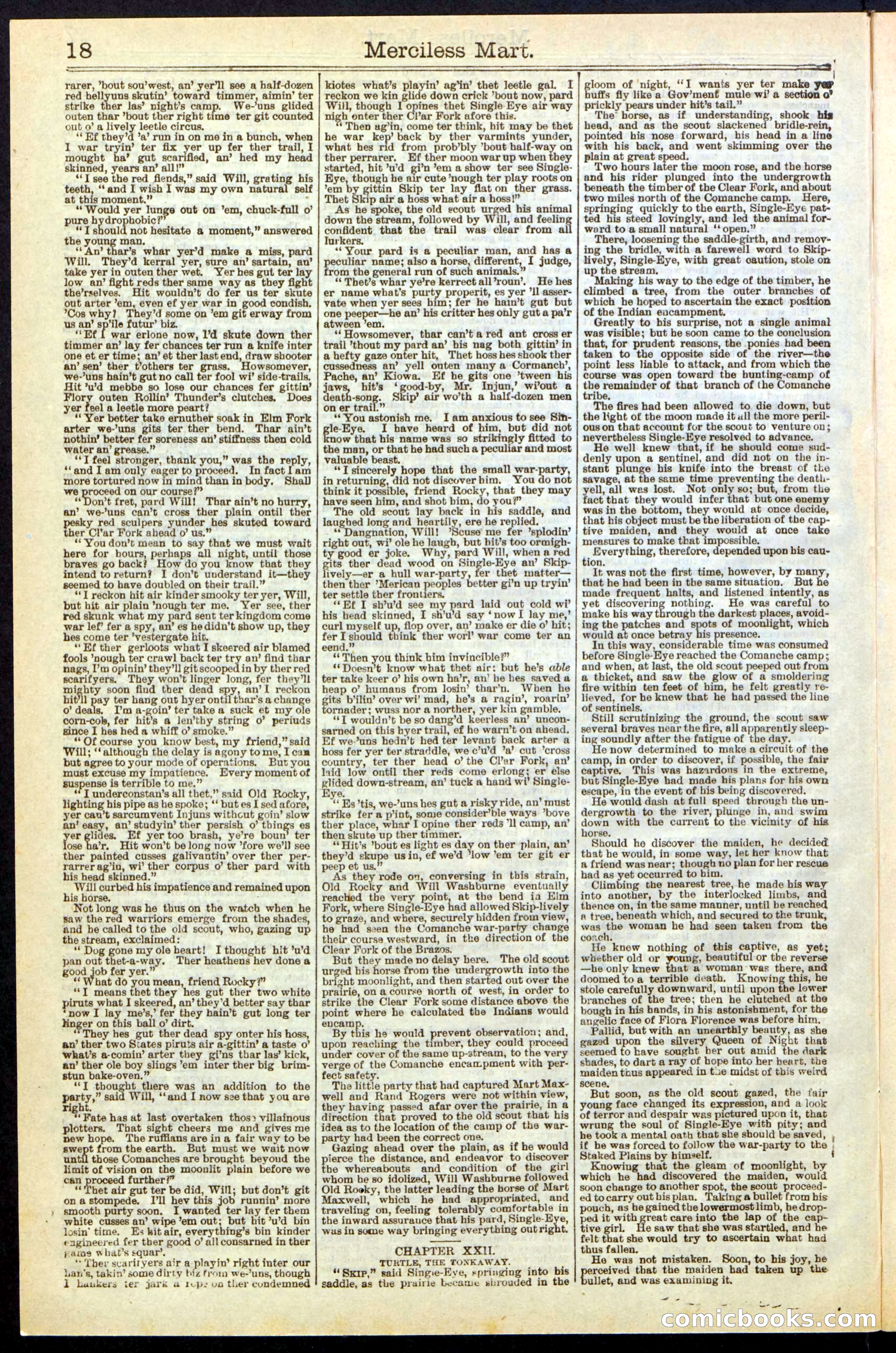
A restored page from Pulp Fiction, 1883. Page through the whole issue in the reader above.
📄 Transcribed text from this page (OCR, searchable)
Machine-transcribed from the original scan — historical spelling and the odd misread are preserved.
— 18 rarer, "bout sou’west, an’ yer’ll see a half-dozen red hellyuns skutin’ toward timmer, aimin’ ter strike ther las’ night’s camp. We-uns glided outen thar ’bout ther right time ter git counted out 0’ a lively leetle circus. ‘* Ef they’d ’a’ run in on me in a bunch, when I war tryin’ ter fix yer up fer ther trail, I mought ha’ gut scarified, an’ hed my head skinned, years an’ all!” **T see the red fiends,” said Will, grating his teeth, ‘and I wish I was my own natural self at this moment,” - “Would yer lunge out on ’em, chuck-full o’ pure hydrophobic? “T should not hesitate a moment,” answered the young man. ** An’ thar’s whar yer’d make a miss, pard Will. They’d kerral yer, sure an’ sartain, an’ take yer in outen ther wet. Yer hes gut ter lay low an’ fight reds ther same way as they fight the’rselves. Hit wouldn’t do fer us ter skute out arter ’em, even ef yer war in good condish, ’Cos why? They’d some on ’em git erway from us an’ rpue futur’ biz. ‘‘Ef | war erlone now, l’d skute down ther timmer an’ lay fer chances ter run a knife inter one et er time; an’ et ther last end, draw shooter an’ sen’ ther t/others ter grass. Howsomever, we~’uns hain’t gut no call ter fool wi’ side-trails. Hit ’u’d mebbe so lose our chances fer gittin’ Flory outen Rollin’ Thunder’s clutches, Does yer feel a leetle more peart? ‘Yer better take ernuther soak in Elm Fork arter we-uns gits ter ther bend. Thar ain’t nothin’ better fer soreness an’ stiffness then cold water an’ grease,” ‘*T feel stronger, thank you,” was the reply, *‘and Iam only eager to proceed. In fact lam more tortured now in mind than in body, ShalJ we proceed on our course?” “Don’t fret, pard Will! Thar ain’t no hurry, an’ we-’uns can’t cross ther plain ontil ther pay red sculpers yunder hes skuted toward er Cl’ar Fork ahead o’ us,” **'You don’t mean to say that we must wait here for bours, perhaps all night, until those braves go back? How do you know that they intend to return? I don’t understand it—they seemed to have doubled on their trail.” *‘] reckon hit air kinder smooky ter yer, Will, but hit air plain ’nough ter me. Yer see, ther red skunk what my pard sent ter kingdom come war lef’ fer a spy, an’ es hedidn’t show up, they hes come ter ’vestergate hit. “Ef ther gerloots what I skeered air blamed fools ’nough ter crawl back ter try an’ find thar nags, I’m opinin’ they’ll git scooped in by ther red scarifyers. They won’t linger long, fer they'll ch A soon find ther dead spy, an’I reckon hi ay ter hang out byer ontil thar’s a change 0’ deals, I’m a-goin’ ter take a suck et my ole corn-cob, fer hit’s a len’thy string o’ periuds since I hes hed a whiff 0’ smoke.” **Of course you know best, my friend,” said Will; ‘although the delay is agony tome, I cam but agree to your mode of operations. But you must excuse my impatience. Every moment of suspense is terrible to me.” **T underconstan’s all thet,” said Old Rocky, lighting his pipe as he spoke; ‘‘ but es I sed afore, yer can’t sarcumyent Injuns without goin’ slow an’ enty an’ studyin’ ther persish o’ things es er glides. ter ose ~-- Ef yer too brash, ye’re boun ar. Hit won't belong now ’fore we'll) see ther painted cusses galivantin’ over ther per- rarrerag’in, wi’ ther corpus o’ ther pard with his head skinned.” Wil! curbed his impatience and remained upon his horse. Not long was he thus on the watch when he saw the red warriors emerge from the shades, and he called to the old scout, who, gazing up the stream, exclaimed: ‘* Dog gone my ole beart! I thought hit ’u’d pan out thet-a-way. Ther heathens hev done a good Se fer yer.” **What do you mean, friend Rocky?” “Tl means thet they hes gut ther two white piruts what I skeered, an’ they’d better say thar now I lay me’s,’ fer they hain’t gut long ter finger on this ball o’ dirt. “They hes gut ther dead spy onter his hoss, an’ ther two States piruts air a-gittin’ a taste o’ what’s a-comin’ arter they gi’ns thar las’ kick, an’ ther ole boy slings ’em inter ther big brim- stun bake-oven.” “I thought there was an addition to the party,” said Will, ‘‘and I now see that you are ‘Fate has at last overtaken thos? villainous plotters. That sight cheers me and gives me new ho The ruffians are in a fair way to be swept from the earth. But must we wait now until those Comanches are brought beyoud the limit of vision on the moonlit plain before we can proceed further?” ‘het air gut ter be did, Will; but don’t git on a stompede. I'll hev this job runnin’ more smooth purty soon. I wanted ter lay fer them white cusses an’ wipe ’em out; but hit ’u’d bin losin’ time. Es hit air, everything’s bin kinder engineered fer tber good o’ all consarned in ther aime what's squar’, * Ther scariryers air a-playin’ right inter our lan’s, takin’ some dirty biz fromm we-~uns, though ] heukers ier jark a repe va ther condemned Merciless Mart. kiotes what’s playin’ ag’in’ thet leetle gal. I reckon we kin glide down crick ’bout now, Will, though I ig thet Single-Eye air way nigh onter ther Cl’ar Fork afore this. ‘Then ag’in, come ter think, hit may be thet he war kep’ back by ther varmints yunder, what hes rid from prob’bly ’bout half-way on ther perrarer. Ef ther moon war up when they started, hit ’u’d gi’n ’em a show ter see Single- Eye, though he air cute ’nough ter play roots on ’em vy gittin Skip ter lay flat on ther grass. Thet Skip air a hoss what air a hoss!” As he spoke, the old scout urged his animal down the stream, followed by Will, and feelin confident that the trail was clear from al lurkers. ‘“‘Your pard is a peculiar man, and has a peculiar name; also a horse, different, I judge, from the general run of such animals.” “‘Thet’s whar ye’re kerrectall’roun’. He hes er name what's purty properit, es yer ’ll asser- vate when yer sees him; fer he hain’t gut but one peeper—he an’ his critter hes only gut a pa’r atween ’em. ‘“‘ Howsomever, thar can’t ared ant cross er trail ’thout my pard an’ bis nag both gittin’ in a hefty gaze onter hit, Thet hoss hes shook ther cussedness an’ yell outen many a Cormanch’, Pache, an’ Kiowa. Ef he gits one tween his jaws, hit’s ‘good-by, Mr. Injun,’ wi’out a death-song. Skip’ air wo’th a half-dozen men on er trail.” “You astonish me. I am anxious to see Sin- le-Eye. I have heard of him, but did not ow that his name was so strikingly fitted to the man, or that he had such a peculiar and most valuable beast. “‘T sincerely hope that the small war-party, in returning, did not discover him. You do not think it possible, friend Rocky, that they may have seen him, and shot bim, do you?” The old scout lay back in his saddle, and laughed long and heartily, ere he replied. ‘““Dangnation, Will! ’Scuse me fer ’splodin’ right out, wi’ ole he laugh, but bit’s too ormigh- ty good er joke. Why, pard Will, when a red gits ther dead wood on Single-Eye an’ Skip- lively—er a hull war-party, fer thet matter— then ther ’Merican peoples better gi’n up tryin’ ter settle ther frontiers. ‘‘Bf I sh’u’d see my pard laid out cold wi’ his head skinned, I sh’u’d say ‘now I lay me,’ curl myself up, flop over, an’ make er die o’ hit; fer I should think ther worl’ war come ter an eend.” Then you think bim invincible?” ‘‘Doesn’t know what thet air: but he’s able ter take keer o’ his own ha’r, an’ he hes saveda heap o’ humans from losin’ thar’n. When he gits b’ilin’ over wi’ mad, he’s a ragin’, roarin’ tornader; wuss nor a norther, yer kin gamble. ‘*T wouldn’t be so dang’d keerless an’ uncon- sarned on this hyer trail, ef he warn’t on ahead, Ef we’uns hedn’t hed ter levant back arter a hoss fer yer ter straddle, we c’u’d ’a’ cut ’cross country, ter ther head o’ the Cl’er Fork, an’ laid low ontil ther reds come erlong; er else glided down-stream, an’ tuck a hand wi’ Single- e. x Es tis, we-’uns hes gut a risky ride, an’ must strike fer a p’int, some consider’ble ways ’bove ther place, whar I opine ther reds ‘ll camp, an’ then skute up ther timmer. **Hit’s "bout es light es day on ther plain, an’ they’d skupe us in, ef we’d ‘low ’em ter git er et us.” As they rode on, conversing in this strain, Old Rocky and Will Washburne eventually reached the very point, at the bend ia Elm Fork, where Single-Eye had allowed Skip-lively to graze, and where, securely hidden from view, he had seen the Comanche war-party change their course westward, in tke direction of the Clear Fork of the Brazos. But they made no delay here. The old scout urged his horse from the undergrowth into the bright moonlight, and then started out over the prairie, on a course north of west, in order to strike the Clear Fork some distance above the point where he calculated the Indians would encamp. By this he would prevent observation; and, upon reaching the timber, they could proceed under cover of the same up-stream, to the very verge of the Comanche encampment with per- fect safety. The little party that had captured Mart Max- well and Rand Rogers were not within view, they having passed afar over the prairie, in @ direction that proved to the old scout that his idea as to the location of the camp of the war- party had been the correct one. ; Gazing ahead over the plain, as if he would ierce the distance, and endeavor to discover he whereabouts and condition of the girl whom he so idolized, Will Washburne followed Old Roeky, the latter leading the borse of Mart Maxwell, which he had appropriated, and traveling on, feeling tolerably comfortable in the inward assurauce that his pard, Single-Eye, was in some way bringing everything outright. CHAPTER XXII. TURTLE, THE TONKAWAY. “Sxrp,” said Singie-Eye, springing into bis saddle, as the prairie became sirouded in the ‘ a ee cane of night, ‘I wants yer ter make yep uffs fly like a Gov’menf mule wi’ a section o prickly pears under hit’s tail.” The horse, as if understanding, shook hig head, and as the scout slackened bridle-rein, pointed his nose forward, his head in a line with his back, and went skimming over the plain at great speed. Two hours later the moon rose, and the horse and his rider plunged into the undergrowth beneath the timber of the Clear Fork, and about two miles north of the Comanche camp. Here, springing quickly to the earth, Single-Eye pat- ted his steed lovingly, and led the animal for- ward to a small natural ‘‘ open.” There, loosening the saddle-girth, and remoy- ing the bridle, with a farewell word to Skip- lively, Single-Eye, with great caution, stole on up the stream. Making his way to the edge of the timber, he climbed a tree, from the outer branches of which he hoped to ascertain the exact position of the Indian excampment. Greatly to his surprise, not a single animal was Visible; but he soon came to the conclusion that, for prudent reasons, the ponies had been taken to the opposite side of the river—the point less liable to attack, and from which the course was open toward the bunting-camp of - remainder of that branch of the Comanche ribe, The fires had been allowed to die down, but the light of the moon made it ull the more peril- ous on that account for the scout to venture on; nevertheless Single-Eye resolved to advance. He well knew that, if he should come sud- denly upon a sentinel, and did not on the in- stant plunge his knife into the breast of the savage, at the same time preventing the death- yell, all wes lost. Not only so; but, from the fact that they would infer that but one enemy was in the bottom, they would at once decide, that his object must be the liberation of the cap- tive maiden, and they would at once take measures to make that impossible. ie Everything, therefore, depended upon bis cau~- ion. It was not the first time, however, by many, that he had been in the same situation. But he made frequent halts, and listened intently, as yet discovering nothing. He was careful to make his way through the darkest places, avoid- ing the patches and spots of moonlight, which would at once betray his presence. In this way, considerable time was consumed before Single-Eye reached the Comanche camp; and when, at last, the old scout peeped out from a thicket, and saw the glow of a smoldering fire within ten feet of him, be felt greatly re- lieved, for he knew that he had passed the line of sentinels. Still scrutinizing the ground, the scout saw several braves near the fire, all apparently sleep- ing soundly after the fatigue of the day. He now determined to make a circuit of the camp, in order to discover, if possible, the fair captive. This was hazardons in the extreme, but Single-Eye had made his plans for his own escape, in the event of his being discovered. He would dash at full speed through the un- dergrowth to the river, plunge in, and swim down with the current to the vicinity of his horse. Should he discover the maiden, he decided that he would, in some way, let her know that a friend was near; though no plan for her rescue had as yet occurred to bim. Climbing the nearest tree, he made his way into another, by the interlocked limbs, and thence on, in the same manner, until be reached a tree, beneath which, and secured to the trunk, was oo woman he had seen taken from the coach. He knew nothing of this captive, as yet; whether old or young, beautiful or the reverse —he only knew that a woman was there, and doomed to a terrible death. Knowing this, he stole carefully downward, until upon the lower branches of the tree; then he clutched at the bough in his bands, in his astonishment, for the angelic face of Flora Florence was before him. Pallid, but with an unearthly beauty, as she gazed upon the silvery Queen of vi that seemed to have sought ber out amid the dark shades, to dart a ray of hope into her heart, the maiden thus appeared in tue midst of this weird scene, . But soon, as the old scout gazed, the fair young face changed its expression, and a look of terror and despair was pictured upon it, that wrung the soul of Single-Eye with pity; and he took a mental oath that she should be saved, , if he was forced to follow the war-party to the Staked Plains by himself. Knowing that the gleam of moonlight, by which he had discovered the maiden, would soon change to another spot, the scout proceed- ed tocarry outhis plan. Taking a bullet from his pouch, as he gained the lowermost limb, he drop- ped it with great care into the lap of the cap- tive girl e saw that she was startled, and he felt that she would try to ascertain what had thus fallen. : He was not mistaken. Soon, to his joy, he received that the maiden had taken up the ullet, and was examining it, » — - j { ~— ~~ ane (ale) JOOKS com ©